



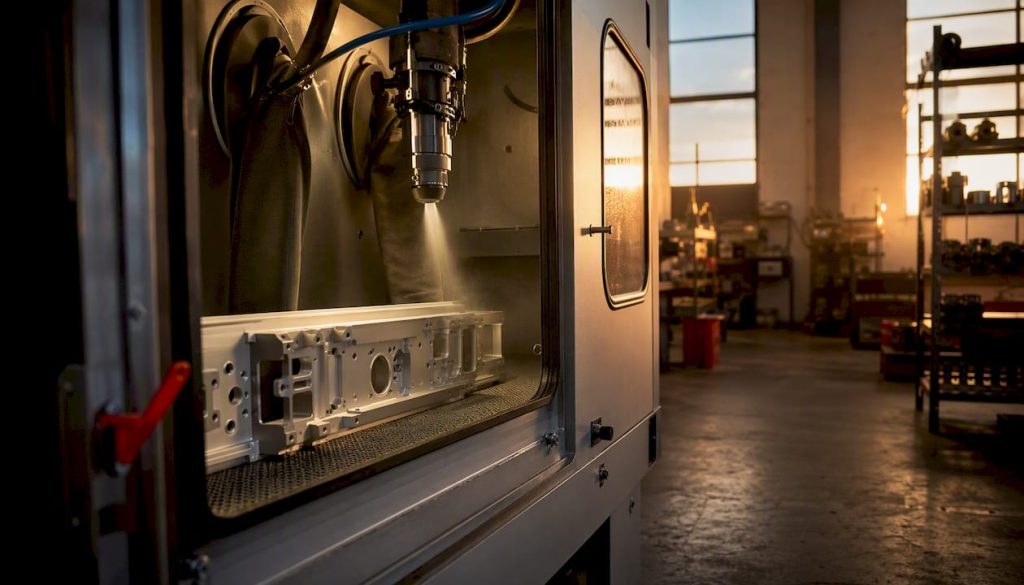

A bead blasting finish is a satin-to-matte surface texture produced by propelling spherical media at a part under compressed air, creating thousands of micro-dimples that scatter light and eliminate directional machining marks. Choose it when you need a uniform cosmetic appearance, a controlled adhesion surface for anodizing or powder coat, or light deburring with minimal material removal.
Three things bead blasting reliably delivers:
- A consistent, non-directional satin or matte appearance with Ra values typically in the 1.6–6.3 μm range suitable for satin-to-matte finishes
- Minimal dimensional change (aluminum experiences material removal of approximately 0.008–0.012 mm; stainless steel 0.015–0.025 mm)
- Light surface cleaning and deburring without aggressive material removal
Table Of Contents
What A Bead Blasting Finish Looks Like And Why It Works
The physics are straightforward. Spherical media strike the surface and form tiny, round-bottom dimples rather than the sharp, angular craters left by grit blasting. Those rounded dimples scatter incoming light in multiple directions instead of reflecting it at a single angle, which is exactly what produces the satin or matte look designers specify.
The finish type you get depends on media size, pressure, and how many passes the operator runs:
- Satin: Fine glass beads at moderate pressure, one or two passes. Slight sheen, no directionality.
- Matte: Larger beads or more passes. Flatter, lower-gloss appearance. Common on matte finish aluminum enclosures and architectural panels.
- Semi-reflective: Fine beads at low pressure on polished stock. Preserves some base reflectivity while eliminating machining lines.
- Peened: Heavier steel shot at higher pressure. Primarily a stress-relief treatment, though it also produces a distinctive dimpled texture.
The practical benefits beyond appearance are real. Bead blasting removes light burrs left by laser cutting or milling, cleans oxide scale from welds, and creates a micro-textured surface that paint and anodize bond to far more reliably than a smooth, machined one. Engineers who skip the blast step before anodizing often see adhesion failures at edges and corners first.
How Bead Blasting Works In A Shop And The Equipment You’ll Encounter
Most production shops run one of three system types, and the choice affects how repeatable and controllable your finish will be.
Cabinet systems are the workhorse for production bead blasting. The part sits inside a sealed enclosure; the operator works through gloves and views through a window. A reclaim system at the bottom collects spent media, sifts out fines and contaminants, and returns usable beads to the hopper. Closed-loop reclaim is what makes cabinet systems cost-effective for volume work and keeps media quality consistent over time.
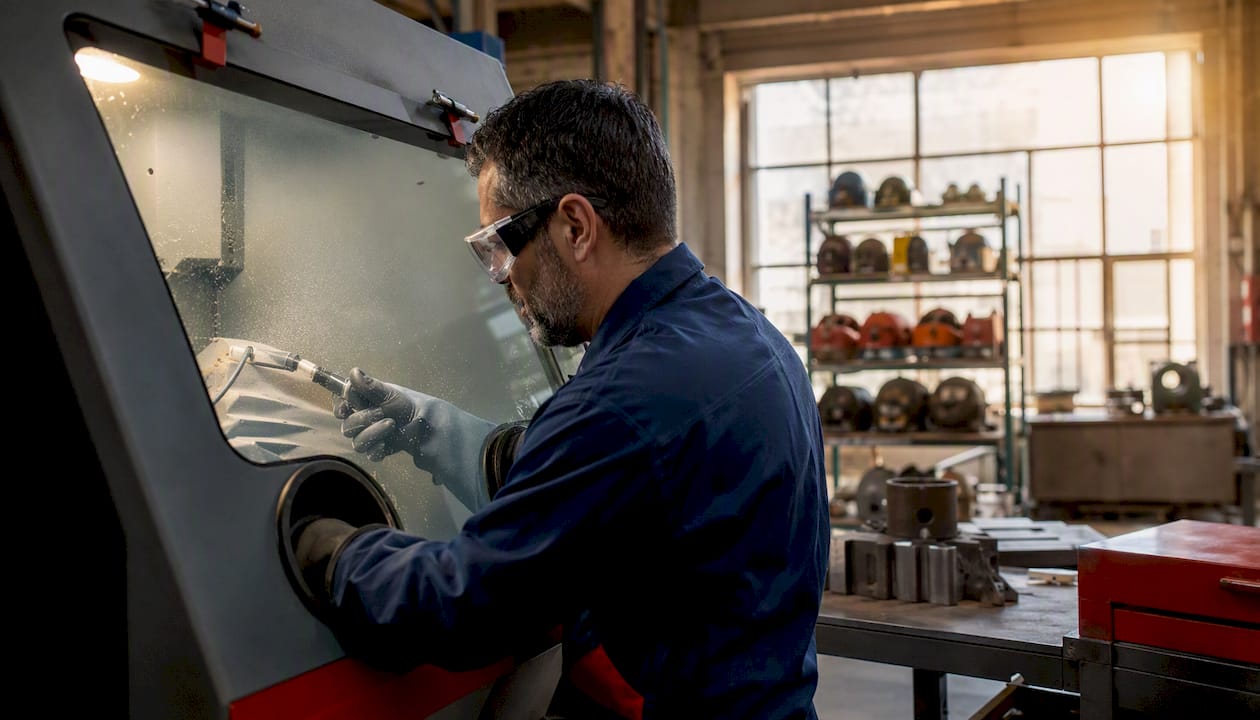
Pressure pots deliver media at higher, more consistent velocity than siphon guns because the media is pressurized directly rather than drawn by venturi effect. For tight Ra targets or harder alloys, a pressure pot gives the operator better control over impact energy.
Portable siphon guns are flexible but harder to control. Velocity varies with air pressure and hose length, which makes repeatable Ra targets difficult to hit without careful setup. They work well for touch-up, large elements, or architectural panels that won’t fit in a cabinet.
Key equipment components and what to watch:
| Component | Role | What to monitor |
|---|---|---|
| Compressor / air dryer | Delivers clean, dry air at consistent pressure | Moisture in the line contaminates media and causes streaking |
| Nozzle | Directs and accelerates media stream | Wear flares the pattern; replace when ID grows beyond spec |
| Media hopper / reclaimer | Stores and recycles media | Sieve condition; fines buildup degrades finish uniformity |
| Dust collector / HEPA filter | Captures airborne particulate | Filter loading; differential pressure alarms |
| Pressure regulator | Sets blast pressure | Calibration drift; check before each production run |
Nozzle wear is the most overlooked variable in bead blasting consistency. A worn nozzle widens the blast pattern and drops impact velocity, which shifts the Ra result without any change to the pressure setting. Shops running production quantities should track nozzle hours and replace on a schedule, not by feel.
Bead Media Types, Sizes, And How They Change Surface Roughness And Material Removal
Media selection is where most finish problems start. The four main types each have a distinct use case.
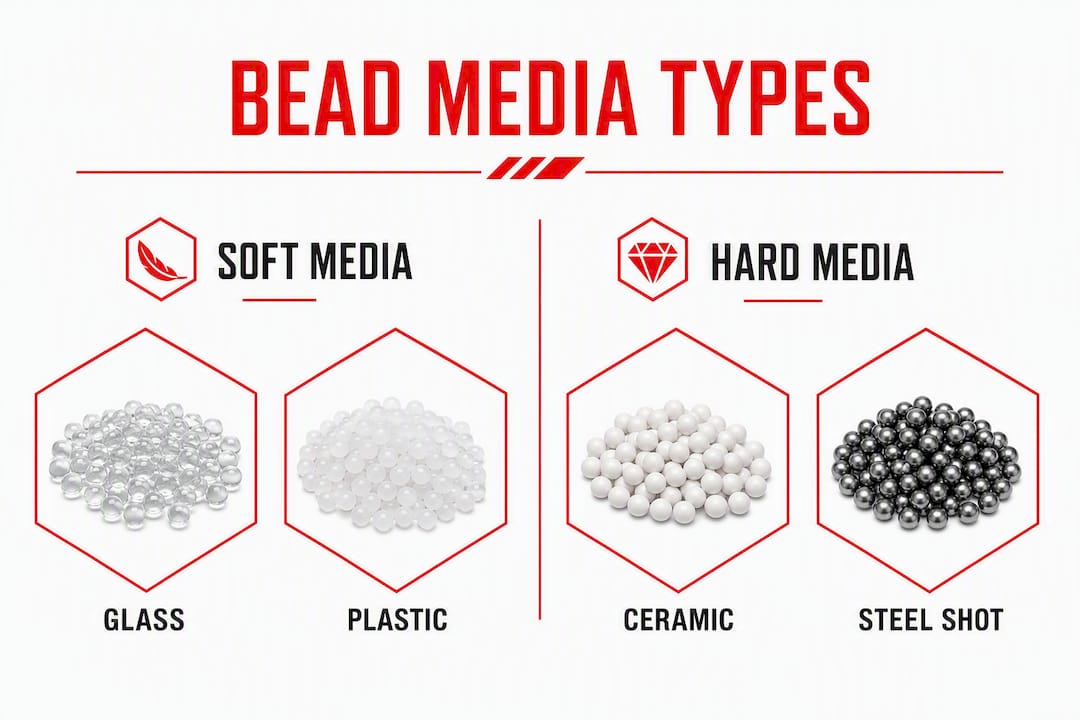
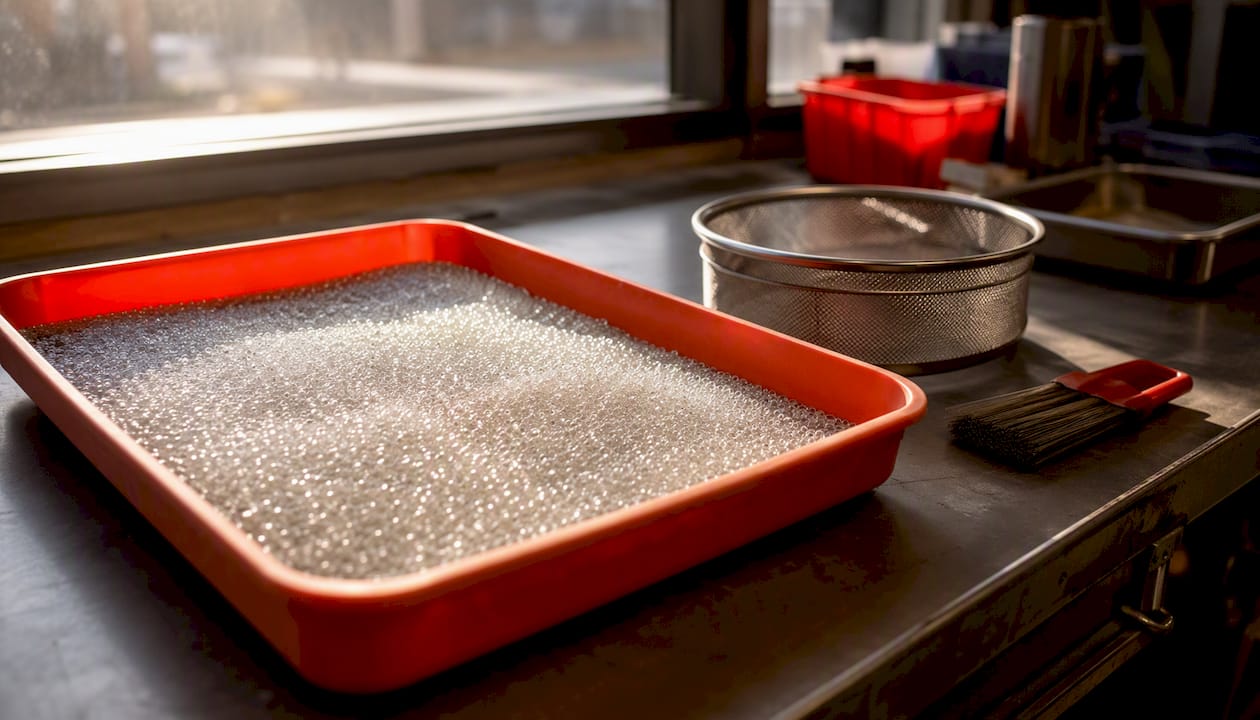
Glass beads are the default for cosmetic bead blasting. They’re inexpensive, recyclable, and produce a consistent, uniform finish on aluminum, stainless steel, and many plastics. Glass is soft enough that it won’t embed in softer alloys or leave ferrous contamination on stainless. For most matte finish aluminum work, glass beads are the right starting point.
Ceramic beads are harder and denser than glass. They last longer in high-volume runs, resist fracturing, and are suited for tougher alloys like titanium or hardened steel. The tradeoff is cost: ceramic media costs more upfront, though the extended service life often offsets that on long production runs.
Plastic media (typically polyester or urea) is the choice for delicate surfaces where even glass beads would remove too much material or cause distortion. Thin-wall aluminum castings, plated parts, and composite surfaces are typical candidates.
Steel shot produces a peened surface rather than a satin one. It’s used primarily for fatigue life improvement and stress relief, not cosmetic finishing. If your drawing calls for a matte appearance, steel shot is almost certainly the wrong media.
Bead size drives Ra more than any other single variable. Finer mesh sizes (120–200) produce Ra values in the 1.6–2.5 μm range, which is suitable for anodize prep. Coarser sizes (40–80 mesh) push Ra toward 4–6 μm and produce a more pronounced matte texture. For Type II anodizing, a target Ra of approximately 2–3 μm balances cosmetic uniformity with enough micro-anchoring for the anodic layer to bond reliably.
Pro Tip: Sieve your media before each production run. Broken beads become angular fragments that scratch rather than dimple, and fines accumulate quickly in reclaim systems. A contaminated media charge is the most common cause of unexpected Ra spikes mid-batch.
Media cleanliness also matters for downstream processes. Glass beads used on carbon steel will pick up iron particles. Run those same beads on stainless steel afterward and you’ve introduced free iron that will rust under the anodic or passivation layer. Dedicated media charges per material type, clearly labeled and stored separately, prevent this.
Bead Blasting Vs. Sandblasting And Other Abrasive Methods
The sandblasting vs. bead blasting question comes down to one variable: media shape. Sandblasting uses angular grit (aluminum oxide, silicon carbide, or crushed glass) that cuts into the surface. Bead blasting uses spherical media that peens it. That difference in geometry produces very different outcomes.
| Method | Media shape | Typical Ra | Material removal | Best application |
|---|---|---|---|---|
| Bead blasting | Spherical | 1.6–6.3 μm | Aluminum: 0.008–0.012 mm; Stainless steel: 0.015–0.025 mm | Cosmetic finish, anodize prep, light deburring |
| Sandblasting / grit blasting | Angular | 3–12+ μm | Moderate to high | Coating adhesion on structural parts, heavy scale removal |
| Shot peening | Spherical (steel) | 4–10 μm | Low | Fatigue life improvement, stress relief |
| Vapor blasting | Spherical (wet) | 0.8–3 μm | Very low | Precision parts, no heat distortion risk |
When to choose sandblasting or grit blasting:
- Heavy mill scale or rust that needs aggressive removal before painting
- Structural steel where a high-profile anchor pattern (Ra 6–12 μm) is required for coating adhesion
- Parts where cosmetic uniformity is not a requirement
When bead blasting finish is the right call:
- Any part where appearance matters: consumer hardware, medical device housings, aerospace interior trim
- Pre-anodize prep on aluminum where you need a controlled Ra without aggressive material loss
- Thin-wall parts where angular media would cause distortion or excessive removal
- Stainless steel components where iron contamination from steel grit would compromise passivation
One nuance worth knowing: chemical etching (“satin mask”) can produce a near-matte finish on aluminum that is more uniform than bead blasting for complex geometries, and it’s often offered as part of an anodizing prep sequence. For parts with deep pockets or internal features that a blast nozzle can’t reach consistently, it’s worth asking your finisher about the etching alternative.
Common Applications And Industries That Use Bead-blast Finishes
The finish shows up across a wide range of sectors, but the reason for specifying it differs by industry.
- Aerospace: Interior panels, brackets, and housings where a uniform, non-reflective surface reduces glare and meets cosmetic standards. Aerospace sheet metal manufacturing demands tight Ra control and documented QA, making profilometer verification standard practice.
- Medical devices: Instrument housings, surgical tool handles, and implant-adjacent components where a matte, cleanable surface is required and where surface contamination from media must be controlled and documented.
- Consumer electronics enclosures: Aluminum and stainless steel enclosures for servers, networking gear, and audio equipment. The bead-blast look has become a design language in premium hardware, signaling quality without the cost of brushing or polishing.
- Automotive trim: Interior and underhood brackets, covers, and decorative panels where a uniform matte appearance replaces painting on visible aluminum parts.
- Architectural panels: Facade cladding and interior metalwork where panel-to-panel consistency is critical. Products like InvariMatte® from Rigidized Metals Corporation deliver a factory-produced, nondirectional low-gloss appearance engineered for panel matching at scale, which shows how demanding the consistency requirement is in this segment.
- Industrial enclosures and EMI shielding enclosures: Bead blasting aluminum or steel enclosure panels before powder coat or conductive coating improves adhesion uniformly across the surface, which matters for both corrosion resistance and the contact resistance of EMI gaskets at seams.
How Operators Control The Finish: Pressure, Angle, Distance, And Measurement
Getting a repeatable bead-blast finish requires locking down four variables: pressure, standoff distance, angle, and dwell time. Change any one of them mid-run and the Ra shifts.
Recommended process parameters by material:
- Aluminum (general): 40–60 PSI, 6–10 inch standoff, 80–90° angle, steady sweeping motion. Thin-wall parts (under 1.5 mm) should drop to 30–40 PSI to avoid distortion.
- Stainless steel: 50–70 PSI, 6–8 inch standoff, 80–90° angle. Higher hardness means you need more impact energy to achieve the same Ra as aluminum.
- Titanium: 40–60 PSI with ceramic beads, 6–10 inch standoff. Glass beads fracture against titanium at higher pressures, contaminating the surface.
- Thin-wall sheet metal (any material): Use lower pressures in the 30–40 PSI range and keep the nozzle moving. Dwelling in one spot concentrates heat and impact, which warps thin sections.
- Angle and motion: A 90° angle maximizes dimple depth; shallower angles (60–75°) produce a slightly smoother result. Sweeping at a consistent speed matters more than the exact angle. Operators who slow down at part edges create hot spots with higher local Ra.
- Measuring the result: Specify Ra in micrometers, not visual descriptors. A profilometer reading at three or more locations on the part is the only objective check. Specify the cut-off length (typically 0.8 mm for Ra 1.6–6.3 μm per ISO 4288) and the instrument type in your drawing note.
Spec tip: Ra 2.0–2.5 μm is the sweet spot for most anodize-prep and cosmetic applications on aluminum. It’s achievable with 100–120 mesh glass beads at 45–55 PSI and produces a finish that looks consistent under both direct and diffuse lighting.
Preparing Parts For Bead Blasting And Post-treatments
Pre-blast Preparation
The surface going into the blast cabinet determines the surface coming out. Oils, coolants, and drawing compounds prevent uniform media contact and create blotchy, inconsistent results.
Pre-blast checklist:
- Degrease with an alkaline cleaner or solvent wipe; verify no residue remains before loading.
- Remove machining coolant completely, especially from blind holes and pockets where it pools.
- Mask all threaded holes, precision bores, and mating surfaces with silicone plugs or blast tape rated for abrasive service. Standard masking tape fails quickly under media impact.
- Plug or cap any features that must stay dimensionally unchanged; bead blasting removes material, even if slowly.
- Inspect for pre-existing surface defects. Bead blasting will not fill scratches or pits; it will make them more visible by creating a uniform texture around them.
Post-blast Sequence
What happens in the first hour after blasting largely determines how the finish performs long-term.
- Clean immediately: Rinse or blow off media residue before it embeds or oxidizes on the surface. Aluminum oxidizes quickly after blasting because the fresh surface is highly reactive.
- Passivation for stainless steel: Bead blasting can smear surface iron and disrupt the passive layer. Passivate per ASTM A967 or AMS 2700 before any coating or assembly.
- Anodizing: For Type II anodize, target Ra 2–3 μm from the blast step. Coatings standards such as AAMA 2604-17a define adhesion and performance metrics that depend on consistent surface prep.
- Powder coat: Bead blasting before powder coat improves adhesion significantly over bare machined aluminum. Apply primer or conversion coating within four hours of blasting on aluminum to prevent re-oxidation.
- Clearcoat: For parts where the bead-blast appearance must be preserved without further treatment, a thin clearcoat applied immediately after blasting locks in the finish and prevents handling marks.
Keep separate blast cabinets for ferrous and non-ferrous materials, or at minimum run a dedicated media charge per material family. Iron contamination from a shared cabinet will cause rust spots on stainless and adhesion failures under anodize.
Safety, Environmental, And Regulatory Considerations
Abrasive blasting generates fine airborne particulate that poses serious respiratory risk. OSHA’s general industry standards (29 CFR 1910) and NIOSH guidance on abrasive blasting both identify dust inhalation as the primary hazard, with silica-containing media (like conventional sand) carrying the highest risk. Glass bead and ceramic media are significantly safer, but they still generate respirable dust that requires controls.
OSHA/NIOSH guidance for abrasive blasting: Operators must use supplied-air respirators (not just dust masks) during open blasting operations. Cabinet systems with intact seals and functioning dust collectors reduce operator exposure substantially, but the dust collector itself must be maintained and its filters replaced on schedule. Local exhaust ventilation at the blast zone is required for any open-air operation. Employers must conduct air monitoring to verify exposure levels stay below the permissible exposure limit for the specific media in use.
Shop safety checklist for managers:
- Verify dust collector differential pressure is within spec before each shift.
- Confirm blast cabinet door seals are intact; worn seals allow dust to escape into the work area.
- Use supplied-air respirators for any open blasting; half-face respirators with P100 filters for cabinet work with intact seals.
- Label media containers by material type and date of last sieve; never mix ferrous and non-ferrous media.
- Dispose of spent media per local regulations; glass bead waste is generally non-hazardous, but media contaminated with heavy metals (from coated parts) may require special disposal.
- Train operators on recognizing nozzle wear and media degradation, both of which increase dust generation.
Media reclaim systems reduce waste and airborne dust simultaneously. A closed-loop reclaimer keeps spent media contained, sifts out fines before they re-enter the stream, and extends media service life. For shops running production quantities, reclaim is both the economical and the environmentally responsible choice.
Typical Cost Drivers And How Long Bead Blasting Takes
Bead blasting finish is not expensive as a standalone operation, but several factors push costs up quickly on complex parts.
Primary cost drivers:
- Masking: Threading plugs into dozens of holes and applying blast tape to precision surfaces is labor-intensive. A part with 20 threaded inserts can take longer to mask than to blast. Specify masking requirements clearly in your drawing; vague notes lead to either over-masking (wasted time) or under-masking (damaged threads).
- Media type: Glass beads are the least expensive. Ceramic media costs more upfront but lasts longer on high-volume runs. Plastic media is the most expensive per pound and is typically single-use.
- Reclaim vs. single-use: Shops with reclaim systems spread media cost across many parts. Single-use media (common with plastic beads) adds direct material cost per part.
- Part handling: Large or heavy parts require fixtures or multiple operators. Thin-wall parts need careful support to prevent distortion during blasting.
- Inspection: If your spec requires profilometer readings and a signed inspection report, budget for that time.
Lead time typically adds 2–3 business days for bead blasting finish in most production shops; complex masking can add another 1–2 days. The fastest way to shorten iteration cycles is to provide a sample coupon with your first order and get it approved before the production run. A coupon eliminates the “that’s not what I meant by matte” conversation after 500 parts are finished.
Quote-preparation tips:
- Call out thin-wall sections explicitly; they require reduced blasting pressure and careful handling to avoid distortion.
- List every feature that needs masking with dimensions or a drawing callout.
- State your Ra target in micrometers, not visual terms.
- Specify whether a profilometer report is required; it adds time and cost but prevents disputes.
Exactly What To Write In A Bead-blast Finish Spec For Fabrication Orders
Vague finish notes cost money. “Bead blast to matte” gives a shop almost no information to work with, and the result will vary between operators, shifts, and facilities. A complete spec takes about three lines on a drawing and eliminates most of the ambiguity.
Spec Template Fields
| Field | What to specify | Example |
|---|---|---|
| Finish name | Standard term | Bead blast finish |
| Target Ra band | In micrometers, with tolerance | Ra 2.0–3.0 μm |
| Media type and max size | Material and mesh range | Glass beads, 100–120 mesh |
| Pressure band | PSI range | 45–55 PSI |
| Masking instructions | Features to protect | Mask all M4 threads and datum bore per drawing |
| Coupon / photo reference | Reference standard | Match approved coupon #BB-001 |
| Inspection method | Instrument and cut-off | Profilometer, 0.8 mm cut-off, 3 readings per part |
| Acceptance criteria | Pass/fail threshold | Ra within spec; no visible streaks, hot spots, or media embedment |
Sample Drawing Note
Bead blast all external surfaces per this note. Media: glass beads, 100–120 mesh. Pressure: 45–55 PSI. Target Ra: 2.0–3.0 μm. Mask all threaded features and datum surfaces per drawing. Verify with profilometer (0.8 mm cut-off); record three readings per part. Match approved coupon #BB-001.
On AA Finish Designations For Aluminum
The Aluminum Association’s AA designation system uses codes that combine mechanical (M), chemical ©, and anodic (A) finish sequences. For example, AA-M10 C12 A31 describes a specific sequence of mechanical prep, chemical treatment, and anodic finish. When your part will be anodized after bead blasting, adding the appropriate AA code alongside your Ra spec gives the anodizer a complete picture of the intended process sequence. For parts that won’t be anodized, a bespoke Ra specification with media and pressure notes is more useful than an AA code alone.
How HLH SHEET METAL Applies Bead Blasting In Production
HLH SHEET METAL’s bead blasting workflow is built around repeatability from the first prototype through high-volume production runs. The process follows a structured sequence:
- Sample coupon approval: Before any production batch runs, HLH SHEET METAL produces a coupon to the client’s Ra spec and submits it for sign-off. This locks in the visual and measurable standard before parts are committed.
- Parameter lock-down: Once the coupon is approved, blast pressure, media type and mesh, standoff distance, and traverse speed are recorded and fixed for the production run. Operators do not adjust parameters without a documented change request.
- ISO-aligned QA: Profilometer readings are taken at multiple locations per part (or per batch sample, depending on volume and spec). Results are logged and available for client review.
- Media segregation: Ferrous and non-ferrous parts run on separate media charges. Stainless steel parts get dedicated glass bead charges to prevent iron contamination before passivation.
- Multi-plant capacity: HLH SHEET METAL’s multiple manufacturing facilities in China handle both prototype quantities and large production batches, with English-speaking support throughout the project.
On finish consistency in production: The most common failure mode in production bead blasting is not wrong media or wrong pressure. It’s undocumented parameter drift between the sample run and the production run. Locking parameters to a signed coupon, not a verbal description, is the only reliable way to get the same finish on part 500 that you got on part 1.
When HLH SHEET METAL is the right production partner for bead blasting: your project requires documented Ra control, you’re moving from prototype to volume and need consistent finish across batches, or your part combines bead blasting with downstream processes like anodizing, powder coat, or passivation that HLH SHEET METAL handles in sequence. The fabrication capabilities page covers the full finishing and production scope.
Key Takeaways
A bead blasting finish delivers a measurable, repeatable satin-to-matte surface when you specify Ra targets, media type, and masking requirements explicitly rather than relying on visual descriptions.
| Point | Details |
|---|---|
| Specify Ra, not just “matte” | Target Ra 2.0–3.0 μm for anodize prep; 1.6–6.3 μm is the typical achievable range after bead blasting for most materials. |
| Match media to material | Glass beads for aluminum and stainless; ceramic for tough alloys; plastic for delicate surfaces. |
| Thin-wall caution | Parts under 1.5 mm need 30–40 PSI to avoid distortion; call this out explicitly in your spec. |
| Use a coupon | Approve a physical coupon before the production run to prevent finish disputes on completed parts. |
| HLH SHEET METAL for production | HLH SHEET METAL locks parameters to an approved coupon and provides profilometer-verified QA from prototype through volume. |
When To Outsource Bead Blasting Vs. Attempt It In-house
The in-house vs. outsource question is simpler than most engineers make it. If you’re doing one-off prototypes where appearance is secondary and you have a basic blast cabinet, in-house works. The moment any of the following apply, send the parts out.
Outsource when:
- Your Ra target is tighter than Ra 3 μm and you don’t have a calibrated profilometer to verify it.
- The part will be anodized, passivated, or powder-coated afterward, and contamination from shared media would compromise the downstream process.
- You’re running more than a handful of parts and finish consistency between them matters.
- The part has thin walls, complex masking requirements, or features that need documented protection.
- Your customer or quality system requires a signed inspection report.
In-house makes sense when:
- You’re iterating on prototypes and the finish is for appearance reference only, not a production standard.
- You have a dedicated cabinet per material type and the discipline to maintain media cleanliness.
- Volume is low enough that setup and media management costs don’t outweigh the convenience.
The equipment cost argument for in-house is often overstated. A decent pressure-pot cabinet with a reclaim system and dust collector runs well into five figures before you add a calibrated profilometer. For most engineering teams, outsourcing to a production finisher with documented QA is faster, cheaper per part, and produces a more defensible result when a customer or auditor asks for finish records.
Chemical etching is worth a conversation with your finisher if your part has deep pockets or internal features that a blast nozzle can’t reach uniformly. It’s not a replacement for bead blasting in most cases, but for complex geometries it can produce a more consistent matte appearance with less labor.
HLH SHEET METAL Handles Bead Blasting From Prototype To Production
Procurement teams that have dealt with finish inconsistency between prototype and production runs know the real cost: rejected batches, re-work cycles, and schedule slippage. HLH SHEET METAL’s approach addresses that directly. Every bead-blast order starts with a coupon, locks parameters on approval, and ships with profilometer documentation.
HLH SHEET METAL’s precision sheet metal fabrication service covers the full sequence: laser cutting, forming, welding, bead blasting, and downstream finishing (anodizing, powder coat, passivation) under ISO-certified quality controls. Multiple plants in China handle prototype quantities and high-volume production runs with English-speaking project support throughout.
To get a quote, prepare your CAD file, call out your target Ra band and masking requirements in a drawing note, and note whether you need a coupon approval step. The team will confirm media selection, pressure parameters, and inspection method before the first part runs. Get started at HLH SHEET METAL.
Useful Sources And Further Reading
- What Is Bead Blasting? — Hubs Knowledge Base: Clear process overview covering media types, finish outcomes, and typical applications. Good starting point for engineers new to the process.
- Bead Blasting: Applications, Techniques, and Benefits — ProtoTek: Practical guide covering glass, ceramic, and plastic media selection with use-case guidance.
- Everything You Need to Know About Bead Blasted Finish — Uneed: Detailed technical reference with Ra ranges, material removal rates, lead-time guidance, and thin-wall cautions.
- Specifying Aluminum Finishes — Aluminum Anodizers Council: Authoritative reference for AA designation codes (M/C/A sequences) used in procurement and fabrication drawings. Regulatory/standards source.
- IFS Coatings Matte Aluminum TDS: Technical data sheet referencing AAMA 2604-17a performance standards for matte aluminum coatings; useful for specifying post-blast coating requirements.
- InvariMatte® Aluminum — Rigidized Metals Corporation: Vendor reference for factory-produced, panel-matched bead-blast-appearance finishes in architectural applications.
- Polishing Aluminum for a Dull Matte Finish — Finishing.com: Practitioner forum covering chemical etching as an alternative to bead blasting for complex geometries; useful for understanding when to consult a finisher about alternatives.
- OSHA General Industry Standards (29 CFR 1910): Primary regulatory source for respiratory protection and ventilation requirements in abrasive blasting operations. Regulatory source.

