




Table Of Contents
Specify chromate conversion coating on aluminum drawings with three mandatory callouts: the governing spec (MIL-DTL-5541 or NASA PRC-5005), the Type (I for hexavalent, II for trivalent), and the Class (1A for maximum corrosion protection, 3 for low electrical resistance). Miss any one of those three and your Chinese supplier will default to whatever they have in the bath that week.
The drawing note format looks like this: CHEMICAL CONVERSION COAT PER MIL-DTL-5541, TYPE II, CLASS 1A. Add a time-to-paint limit (typically 24 hours for adhesive bonding, confirm with your process spec) and call out any areas to mask or strip before bonding. That single note, written correctly, eliminates the most common source of coating-related rework on China-sourced aluminum parts.
Key procurement actions to take before the RFQ goes out:
- Confirm the supplier’s bath chemistry: Type I (hexavalent) or Type II (trivalent), and get it in writing.
- State the ASTM B117 salt-spray hours required for Class 1A acceptance (168 hours minimum is a common threshold for general corrosion protection).
- Identify bond and contact areas on the drawing and specify whether the coating should be masked, removed, or retained.
- Request a Certificate of Analysis (CoA) and salt-spray test report with each shipment.
- For parts exported to EU markets, require a written declaration that the process complies with RoHS/REACH hexavalent chromium restrictions.
Key Takeaways
Chromate conversion coating on aluminum requires three drawing callouts — governing spec, Type, and Class — plus a time-to-paint limit and bond-area instructions to prevent the most common rework failures on China-sourced parts.
| Point | Details |
|---|---|
| Always specify Type and Class | Use MIL-DTL-5541 Type II, Class 1A as the default for most commercial and export applications. |
| Salt-spray acceptance criteria | Require 168 hours ASTM B117 minimum for Class 1A; state it in the PO and on the drawing. |
| Class 3 for conductivity | Specify Class 3 per AMS2474 with a contact-resistance limit in ohms when EMI bonding or grounding is required. |
| Bond and contact areas | Call out masking or coating removal in bond areas on the drawing; never leave it to supplier discretion. |
| Documentation at delivery | Require CoA, salt-spray test report, and photographic records of parts post-coat as standard deliverables. |
| HLH SHEET METAL | Provides DFM review, finishing coordination, and ISO-certified QA for conversion-coated aluminum parts sourced from China. |
What Chromate Conversion Coating Actually Does To Aluminum
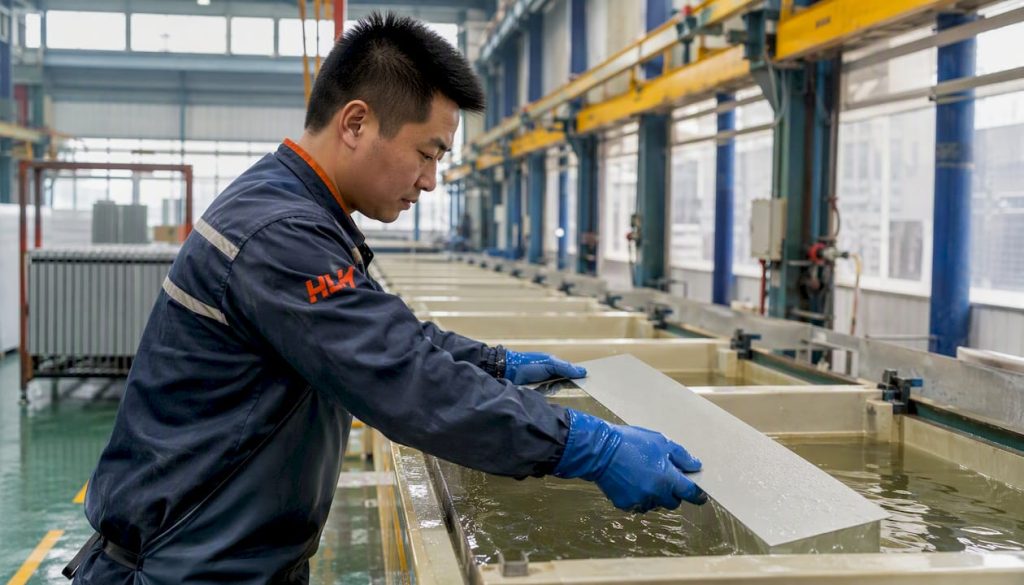
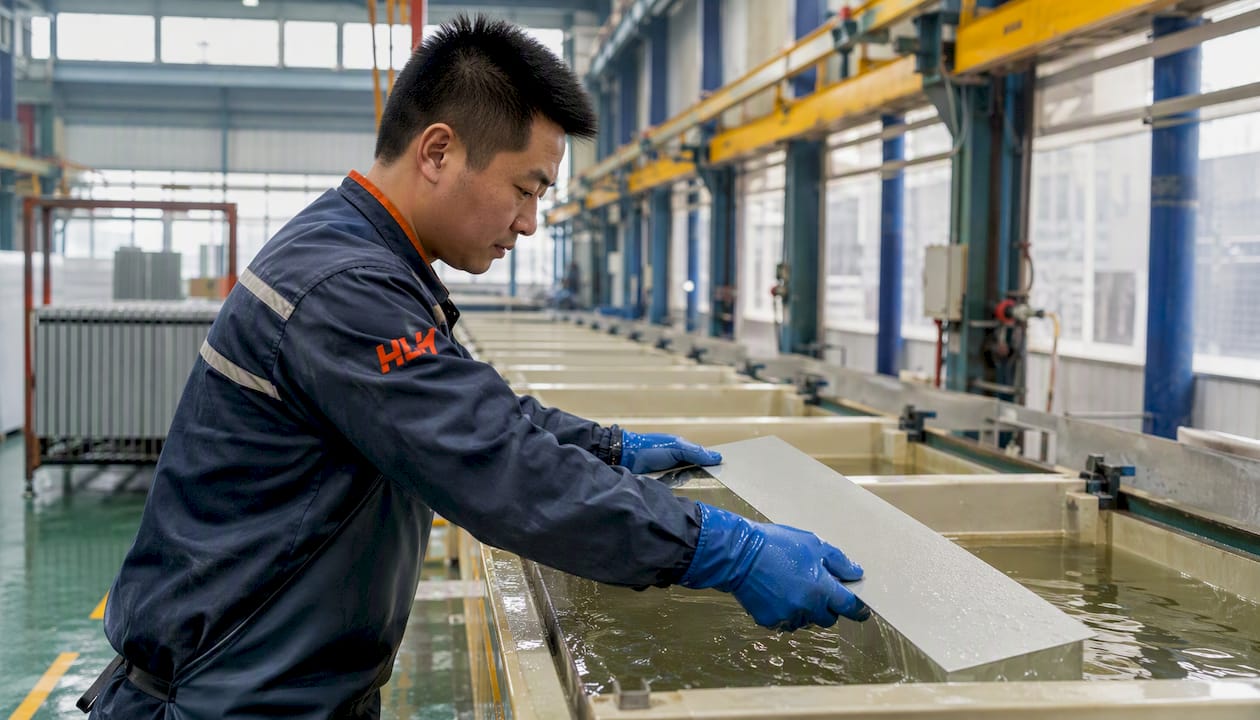
Chromate conversion coating, also called chem film or chemical film, is a chemical conversion process, not a deposited or plated layer. The aluminum surface reacts with a chromate-bearing solution to form a thin, adherent oxide film in place of the native aluminum oxide. The result is a coating that is chemically bonded to the substrate, not mechanically attached.
Three functions make it worth specifying. First, it passivates the aluminum surface, slowing further oxidation and providing baseline corrosion resistance without paint. Second, it dramatically improves paint and adhesive adhesion by creating a chemically active, micro-rough surface that primers and adhesives grip far better than bare or anodized aluminum. Third, and critically for electronics enclosures and RF shielding applications, it retains electrical conductivity. Unlike anodizing, which is an insulating oxide, a properly applied Class 3 chem film keeps contact resistance low enough for grounding and EMI bonding.
Trade names engineers encounter most often: Alodine and Bonderite (both Henkel product families), and Iridite (a legacy MacDermid trade name still referenced in older drawings). Henkel’s BONDERITE process follows the same basic sequence as the military spec: clean, rinse, treat, rinse, dry. The color you see after treatment, ranging from clear iridescence to yellow-gold to brown, depends on coating thickness and bath formulation, not on whether the part is properly coated.
Typical dry-film thickness runs in the 200–300 nm range for standard formulations, though practical ranges extend higher depending on bath chemistry and alloy. That thinness is why chem film adds essentially zero dimensional change, a real advantage over anodizing when you have tight-tolerance features or threaded holes.
Pro Tip: On 2024-T3 and 2024-T4 alloys, which are high in copper, the coating can appear darker and less uniform than on 6061. That appearance difference is normal and does not indicate a process failure — call out acceptable color range on your drawing or in the purchase order to avoid unnecessary rejections.
Types And Classes: Choosing The Right Chemistry And Performance Class
The two-axis classification system (Type and Class) is where most drawing errors happen. Get both right.
Type I Vs. Type II
Type I uses hexavalent chromium chemistry. It produces a thicker, more corrosion-resistant film and retains the so-called self-healing behavior described in the next section. Legacy aerospace and defense specs frequently mandate Type I, and NASA PRC-5005 notes that if Type is not specified, Type I is the default. The trade-off is significant: hexavalent chromium is a regulated carcinogen, which means supplier compliance burden, export restrictions, and RoHS/REACH incompatibility for EU-bound parts.
Type II uses trivalent chromium chemistry (non-hexavalent). Research on trivalent conversion coatings confirms that Type II provides good corrosion protection and is being actively developed to close the performance gap with Type I, while eliminating the hexavalent chromium regulatory burden. For most commercial, consumer, and export applications, Type II is the right default today.
Class 1a Vs. Class 3
| Parameter | Class 1A | Class 3 |
|---|---|---|
| Primary purpose | Maximum corrosion protection; paint/adhesive primer | Low electrical resistance; EMI bonding, grounding |
| Typical appearance | Yellow-gold to brown iridescence | Clear to light iridescent |
| Film thickness | Heavier (higher deposit weight) | Lighter |
| Corrosion resistance | Higher (168+ hours ASTM B117 salt spray typical) | Lower than Class 1A |
| Electrical conductivity | Lower (thicker film raises resistance) | Higher (thin film retains conductivity) |
| Typical applications | Aerospace structures, painted enclosures, general corrosion protection | RF enclosures, EMI shielding, electrical contact surfaces |
Application mapping by industry:
- Aerospace and defense: Type I, Class 1A where MIL spec mandates it; Type II, Class 1A where hexavalent is restricted.
- Electronics enclosures and server chassis: Type II, Class 3 for grounding surfaces; Class 1A for exterior painted surfaces.
- Consumer goods and general commercial: Type II, Class 1A for painted parts; Type II, Class 3 where conductivity matters.
When electrical contact is the design requirement, specify AMS2474 on the drawing alongside the contact-resistance limit in ohms. Leaving that number off the drawing lets suppliers default to Class 1A, which raises resistance and can cause EMI bonding failures in the field.
How The Coating Forms: Chemistry, Fluoride, And Self-healing
The chromate film forms through a redox reaction. The chromate solution (acidic, pH typically 1.5–2.5) chemically attacks the aluminum surface, dissolving the native oxide and oxidizing the base metal. Chromate ions are simultaneously reduced from Cr(VI) to Cr(III), precipitating as a hydrated chromium oxide gel that incorporates aluminum ions from the substrate. The result is a mixed Cr(III)/Al oxide matrix that is chemically bonded to the aluminum.
Fluoride ions in the bath play a disproportionately large role. NIST materials data documents that fluoride strongly increases film thickness and performance, with AES depth profiles showing fluoride-containing baths producing substantially thicker films than fluoride-free formulations. Fluoride accelerates aluminum dissolution, which drives more Cr(III) precipitation and produces a denser, more adherent film. Bath fluoride concentration is therefore a critical process control parameter, not a secondary variable.
Alloy composition matters more than most engineers expect. High-copper alloys (2024, 2219) coat less uniformly because copper-rich intermetallic particles in the microstructure react differently than the aluminum matrix. High-silicon alloys (cast alloys, 4xxx series) can show similar non-uniformity. Neither is a disqualifier, but both require tighter bath control and may need a more aggressive deoxidizing step to produce an acceptable film.
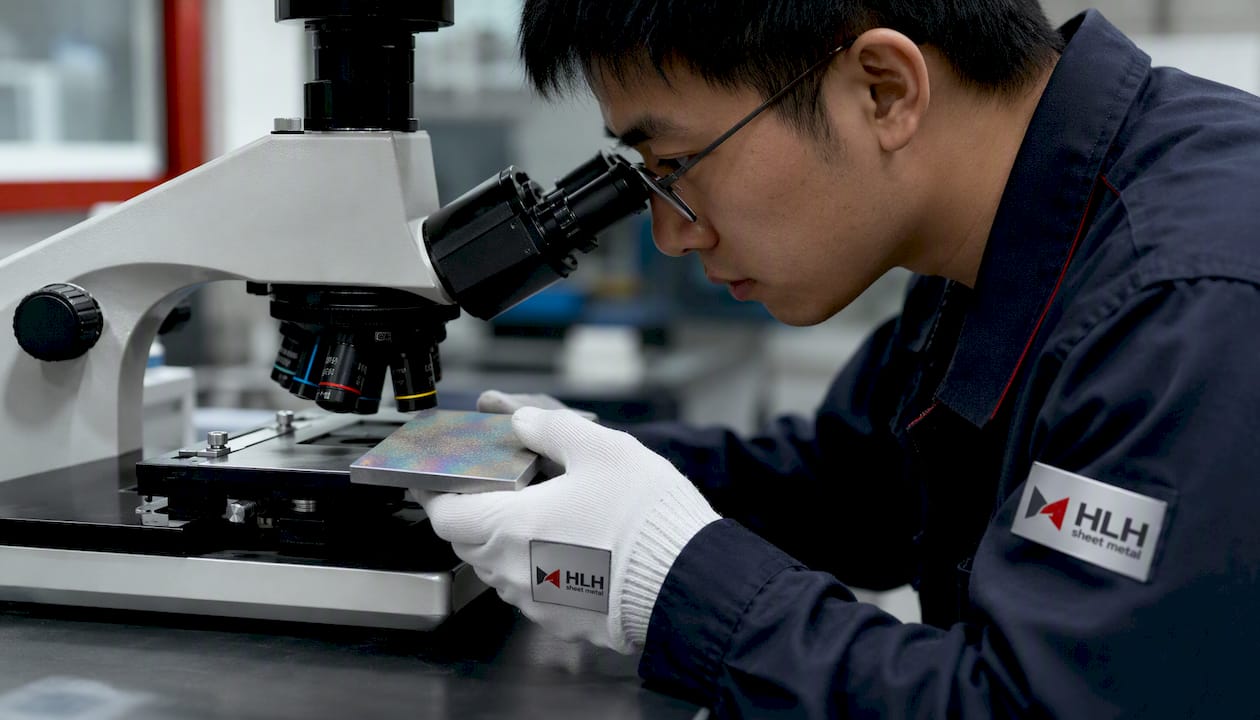
The self-healing behavior attributed to Type I coatings comes from residual Cr(VI) retained in the Cr(III) oxide matrix. When the film is scratched, soluble hexavalent chromium migrates to the damaged area and re-passivates the exposed aluminum. Type II coatings lack this mechanism because trivalent chromium does not migrate. That difference is why legacy flight hardware specs still call for Type I: a scratch on a Type I-coated part re-seals itself; a scratch on a Type II part does not.
Process Steps And Critical Controls For Manufacturing
The process sequence is short but unforgiving. Each step has a failure mode that shows up as coating defects or adhesion failures downstream.
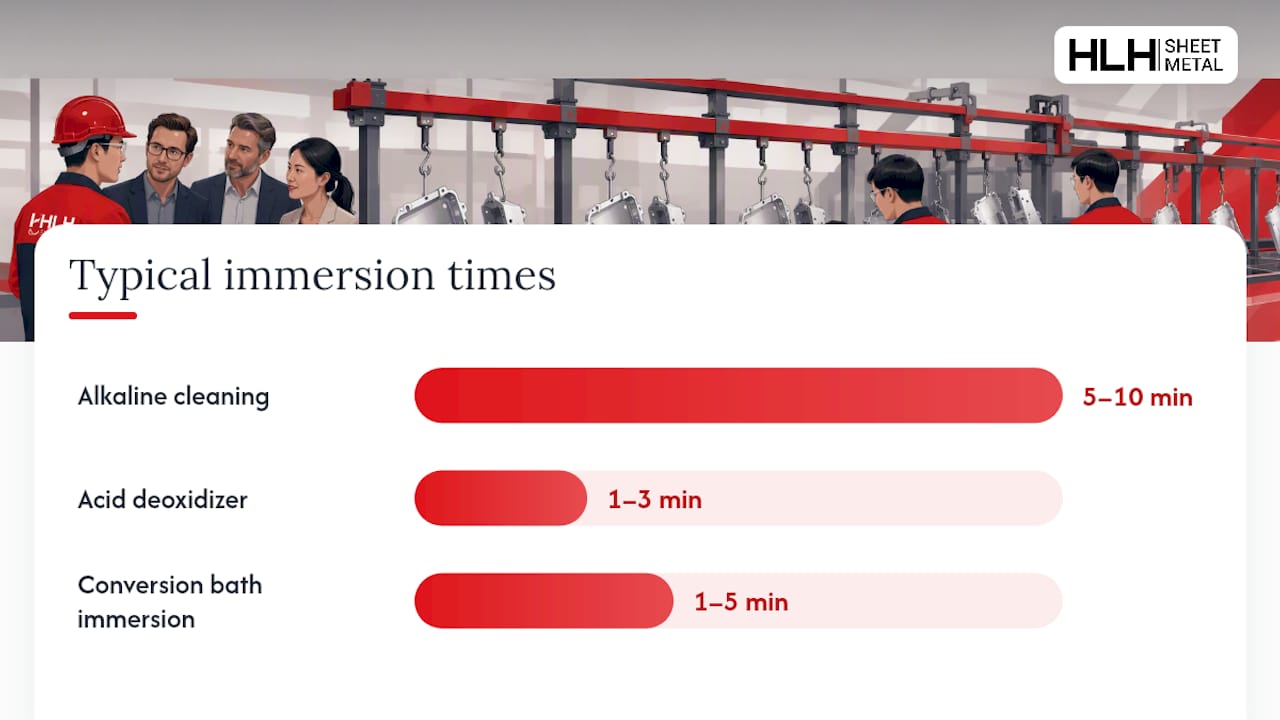
- Alkaline cleaning / degreasing. Remove oils, machining fluids, and handling contamination. Inadequate cleaning is the single most common root cause of patchy or non-adherent coatings. Typical immersion: 5–10 minutes at 130–160°F (55–70°C).
- Rinse. Thorough water rinse to remove cleaner residues. Drag-out from the cleaner tank contaminates the deoxidizer.
- Deoxidizing / etching. Chemical or mechanical removal of the native aluminum oxide and any smut. MIL-DTL-5541 and NASA PRC-5005 both require deoxidation prior to coating. Typical immersion: 1–3 minutes in an acid deoxidizer (nitric/sulfuric or proprietary formulations).
- Rinse. Again, thorough. Acid drag-out into the conversion bath shifts pH and degrades bath performance rapidly.
- Conversion bath application. Immersion (dip), spray, or brush. Immersion is the most consistent. Typical immersion time: 1–5 minutes at ambient temperature (65–85°F / 18–30°C) for most commercial baths. Spray and brush are acceptable for touch-up or large parts but require explicit drawing authorization.
- Rinse. Removes excess chromate and stops the reaction. A deionized water final rinse improves film quality and reduces staining.
- Drying. Air dry or low-temperature forced air. Avoid temperatures above 140°F (60°C) during drying — elevated heat degrades the film and reduces corrosion resistance.
Critical process controls to verify with your supplier:
| Control Parameter | Why It Matters | Typical Target Range |
|---|---|---|
| Bath pH | Controls reaction rate and film quality | 1.5–2.5 (bath-specific) |
| Bath temperature | Affects film thickness and uniformity | 65–85°F (18–30°C) |
| Fluoride concentration | Drives film thickness and adhesion | Per bath spec (titration) |
| Immersion time | Determines deposit weight and color | 1–5 minutes |
| Rinse water conductivity | Indicates drag-out contamination | <100 µS/cm (DI final rinse) |
| Time to paint/bond | Film degrades if left too long before painting | Per drawing note; typically ≤24 hours |
Pro Tip: Ask your supplier how often they titrate the conversion bath and what their replenishment protocol is. A bath that is not titrated daily in production volume will drift out of spec, and the first sign is usually a color shift on parts — from gold to clear — indicating an under-strength bath.
Standards, Tests, And How To Write The Drawing Callout
Governing Specifications
MIL-DTL-5541 is the primary U.S. military specification for chemical conversion coatings on aluminum and aluminum alloys. It defines Type I (hexavalent) and Type II (trivalent), Class 1A and Class 3, and sets acceptance requirements. Any defense or aerospace drawing should reference it.
NASA PRC-5005 is NASA’s process specification implementing MIL-DTL-5541 requirements with additional process controls. It explicitly requires the drawing note to identify the process spec, Type, and Class, and specifies that Type I is the default if Type is not called out.
SAE AMS2474 covers chemical treatment of aluminum base alloys for low electrical resistivity, the spec to cite when Class 3 performance and a contact-resistance limit are both required.
SAE AMS2473 covers general-purpose chemical treatment of aluminum base alloys. Reference it for commercial applications where MIL-DTL-5541 is not required but a recognized spec is still needed.
ASTM B117 is the standard salt-spray (salt fog) test method. Specify the required exposure hours in the purchase order and on the drawing when salt-spray certification is required.
Common Acceptance Tests
- ASTM B117 salt fog: Class 1A typically requires 168 hours minimum with no corrosion (white corrosion products) on the test specimen. Confirm the specific hours with your end-use spec.
- Adhesion: Cross-hatch tape test per ASTM D3359 after painting; no more than 5% coating removal for Class 1A painted systems.
- Contact resistance: Specify the maximum allowable resistance in ohms between mated surfaces on the drawing when Class 3 is required. Without a number, the test is meaningless.
- Visual inspection: Uniform color and coverage with no bare spots, blistering, or powdery deposits.
Example Drawing Callouts
For maximum corrosion protection:
CHEMICAL CONVERSION COAT PER MIL-DTL-5541, TYPE II, CLASS 1A. PAINT WITHIN 24 HOURS OF COATING.
For electrical contact surfaces:
CHEMICAL CONVERSION COAT PER MIL-DTL-5541, TYPE II, CLASS 3 PER AMS2474. MAX CONTACT RESISTANCE: [X] mΩ. DO NOT PAINT CONTACT AREAS.
For bond areas:
CHEMICAL CONVERSION COAT PER MIL-DTL-5541, TYPE II, CLASS 1A. REMOVE CONVERSION COATING IN BOND AREA A (SEE DETAIL) BEFORE ADHESIVE APPLICATION.
NADCAP accreditation covers chemical processing (AC7108) and is the recognized qualification standard for aerospace and defense suppliers. If your end-use application requires NADCAP, state it in the purchase order — most Chinese commercial shops are not NADCAP-accredited, and finding one that is requires explicit supplier qualification.
DFM Considerations That Prevent Rework On China-sourced Parts
Most coating-related rework on China-sourced aluminum parts traces back to drawing notes that are incomplete, not to process failures. The supplier did exactly what the drawing said. The drawing just did not say enough.
Drawing Checklist
- Specify Type and Class explicitly. Never rely on the supplier’s default.
- Call out color and appearance acceptability: “Yellow-gold to brown iridescence acceptable; clear or uncoated areas are rejectable.”
- State dimensional change expectations: chem film adds less than 0.0001 inch per surface, so it is negligible for most features, but call it out for ultra-tight tolerances.
- Identify threaded holes, press-fit bores, and contact pads that must be masked or stripped.
- Set the time-to-paint or time-to-bond limit on the drawing, not just in the PO.
Masking And Selective Removal
Masking before coating is the cleaner approach for contact pads and precision bores. Plugs, caps, and tape are all acceptable; specify the masking method or simply call out “mask to prevent coating” and let the supplier choose. For adhesive bond areas, the better practice is often to coat the whole part and then mechanically or chemically strip the bond area immediately before bonding. Adhesion promoters applied to the stripped area can further improve adhesive performance on aluminum.
The DFM guidance from HLH SHEET METAL reinforces a consistent principle: decisions made at the drawing stage cost nothing to change; decisions made after the first article inspection cost real money.
Supplier Questions To Ask Before Award
- What Type and Class do you currently run, and can you provide a recent bath titration record?
- What is your fixturing method, and how do you prevent rack marks on critical surfaces?
- Do you have a dedicated rinse tank, or is rinse water shared between process lines?
- What is your maximum batch size, and how do you handle parts that require selective masking?
- For China-sourced parts exported to regulated markets, can you provide a written Type II / RoHS compliance declaration?
Performance Testing, Inspection, And Acceptance Criteria
Incoming inspection on conversion-coated aluminum parts is faster and cheaper than it sounds. Most of the critical checks are visual or require only a simple resistance meter.
Routine Incoming Inspection
- Visual color and coverage: Uniform color across the part with no bare spots, streaks, or powdery deposits. Bare spots indicate inadequate cleaning or deoxidizing. Powdery deposits suggest an over-concentrated bath or inadequate rinsing.
- Film continuity: The copper sulfate spot test (a drop of copper sulfate solution on the surface) is a quick field check. A properly coated surface resists copper deposition for at least 15 seconds; bare aluminum plates copper almost immediately.
- Contact resistance: For Class 3 parts, use a four-wire milliohm meter across mated contact surfaces. Compare against the drawing limit.
- Thickness: Chem film is too thin for standard eddy-current gauges to measure reliably. Thickness is typically controlled by process parameters (bath concentration, immersion time) rather than post-process measurement.
Laboratory Tests To Specify In The Purchase Order
Require these for production qualification and periodic lot audits, not necessarily for every shipment:
- ASTM B117 salt fog: State hours (e.g., 168 hours) and acceptance criterion (no white corrosion products on the test area).
- Adhesion (painted parts): ASTM D3359 cross-hatch tape test after primer application.
- CoA and TDS: Certificate of Analysis confirming bath chemistry and process parameters used; Technical Data Sheet for the conversion coating product.
Rework Rules
Rework of failed parts is allowed under MIL-DTL-5541 provided the part is stripped and reprocessed from the deoxidizing step. Spot repair by brush application is only permitted when the drawing or engineering disposition explicitly authorizes it. Specify in the purchase order who is authorized to approve touch-up repairs — leaving this open invites suppliers to brush-coat bare spots without disclosure.
Advantages, Disadvantages, And When To Use Alternatives
Chromate conversion coating is not always the right answer. The table below maps the key trade-offs against the most common alternatives.
Chem film wins when you need corrosion protection without paint, a paint primer that does not add dimensional change, or retained conductivity on aluminum. Anodizing wins when you need a harder, more abrasion-resistant surface or a thicker corrosion barrier on unpainted parts. Hard anodize is the right call for wear surfaces and hydraulic components. Zinc phosphate is worth considering for steel-aluminum assemblies where a single pretreatment process is preferred.
For China DFM, chem film is also the lowest-cost and fastest-turnaround surface treatment. Most Chinese sheet metal shops run conversion coating in-house or have a local sub-supplier within the same industrial park. Anodizing requires a dedicated anodizing line, which fewer shops operate, and hard anodize is rarer still.
Regulatory, Environmental, And Worker-safety Considerations
Hexavalent chromium is a known human carcinogen. That is not a regulatory technicality — it shapes every aspect of Type I process management, from supplier selection to export documentation.
U.S. Regulatory Framework
OSHA’s hexavalent chromium standard sets a permissible exposure limit (PEL) of 5 µg/m³ as an 8-hour time-weighted average and an action level of 2.5 µg/m³. Suppliers running Type I chemistry must provide engineering controls (ventilation, enclosed process tanks), PPE (respirators, gloves, eye protection), medical surveillance for exposed workers, and documented training. Ask for evidence of all four before awarding a Type I job.
EPA regulations classify hexavalent chromium process waste as hazardous. Suppliers must hold the appropriate hazardous waste generator permits, use licensed waste haulers, and maintain disposal records. Request copies of current permits and the most recent waste disposal manifest.
Rohs And REACH Implications
RoHS Directive 2011/65/EU restricts hexavalent chromium in electrical and electronic equipment sold in the EU. REACH Regulation (EC) 1907/2006 restricts Cr(VI) compounds under Annex XIV (authorization required) and Annex XVII (restriction on use). For China-sourced parts destined for EU markets, Type I chemistry creates a compliance risk that Type II eliminates entirely.
Practical Compliance Checklist For Suppliers
- Written confirmation of bath Type (I or II) and the chemical product used.
- Copy of current hazardous waste generator permit (Type I suppliers).
- Evidence of OSHA-compliant engineering controls and PPE program (Type I).
- Written RoHS/REACH compliance declaration for Type II or chrome-free processes.
- Waste disposal records from the past 12 months.
- Worker training records for chemical handling.
The trend in China’s export-oriented finishing shops is clearly away from Type I. Regulatory pressure from EU customers, combined with improving Type II performance, has made trivalent chemistry the default at most shops serving U.S. and European OEMs. If a supplier insists on Type I for a commercial application with no MIL spec requirement, ask why.
How To Write Procurement And Drawing Notes: A Practical Checklist
Example Drawing Callout (general Commercial, Export-safe)
CHEMICAL CONVERSION COAT PER MIL-DTL-5541, TYPE II, CLASS 1A. YELLOW-GOLD TO BROWN IRIDESCENCE ACCEPTABLE. PAINT OR BOND WITHIN 24 HOURS. MASK THREADS AT LOCATIONS A, B (SEE DETAIL). REMOVE COATING IN BOND AREA C BEFORE ADHESIVE APPLICATION. SALT SPRAY TEST PER ASTM B117, 168 HOURS MINIMUM, REQUIRED FOR FIRST ARTICLE AND PERIODIC LOT AUDIT.
Procurement Questions To Ask Suppliers
- What conversion coating product do you use, and can you provide the TDS?
- What is your bath titration frequency, and can you share recent titration logs?
- Do you have salt-spray test capability in-house, or do you sub it out? If sub, to whom?
- How do you fixture parts to avoid rack marks on critical surfaces?
- Can you provide photographic records of parts on the rack post-coat and pre-packaging?
- For Type I: provide current OSHA compliance documentation and hazardous waste disposal records.
- For export parts: provide written RoHS/REACH compliance declaration.
Documentation To Require At Delivery
- CoA: Confirms bath Type, Class, product used, lot number, and process date.
- Salt-spray test report: ASTM B117 results for first article and any periodic lot samples.
- Photographic records: Parts on rack post-coat, pre-packaging. This one deliverable catches fixturing problems before goods ship.
- Inspection sign-off: Supplier QC signature on the packing list confirming visual and dimensional acceptance.
The NASA PRC-5005 specification provides a model for how thorough a drawing callout and process record should be. Even for commercial work, using it as a template raises the quality of your supplier communication significantly.
Practical Tips From HLH SHEET METAL For Reducing Rework On China-sourced Parts
These are the actions that consistently separate clean first-article results from costly rework loops on conversion-coated aluminum parts.
Incoming QC Checklist
- Inspect color and coverage under good lighting before accepting shipment. Reject parts with bare spots, streaks, or powdery deposits immediately — do not wait for downstream assembly to find them.
- Spot-test a sample from each lot with copper sulfate solution. Record results on the incoming inspection report.
- For Class 3 parts, measure contact resistance on a sample before accepting. Compare against the drawing limit.
- Check that CoA lot numbers match the packing list. Mismatched lots are a red flag for substitution.
Packaging To Protect Coatings In Transit
Conversion coatings are thin and soft when fresh. Protect them:
- Individual part bags or interleaving paper between stacked parts. No bare metal-to-metal contact.
- Foam-lined boxes for parts with critical contact surfaces.
- “Do not stack” labels on boxes containing parts with Class 3 contact surfaces.
- Desiccant packs in sealed bags for long ocean-freight transit.
Vendor Communication Template Essentials
Your PO or RFQ should state, at minimum:
- Type and Class (e.g., “TYPE II, CLASS 1A per MIL-DTL-5541”).
- Areas to mask or strip (reference drawing detail callouts by letter/number).
- Acceptable color range (e.g., “yellow-gold to brown; clear or uncoated areas are rejectable”).
- Required documentation: CoA, salt-spray report, photographic records.
- Repair authorization: “No touch-up or brush application without written engineering disposition.”
Avoiding Cross-contamination
The most common hidden quality problem in Chinese multi-process shops is cross-contamination between the alkaline cleaner and the conversion bath. A cleaner that is too alkaline, dragged into the conversion bath on parts or fixtures, raises bath pH and produces thin, poorly adherent films that look fine visually but fail salt spray. Ask specifically whether the shop uses dedicated rinse tanks between each process stage, not a shared rinse.
Pro Tip: Request photographic evidence of parts on the rack immediately after coating and before packaging as a standard deliverable on every production run. This single requirement catches rack-mark patterns, bare spots from fixturing contact, and coverage gaps before goods leave China — and it costs the supplier nothing to provide.
For aluminum sheet metal fabrication that includes conversion coating, the fixturing layout deserves as much attention as the bath chemistry. A part hung at the wrong angle drains poorly, traps solution in recesses, and produces staining or bare spots that no amount of bath optimization will fix.
The Case For Type II As Your Default, With Honest Exceptions
Most engineers specifying chromate conversion coating on commercial aluminum parts should default to Type II, Class 1A. The corrosion protection is sufficient for the vast majority of unpainted and painted applications, the regulatory burden on your supplier is manageable, and parts destined for EU markets are RoHS-compliant without additional paperwork. That is the right call for consumer electronics enclosures, commercial HVAC components, general industrial hardware, and most weatherproof electrical enclosures where paint is the primary barrier.
Type I remains the right choice in two specific situations: when a legacy MIL or aerospace spec explicitly requires it (and there is no approved deviation), and when the application genuinely depends on the self-healing behavior that only hexavalent residues provide. Flight hardware on programs with no approved Type II substitution is the clearest example. For everything else, the regulatory cost of Type I, both for your supplier and for your export compliance team, is not worth the marginal corrosion performance gain.
The Class 3 specification is underused. Engineers who need grounding continuity on aluminum enclosures often specify Class 1A out of habit, then discover in EMC testing that contact resistance is too high. Specifying Class 3 with an explicit contact-resistance limit on the drawing, and referencing AMS2474 for the low-resistivity requirement, prevents that failure mode entirely. It costs nothing extra to specify correctly.
On supplier qualifications: for commercial work, a supplier with documented bath control records, a recent salt-spray test history, and a clean CoA process is more valuable than a supplier with impressive certifications but no data. Ask for the records. If they cannot produce titration logs and salt-spray reports from the past six months, keep looking.
HLH SHEET METAL Handles Finishing And Procurement For Your Aluminum Parts
Getting the drawing note right is only half the job. The other half is finding a supplier in China who actually runs the process the way the drawing says, documents it, and ships parts that pass incoming inspection the first time.
HLH SHEET METAL manages precision sheet metal fabrication in China with finishing coordination built into the production workflow, not bolted on at the end. That means conversion coating specs are reviewed at the DFM stage, suppliers are audited against bath control and documentation requirements, and CoAs and photographic records are standard deliverables on every order. ISO-certified QA processes and an English-speaking engineering team mean your specs are understood correctly before production starts, not interpreted after the fact.
For engineers who need Type II, Class 1A or Class 3 chem film on aluminum parts with tight tolerances, bond areas, or contact surfaces, HLH SHEET METAL’s team can review your drawing, flag specification gaps, and include accurate conversion-coating requirements in the RFQ. Request a quote or contact the engineering team directly to get started.
Sources
Before finalizing your drawing notes and RFQ, download and review these primary sources:
- Process Specification for the Chemical Conversion Coating of Aluminum Alloys
- Hexavalent Chromium
- Chrome-based conversion coatings – Henkel Adhesives
- AMS2474 Chemical treatment — aluminum base alloys; low electrical resistivity coating
Full URLs for each source are linked throughout this guide and should be consulted before finalizing specs.
FAQ
What Is The Difference Between Class 1a And Class 3 Chromate Conversion Coating?
Class 1A provides maximum corrosion protection and is the standard choice for painted parts and general corrosion resistance. Class 3 produces a thinner film that retains low electrical resistance, making it the correct specification for grounding surfaces, EMI bonding, and electrical contact areas.
Can Chromate Conversion Coating Replace Anodizing On Aluminum?
Not directly. Chem film provides less corrosion resistance than anodizing on unpainted aluminum and offers no abrasion resistance. It is the better choice when you need retained electrical conductivity, negligible dimensional change, or a paint primer that anodizing cannot match on tight-tolerance features.
Is Type I Chromate Conversion Coating Allowed On Parts Exported To The EU?
Type I (hexavalent chromium) chemistry is restricted under RoHS and REACH for electrical and electronic equipment sold in the EU. For EU-bound parts, specify Type II (trivalent) and require a written compliance declaration from your supplier.
How Long After Coating Can You Paint Or Bond Aluminum Parts?
Most process specs and supplier guidelines recommend painting or bonding within 24 hours of coating. The conversion film begins to degrade in humidity and handling after that window, reducing paint adhesion. State the time limit explicitly on the drawing.
What Documentation Should You Require From A Chinese Supplier For Conversion-coated Parts?
Require a Certificate of Analysis confirming bath Type, Class, and process date; an ASTM B117 salt-spray test report for first article and periodic lots; and photographic records of parts on the rack post-coat and pre-packaging. These three deliverables catch the most common process and handling failures before goods ship.

