




Table Of Contents
Qualified aerospace sheet metal fabricators are found through AS9100 supplier registries, NADCAP-accredited process directories, OEM-recommended supplier lists, specialized RFQ procurement platforms, and aerospace trade shows. For buyers who want a vetted option with English-language QA support and ISO-certified quality controls, HLH SHEET METAL handles aerospace fabrication from prototype through production.
Before you contact anyone, prepare three non-negotiable requests: AS9100 or ISO 9001 certification documentation, Mill Test Reports (MTRs) traceable to current AMS specifications, and evidence of NADCAP accreditation or ITAR registration where your parts require it.
The fastest path to a qualified shortlist:
- Search the IAQG OASIS database for AS9100-registered suppliers filtered by process code and geography.
- Check the NADCAP supplier directory for special-process accreditations (heat treat, welding, coatings).
- Review OEM-approved supplier lists from Boeing, Lockheed Martin, or Raytheon if your program has a prime contractor.
- Use aerospace-specific RFQ platforms and cross-reference with LinkedIn for peer references.
- Attend MRO Americas or the International Manufacturing Technology Show (IMTS) and pull exhibitor lists before the event to pre-qualify vendors.
Pro Tip: Request a sample MTR and a first-article inspection (FAI) report during initial outreach, before you send a drawing. A supplier who cannot produce both within 48 hours has not done this work at the level aerospace demands.
Key Takeaways
Aerospace-capable fabricators are found through AS9100 registries, NADCAP directories, and OEM supplier lists — but certification alone does not confirm flight-hardware experience; request a completed FAI package and a recent MTR to verify it.
| Point | Details |
|---|---|
| Where to search | Use IAQG OASIS, NADCAP directories, OEM supplier lists, and aerospace trade show exhibitor lists to build a qualified shortlist. |
| Three must-have trust signals | AS9100D certification, MTRs traceable to AMS specs, and CMM or FAI inspection capability are pass/fail items in pre-qualification. |
| RFQ completeness drives cost | Include GD&T drawings, AMS material specs, MTR level, and acceptance criteria; ambiguous tolerances raise cost and extend lead time. |
| Capacity risk is real | Workforce and skills pressures in aerospace manufacturing can affect lead times; verify staffing plans and cross-site capacity for any ramp requirement. |
| HLH SHEET METAL | Offers ISO-certified aerospace fabrication with English-language QA support, MTRs, and FAI documentation for U.S. procurement teams. |
Where Can You Find Qualified Aerospace Sheet Metal Fabricators?
The IAQG OASIS database is the most authoritative starting point. It lists every AS9100-certified supplier by scope, location, and certification status, and it is publicly searchable. Filter by CAGE code or process code to narrow results to sheet metal fabrication specifically.
NADCAP’s supplier directory adds a second filter. If your parts need heat treatment, chemical processing, or complex welding, NADCAP accreditation is the signal that a supplier’s special processes have been audited by the Performance Review Institute, not just self-certified. Aerospace quality certifications from AS9100 through NADCAP each cover a distinct scope, and knowing which applies to your part type saves significant pre-qualification time.
Trade shows and conferences are underused for supplier discovery. The IMTS, MRO Americas, and the Aerospace & Defense Manufacturing Summit all publish exhibitor lists weeks before opening day. Download the list, filter for sheet metal or precision fabrication exhibitors, and send a pre-qualification questionnaire before you arrive. You walk in with a shortlist instead of a badge and a prayer.
Procurement platforms such as Thomas Network, Aerospace Exchange, and defense-specific portals like SAM.gov (for government-adjacent work) let you filter by certification, process capability, and geography. LinkedIn is genuinely useful here too: search for procurement peers at similar OEMs and ask which fabricators they have audited successfully.
Geographic hubs worth filtering for in the U.S. include Southern California (Los Angeles, Wichita corridor), the Pacific Northwest (Boeing country), Texas (aerospace MRO and defense), and Connecticut (Pratt & Whitney supply chain). Offshore, China-based suppliers with ISO certification and English-language QA teams offer cost advantages on high-volume runs. However, buyers should verify ITAR compliance and data-transfer controls before sending controlled drawings.
Pro Tip: The best proof of real material traceability is not a supplier’s claim — it is their ability to pull a recent MTR and show an active mill relationship on request. Reliable aerospace metal suppliers maintain MTRs to current AMS specifications so every item traces back to the mill.
What Processes And Parts Do Aerospace Sheet Metal Fabricators Typically Handle?
Core process capabilities to confirm in any aerospace-capable shop:
- Laser cutting and laser tube cutting for flat blanks and structural profiles
- CNC punching for high-volume flat parts with repeatable hole patterns
- Press-brake forming and CNC bending for ribs, brackets, and formed skins
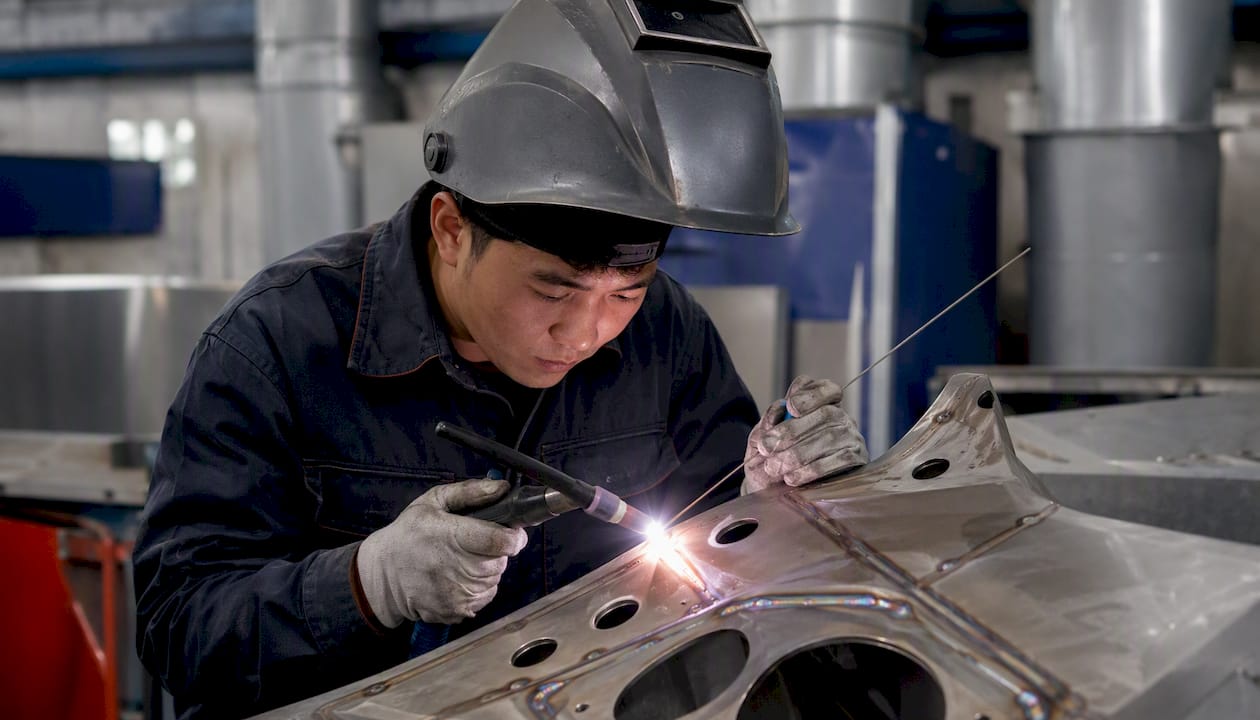
- TIG and MIG welding, robotic welding for structural assemblies and ducting
- Riveting and fastening for multi-piece assemblies
- Secondary machining for tapped features, countersinks, and close-tolerance bores
- Heat treatment, anodizing, passivation, and chromate conversion for surface and corrosion requirements
HLH SHEET METAL’s fabrication capabilities span laser cutting, CNC forming, welding, and finishing across aluminum, stainless steel, titanium, and specialty alloys.
Common aerospace parts produced from sheet metal:
| Process Category | Typical Part Examples | Dimensional Expectations |
|---|---|---|
| Laser cutting + forming | Skins, access panels, fairings | ±0.005 in. flatness; ±0.010 in. profile |
| Press-brake / CNC bending | Ribs, bulkhead webs, brackets | ±0.010 in. flange length |
| Welded assemblies | Ducting, shrouds, structural frames | Per AWS or equivalent weld class |
| Punched / fastened assemblies | Equipment racks, brackets with tapped features | ±0.005 in. hole location |
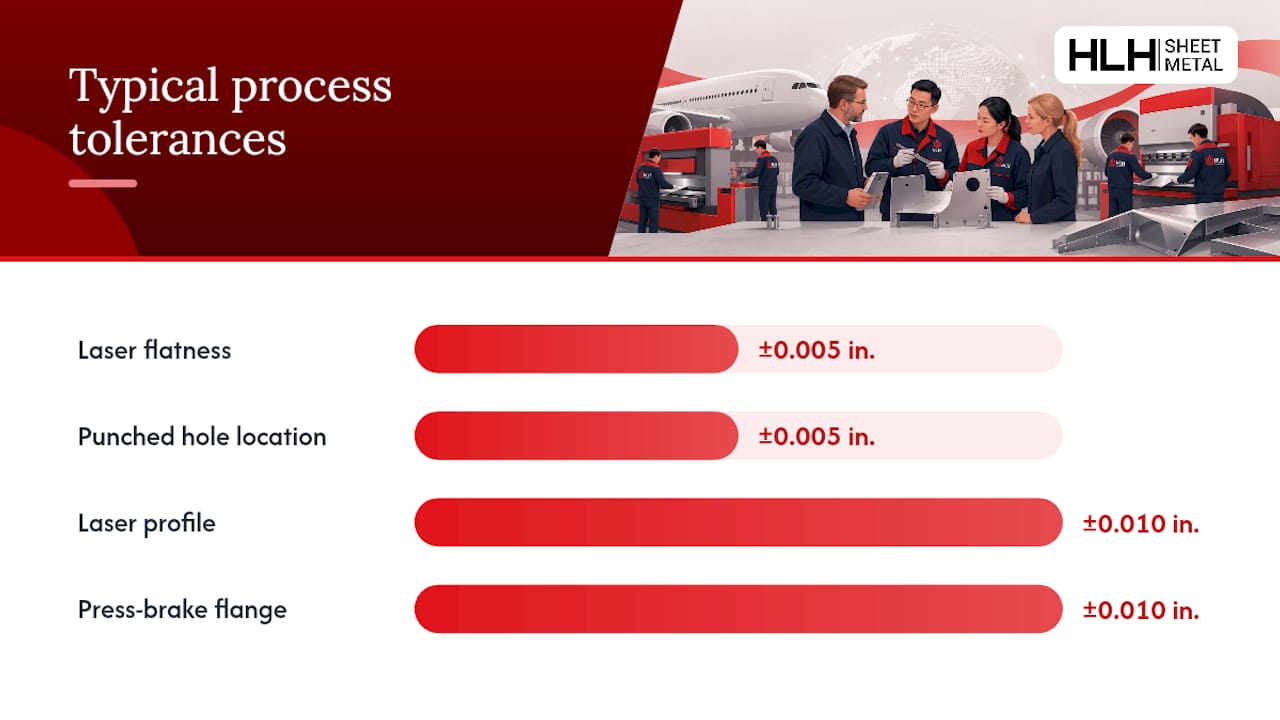
Prototyping vs. production is a real capability split. Short-run prototype shops offer flexibility and fast turnaround but may lack the tooling investment and process documentation for steady-state production. Confirm that a supplier can transfer a prototype program to production without requalification delays, and ask specifically about tooling ownership and lead times for production-grade fixtures.
What Certifications And Traceability Must You Require From Aerospace Fabricators?
AS9100D is the baseline. It is the aerospace extension of ISO 9001 and covers risk management, configuration control, and first-article requirements that standard ISO 9001 does not address. Any fabricator calling itself aerospace-capable should hold a current AS9100D certificate with a scope that explicitly covers sheet metal fabrication, not just general manufacturing.
ITAR registration is required when your drawings or technical data are controlled under the U.S. International Traffic in Arms Regulations. Not every sheet metal part triggers ITAR, but if your program does, the fabricator must be registered with the U.S. State Department’s Directorate of Defense Trade Controls. Sending controlled drawings to an unregistered supplier is a federal violation, not a paperwork inconvenience.
NADCAP accreditation applies to special processes: heat treatment, chemical processing, non-destructive testing, and certain welding operations. When NADCAP is required depends on the prime contractor’s flow-down requirements, but for any part that goes through a special process, NADCAP-accredited suppliers reduce audit burden significantly.
Material traceability is where many suppliers fall short. Procurement experts confirm that reliable suppliers must provide MTRs to current AMS specifications, enabling every sheet, plate, or tube to be traced back to the originating mill. Batch-level traceability and a documented chain of custody are not optional for flight hardware. Make MTRs a pass/fail item in pre-qualification.
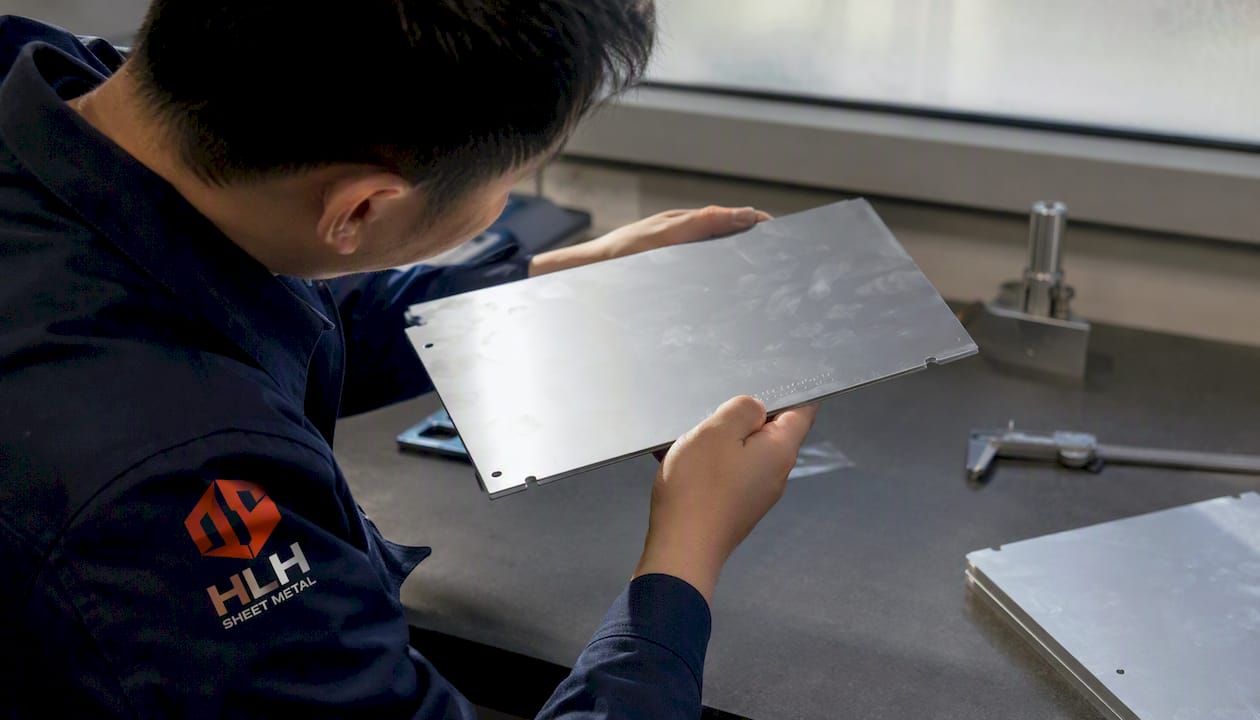
Inspection capabilities to verify: first-article inspection (FAI) per AS9102, CMM dimensional reports, in-process statistical controls, and the ability to supply full inspection records with each shipment. HLH SHEET METAL’s aerospace QA documentation practices outline how overseas suppliers can meet U.S. buyer expectations for MTRs, FAI examples, and English-language QA liaison.
Pro Tip: During pre-qualification, request a copy of the supplier’s current AS9100 certificate scope and one example FAI report. The FAI report alone tells you whether their inspection process is mature or just a checkbox.
How Do You Evaluate And Choose The Right Aerospace Fabricator?
Start with a prioritized checklist, weighted toward quality over cost:
- Certifications and scope — AS9100D certificate with explicit sheet metal fabrication scope; ITAR registration if applicable; NADCAP for special processes.
- Traceability — MTRs available for all raw material; batch-level records; documented chain of custody.
- Inspection capability — CMM on-site, FAI capability per AS9102, in-process controls, and willingness to share records.
- Aerospace references — named programs or part families they have produced; customer references you can actually call.
- Capacity and staffing — spare capacity for ramp-up, cross-site backup, and documented workforce plans.
On capacity: a 2025 workforce analysis highlights ongoing skills and capacity pressures across aerospace manufacturing that directly affect supplier lead times and ramp capability. McKinsey’s research reinforces this: talent gaps create real operational risk in the supply chain, and procurement teams that skip capacity verification pay for it in missed delivery milestones.
Commercial checks: prototype lead times typically run 2–4 weeks for sheet metal parts; steady-state production runs 4–8 weeks depending on material availability and finishing requirements. Tight tolerances, specialty alloys, and multi-step finishing all extend lead time and cost. Get these drivers on the table in the RFQ, not after award.
Red flags: evasive answers on MTR availability, no documented QA system, inability to produce an FAI or CMM report on request, inconsistent lead-time quotes across contacts at the same company, and opaque subcontracting chains where the actual fabrication happens at an unaudited third party.
Include 6–8 technical pre-qualifier questions (certifications, MTR process, FAI capability, ITAR status) to eliminate unqualified vendors before you spend time on full RFQ review. HLH SHEET METAL’s manufacturing challenges guide covers common pitfalls in prototype-to-production transfer worth including in your pre-qualifier.*
What Should Your RFQ Include When Contacting Aerospace Fabricators?
Send with the RFQ:
- Full drawings with GD&T callouts, critical tolerances, and surface-finish notes
- Material specification (AMS or QQ-A reference, not just “6061 aluminum”)
- Required MTR level (heat/lot traceability minimum; full chemical and mechanical cert preferred)
- Required certifications (AS9100D, ITAR, NADCAP where applicable)
- Quantity: prototype quantity and anticipated production volumes
- Acceptance criteria and applicable standards (AS9102 for FAI, drawing revision level)
- Packaging and shipping requirements, including any export control notes
Request from the supplier in their response:
- Proposed process flow and operations sequence
- Tooling list and tooling ownership terms
- Planned inspection points and inspection method for each critical feature
- Available CMM or FAI reports from similar parts
- Lead time for prototype and for steady-state production separately
- Sample MTR and current certification scope document
Ambiguous tolerances are the single biggest cost and schedule driver in aerospace RFQs. A drawing that says “±0.010 unless otherwise noted” on a formed bracket with no profile callout forces the supplier to assume, and assumptions become disputes at first article. Specify every critical feature explicitly.
Pro Tip: Paste your RFQ checklist into a shared template and version-control it. Suppliers who receive a complete, well-structured RFQ respond faster and with more accurate quotes — and it signals that your organization runs a disciplined procurement process, which attracts better suppliers.
What Most Procurement Guides Get Wrong About Sourcing Aerospace Fabricators
The standard advice is to search directories, check certifications, and get three quotes. That is not wrong, but it misses the actual failure mode in aerospace sheet metal sourcing: suppliers who hold the right certificates but have never actually produced flight-critical parts at volume.
AS9100 certification tells you a supplier has a documented quality system. It does not tell you they have produced a titanium rib to ±0.005 inches, managed a first-article rejection, or maintained MTR records through a three-year production run. The certificate is the entry ticket, not the qualification.
The pre-qualification step most buyers skip is asking for a real example: a completed FAI package, an MTR from a recent aerospace job, a CMM report on a formed part. Suppliers who have done this work produce these documents in hours. Suppliers who have not will stall, offer generic quality manuals, or send you a certificate and hope you stop asking.
The other underrated factor is communication infrastructure, especially for offshore suppliers. A fabricator with excellent process capability but a 24-hour response lag and no English-speaking QA contact creates schedule risk that does not show up in a capability audit. For U.S. buyers working with international suppliers, English-language QA support and a named point of contact for technical questions are important factors to consider in your evaluation rubric.
HLH SHEET METAL For Aerospace Procurement Teams
Precision fabrication without the qualification uncertainty: HLH SHEET METAL delivers laser cutting, CNC forming, TIG welding, anodizing, and passivation across aluminum alloys, stainless steel, titanium, and specialty alloys, with ISO-certified quality controls and multi-plant capacity for both prototype and production volumes.
For U.S. aerospace buyers specifically, HLH provides MTRs, FAI examples, and CMM reports on request, with an English-speaking QA team handling documentation and technical queries directly. That removes the communication lag that turns offshore sourcing into a schedule risk.
Start by submitting your drawings and material specifications through the aerospace fabrication quote page or the precision fabrication landing page. Request a sample MTR and FAI example with your initial inquiry to confirm QA maturity before committing to a full RFQ.
Sources
- Aerospace Metal Supplier | Aircraft Grade Metals | TW Metals
- MPG Global Insights Aerospace and Defense 2025
FAQ
What Certifications Should An Aerospace Sheet Metal Fabricator Hold?
AS9100D is the baseline requirement, covering risk management and configuration control beyond standard ISO 9001. ITAR registration is required for controlled technical data, and NADCAP accreditation applies when parts undergo special processes such as heat treatment or chemical processing.
Is Sheet Metal Fabrication Used In Aerospace?
Sheet metal is used throughout aerospace structures and systems, including skins, ribs, bulkheads, brackets, ducting, access panels, and structural assemblies. Aluminum alloys, titanium, and stainless steel are the most common materials.
Who Are The Major Aerospace Manufacturers In The U.S.?
Boeing, Lockheed Martin, Raytheon Technologies, Northrop Grumman, and General Dynamics are among the largest U.S. aerospace and defense primes. Their approved supplier lists are a reliable source for identifying pre-qualified sheet metal fabricators in their supply chains.
Are Experienced Aerospace Metal Fabricators In Demand?
Demand remains strong. A 2025 workforce analysis highlights ongoing skills and capacity pressures across aerospace manufacturing, which means qualified fabricators with documented QA systems and available capacity are genuinely competitive to source.
How Do I Verify A Supplier’s Aerospace Fabrication Experience?
Request a completed first-article inspection package and a recent MTR from an aerospace job. Suppliers with real flight-hardware experience produce both within 48 hours; those without will offer generic quality documentation instead.

