




Table Of Contents
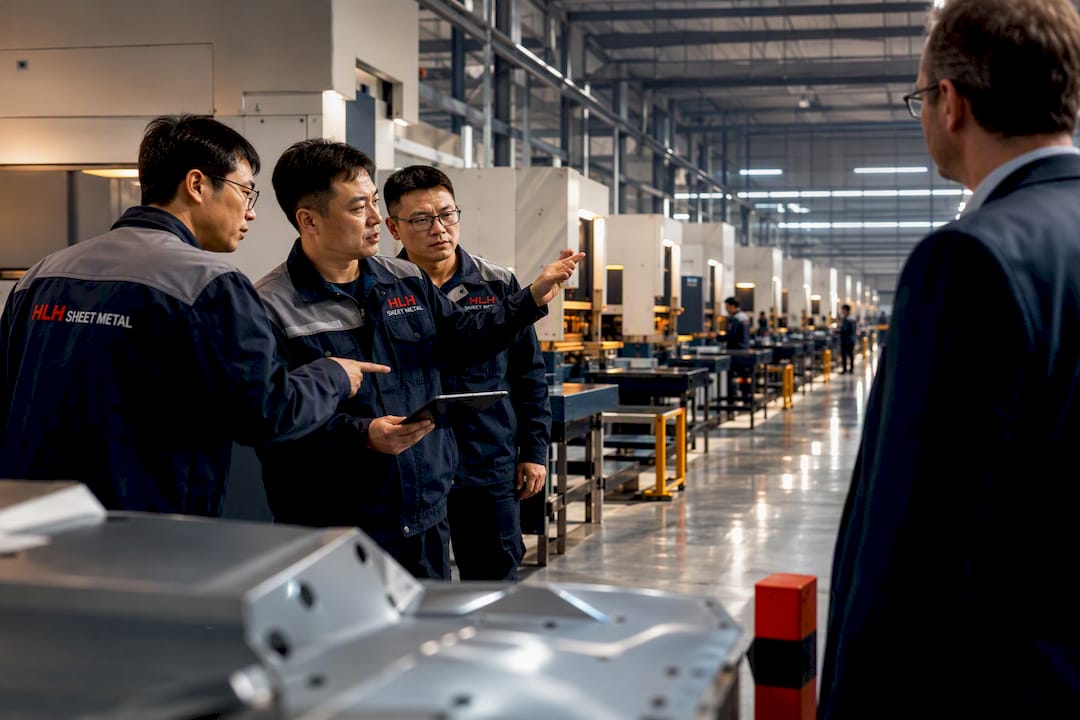
Start with three channels: large domestic contract manufacturers, factory-direct plants in high-capacity manufacturing regions like China, and steel service centers that add processing to secure material at scale. Digital quoting platforms fill in gaps for fast capacity checks. The next move is simple: send a short RFQ asking for parts-per-month capacity, certifications, recent program references, and a first-article sample policy before anyone quotes a price.
TL;DR:
- Domestic fabricators offer faster lead times and easier quality oversight, but may require splitting large programs across multiple shops due to capacity limits.
- Overseas large-scale suppliers provide better pricing and capacity but need longer lead times and remote quality management practices.
- Verifying high-volume capacity requires detailed metrics on process throughput, certifications, automation, supply backups, and contractual KPIs, not just capacity claims.
- RFQs should specify volumes, tolerances, inspection needs, and ramp schedules, while suppliers should provide verifiable references and transparent production data.
- Choosing a partner with integrated production systems and a proven track record ensures consistent quality and reliability over multi-year fabrication programs.
Where To Search For High-volume Sheet Metal Fabricators
Every sourcing channel trades speed against control, and knowing which one fits your priority saves weeks of vetting.
Domestic contract manufacturers and OEM-focused fabricators make sense when logistics control and shorter shipping windows matter more than the lowest unit cost. You get tighter communication loops and easier plant visits, but capacity ceilings can force you to split large programs across multiple domestic shops.
Factory-direct producers in high-capacity regions, including many China-based manufacturers, offer scale and price advantages that are hard to match domestically, provided you’re comfortable managing longer lead times and remote quality oversight. Xometry is one example of a platform that markets the ability to move from low-volume prototypes to high-volume runs without switching vendors, which matters if your program grows from a pilot batch into a multi-year contract.
Service centers and distributors deserve more attention than most procurement teams give them. Companies like Kloeckner Metals hold flat roll inventory and offer slitting and blanking, which stabilizes material supply when mill minimums exceed what your program needs.
A few other channels worth working into your search:
- Digital marketplaces for fast capacity checks, though platform leads still need the same qualification rigor as any cold lead.
- Trade associations and industry events (Fabtech is the largest in North America) for vetted introductions from peers running similar programs.
- Referrals from your existing material suppliers, who usually know which fabricators actually hit their delivery promises.
How Do You Verify A Fabricator’s Real High-volume Capacity?
Plenty of shops can nail a one-off prototype and still buckle under a sustained 50,000-unit-a-month release schedule. The gap between “can build this part” and “can build this part reliably, every month, for three years” is where most vendor relationships fail.
Ask for these specifics before you take any capability claim at face value:
- Capacity metrics by process — parts per month for laser cutting, bending, welding, and stamping separately, plus the number of lights-out machines, available shifts, and stamping lines.
- Certifications and quality documentation — ISO 9001 at minimum, plus relevant industry-specific standards, backed by recent First Article Inspection (FAI) reports or Statistical Process Control (SPC) data rather than a certificate alone.
- Repeatability evidence — stored CNC and press brake programs, automated setups, and historical yield data. Fabricators like EVS point to lights-out production and stored program libraries as the mechanism that keeps output consistent between runs, and that automation is a reasonable proxy for whether a shop can hold tolerances at volume.
- Supply continuity — multi-plant capability, direct mill relationships, and a documented backup supplier plan if their primary material source stalls.
- Contractual KPIs — on-time delivery percentage, first-pass yield percentage, and a defined corrective action timeline written into the purchase agreement, not just discussed verbally.
Some fabricators publish hard numbers up front. SR MFG lists a standard capacity above 100,000 parts per month and describes how it adds shifts or reconfigures workstations to absorb seasonal spikes, which gives you a real benchmark to compare against a vague “yes, we can handle that” answer.
Pro Tip: Ask a candidate supplier to walk you through what happens when a single press brake goes down mid run. Their answer tells you more about real capacity than any brochure metric.
Sourcing Checklist And RFQ Template For High-volume Programs
A clean RFQ gets you comparable bids instead of five vendors answering five different questions. Build yours around these fields:
- Annual volume and release cadence — total units per year and how often you expect scheduled releases (weekly, monthly, quarterly).
- Part drawings and tolerances — full specs, critical dimensions called out, and any GD&T requirements.
- Target unit cost and volume breaks — the price you’re modeling toward and at what quantities you expect it to drop.
- Required inspections — FAI, in-process checks, final inspection reports, and whether you need Certificates of Conformance.
- Packaging and labeling requirements — especially important if parts feed a JIT (just-in-time) assembly line.
- Ramp schedule — how fast you need to go from sample approval to full-rate production.
Pair the RFQ with a supplier checklist covering capacity, certifications, tooling on hand, sample policy, QA data, three verifiable references, quoted lead times, and payment terms. For timelines, budget one to three weeks for sample runs, a separate FAI cycle before production tooling locks in, and a staged ramp (often 25/50/100 percent of target volume) rather than jumping straight to full output. Structuring a blanket order with scheduled releases against it reserves capacity on the supplier’s floor and typically earns better pricing than repeated spot orders.
What Drives Pricing And Lead Times At High Volume?
Material grade, finish, secondary operations, and tolerance requirements all move per-part cost, and at scale even small variances compound fast. Tighter tolerances mean more inspection time per part; a mirror finish adds a labor step laser cutting alone can’t touch.
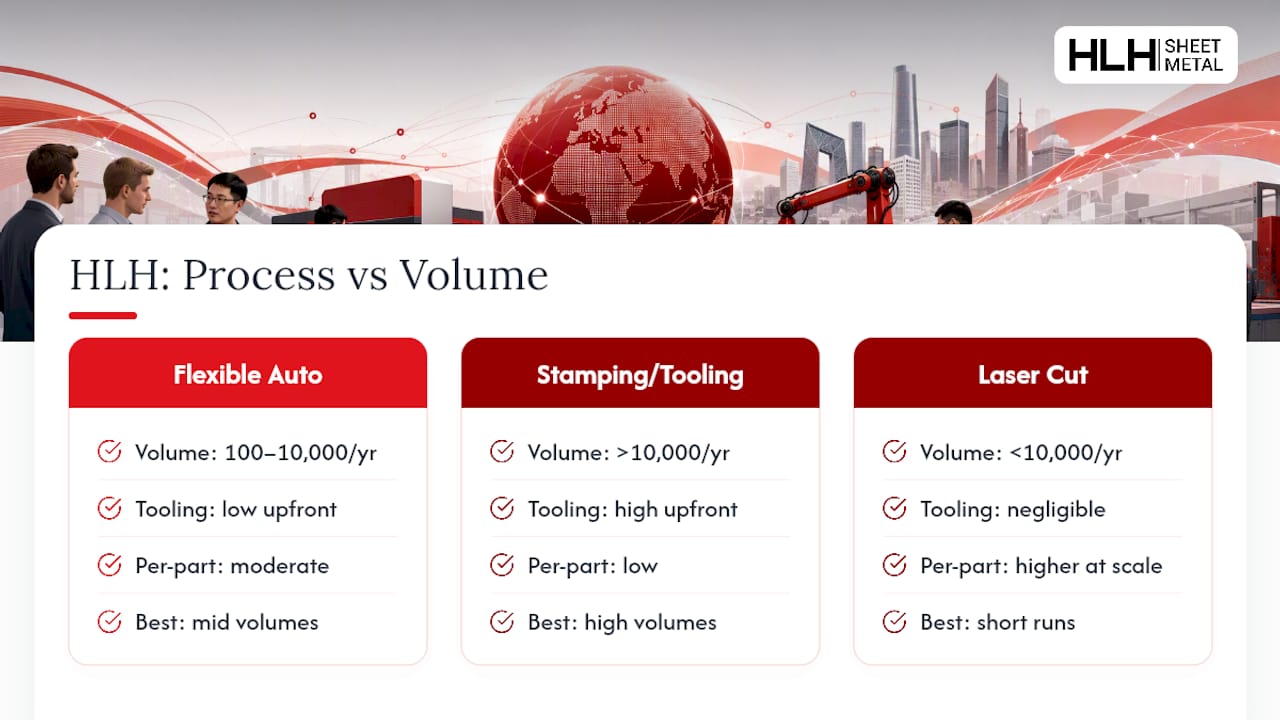
Volume itself changes which process makes financial sense. AP Precision Metals positions annual volumes between 100 and 10,000 units as the range where flexible automation, rather than dedicated tooling, tends to be most cost-efficient. Above that, progressive stamping or dedicated tooling usually lowers per-part cost enough to justify the upfront tooling spend, even though laser cutting stays cheaper for smaller runs. Ask any finalist to model both approaches across your expected annual volume before you commit to a process.
Lead times vary sharply by sourcing channel: domestic shops often quote in weeks, factory-direct overseas plants in a wider band depending on ocean freight versus air. Blanket orders with scheduled releases and local stocking arrangements shrink your effective lead time even when the base production cycle stays the same.
Reduce risk with inventory models like consignment stock, vendor-managed inventory (VMI), or dock-to-stock programs, and consider dual sourcing for your highest-volume parts. Building safety stock and writing delivery penalties into the contract costs you upfront, but it beats a stalled assembly line.
What I’ve Learned Running Multi-year Fabrication Programs
Every program I’ve watched succeed long-term treated first-article approval as a repeatable system, not a one-time hurdle. Store the approved program, drawing revision, and inspection data centrally so a reorder eighteen months later doesn’t restart the qualification clock from zero.
The suppliers worth keeping are the ones who push back on your design before tooling gets cut. A fabricator offering real design-for-manufacture input during quoting saves you from the change orders that derail a ramp schedule, and that input is worth more than a marginally lower unit price.
I’d also weight ERP or MES transparency higher than most scorecards do. A supplier who can show you tracked production data week over week, rather than a status update when you ask, is the one who catches a slipping schedule before it becomes your problem.
— Nash
Request Capacity Details Directly From HLH Sheet Metal
HLH SHEET METAL offers manufacturing capabilities that support moving from prototyping into production runs without changing vendors mid-contract. That’s the practical advantage over splitting your sourcing between a prototype shop and a separate volume producer: one qualified partner, one quality system, no handoff risk between them.
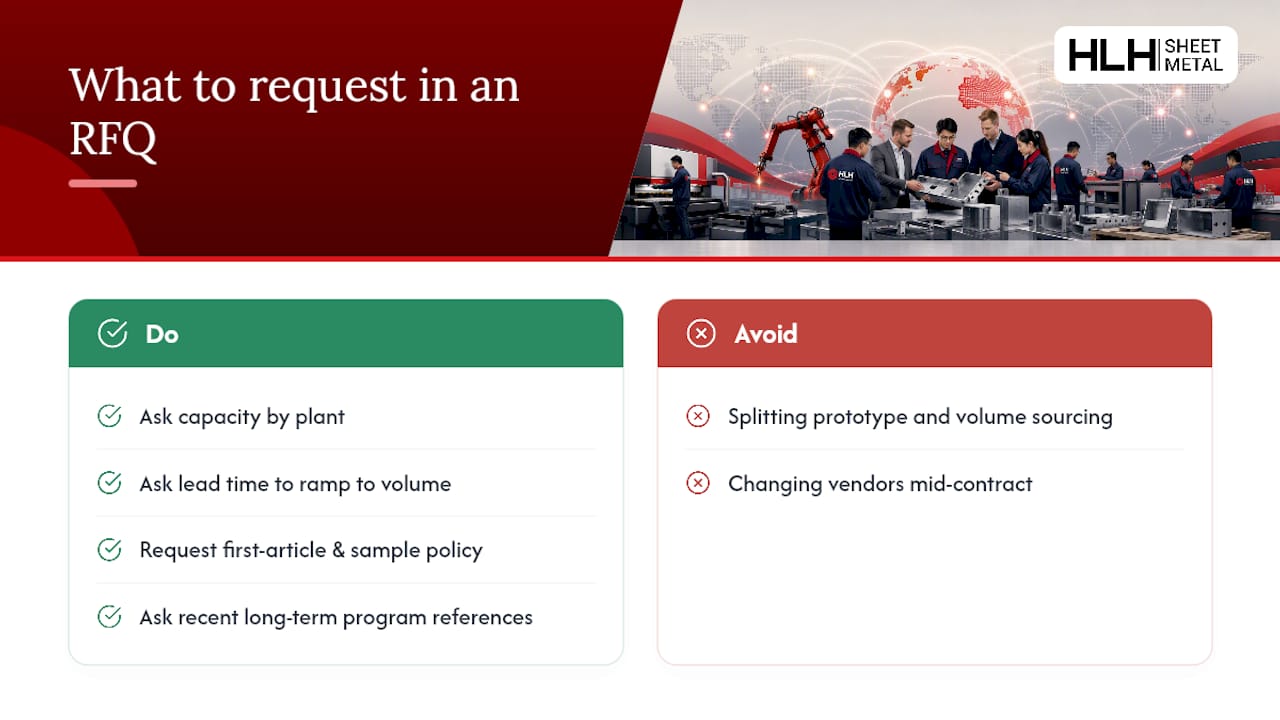
When you send an RFQ, ask specifically about capacity by plant, lead time to ramp from sample approval to full volume, first-article and sample policy, and recent long-term program references. HLH SHEET METAL backs its production with ISO certifications and a support team that responds in English, which matters when you’re coordinating specs and schedules across time zones. Check the sheet metal fabrication capabilities page and submit your part drawings and target volumes to get a capacity-based quote back.
FAQ
How Much Do Metal Fabricators Charge?
Pricing depends on material, thickness, finish, tolerances, and volume, so there’s no flat rate. Expect per-part cost to drop meaningfully once you cross volume breaks where progressive stamping or dedicated tooling becomes cheaper than laser cutting.
Where Can I Find Metal Fabricators Online?
Digital quoting platforms like Xometry let you check capacity and get instant estimates, but treat every online lead the same way you’d treat a referral: request certifications, capacity data, and references before committing volume.
Who Is The Biggest Steel Fabricator In The US?
Capacity leadership varies by product category and region, and no single fabricator dominates every segment of sheet metal production. Large domestic mills such as Nucor report sheet capacity in the millions of tons per year, but that’s raw steel supply, not finished fabrication volume.
How Much Do Sheet Metal Fabricators Make A Year?
Earnings vary widely by role, region, and shop size, from shop floor operators to fabrication business owners, so there’s no single reliable figure to cite. Program-level revenue for a fabrication shop depends far more on contract volume and part complexity than on any industry-wide average.
What’s A Realistic Timeline From RFQ To Full Production?
Expect one to three weeks for sample runs, a separate cycle for first-article inspection, then a staged ramp moving through partial volume before hitting full-rate production. Suppliers with ERP or MES tracking, like the systems Dongji Factory Direct describes, tend to hold that schedule more reliably than shops managing releases manually.

