




Table Of Contents
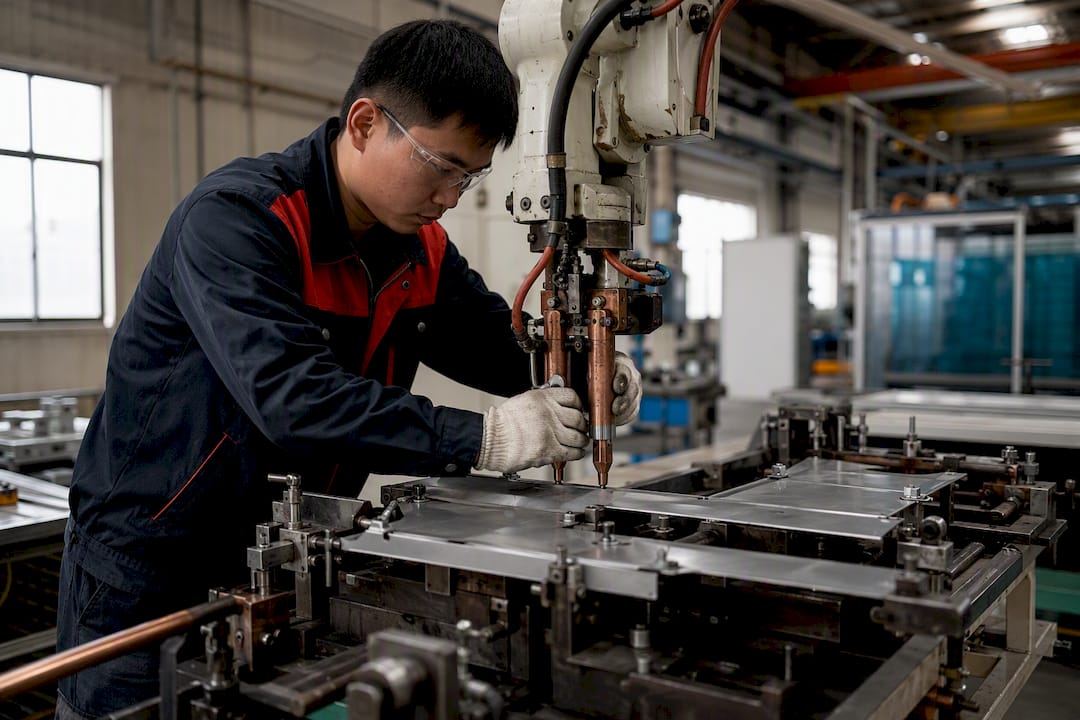
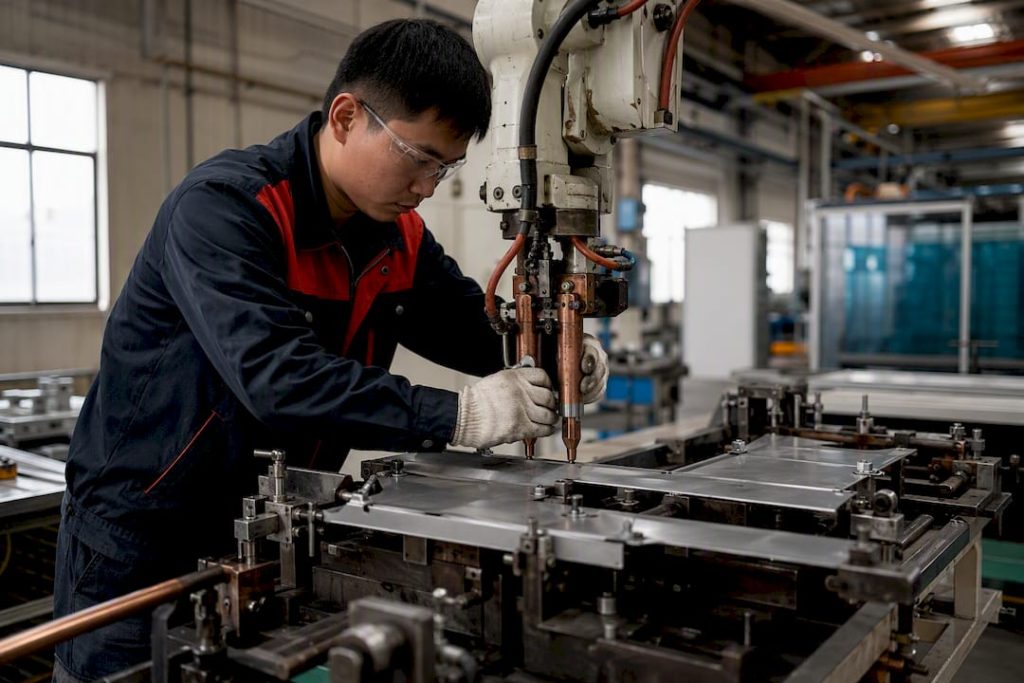
Yes, China remains a sound sourcing base for precision spot-welded sheet metal, provided you vet suppliers on process control, not just price. Spot welding sheet metal precision fabrication sourcing in China works when procurement treats documentation as a gate, not paperwork: no supplier moves past sampling without a Welding Procedure Specification, a Welder/Operator qualification record, and a first-article sample with a visible cross-section.
Before you send an RFQ, do three things:
- Ask for the supplier’s WPS/WPQ package for the specific gauge and alloy combination you need.
- Request a first-article sample with a cross-sectioned nugget photo, not just a finished part.
- Confirm inspection reports (peel or shear test data) ship with every pilot batch.
Put these three lines directly in your RFQ email. Suppliers who answer without hesitation are worth a call. Suppliers who deflect are worth crossing off.
Key Takeaways
Successful China sourcing for spot-welded sheet metal depends on requiring WPS/WPQ documentation, cross-sectioned first articles, and clear acceptance criteria before scaling any order.
| Point | Details |
|---|---|
| Verdict on China sourcing | Recommended for precision spot welding when suppliers provide WPS/WPQ and first-article cross-sections. |
| Vetting priority | Check equipment, ISO certification, DFM responsiveness, and export history before quoting price. |
| Design constraints matter | Keep edge distance at three times sheet thickness and confirm electrode access before finalizing drawings. |
| Documentation gates production | Require nugget cross-sections, peel/shear tests, and FAI reports tied to payment milestones. |
| HLH Sheet Metal fit | Offers ISO-certified multi-plant spot welding with in-house CMM inspection and DFM feedback for pilot orders. |
Spot Welding Sheet Metal Sourcing: The Vetting Checklist
Before a single quote gets serious, run the supplier through five checkpoints. Skip one and you inherit its risk later, usually during ramp, when it’s expensive to fix.
- Equipment and capability. Ask whether spot welding runs on robotic arms or manual guns, how many welding stations the plant operates, and what maximum fixture size they can hold. Robotic cells hold tighter repeatability across thousands of spots; manual stations still make sense for low-volume or oddly shaped assemblies.
- Certifications and quality systems. Request their ISO 9001 (or higher) certificate directly, along with the WPS and WPQ records tied to your material and thickness. ISO’s quality management standards give buyers a baseline to confirm process control exists on paper and in practice.
- Engineering support. A fabricator worth working with sends back DFM feedback on your first CAD upload, not after tooling is cut. Ask how they’ve handled first-article builds for other clients and what changes they typically flag.
- Export and communication proof. Confirm they’ve shipped to your region before, ask for a sample commercial invoice, and gauge how fast English-speaking staff respond to a technical question. A slow, vague answer during quoting predicts a slow, vague answer during a production hiccup.
- Commercial fundamentals. Get their minimum order quantity, current capacity, typical lead time for your part family, payment terms, and at least one reference project in a comparable industry.
An 8-point evaluation framework for Chinese sheet metal fabricators built around equipment, DFM support, certification, export history, and QA capability lines up closely with what experienced buyers already screen for informally.
Pro Tip: Send the same technical drawing to three shortlisted suppliers and compare their DFM comments side by side. The quality of the questions they ask back tells you more than their quoted price.
Certifications tell you a supplier passed an audit once. DFM feedback and export history tell you what happens on your actual order.
Design Rules For Spot-welded Sheet Assemblies
Spot welding has real physical limits, and designs that ignore them cause inconsistent nuggets no supplier can fully engineer around. Get these details right before tooling starts.
- Material and stack-up. Spot welding works best on mild steel, galvanized steel, and stainless in the 0.5mm to 3mm range per layer; aluminum needs higher current and different electrode caps, and mixed-metal stacks (steel to aluminum) generally aren’t good candidates without adhesive bonding or mechanical fasteners as a backup.
- Edge distance and spacing. Keep spot centers at least three times the sheet thickness from any edge, and space spots roughly 25 to 50mm apart depending on stack-up, per typical resistance spot welding parameters.
- Electrode access. Every spot needs clearance for both electrode tips, meaning the fixture design and part geometry have to allow the gun (or robot arm) a straight approach angle.
- Alignment features. Pilot holes or locating tabs near weld zones keep sheets registered during fixturing, which matters more than tolerance on the weld spot itself.
- First-article requests. Require a cross-sectioned sample showing nugget diameter and penetration, plus a dimensional report against your drawing, before releasing production tooling.
Quality Controls And Documentation To Require
Weld quality is invisible from the outside, which is exactly why documentation carries the weight in a spot-welding contract. Build the paper trail into your purchase order, not as an afterthought after parts arrive.
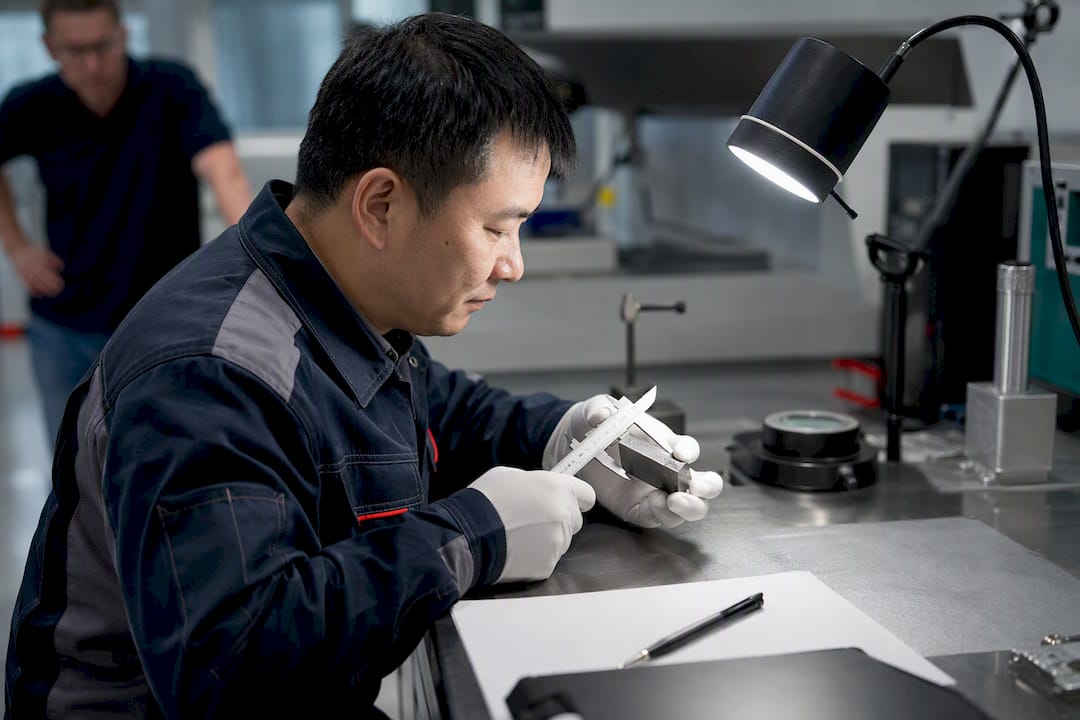
Core records to request as standard: the Welding Procedure Specification and matching Welder/Operator qualification, plus material certificates tracing coil or sheet lot numbers. On the testing side, ask for nugget cross-section photos, peel or shear test results on sample coupons, and a defined sampling plan with stated acceptance criteria (minimum nugget diameter, no interfacial fracture, and so on).
| Deliverable | What it confirms |
|---|---|
| WPS/WPQ package | The welding process and the operator are both qualified for your material |
| Nugget cross-section photo | Weld penetration and fusion meet size requirements |
| Peel/shear test report | Weld strength holds under mechanical load, not just visually |
| First Article Inspection (FAI) report | Dimensions and weld locations match your drawing before full production |
Write nonconformance and rework definitions directly into the contract: what counts as a defect, who pays for rework, and how long the supplier has to respond to a rejected lot.
A cross-section photo and a short peel test on the pilot batch will tell you more about a supplier’s real competence than a stack of certificates ever will.
What Drives Lead Time And Cost In China Sourcing
Setup and tooling cost is usually the biggest line item on a small order, and it’s the one buyers most often forget to amortize when comparing quotes. A fixture built for robotic spot welding costs more upfront than a manual jig, but it pays back fast once your lot sizes climb past a few hundred units.
Per-spot cycle time runs in the range of 0.1 to 0.5 seconds per spot, with electrode forces commonly between 2 and 6 kilonewtons depending on stack-up. That’s fast enough that labor and fixturing, not the weld itself, usually decide your per-part cost.
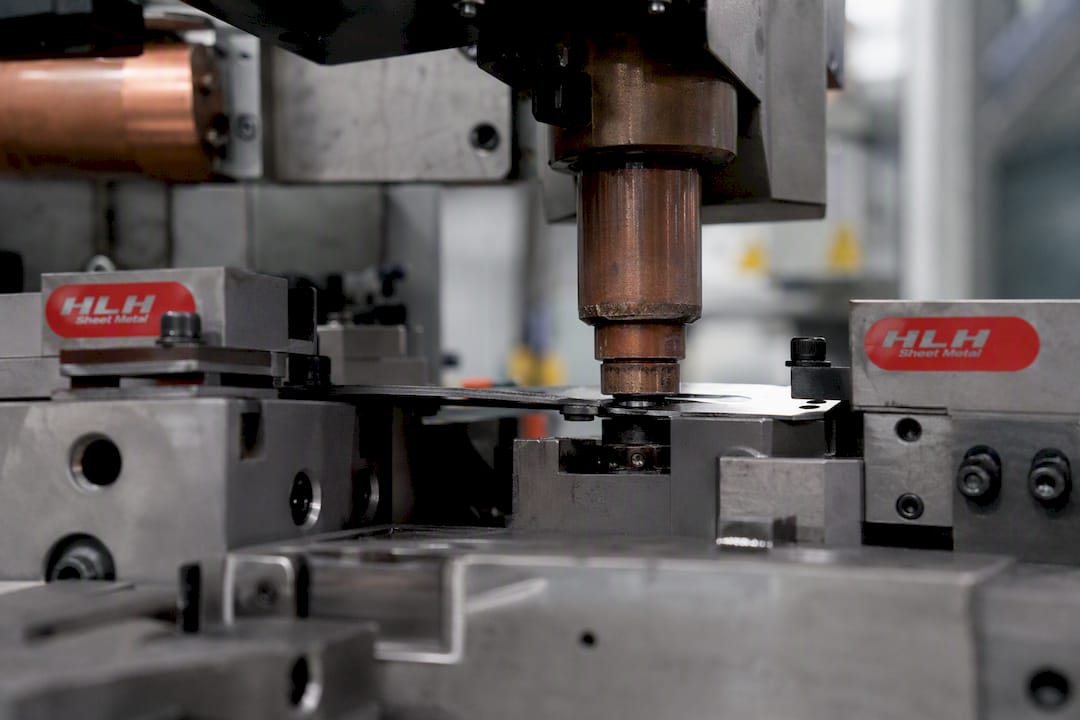
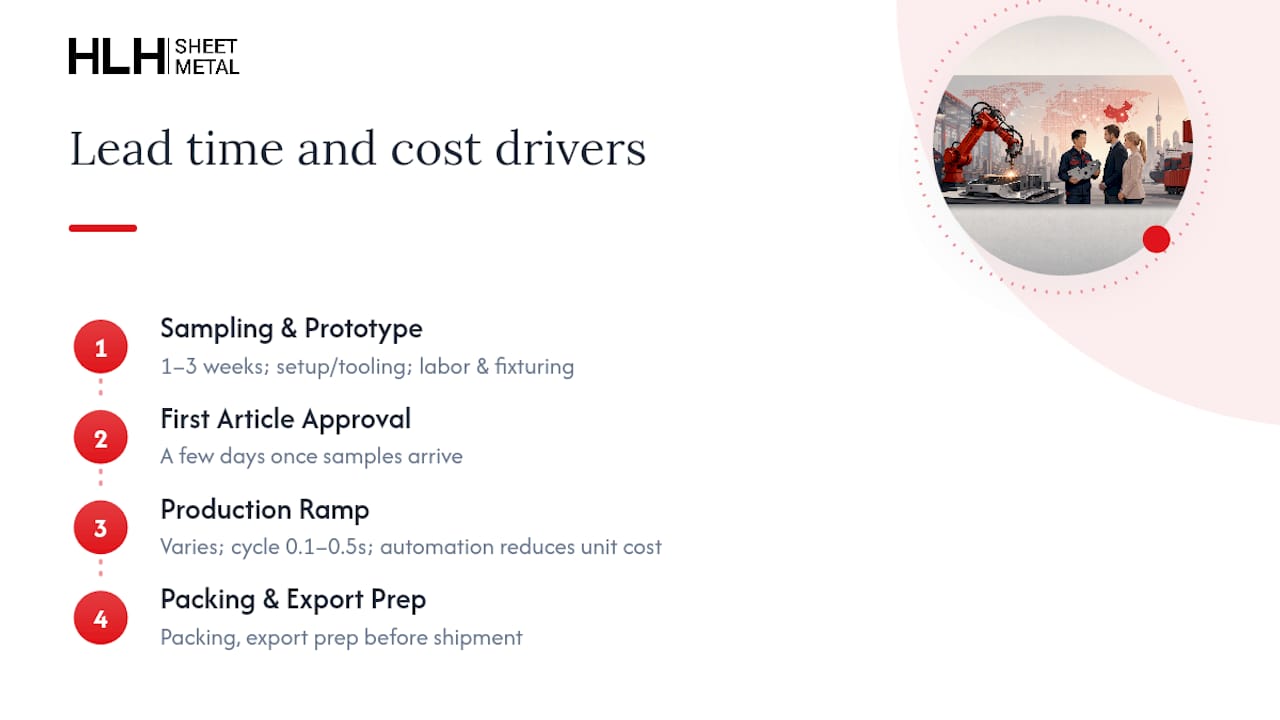
Lead time typically breaks into four phases: sample and prototype (1 to 3 weeks), first article approval (a few days once samples arrive), production ramp (varies heavily by part complexity and order size), and packing plus export prep before the shipment leaves port.
Larger lots and robotic automation both push per-part cost down. Total landed cost still needs tariffs, customs clearance fees, inland freight on both ends, and currency exposure between your invoice currency and your reporting currency added on top of the quoted unit price. Skip that math and your “cheaper” China quote can land at parity with a domestic one.
Reducing Risk: Contracts, Packaging, And Shipping
Protecting a spot-welded shipment starts with the packaging spec, not the shipping method. Welded seams and formed edges scratch or deform easily in transit if the supplier defaults to generic packing.
- Write inspection windows, hold points, and nonconformance report (NCR) terms into the purchase order before production starts, not after a bad lot arrives.
- Require an NDA covering your drawings and any proprietary tooling, especially if you’re supplying custom fixtures.
- Specify internal padding or foam separators for welded assemblies, and confirm whether the shipment goes by sea (cheaper, slower) or air (faster, costlier) based on your timeline.
- Confirm the commercial invoice, packing list, and certificate of origin will be ready before the container books, since missing paperwork is a common customs delay.
- Tie a portion of payment to First Article Inspection approval rather than paying in full at PO placement, and consider a pre-shipment inspection (PSI) on larger orders.
HLH Sheet Metal’s Fit For Precision Spot-welding Programs
HLH Sheet Metal runs ISO-certified processes across multiple manufacturing plants in China, combining spot welding with laser cutting, bending, and stamping under one roof, which cuts the handling and alignment risk that comes from bouncing a part between separate vendors.
For a working reference, paste these ranges into your own RFQ: nugget diameter typically scales with sheet thickness, weld cycle times run 0.1 to 0.5 seconds per spot, and electrode forces commonly fall between 2 and 6 kilonewtons for standard steel gauges.
- In-house CMM inspection, microscope nugget review, and tensile/peel test rigs back up every first-article report.
- DFM feedback comes back on initial CAD submissions, before tooling commitments lock in.
- Material certificates and FAI documentation ship as standard with pilot orders, not as a paid add-on.
Pro Tip: Structure your pilot order as two small batches instead of one. Approve the first on quality alone, then use the second to validate packaging and shipping timing before committing to a full production release.
A Buyer’s Note On Running The Pilot
Most successful pilots follow the same sequence: sample, cross-section review, small batch, then scale. The step that catches problems early almost every time is the cross-section photo, paired with acceptance criteria written down before parts ship, not negotiated after.
Get A Quote Or DFM Review From HLH Sheet Metal
If the checklist above feels like a lot to manage across multiple vendors, that’s the actual argument for working with one integrated shop instead of stitching together a laser-cutting house, a welding subcontractor, and a finishing line separately. HLH Sheet Metal runs spot welding, cutting, bending, and finishing across the same certified plants, so your DFM feedback, first-article sample, and inspection reports all come from one accountable source instead of three.
Start by submitting your CAD file through the sheet metal fabrication page for a free quote and DFM review, or go straight to the welding services page if spot welding capacity and WPS documentation are your main concern right now. Manufacturers in regulated sectors can also check the aerospace fabrication page for tolerance and QA specifics tied to their industry. Either way, request a first-article sample before committing to a production run.
Sources
FAQ
Is China A Good Source For Precision Spot-welded Sheet Metal?
Yes, provided the supplier can produce a WPS/WPQ package, a cross-sectioned first-article sample, and ISO 9001 (or higher) certification before you commit to production tooling.
What Documents Should I Request Before Placing A Pilot Order?
Request the Welding Procedure Specification, Welder/Operator qualification records, material certificates, and a first-article inspection report with a nugget cross-section photo.
How Long Does A Typical Spot-welding Pilot Take?
Sampling and prototyping usually take a few weeks, with first-article approval requiring some additional days once samples arrive; full production ramp varies by part complexity and order size.
What’s The Biggest Cost Driver In Spot-welded Sheet Metal Projects?
Setup and tooling cost dominates small orders, while per-spot cycle time (roughly 0.1 to 0.5 seconds) and labor skill matter more once volume climbs.
Can HLH Sheet Metal Support A Small Pilot Order Before Full Production?
Yes, HLH Sheet Metal supports staged pilot orders with DFM feedback, first-article documentation, and in-house inspection equipment before scaling to full production runs.

