




Table Of Contents
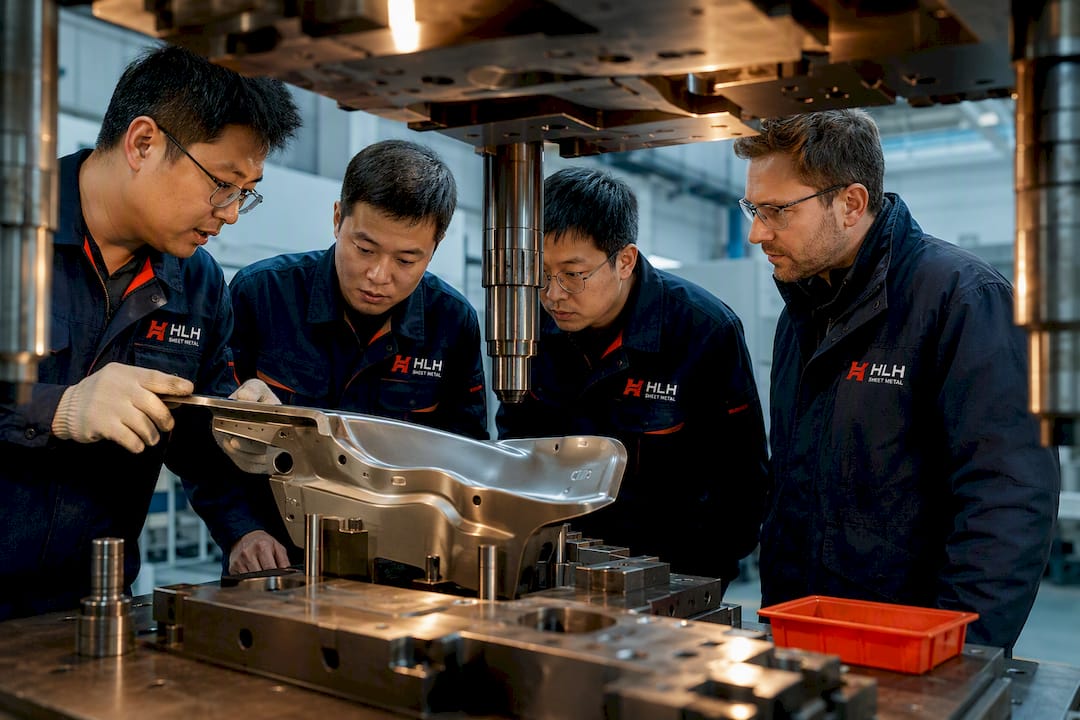
Precision stamping houses, tool and die shops, and contract sheet-metal fabricators supply the specialized forming work behind auto parts: brackets, panels, chassis components, and enclosures. China has become a leading source for this work because a cluster of suppliers there combine in-house tooling, large-press capacity, and ISO-backed quality systems, provided you vet them properly. HLH Sheet Metal runs multiple China-based plants built around exactly that model.
TL;DR:
- Chinese suppliers often combine in-house tooling, large presses, and ISO-backed quality systems, reducing lead times and increasing flexibility for automotive parts.
- Quality certifications like ISO 9001 and IATF 16949 are essential, along with thorough first-article inspections, material certifications, and process capability data.
- A typical path from prototype to volume involves 1-2 weeks for design review, 1-3 weeks for prototypes, 3-8 weeks for tooling, and small pilot runs before full production.
- Building customs clearance, ocean freight, and shipping buffers into your schedule is critical to avoid delays and schedule slips.
- HLH Sheet Metal operates multiple ISO-certified plants in China offering rapid prototyping and production, making them suitable for automotive projects.
Which Suppliers Handle Specialized Sheet Metal Forming For Auto Parts?
Four supplier types dominate this space, and each fits a different part of your production curve.
- Contract fabricators handle mixed-process jobs (cutting, bending, welding, finishing) for low-to-mid volume runs and multi-part assemblies.
- Stamping and tool-and-die shops own their dies and presses, making them the right call once you’re past prototyping and into repeatable volume production.
- Progressive die shops run multi-stage dies that form, pierce, and trim in a single press cycle, ideal for high-volume brackets and structural panels.
- Precision laser and robotic fabrication houses lean on laser cutting and robotic welding cells for tight-tolerance, lower-volume, or highly configurable parts.
The processes themselves determine which shop you need. Stamping and progressive dies suit high-volume, repeatable geometries and typically hold tolerances tight enough for structural brackets and panels. Deep drawing forms cup-shaped or recessed parts, like housings, in a single draw rather than multiple bends. Laser cutting handles complex profiles and short runs without tooling investment, while robotic welding adds consistency to multi-piece assemblies that would vary too much under manual welding. Suppliers active in this space commonly claim tolerances around ±0.1mm for complex automotive brackets and panels.
If your part count is under a few thousand units and geometry is still changing, a precision fabrication house gets you there faster. Once you’re locking a design for tens of thousands of units annually, a stamping specialist with owned tooling brings the per-part cost down enough to matter.
Why Source Specialized Sheet Metal Forming From China?
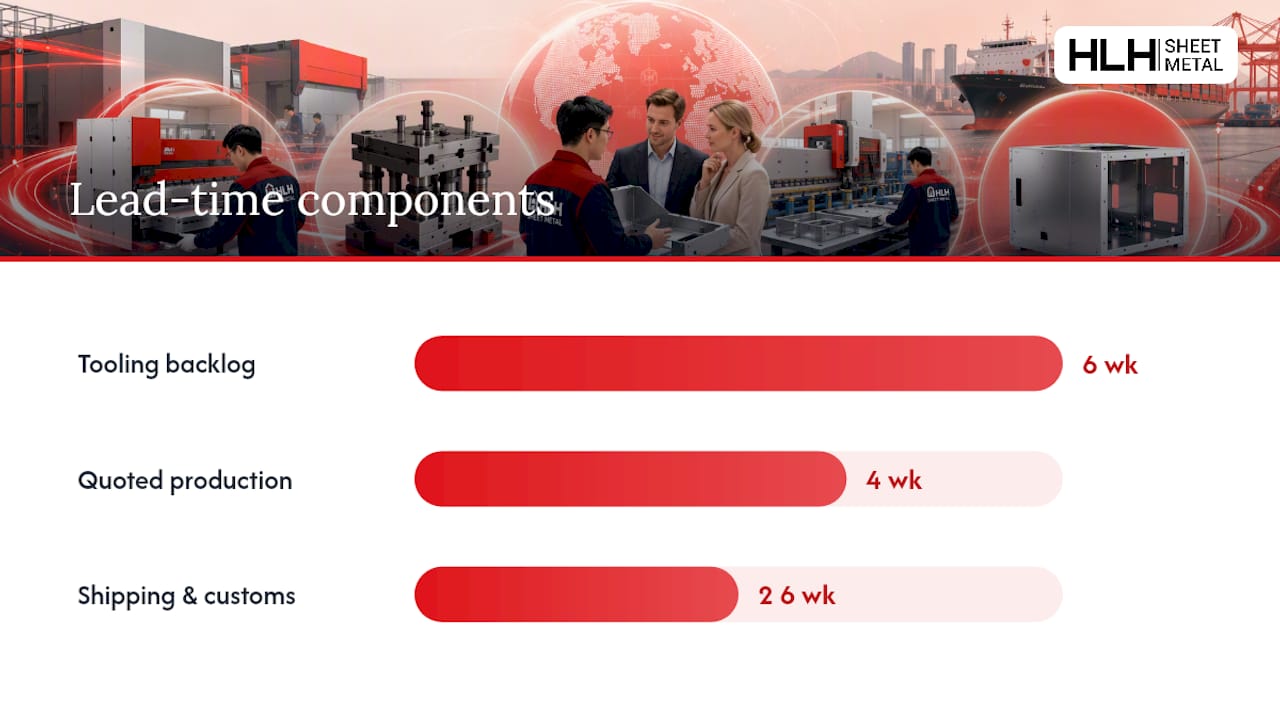
Cost is the obvious answer, but it’s the wrong one to lead with. What actually moves the needle is total landed cost: unit price plus tooling amortization, freight, duties, and the buffer time built into your schedule. A supplier quoting a lower per-part price but sitting on a six-week tooling backlog can cost you more than a slightly pricier shop that ships on time.
Three factors tend to make China a genuine advantage rather than just a cheaper one:
- Equipment breadth. Large stamping presses, robotic welding cells, and in-house toolmaking sit under one roof at many Chinese fabricators, which shortens the handoff between prototype approval and tooling build.
- Supply-chain density. Raw sheet stock, plating and coating lines, and subcomponent vendors cluster near major manufacturing regions, cutting the logistics gaps that slow down Western supply chains.
- Tooling flexibility. In-house die-making lets shops offer shorter tooling lead times and more flexible minimum order quantities than shops that outsource die construction.
That density also shows up in prototype-to-production continuity. A shop that can prototype your bracket on a laser cutter and then transition it to a stamping die under the same roof avoids the re-quoting and re-tooling delays that come from switching vendors mid-project. Some Chinese suppliers have built a decade or more of experience specifically around automotive components, which matters when your part needs to survive vibration testing, not just look right on a CAD screen.
Pro Tip: Build customs clearance and ocean freight transit into your lead-time math before you commit to a launch date. A supplier’s “four-week production” quote rarely includes the two to four weeks that shipping and customs can add, and that gap is where automotive launch schedules quietly slip.
What Quality Standards Should You Verify Before Committing?
Certifications tell you what a supplier’s quality system is supposed to catch, not what it actually catches on your part. Ask for both.
Start with the paperwork. ISO 9001 certification is table stakes and confirms a documented quality management system is in place. IATF 16949 matters more for automotive-specific work; it signals the supplier runs quality processes designed around automotive defect rates and traceability, not general manufacturing.
Below the certification level, verify at the sample stage:
- First-article inspection (FAI) on the initial production sample, checked against your drawing dimension by dimension.
- Material certificates confirming the sheet stock matches your spec, not a substitute alloy.
- Dimensional inspection reports covering critical-to-function features, not just overall envelope dimensions.
- Process capability data (CP/CPK) where the part is safety-critical. The absence of capability data is a legitimate reason to decline a supplier for structural or safety-related parts.
At the factory level, confirm tooling ownership records, current calibration logs on measuring equipment, and whether the shop runs 100% dimension checking rather than spot sampling. A partner site on 3D scanning for mechanical part inspection covers how newer inspection methods catch deviations that manual gauging misses.
Pro Tip: Vague answers to “how do you check this dimension” are the real red flag, not accented English or slow email replies. A shop with real process control can point to the specific gauge or fixture it uses.
How Do You Evaluate And Choose A China-based Forming Partner?
Turn the QA checklist into a live RFQ conversation. Ask directly:
- Who owns the tooling, and what happens to it if we leave?
- What’s your first-article and sample approval process, step by step?
- What tolerances can you hold on this specific geometry, not just in general?
- What’s your realistic lead time from PO to first shipment, including any tooling build?
- What’s your minimum order quantity, and does it change after the first production run?
- Who is our engineering point of contact once we’re past sampling?
Contract terms deserve the same scrutiny as the technical answers. Require clear tooling ownership language (you paid for it, you own it), a signed NDA before sharing drawings, defined acceptance criteria tied to your inspection reports, and a warranty clause that spells out liability for dimensional nonconformance. A supplier evaluation guide for auto parts sourcing walks through additional selection criteria worth reviewing before you sign.
Weight your decision matrix toward certification and repeatability first, engineering support second, and lead time or landed cost third. A cheap supplier who can’t hold tolerance on the tenth run costs more than a pricier one who can.
Pro Tip: Stage a pilot run of a few hundred units before signing off on full production tooling. It’s the cheapest insurance against discovering a die problem after you’ve committed to a 20,000-unit order.
From Prototype To Volume: What The Timeline Actually Looks Like
The path from CAD file to shipped parts follows a fairly predictable sequence, though timing varies by part complexity.
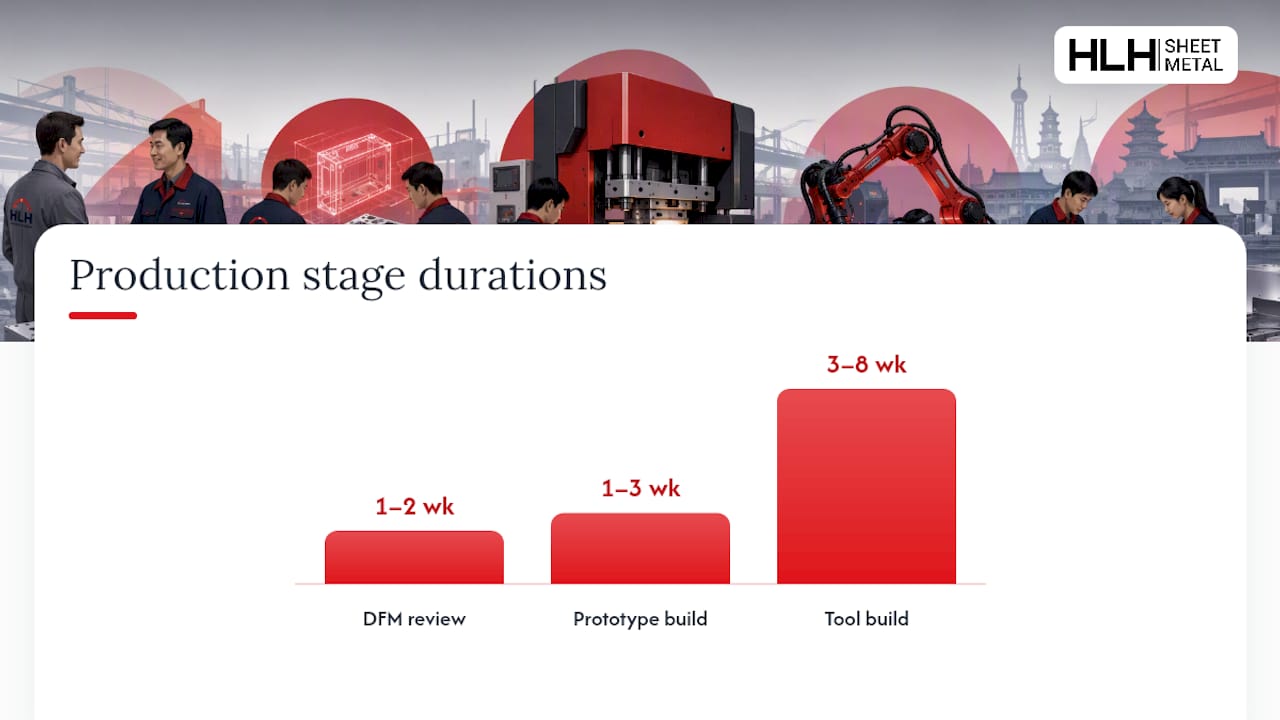
- DFM review (1 to 2 weeks): the fabricator flags geometry that’s hard to stamp or bend and suggests changes before tooling starts.
- Prototype build (1 to 3 weeks): laser cut or soft-tooled samples for fit and function testing.
- Tool build (3 to 8 weeks depending on die complexity): the production die or fixture gets machined and tested.
- Validation and pilot run: a small batch runs through the new tooling to confirm dimensional stability before full commitment.
- Ramp to volume: production scales up, and per-part cost drops as tooling investment gets spread across more units.
Minimum order quantities usually loosen once tooling is amortized. A shop that required 5,000 units at prototype pricing may accept smaller repeat orders once the die exists and its cost is already recovered.
Logistics planning matters as much as production scheduling. Ocean freight is standard for volume shipments, air freight covers urgent prototype samples, and both need customs documentation and packaging built for international transit, not just a domestic pallet run. This is where a dedicated project manager and English-speaking support team earns its keep: coordinating time-zone gaps and catching a shipping document error before it costs you a week at the port.
A Note From HLH Sheet Metal
We run sheet metal forming operations across multiple plants in China to cover both ends of this process: fast prototyping when a design is still moving, and production capacity once it’s locked. That combination is why automotive engineers come to us instead of juggling separate vendors for sampling and volume. If you’re evaluating a part right now, send us the drawing and ask for a DFM review or a prototype quote before you commit to tooling.
— Nash
Get A Quote On Your Auto Sheet Metal Parts
You’ve seen what separates a capable China-based forming partner from a risky one: owned tooling, ISO 9001 and IATF-aligned quality systems, real inspection data, and a team that answers engineering questions in plain English. HLH Sheet Metal was built around exactly that combination. Multiple manufacturing plants cover stamping, laser cutting, robotic welding, and finishing under one quality system, so parts can move from prototype to production without switching vendors or re-verifying tolerances halfway through. For automotive components specifically, our automotive metal parts manufacturing page breaks down the processes and certifications we run on brackets, panels, and chassis parts. If you have a drawing ready, submit it there for a DFM review and a production quote, and you’ll get a response from an engineer, not a sales queue.
FAQ
Who Offers Specialized Sheet Metal Forming For Auto Parts?
Contract fabricators, stamping and tool-and-die shops, progressive die specialists, and precision laser/robotic fabrication houses each cover different part volumes and geometries, with China hosting many suppliers that combine several of these capabilities under one roof.
Why Choose China For Automotive Sheet Metal Forming?
China offers dense supply chains for raw sheet and finishing, in-house toolmaking that shortens lead times, and large-press capacity that supports both prototyping and high-volume production without switching vendors.
What Certifications Should A China-based Fabricator Have?
Look for ISO 9001 as a baseline quality management certification and IATF 16949 for suppliers handling automotive-specific components, backed by first-article inspection reports and material certificates.
How Long Does It Take To Go From Prototype To Production?
The full path from DFM review through tool build and pilot run typically spans several weeks to a few months, depending on part complexity and die requirements, before volume production ramps up.
Is HLH Sheet Metal A Good Fit For Automotive Sheet Metal Parts?
The company operates multiple ISO-certified plants in China with rapid prototyping and project support, making it a viable option for automotive teams that need both sampling speed and production-scale tooling.

