




Stainless Steel Sheet Metal Fabrication: Which Providers Fit
The providers that specialize in stainless steel sheet metal fabrication fall into three groups: regional U.S. job shops that serve food, medical and architectural work, certified precision shops that serve regulated industries, and overseas manufacturers that win on capacity and lead time. No single name is “best”. The right one depends on your grade, volume, documentation and how fast you need parts. This guide shows how to sort them, what to verify before you send a drawing, and where HLH Sheet Metal fits.
TL;DR
- Stainless is a different job from mild steel. Ask every shop how it prevents cross-contamination with carbon steel and how it controls heat tint on welds.
- Certifications narrow the field fast. Only about 12% of fabrication shops hold ISO 9001 and as few as 3% hold AS9100, so if your parts go into medical or aerospace assemblies, check the certificate first.
- Name the welding code in your purchase order. AWS D1.6 covers stainless structural weldments, and D18.1 covers sanitary tubing systems.
- U.S. job shops suit short-run, local, hands-on work. An ISO-certified China-based manufacturer such as HLH suits prototype-to-production programs where unit cost and capacity matter.
Three Kinds Of Stainless Fabricators
Search results for this topic look similar, but the companies behind them differ in ways that matter to a buyer.
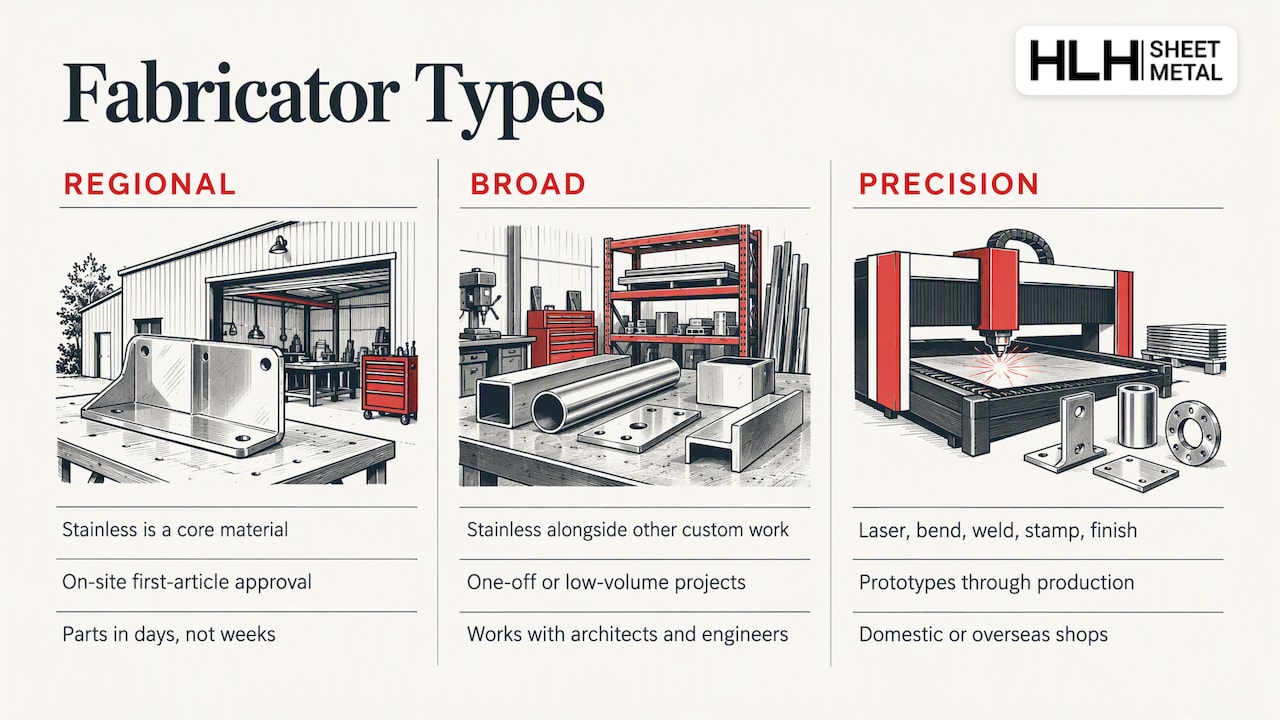
Regional specialists. Shops such as Stainless Metal Works in Wisconsin, which says it has served food, medical and pharmaceutical customers since 1989, or Boardman in Oklahoma City, which pitches sanitary and equipment fabrication, build their reputation on stainless as a core material. Others, such as Stainless Steel Fabricators (ssfab.net), combine sheet metal and structural work with laser cutting. These shops are strong when you want to visit, approve a first article in person and get a part in days rather than weeks.
Broad metal fabricators with a stainless department. Aero Manufacturing and Pacific Stainless Products present stainless alongside other custom work and quality programs. They often work with architects, engineers and consultants on one-off or low-volume projects.
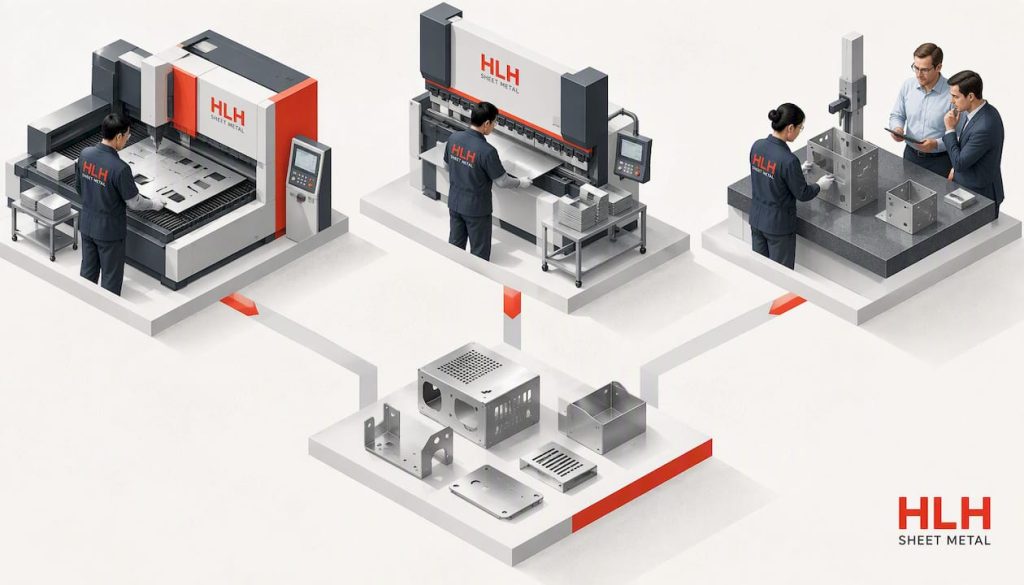
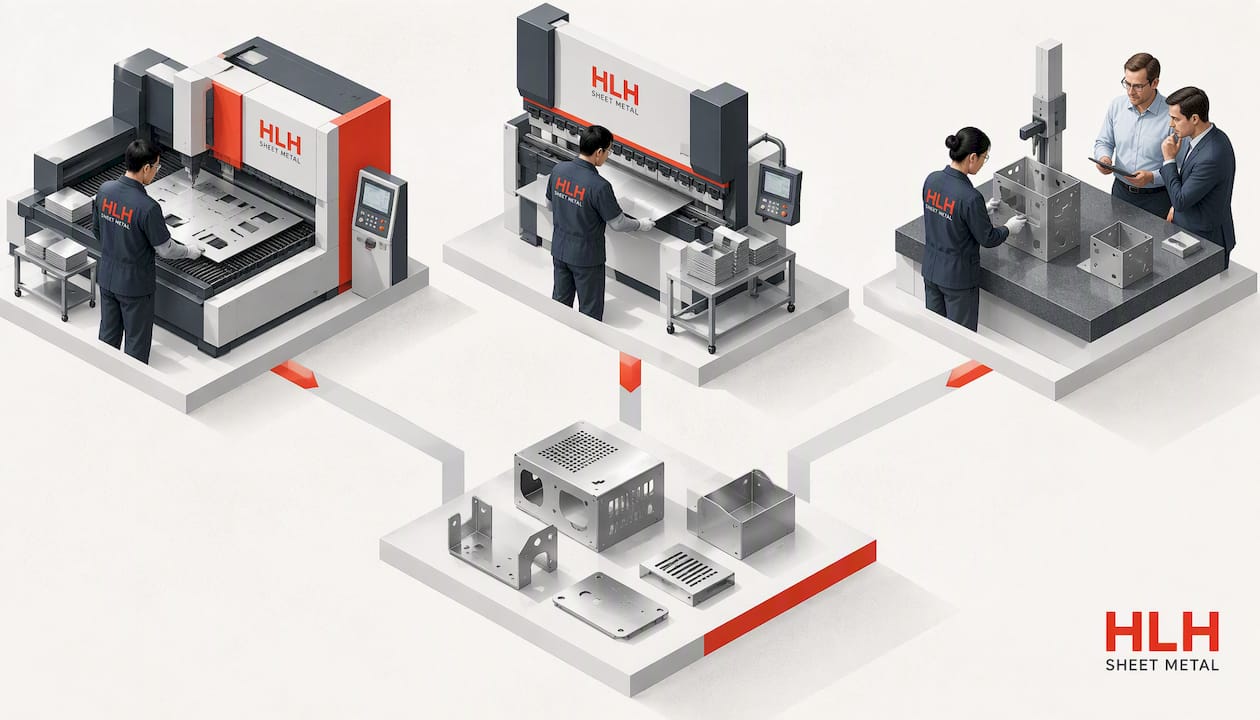
Precision contract manufacturers. These shops run laser cutting, bending, welding, stamping and finishing under one roof and quote prototypes through production. They can be domestic or overseas. HLH Sheet Metal belongs here, with multiple plants in China and English-speaking project support for international buyers.
We name these businesses only to show the landscape. Check each one’s current capabilities and certificates directly, since they change.
What Makes Stainless Different On The Shop Floor
Stainless looks like a simple material swap. It is not. Three things separate a stainless specialist from a general shop.
Contamination Control
Iron particles from carbon steel grinding or tooling can embed in a stainless surface and later rust. The AWS stainless structural welding code, AWS D1.6, is the document that defines welding requirements where at least one material is stainless. Experienced buyers ask whether a shop keeps dedicated stainless tooling and brushes, or follows strict cleaning protocols when equipment is shared. For medical, food and aerospace parts, this question matters more than the machine list.
Heat And Distortion
Stainless conducts heat poorly and expands more than carbon steel, so thin sheet warps if welding is sloppy. Good shops control heat input, fixture parts and plan the weld sequence. Ask to see welded sample parts, not only flat laser-cut ones.
Finish
A brushed, polished, passivated or bead-blasted surface is part of the spec, not an afterthought. If the finish must survive washdown or sterilization, say so in the RFQ and ask who performs it, in-house or subcontracted.
Comparison: How The Options Stack Up
Use this table as a starting point. It describes categories, not guarantees about any single company.
| Criterion | Regional U.S. stainless specialist | Broad U.S. fabricator | China-based precision manufacturer (e.g. HLH) |
|---|---|---|---|
| Best for | Sanitary equipment, architectural pieces, local repeat work | Custom one-offs, mixed-material projects | Prototypes through volume production, enclosures, chassis |
| Communication | Phone, site visits | Phone, site visits | Email and project support across time zones |
| Volume fit | Low to medium | Low to medium | Small prototypes to large runs |
| Material range | Often stainless and aluminum | Varies | Stainless plus steel, aluminum, copper, brass, titanium, magnesium and more |
| Certification | Verify case by case | Verify case by case | ISO-certified quality system at HLH |
| Logistics | Domestic freight | Domestic freight | International shipping, longer transit |
The honest trade-off: domestic shops win on proximity and transit time. Overseas manufacturers win when a program has enough volume or enough parts that capacity and unit economics dominate the decision, and when your engineers can work from drawings and files.
How To Qualify Any Stainless Fabricator
- Ask for the certificate, not the claim. ISO 9001 is the baseline quality system. Medical device work usually points toward ISO 13485, and aerospace toward AS9100. Confirm the scope on the certificate covers the processes you need. If you want to understand what these standards actually mean for a supplier relationship, ISO certification and your business is a helpful primer on the logic behind quality-management systems.
- Cite the weld standard. Write AWS D1.6 into the purchase order for stainless structural weldments. For austenitic piping and tubing, AWS D10.4 is the guide, and for dairy and food processing tubing, AWS D18.1 sets requirements for qualification, fabrication and visual examination.
- Specify the grade and the mill cert. 304 and 316 behave differently in chlorides and in cleaning chemistry. Ask for material test reports so you can trace each lot.
- Request a first article inspection. Agree on critical dimensions, flatness, weld appearance and finish before the production run.
- Test responsiveness. Send a real drawing and see how long a thoughtful reply takes and whether the questions are good ones. A shop that asks about tolerances and finish is one that has done this before.
- Confirm what is subcontracted. Plating, passivation, powder coating and heat treatment are often outsourced. Know who is accountable.
What Stainless Fabrication Costs
Be wary of any page that gives a single price per pound or per part. Cost depends on grade, thickness, part complexity, weld length, finish, tolerance and quantity. Prices for raw sheet also move with the market. What you can do is control the drivers: design for fewer bends and shorter welds, specify standard sheet sizes, loosen tolerances that do not affect function, and quote several quantities (for example 10, 100 and 1,000) to see where the price breaks fall. HLH does not publish prices; each project is quoted from your drawings.
Perspective: What We See On Stainless Projects
We build custom sheet metal parts for aerospace, medical, automotive and data center customers, and stainless is among the materials we are asked about most. Here is our view.
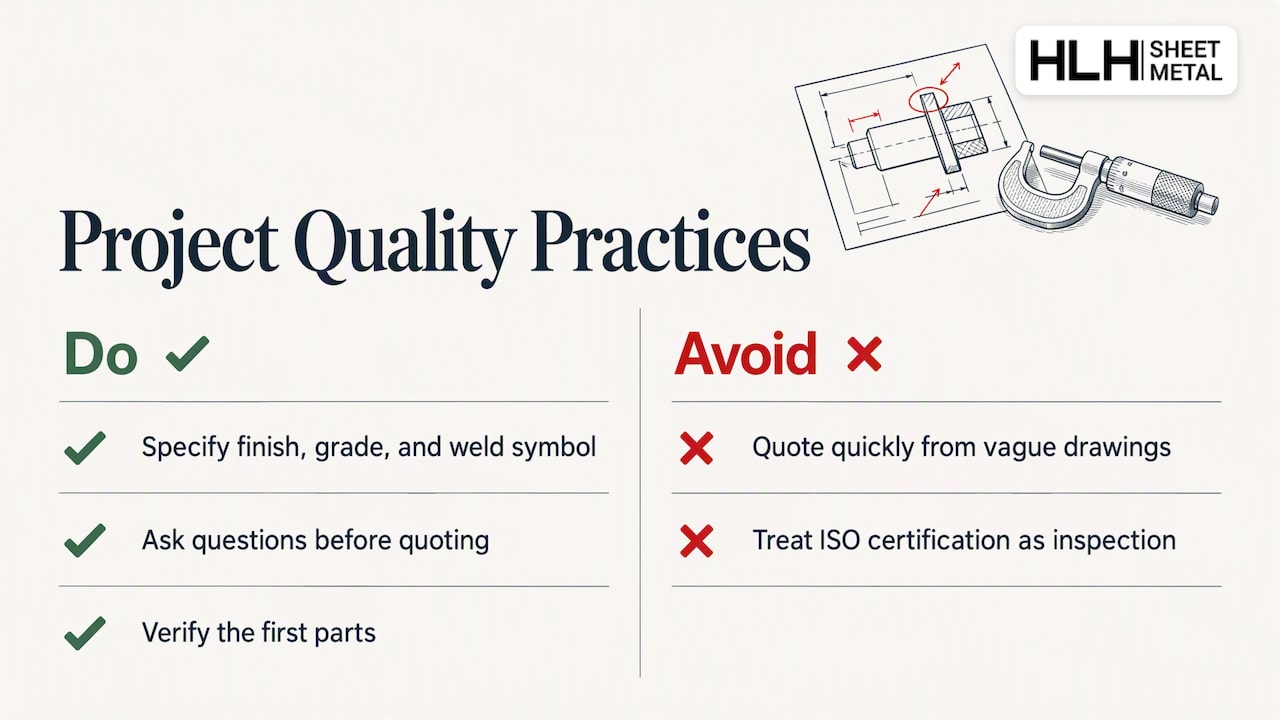
Most quoting problems are not about the metal. They come from incomplete drawings: no finish callout, no grade, an ambiguous weld symbol. A fabricator who quotes quickly from a vague drawing is often guessing. We would rather ask three questions up front than rework a batch later.
Second, we think prototypes and production should happen with the same supplier whenever possible. Process settings, fixtures and inspection notes carry over, so the production part matches the one you approved. Our multiple plants in China let us handle both a handful of prototype parts and large runs, and our English-speaking support team answers international inquiries around the clock.
Third, we do not think a certificate replaces inspection. ISO certification gives you a documented quality system. You still verify the first parts. A good supplier welcomes that.
— Nash
Where HLH Sheet Metal Fits
HLH is a good fit if you are an OEM, product designer or procurement team that needs precision stainless parts, enclosures or chassis, with prototype speed and the capacity to scale. Our stainless steel sheet metal fabrication page covers the material in detail. The processes behind it are available individually: laser cutting, bending, welding, stamping and surface finishing.
We also work in other metals, including carbon steel, galvanized steel, aluminum, copper, brass, titanium, nickel and magnesium. That helps when an assembly mixes materials, for instance a stainless front panel on an aluminum chassis. If you are ready to price a part, send drawings through our capabilities page and our team will respond with questions and a quote.
When Another Option Is The Better Call
Being straight about fit saves everyone time. A regional specialist may suit you better if you need a single custom piece within a week, want to inspect work on site, or need a local welder certified for a specific site code. For a hygienic process line installed at a U.S. dairy plant, a nearby shop familiar with D18.1 field work may be the practical choice. For recurring production, multi-part assemblies and enclosure programs where lead time and unit cost both count, a certified manufacturer with several plants is worth quoting alongside it.
Whichever way you lean, request quotes from at least three suppliers on the same drawing package and compare the questions they ask, not only the totals.
FAQ
Which Providers Specialize In Stainless Steel Sheet Metal Fabrication?
Both U.S. regional shops and international manufacturers do. Regional examples include Stainless Metal Works, Boardman and Stainless Steel Fabricators. HLH Sheet Metal offers stainless fabrication from its plants in China. Compare them on certification, grades, finishing and lead time rather than on marketing claims.
How Much Does Stainless Steel Fabrication Cost?
There is no standard figure, because grade, thickness, welding, finish and quantity all change the price. Request quotes at several quantities from the same drawing package to see the real breaks. HLH quotes each project individually and does not publish prices.
What Certifications Should A Stainless Fabricator Have?
ISO 9001 is the common baseline, yet only about 12% of shops hold it. Medical and aerospace work often calls for ISO 13485 or AS9100. For welding, cite the relevant AWS code, such as D1.6 for structural stainless.
What Is A Stainless Steel Fabricator?
It is a manufacturer that cuts, forms, welds and finishes stainless steel into parts, enclosures, equipment or structures. The best ones control contamination and heat during welding, because both affect corrosion resistance.
Sources
- Stainless Steel Fabrication: 1,935 Shops Compared | Kerfgrid
- AWS D1.6 Structural Welding Code, Stainless Steel
- AWS D10.4 Guide for Welding Austenitic Stainless Steel Piping and Tubing
- AWS D18.1 Specification for Welding of Austenitic Stainless Steel Tube and Pipe Systems in Sanitary Applications

