




Table Of Contents
For most outdoor and coastal installations, specify 316 stainless steel or coated aluminum, pair it with insulated fasteners, and require a salt-spray test report before approving any production run. Where dissimilar metals are unavoidable, demand MIL-STD-889D compatibility data proving the pairing falls below the recognized corrosion-rate threshold. Add these three requirements to every RFQ and PO: material grade certification, fastener/insulation specification, and third-party test reports.
TL;DR:
- Use materials like 316 stainless steel or anodized aluminum for coastal sites, and ensure third-party salt spray test reports before approving production.
- Pair dissimilar metals only within 0.2 volts of each other on the galvanic series, and avoid aluminum contact with carbon black-loaded gaskets to prevent accelerated corrosion.
- Incorporate insulation, drainage, area ratio control, and sacrificial anodes in the design phase to minimize galvanic corrosion risks.
- Demand detailed test results, including hours to first corrosion and coating thickness, from independent labs rather than relying on supplier claims.
- Specify fastener materials (like 316 or 304 stainless steel) and insulative hardware to prevent field failures and ensure longevity in outdoor enclosures.
What Causes Galvanic Corrosion In Outdoor Electrical Enclosures?
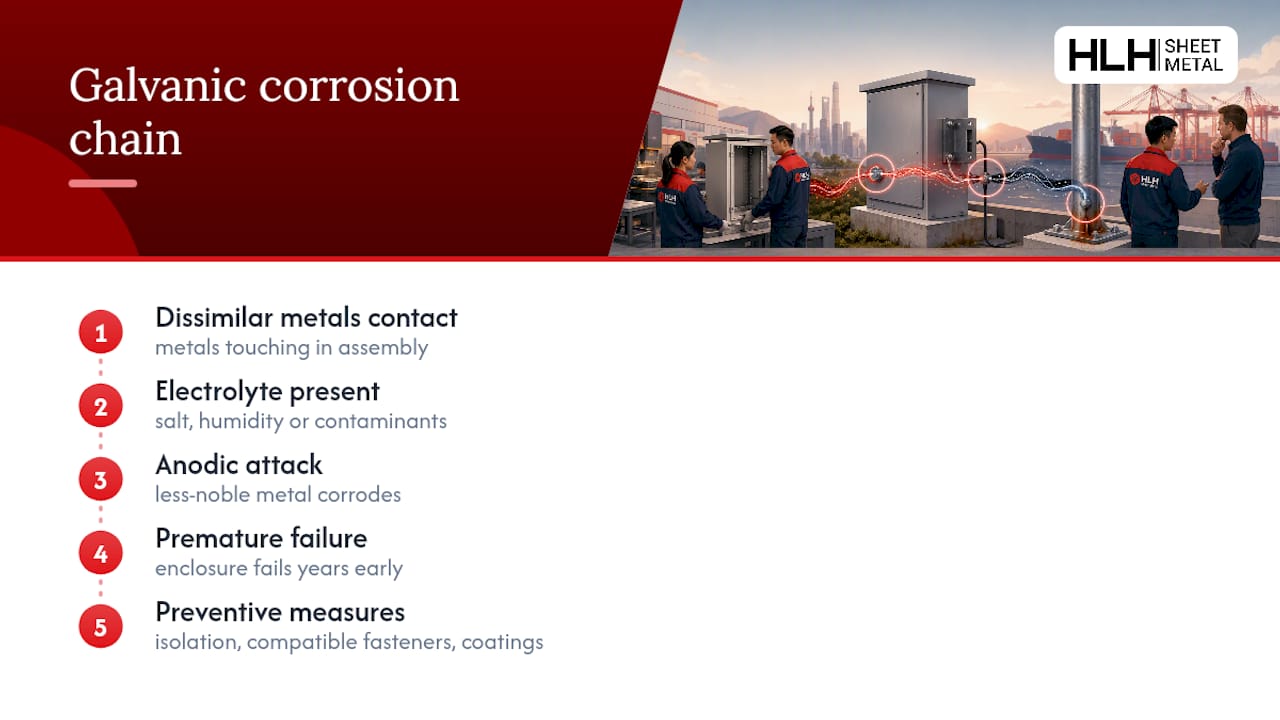
Galvanic corrosion isn’t a material flaw. It’s a chemistry problem that shows up the moment procurement mixes metals without a plan, and it’s the single biggest reason outdoor enclosures fail years ahead of schedule in coastal, humid, or industrial sites. Picking the right base material determines whether that failure ever gets a chance to start.
304 Vs. 316 Stainless: When The Upgrade Earns Its Cost
304 stainless resists rust well in dry, temperate climates and costs meaningfully less than 316. It struggles near coastlines, road salt, or industrial chlorides, where pitting starts within a few seasons. 316 stainless adds molybdenum, which raises resistance to chloride attack substantially, and it’s the standard choice for coastal substations, marine terminals, and any enclosure within a few miles of salt spray. The price premium over 304 typically runs a noticeable percentage depending on the mill and gauge, but replacing a corroded enclosure costs far more than that spread.
Aluminum Alloys: Light, Capable, And Easy To Compromise
Aluminum enclosures (commonly 5052 or 6061 alloy) offer excellent strength-to-weight ratios and natural corrosion resistance through their oxide layer. That oxide layer is also the weak point: scratch it, bolt a steel bracket directly to it, or let it sit wet against a more noble metal, and the aluminum becomes the sacrificial anode in the pairing. Anodizing thickens and hardens that protective layer and holds up well in most outdoor exposures. Powder-coated aluminum trades some of that inherent resistance for cosmetic finish flexibility, but any break in the coating, a scratch during shipping, a drilled mounting hole, exposes bare aluminum to whatever metal touches it.
Galvanized And Galvannealed Steel: Cost-effective If The Zinc Layer Holds
Hot-dip galvanized steel gets a thick, durable zinc coating that sacrifices itself to protect the base steel, making it a workhorse for outdoor cabinets, junction boxes, and pole-mounted equipment where budget matters; for practical examples of weatherproof pedestal design and protective finishes, see weatherproof EV charging pedestals. Galvannealed steel (galvanized then heat-treated) offers a smoother, more paintable surface at a slight reduction in raw corrosion resistance. Both fail the same way: once the zinc layer wears through at a fastener hole, weld seam, or cut edge, the exposed steel corrodes fast, especially if it’s now in electrical contact with a more noble fastener.
Polycarbonate And Engineered Plastics: Sidestep The Problem Entirely
Nonmetallic enclosures eliminate galvanic risk by definition. No metal, no anodic pairing. Polycarbonate and fiberglass-reinforced plastics work well for lower-voltage junction boxes, sensor housings, and applications where UV stability and impact resistance matter more than structural load-bearing. They fall short on EMI shielding, high-heat dissipation, and mechanical strength for larger cabinet assemblies, and they typically need embedded metal hardware for mounting, which reintroduces the exact compatibility question you were trying to avoid.
Quick reference for material selection:
- Coastal or high-chloride sites: 316 stainless, or 5052 aluminum with intact anodizing.
- General outdoor, non-coastal: 304 stainless or galvanized steel, budget permitting.
- Weight-sensitive installs: anodized aluminum over powder-coated alternatives.
- Low-voltage, non-structural housings: polycarbonate or fiberglass to skip the metal question altogether.
- High industrial pollution or chemical exposure: 316 stainless with passivation verified by test report.
What Are The Three Conditions That Trigger Galvanic Corrosion?
Galvanic corrosion requires three things to happen simultaneously: two dissimilar metals, direct electrical contact between them, and an electrolyte, typically moisture, rain, condensation, or salt spray, bridging the gap. Remove any one condition and the reaction stops. That’s the entire mitigation playbook in one sentence, but the engineering detail is in how you remove one of those three reliably across a production run of hundreds of enclosures.
The “how different is too different” question has a real answer, not a guess. Atlas Tech Note No. 7 sets a practical trigger point around 200 millivolts of separation on the galvanic series. Pairings below that threshold rarely need special protection. Above it, especially outdoors where moisture is a given rather than a maybe, isolation or coating becomes mandatory, not optional. MIL-STD-889D goes further and defines a hard number: coupled conductive materials showing an anodic corrosion rate above 0.009 mil per year in immersed artificial seawater testing are classified as incompatible unless protected. That’s the figure to write into a supplier compatibility clause when you need something a factory can’t argue with.
Statistic Callout: A 200 mV gap on the galvanic series is the point where Atlas Steels flags real corrosion risk outdoors. MIL-STD-889D’s harder threshold, an anodic corrosion rate above 0.009 mil per year in seawater immersion testing, is the line the U.S. Department of Defense uses to call a metal pairing incompatible without added protection.
Here’s a simplified risk matrix procurement can apply against any bill of materials:
- Same metal or alloy family throughout: minimal risk, no special mitigation needed beyond standard coating maintenance.
- Metals within roughly 0.15 to 0.2 V on the galvanic series, dry or sheltered environment: low risk, monitor but no barrier typically required.
- Metals within 0.15 to 0.2 V, exposed to rain, humidity, or condensation: moderate risk, insulating barriers or compatible coatings recommended.
- Metals more than 0.2 V apart, any outdoor exposure: high risk, mandatory isolation, area-ratio control, or elimination of the pairing.
- Metals more than 0.2 V apart, coastal or salt-spray exposure: severe risk, avoid the pairing entirely or specify sacrificial protection with a documented maintenance schedule.
The area-ratio piece of this matters more than most spec sheets acknowledge. A small anodic component, a fastener, a bracket, paired against a large cathodic surface concentrates the entire corrosion current onto that small part. That’s why a handful of the wrong screws can fail an otherwise well-built stainless enclosure years before the panel itself shows any wear.
How Do You Design Enclosures To Prevent Galvanic Attack?
Good galvanic design happens on the drawing before it happens on the factory floor. Four categories of control cover nearly every failure mode inspectors actually see in the field.
- Isolate dissimilar metals physically. Insulating gaskets, nylon or PTFE sleeves around fasteners, and nonconductive spacers between mating surfaces break the electrical contact that galvanic corrosion needs to function. TWI’s guidance treats insulation as the first-line defense, ahead of coatings or sacrificial anodes, because it addresses the contact condition directly rather than slowing the reaction after contact exists.
- Design drainage into every seam and crevice. Water that pools inside a joint or behind a gasket becomes a standing electrolyte bath. Sloped surfaces, weep holes positioned below any potential water trap, and drip edges keep the third condition, the electrolyte, from lingering long enough to matter.
- Control the anode-to-cathode area ratio deliberately. Keep anodic components (typically the less noble metal) proportionally large relative to any cathodic surface they contact. Never let a small anodic fastener carry the corrosion load for a large cathodic panel.
- Add sacrificial elements where mixed metals are unavoidable. Zinc or magnesium sacrificial anodes, or simply choosing a slightly less noble fastener on purpose, redirect the corrosion current away from the structural or functional parts of the enclosure.
Pro Tip: Specify drainage details and fastener isolation on the actual fabrication drawing, not in a separate spec document. Chinese fabricators build to the drawing they’re given; a callout buried in a ten-page PDF spec often never reaches the shop floor.
Anti-corrosion pastes and dielectric grease at fastener interfaces add a low-cost second layer of protection, particularly at threaded connections where insulating sleeves alone can’t fully seal out moisture. They’re cheap, they’re fast to apply during assembly, and they catch the gaps that design controls miss when a factory substitutes a slightly different gasket material than what was drawn.
Which Coatings And Finishes Actually Stop Corrosion?
Not every coating protects the way procurement assumes it does, and the assumption that any coating works equally well is where a lot of outdoor enclosure programs go wrong. Powder coating gives excellent cosmetic control and reasonable moisture resistance on steel and aluminum but relies entirely on an unbroken film; any scratch reintroduces the underlying metal to whatever electrolyte and dissimilar metal it touches. Hot-dip galvanizing sacrifices zinc to protect steel and tolerates minor damage better than powder coat because the zinc corrodes preferentially. Galvannealing trades some of that raw sacrificial capacity for better paint adhesion and a smoother finish. Anodizing on aluminum thickens the natural oxide layer and holds up well against UV and moderate moisture but offers limited protection once the surface is deeply gouged. Passivation on stainless steel removes free iron from the surface after machining or welding, restoring the chromium oxide layer that gives stainless its corrosion resistance in the first place; skip this step and a stainless enclosure corrodes at weld seams almost as fast as mild steel.
The detail most specs miss: coating the cathode matters as much as coating the anode, sometimes more. TWI’s prevention guidance specifically flags that coating both surfaces, with particular attention to the cathode, reduces galvanic current more effectively than coating the anode alone. An uncoated cathodic surface next to a coated anodic one still drives corrosion at every pinhole or edge where the anode’s coating breaks down. A damaged coating on a small anodic component, meanwhile, concentrates the entire galvanic current onto that one weak point, which is exactly the area-ratio problem showing up again at the finish level rather than the material level.
Test evidence separates a real coating claim from a marketing line. Ask suppliers for:
- ASTM B117 salt spray test results, stating hours to first visible corrosion, not just a pass/fail label.
- Coating thickness measurements across multiple points on the part, not a single spot check.
- Adhesion test data (cross-cut or pull-off method) confirming the coating won’t flake at bend lines or edges.
- Porosity or pinhole inspection results, especially for galvanized and anodized finishes where hidden gaps are common.
Digi-Key’s overview of enclosure material tradeoffs makes the same point from a different angle: coating performance data, not the coating name on a spec sheet, is what actually predicts field life. A supplier who can’t produce dwell times and failure-mode descriptions from their own test lab is guessing, same as you would be.
Statistic Callout: Salt spray testing under ASTM B117 reports results in hours to first visible corrosion, a figure worth demanding by name in every coating spec, since “passed salt spray testing” without a duration is close to meaningless.
What Fasteners Are Safe With Different Enclosure Materials?
Fasteners cause more field failures than base material choice, mostly because they’re an afterthought on the BOM while the panel material gets all the engineering attention. Get the screws wrong and the best stainless enclosure in the world corrodes at every mounting point within a year.
- Stainless steel panels: use 316 stainless fasteners to match, or 304 in dry non-coastal applications; never pair with plain zinc-plated steel screws, which corrode rapidly against the more noble stainless and stain the panel around every hole.
- Aluminum panels: stainless fasteners work but need polymer sleeves or insulating washers to prevent direct contact; zinc-plated fasteners are acceptable only with insulation, since bare zinc against aluminum in wet conditions reverses roles and eats the fastener.
- Galvanized steel panels: zinc-plated or hot-dip galvanized fasteners maintain compatibility; stainless fasteners here work but sacrifice the galvanizing’s protective intent locally.
- Mixed-metal assemblies: specify insulated fastener kits (nylon washers, sleeves, and shoulders) as a standard line item, not an exception.
- Sacrificial washer applications: where a mildly anodic fastener is unavoidable against a large cathodic panel, oversized sacrificial washers absorb the corrosion current before it reaches the structural fastener.
One material combination deserves its own warning. Atlas Steels’ technical note specifically flags graphite-containing gasket materials next to stainless steel in wet or seawater-adjacent environments, since carbon black filler in some rubber compounds behaves like graphite and accelerates galvanic attack against the stainless. Ask suppliers what filler their gasket rubber actually uses. Silicone or EPDM gaskets without carbon black loading avoid the issue entirely and cost little more.
What Should Go In An RFQ For A Chinese Enclosure Manufacturer?
China’s outdoor enclosure supply chain is deep, competitive, and genuinely capable, running facilities with the same galvanizing lines, powder-coat booths, and passivation tanks used by top Western fabricators. The risk isn’t capability. It’s specification ambiguity: a vague RFQ gets you the factory’s cheapest compliant interpretation, which is rarely the interpretation your engineering team had in mind.
Sample language to drop directly into an RFQ:
- Material grade: “Panel material shall be 316 stainless steel per ASTM A240, mill certification required with each shipment.”
- Fastener specification: “All fasteners shall be 316 stainless or insulated per attached drawing; substitutions require written approval before production.”
- Finish and coating: “Powder coat thickness minimum [X] mils, ASTM B117 salt spray rated to [X] hours to first corrosion, test report required per lot.”
- Test evidence: “Supplier shall provide passivation verification, coating thickness reports, and adhesion test results for the first production run and any subsequent process change.”
- Compatibility documentation: “Where dissimilar metals are used in the assembly, supplier shall provide galvanic compatibility data referencing MIL-STD-889D or equivalent.”
A factory capability checklist before awarding the contract should confirm passivation tank capacity for stainless parts, an in-house or closely partnered powder-coat booth, an active hot-dip galvanizing line if that’s the specified finish, current ISO 9001 certification at minimum, and demonstrated DFM (design for manufacturability) support that catches problems before tooling, not after the first bad batch ships.
Inspection and acceptance should happen in stages rather than as a single final check:
- First-sample teardown: physically inspect fastener grade, coating thickness, and gasket material against the PO before approving mass production.
- Third-party lab testing: independent salt spray and adhesion testing on a statistically meaningful sample, not just the supplier’s internal report.
- Staged production acceptance: hold a percentage of payment until the first full production lot passes the same tests applied to the sample.
- Ongoing lot sampling: especially on long-running contracts, periodic re-testing catches process drift before it reaches hundreds of units.
Reviewing a fabricator’s approach to custom enclosure production in China before writing the RFQ helps calibrate what capability and lead time to actually expect from a serious shop.
Which Standards And Test Reports Actually Prove Compliance?
Four references do most of the heavy lifting when procurement needs to defend a material or coating decision internally, or push back on a supplier’s claim. MIL-STD-889D supplies the hard numeric threshold, 0.009 mil per year anodic corrosion rate in seawater immersion, for calling a metal pairing incompatible. The IEEE materials and corrosion report covers cathodic protection schemes and supports requiring lab-based compatibility data rather than accepting a supplier’s word. ASTM B117 governs salt spray testing methodology, and TWI’s prevention framework ties it all together into practical design rules.
A valid test report names the specific standard, states numeric results (hours, mils, corrosion rate), and describes the failure mode observed, not just a pass or fail checkbox. Red flags include reports missing dates or lot numbers, thickness values reported as a single average with no range, and any test claim without an accredited lab name attached.
- Compatibility data present and below threshold: approve the pairing as specified.
- Compatibility data missing: request lab testing before approving production, don’t assume compliance.
- Salt spray results below spec hours: require a coating or fastener change, not just a documentation update.
- Supplier substitutes fastener grade without notice: treat as a contract breach, hold payment pending correction.
HLH SHEET Metal’s Approach To Galvanic-safe Enclosure Manufacturing
HLH SHEET METAL runs multiple manufacturing plants across China, each certified to ISO quality standards, with in-house capability across stainless steel, aluminum, galvanized steel, and specialty alloys. That range matters specifically for galvanic risk management: a fabricator that only runs one material family can’t offer the isolation or coating alternatives this article walks through.
Every quote HLH prepares for outdoor electrical enclosure projects includes design-for-manufacturability review flagging dissimilar-metal contact points before tooling starts, not after a failed field unit comes back. Fastener specification gets locked at the quoting stage, with insulated hardware options recommended wherever a mixed-metal assembly can’t be avoided.
What a procurement team typically receives with a quote request:
- A physical sample or prototype reflecting the exact material and finish specified.
- Coating and passivation test documentation matched to the application’s exposure level.
- Recommended mitigation notes where the drawing shows a galvanic risk the designer may not have flagged.
- English-fluent technical support for clarifying spec questions in real time, without the multi-day email delay common with factory-only contacts.
That combination, certified process control plus a support team that actually answers technical questions in English, is what closes the gap between a spec written correctly and an enclosure built correctly.
What Procurement Teams Get Wrong About Sourcing This Category
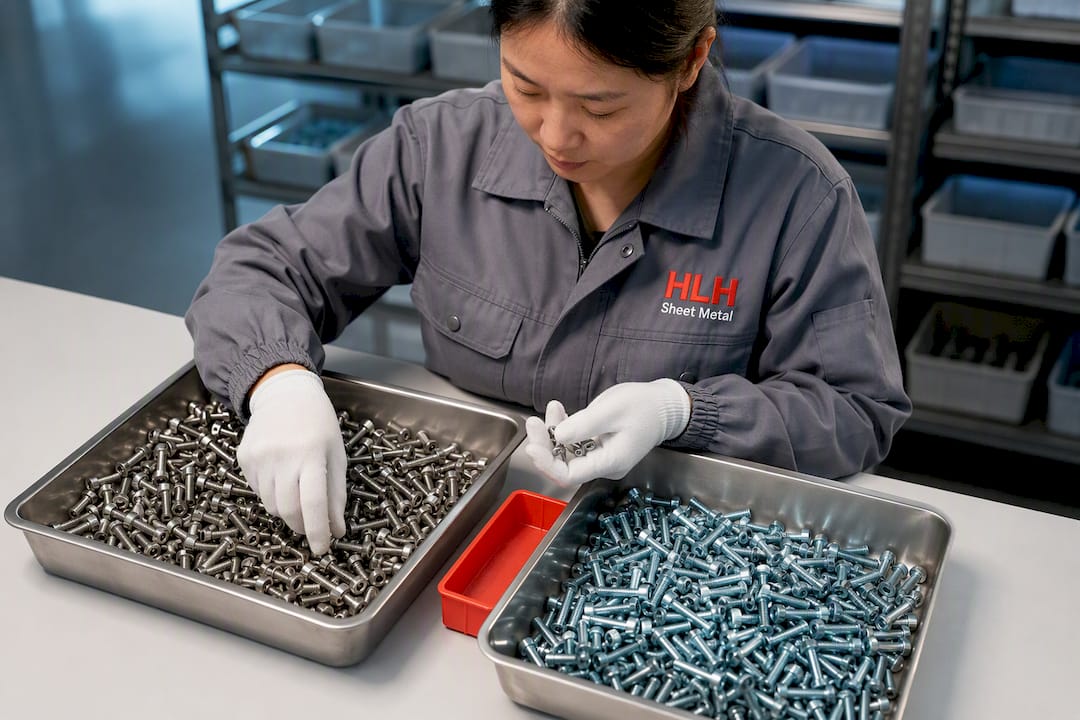
The biggest mistake I see repeated across sourcing projects isn’t material selection. It’s treating a factory’s “we can do stainless” answer as equivalent to “we understand galvanic compatibility.” Those are different claims. A shop can cut and weld 316 stainless beautifully and still hand you zinc-plated screws because that’s what’s in the parts bin.
The second mistake is paying full price before independent testing. Stage payments against test results, not against a sample that looks right on a conference table. A salt spray report from an accredited lab, not the factory’s own claim, should trigger the next payment milestone.
The third: assuming a marketing line about “corrosion-resistant finish” means anything without a duration attached. Ask for hours to first corrosion, every time.
If there’s one line to write on a sticky note above the procurement desk, it’s this: objective test data approves the part, not the supplier’s confidence in it.
— Nash
Get A Weatherproof Enclosure Quote Built Around These Standards
HLH SHEET METAL is the direct route to a galvanic-aware enclosure supplier instead of relying on a factory’s stock finish sheet and hoping it holds up outdoors. As an ISO-certified manufacturer running multiple plants across China, HLH pairs DFM review with real test documentation, so the mitigation strategies covered above, insulated fasteners, cathode-focused coating, verified passivation, get built into the quote from the start rather than negotiated after a bad batch. Request a quote through the weatherproof electrical enclosure page and you’ll get a sample, a coating and salt-spray test report package, and a realistic lead time before committing to production. For broader fabrication needs beyond enclosures, HLH’s full capability list shows the machinery and material range backing every quote.
FAQ
What Material Is Best For Galvanic Corrosion Enclosures Sourced From China?
316 stainless steel handles coastal and high-chloride environments best; 304 stainless or galvanized steel works for general outdoor, non-coastal installations at lower cost.
What Voltage Difference Triggers Galvanic Corrosion Concern?
A difference around 200 millivolts on the galvanic series is the practical trigger point noted by Atlas Tech Note No. 7, with MIL-STD-889D’s 0.009 mil/year corrosion-rate threshold providing a stricter numeric test.
Are Zinc-plated Fasteners Safe With Aluminum Enclosures?
Zinc-plated fasteners against aluminum are risky without insulation, since bare zinc can corrode preferentially in wet conditions; insulated or polymer-sleeved stainless fasteners are the safer default.
What Test Report Should I Demand From A Chinese Enclosure Supplier?
Require ASTM B117 salt spray results stating hours to first corrosion, plus coating thickness and adhesion test data, not a simple pass or fail statement.
Can HLH SHEET METAL Supply Galvanic-compatible Outdoor Enclosures?
Yes. HLH SHEET METAL manufactures outdoor electrical enclosures across multiple ISO-certified China plants with DFM review and coating test documentation built into the quoting process.

