





Table Of Contents

An IP rated enclosure is a protective housing tested and certified under IEC 60529 to keep dust, tools, and water out of electrical or electronic gear, scored on a two-digit scale where the first digit (0-6) rates solids and the second (0-9) rates liquids. For a quick starting point: indoor cabinets facing dust and light splash usually call for IP54, outdoor or washdown gear needs IP65 or IP66, temporary submersion typically requires IP67, and continuous immersion requires IP68, with the manufacturer specifying the depth and duration, and food or vehicle washdown lines need IP69K.
TL;DR:
- IP ratings measure both dust resistance and water ingress, with the second digit specifying resistance to water jets or immersion, but testing conditions vary and are not interchangeable.
- Manufacturers often skip testing certain digits or specify non-standard conditions, so it’s essential to verify the actual IEC tests and avoid relying on “X” ratings that indicate untested threats.
- Passing one water test, such as IPX7, does not guarantee resistance to other threats like high-pressure jets tested under IPX6 or IP69K, which requires separate verification.
- A complete enclosure’s IP rating depends on factors like gasket installation, fastener torque, and cable-entry sealing, not just the sticker on the datasheet.
- When sourcing, request full test reports from accredited labs, confirm the finished product’s configuration, and match the enclosure rating to realistic environmental threats rather than the worst imaginable scenario.
What Are The Most Common IP Ratings For Enclosures?
Picking a rating starts with matching the environment to a tested threat, not guessing at a number that sounds strong enough. The table below covers the ratings that show up in real specifications, based on the practical mapping The Enclosure Company publishes for engineers sourcing IP rated boxes.
Two things trip up buyers here. First, a lowercase “x” replaces an untested digit, so IPX5 means solids protection was never evaluated. Second, IP68 and IP69K test entirely different threats. IP69K uses high-pressure spray near 80 bar at roughly 80°C, while IP68 is a static or slow-moving immersion test. An enclosure rated for one does not automatically pass the other.
How Do The Two IP Digits Actually Get Tested?
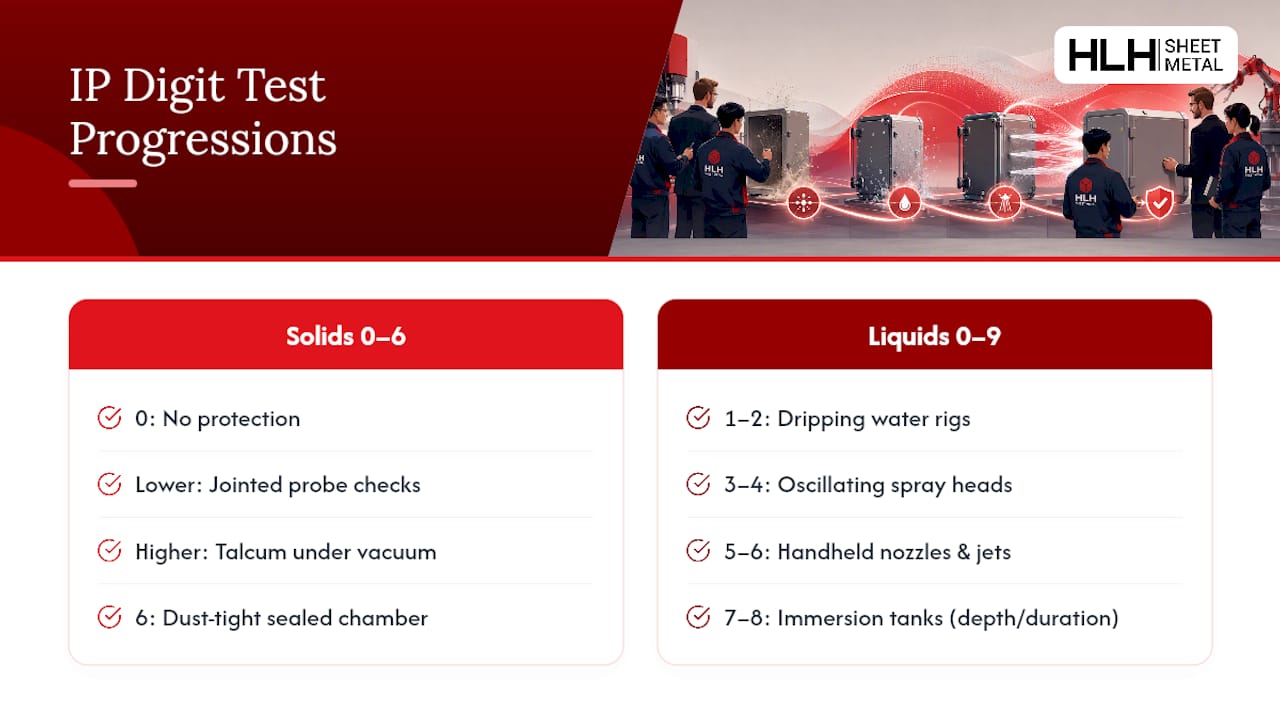
The first digit runs from 0 to 6 and measures resistance to solids, from no protection up to full dust-tightness verified in a sealed dust chamber. Lower numbers use jointed test probes to check finger and tool access to live or moving parts inside the enclosure; higher numbers use talcum powder circulated under vacuum to confirm dust cannot reach internal components.
The second digit, 0 through 9, measures liquid ingress using apparatus that gets more aggressive at each step: dripping water rigs for IPX1 and IPX2, oscillating spray heads for IPX3 and IPX4, handheld nozzles for IPX5 and IPX6 jet tests, and immersion tanks with depth and duration set by the manufacturer for IPX7 and IPX8. Test durations and nozzle pressures are fixed by IEC 60529, so two products both marked IPX6 were tested under identical stress.
Treat any “X” digit as an unknown, not a pass. A manufacturer that skips solids testing and only publishes IPX7 has told you nothing about dust resistance, no matter how good the water number looks.
Why Doesn’t Ipx7 Guarantee Ipx6 Jet Resistance?
This is where a lot of specifications quietly fail. IPX7 immersion and IPX6 jet testing stress a gasket in different directions, so passing one says nothing about the other; the IP code’s water-digit tests are not cumulative. If your application involves both a pressure washer and occasional submersion, you need both digits verified, not just the higher-sounding one.
Standard IP testing also uses fresh water only. Saltwater, cutting oils, and solvents are not part of the IEC 60529 protocol, so a marine or industrial-chemical environment needs separate fluid-compatibility testing or corrosion-resistant material specs layered on top.
Impact resistance is a separate question entirely; specifying industrial impact and industrial stair standards helps ensure safety in rugged environments. IEC 62262 defines the IK scale from IK00 to IK10 in joules of impact energy, and an IP rating implies nothing about it. Anything in a public or industrial space where knocks or vandalism are realistic needs an IK spec alongside the IP number. Finally, ratings apply to the assembled product. A gasket rated IP68 on its own does not make the finished enclosure IP68 once cable glands, fasteners, and breathing membranes are added.
Do You Need NEMA Ratings Too, Or Just IP?
North American buyers often see both markings on the same datasheet, and they are not interchangeable. Rough mapping exists (NEMA 1 corresponds loosely to IP20, NEMA 6P to IP68), but NEMA 250 covers conditions IEC 60529 never tests, including corrosion resistance, ice formation, and oil exposure.
If your equipment sits outdoors in a freeze-thaw climate or near cutting fluids, an IP rating alone leaves a gap NEMA fills. The practical move for an RFQ: specify the IP digits for ingress performance, then add the relevant NEMA type when corrosion, icing, or oil resistance actually matters for the install site. Asking for both markings on a single enclosure isn’t redundant. It’s covering two different test regimes.
How Do You Choose The Right IP Rating For An Enclosure?
Start with the hazards, not the marketing number. Walk the actual install environment and note every threat the enclosure will face over its service life.
- Dust and particulates: workshop floors, agricultural settings, and desert installs usually justify the jump to a dust-tight first digit (5 or 6).
- Spray and jets: wash-down areas or outdoor equipment exposed to rain and hoses call for IP65 or IP66.
- Immersion: buried, submerged, or flood-risk locations need IP67 or IP68 with a stated depth and duration.
- High-pressure, high-temperature washdown: food, beverage, and vehicle-wash environments need IP69K specifically.
- Salt, oil, or solvent exposure: request fluid-compatibility data or corrosion-resistant materials, since standard IP testing won’t cover it.
- Impact or vandalism risk: add an IK rating alongside the IP digits.
Once hazards are mapped, decide the test scope you’ll require in writing: which digits must be declared, what depth and time apply for IPX7/IPX8, what IK level is needed, and whether fluid-compatibility testing applies. Then request documentation: the full IEC 60529 test report, the lab’s accreditation, photos of the tested specimen, and material data for gaskets and seals. Design details like cable gland selection, fastener torque, and gasket compression all affect whether the finished part matches the paper rating.
Pro Tip: Don’t over-specify. An IP68 enclosure for a job that only ever sees rain and dust adds cost through heavier gaskets and tighter tolerances without buying you anything real. Match the rating to the worst realistic hazard, not the worst imaginable one.
How Do You Verify A Supplier’s IP Rating Claims?
A printed IP number on a datasheet is a claim, not proof. Request the underlying test report from an ISO/IEC 17025 accredited lab, and check that it lists the exact digits tested, the immersion depth and time if IPX7/IPX8 applies, and the specimen configuration, since a prototype tested without cable glands installed proves very little about your finished unit.
Keep that report, specimen photos, and material certificates for seals and gaskets in your technical file. Ask the supplier what maintenance or re-torque interval the rating assumes. Gasket compression loosens over time, and a seal that passed testing on day one can fail two years into service if fasteners were never checked. When a claim looks inflated relative to the enclosure’s construction, the only real fix is requiring a fresh test of the final assembled configuration, not the individual components.

HLH Sheet Metal’s Perspective On Building To A Rating
Meeting a printed IP number and building an enclosure that holds that rating in the field are different problems. Gasket selection, fastener torque, and cable-entry layout decide whether a design survives contact with real water and dust, which is why these details get worked out during design-for-manufacturing review rather than left for final inspection.
— Nash
Get An Ip-rated Enclosure Built Right The First Time
Specifying the right rating only matters if the finished part actually holds it, and that comes down to build quality most buyers never see on a datasheet: gasket seating, weld consistency, and cable-entry sealing done correctly the first time. HLH SHEET METAL runs ISO-certified quality processes across multiple manufacturing plants, handling everything from a single prototype to full production runs of weatherproof electrical enclosures without the slow back-and-forth that typically stalls custom enclosure orders.
That matters most for buyers moving between an outdoor NEMA/IP crossover spec and volume production, where a supplier needs to hold tolerance consistently across hundreds of units, not just one sample that passed a lab test. Teams work in English directly with engineering and procurement to translate hazard requirements into gasket, fastener, and cable-gland choices before tooling starts.
If you’re specifying an outdoor enclosure or need a washdown-rated cabinet built to your test scope, request a quote or DFM review with your target IP and IK digits, and get feedback on manufacturability before you commit to tooling.
FAQ
What Is An Ip-rated Enclosure?
It’s a housing tested under IEC 60529 and certified to a specific level of protection against solid objects and liquids, expressed as two digits, such as IP65 or IP68.
Is Ipx6 Or Ipx8 Better For My Application?
Neither is universally better since they test different threats. IPX6 confirms resistance to powerful water jets, while IPX8 confirms extended immersion beyond the standard IPX7 depth and time, so the right pick depends on whether your equipment faces spray, submersion, or both.
What’s The Difference Between A NEMA 1 Enclosure And An IP Rating?
NEMA 1 is a North American enclosure type covering basic indoor protection against dust and incidental contact, roughly comparable to IP20, but NEMA ratings also address corrosion, icing, and oil exposure that IP testing never evaluates.
What Does Ip66 Mean For An Enclosure?
IP66 means the enclosure is fully dust-tight and protected against powerful water jets from any direction, making it a common choice for outdoor or marine-adjacent equipment that never gets fully submerged.

