




Table Of Contents
Laser Cutting Aluminum
Fiber lasers are the right default for most aluminum sheet cutting, with femtosecond systems reserved for micro or heat-sensitive features, and CO2 limited to select thick-plate jobs. Aluminum’s reflectivity and thermal conductivity mean settings tuned for steel will not work here: power, speed, and gas selection all need adjustment by thickness and alloy. For tight tolerances or production volume, requesting a quote from an experienced fabrication partner is better than trial and error on a machine that was not built for reflective metals.
TL;DR:
- Aluminum requires higher laser power, often above 80 kilowatts, to outperform steel in perforation speed due to its high thermal conductivity.
- Using nitrogen assist gas generally produces cleaner cuts with less dross and oxide formation, especially on anodized or painted surfaces.
- Optimal laser parameters include about 1.0 millimeter nozzle standoff and focusing slightly below the surface to minimize kerf taper and surface roughness.
- Choosing the right alloy, such as 5052, 5083, or 6061, improves predictability and cut quality, while higher-strength alloys like 7075 need slower speeds and adjusted gas pressure.
- Reflectivity and heat buildup necessitate proper shielding, PPE, and possibly outsourcing for hobbyists or small shops, as machine hardware must handle aluminum’s reflective nature safely.
How Power, Spot Size, And Speed Scale With Thickness
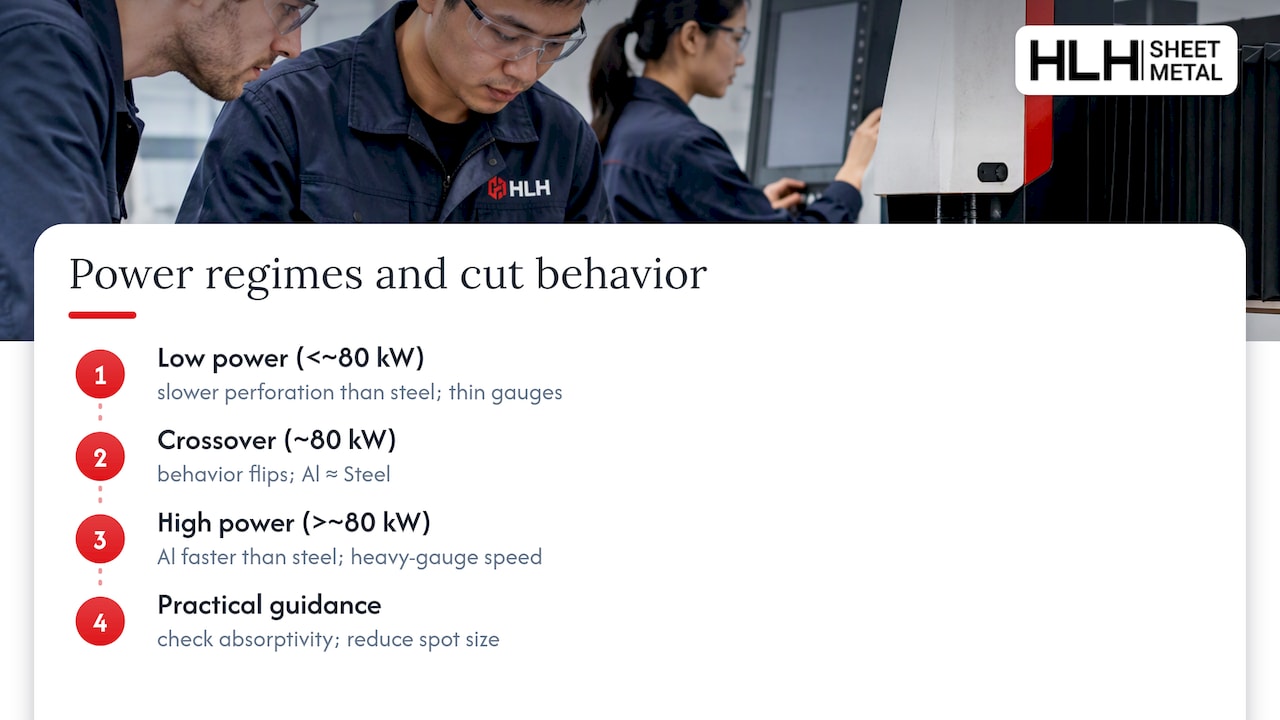
Aluminum’s high thermal conductivity carries heat away from the cut zone laterally, which is why it can perforate more slowly than steel at low laser power: energy escapes sideways before it builds up enough to penetrate. Experimental and simulation work spanning laser powers up to 120 kilowatts found that this relationship flips at higher power, with aluminum’s perforation time crossing over and eventually beating steel’s near roughly 80 kilowatts as the dominant physics shifts.
Roughly 80 kilowatts marks the point where aluminum’s perforation behavior overtakes steel’s in high-power experimental testing, reversing the pattern seen at lower power levels.
For practical sheet work, low-power fiber systems suit thin gauges under a few millimeters, mid-power systems handle mid-thickness plate, and high-power systems are reserved for heavy-gauge production runs where speed matters more than finesse. When a cut refuses to fully penetrate, the fix is rarely just “more power”: check effective absorptivity at your wavelength and confirm spot size is small enough to concentrate energy rather than spread it across a wider, cooler area.
Fixing Reflectivity, HAZ, Dross, And Kerf Taper
Most aluminum cutting complaints trace back to four recurring problems, and each has a specific fix rather than a blanket “increase power” response.
- Back-reflection damage: keep optics clean, use machines built with isolators or reflection protection, and avoid low-cost entry-level lasers that skip this hardware entirely.
- Excessive heat-affected zone or melting: raise cutting speed, dial back power, or switch to a pulsed or femtosecond process for parts that cannot tolerate thermal distortion.
- Dross on the underside: switch to nitrogen assist gas for oxide-free edges, then fine-tune nozzle standoff and focus position before adding a secondary cleaning step.
- Kerf taper and rough edges: adjust focus position (often slightly below the surface reduces taper), shrink nozzle diameter, and increase travel speed.
Pro Tip: When a cut looks inconsistent along its length, check nozzle standoff before touching power settings. It is the cheapest adjustment and often the fastest fix.
Post-processing options like deburring and mechanical or chemical cleaning, available through most surface finishing services, catch whatever dross or edge roughness parameter tuning does not fully eliminate.
Which Alloys And Finishes Cut Best
Alloy choice changes how forgiving a cutting job will be. Workhorse grades like 5052, 5083, and 6061 cut predictably across most laser types, while high-strength alloys like 7075 often need slower speeds or adjusted gas pressure to avoid cracking or excess dross at the cut edge.
- 5052 and 5083: reliable, widely available, and forgiving of moderate parameter variation.
- 6061: a common structural choice that cuts cleanly with standard fiber laser settings.
- 7075: stronger and more brittle, often requiring reduced speed or altered gas pressure for clean edges.
- Anodized or painted stock: needs pre-cleaning or adjusted parameters, since the anodic aluminum oxide layer has a much higher melting point than the base metal and can leave high-melting residue at the cut edge.
If the finished part will be welded, mechanically fastened, or needs specific tensile properties, flag that requirement to your fabricator before cutting starts rather than after parts arrive out of spec.
Nozzle Standoff, Focus Position, And Assist Gas Settings
Three adjustable settings account for most of the variation in cut quality on aluminum, and they interact with each other more than most operators expect.
- Nozzle standoff distance: an optimization study on Al6061-T6 identified roughly a 1.0 millimeter standoff as optimal for minimizing surface roughness, alongside a focus offset near negative 1.5 millimeters.
- Focus position: starting slightly below the surface generally reduces kerf taper compared to focusing exactly at the surface.
- Assist gas: nitrogen produces the cleanest, oxide-free finish, while oxygen cuts faster and removes material more aggressively at the cost of a wider heat-affected zone and more dross.
- Pulse frequency and multibeam scanning: raising pulse frequency or splitting output across multiple beams can reduce particle shielding from the cutting plume, which otherwise blocks incoming laser energy and slows the cut.
A nozzle standoff distance of roughly 1.0 millimeter was found to minimize surface roughness in Taguchi-based parameter testing on thick Al6061-T6 plate, making it one of the most sensitive variables an operator controls.
A broader review of cutting parameter research reaches a similar conclusion: small nozzle diameter, high cutting speed, moderate gas pressure, and nitrogen assist together minimize both heat-affected zone size and surface roughness across aluminum alloys.
Holding Tolerance On Precision Aluminum Parts
Thermal expansion during cutting is the quiet source of most dimensional complaints on aluminum parts, since heat buildup shifts material before it cools back into place. Research on toolpath compensation for fusion laser cutting of Al5754 found that predictive correction strategies reduced dimensional deviations that otherwise reached up to 1.2 millimeters down to within about 0.1 millimeter of target.
- Spread cut features and dense nesting layouts apart where possible to limit cumulative heat buildup across a part.
- Ask your supplier directly whether their CAM system applies toolpath compensation for thermal drift.
- Request a test cut and inspection report before committing to a full production run, especially on parts with tight stack-up tolerances.
Our guide to laser cutting tolerances covers minimum feature sizing and drawing conventions that make these compensation strategies easier to apply from the design stage.
Safety And Machine Protection For Hobbyists And Shops
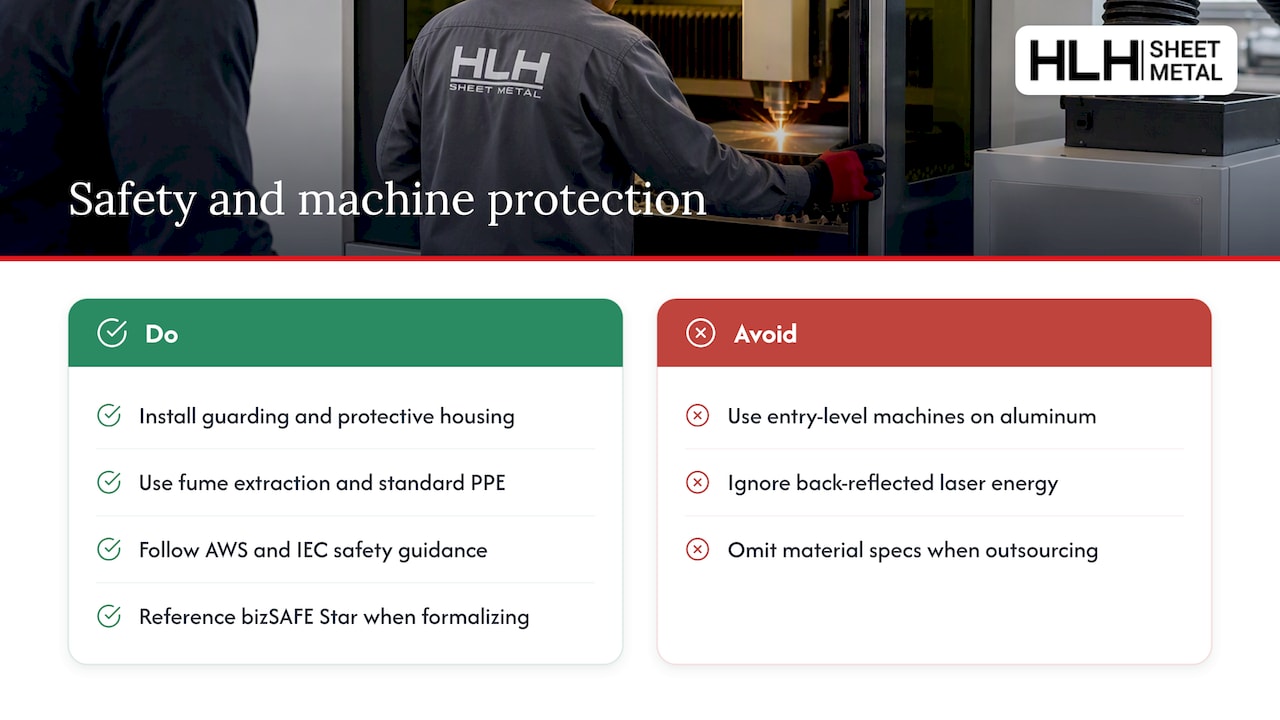
Aluminum’s reflectivity sends a meaningful share of laser energy bouncing back toward the source, which is why machine guarding and protective housings matter more here than with most other metals. Recommended practices from bodies like AWS and IEC outline guarding and process safety expectations for laser cutting equipment, and shops building out safety programs often reference structured guides like bizSAFE Star implementation for precision engineering facilities when formalizing these protocols.
Fume extraction and standard PPE apply as they would to any thermal cutting process. Entry-level machines frequently lack optical isolators or reflection-hardened components, which is a real limitation for anyone attempting aluminum on hobbyist equipment. When outsourcing, share exact alloy, thickness, tolerance, and finish requirements with your provider up front.
When To Cut In-house Versus Hire A Fabrication Partner
Prototypes favor speed and flexibility, so an in-house or local job shop often makes sense for a handful of test parts. Production runs change the math: certification requirements, multi-plant capacity, and tight turnaround windows are where a dedicated partner earns its keep. A clear quote request, listing alloy, thickness, tolerance, finish, and quantity, gets you a faster and more accurate response from any fabricator.
— Nash
HLH Sheet Metal’s Laser Cutting Capabilities
HLH Sheet Metal specializes in custom sheet metal fabrication for clients across aerospace, medical, and industrial sectors, backed by ISO-certified quality assurance and rapid prototyping. Getting an accurate quote starts with a clear request for quotation: specify material and alloy, thickness, finished tolerance, surface finish, quantity, and intended use, since each of these changes both price and achievable cut quality.
A combination of manufacturing plants and support teams that operate extensively can make it practical to move from a single prototype to a full production run without switching suppliers or losing communication along the way. If you have a part ready to quote, our laser cutting services page is the fastest way to get specifications in front of our team and start the quoting process.
Sources
The laser source you pick determines whether a job is fast and clean or slow and frustrating. Fiber lasers dominate industrial aluminum cutting because their near-infrared wavelength couples reasonably well with aluminum’s surface, and their high power density pushes through the metal’s thermal conductivity instead of just heating the surroundings. CO2 lasers can still handle some thick-plate jobs, but they generally couple worse with reflective metals than fiber systems, which limits their use to specific setups. Femtosecond and other ultrashort-pulse lasers work through cold ablation: pulses arrive and leave before heat has time to spread, which keeps the heat-affected zone minimal on delicate or micro-scale parts, though throughput is lower and equipment costs more.
- Change of dominant material properties in laser perforation process with high-energy lasers up to 120 kilowatt
- Compensating thermal expansion via tool path correction during fusion laser cutting of Al5754
- Optimization of laser cutting parameters for enhanced kerf surface quality of thick Al6061-T6 aluminum alloy
- An extensive review of the effects of laser cutting parameters on metal surface and kerf quality
If your only option is a hobbyist-class machine, outsourcing the aluminum cut or switching to a different process for that part is usually the more reliable path.
FAQ
How Powerful Of A Laser Do You Need To Cut Aluminum?
The right power depends heavily on thickness and alloy, with thin sheet requiring far less power than heavy-gauge plate. Industrial fiber laser systems used for aluminum sheet work typically run at higher power levels than those used for steel of the same thickness, since aluminum’s reflectivity and thermal conductivity both work against efficient energy absorption.
Will A 10 Watt Laser Cut Aluminum?
A 10 watt laser, the kind found in most hobbyist diode machines, is not capable of cutting aluminum. These lasers lack both the power density and the protective hardware needed to handle a highly reflective, thermally conductive metal, and are better suited to engraving or marking non-metal materials.
Which Aluminum Grade Is Best For Laser Cutting?
Common structural alloys like 6061 and marine-grade options like 5052 and 5083 cut predictably across most fiber laser setups and tolerate moderate parameter variation well. Higher-strength alloys such as 7075 are workable but often need slower speeds or adjusted gas pressure to avoid edge cracking or excess dross.
Is Aluminum Harder To Laser Cut Than Steel?
At lower laser power levels, aluminum can be harder to cut than steel because its high thermal conductivity pulls heat away from the cut zone before it can fully penetrate. That pattern reverses at very high power, where aluminum’s perforation time can overtake steel’s near roughly 80 kilowatts in experimental testing, though most shop-floor fiber lasers operate well below that threshold.

