




Table Of Contents
For most medium-to-high volume sheet metal runs, the landed cost from China comes out lower, but only once you add tooling, quality control, freight, duty and lead time to the factory quote. Local Australian fabrication often wins for small batches, rush jobs, or heavy and oversized parts where freight eats the savings. The real decision rests on three factors: order quantity, part complexity, and how fast you need the parts in hand.
TL;DR:
- Compare quotes by separating material, labor, tooling, and finishing, then calculate landed cost with inspection, freight, duty, GST, brokerage, and inland delivery.
- Many Australian fabricated metal imports carry 5% duty, but eligible goods may qualify for zero duty with a Certificate of Origin; GST adds 10%.
- A first Chinese order typically takes three to four months: about 12 weeks for production, followed by 3 to 5 weeks of sea transit.
- Choose local fabrication for delivery under four weeks, prototypes, unstable designs, safety critical tolerances, or bulky parts whose freight erases price savings.
- For a first order, set a risk allowance of a few percentage points and require written sample criteria, milestone payments, and pre shipment inspection.
Why Quotes For The Same Drawing Differ So Widely
Send the same drawing to five suppliers and you’ll get five different numbers, often with no obvious reason why. Part of it comes down to process choice. A shop that laser cuts and nests parts tightly on a sheet quotes differently than one using turret punching with manual sheet handling, and bending strategy (how many setups, which tooling) changes the labor line even when the finished part looks identical.
Tooling and fixturing approaches also swing the quote. A supplier that builds a dedicated jig for your part spreads that cost over the run, so a 5,000-unit order absorbs it easily while a 200-unit order barely dents it. Another supplier working from standard tooling skips that line item entirely but may charge more per operation.
Quoting conventions themselves vary:
- Some shops price per bend, per weld, or per hole, so a part with extra features costs more even at the same material and gauge.
- Others quote an all-in unit price that bundles cutting, forming, and finishing into a single number.
- A few build in a minimum order charge that disappears once volume clears a threshold.
Local material sourcing plays a role too. A supplier with an in-house stock of a particular gauge or alloy quotes faster and often cheaper than one that special-orders material for your job. When you compare quotes side by side, ask each supplier to break out material, labor, tooling, and finishing separately. That’s the only way to tell whether a cheaper number reflects real efficiency or just a different way of slicing the same costs.
What A Full Landed-cost Breakdown Actually Includes
A factory quote is not the landed cost, and treating it as one is the single most common mistake in offshore sourcing. The landed cost adds everything that happens between “part leaves the factory” and “part is usable in your warehouse.”
The core elements to populate in a sourcing spreadsheet are:
- FOB unit price: what the factory charges per part at its loading dock.
- Tooling and setup: one-off charges for dies, jigs, or fixtures, amortized across the order.
- Samples and first-article approval: cost of pre-production units you inspect before full production runs.
- Quality control and inspection: third-party or in-house checks during and after production.
- Freight: sea or air transport to your port or warehouse.
- Import duty and GST: government charges on entry.
- Customs broker and inland freight: clearance fees and the trip from port to your door.
A worked example from a 2026 cost breakdown for Australian businesses shows how fast these additions compound. For a 1,000-unit run with an FOB unit price of A$3.50, the landed cost after tooling, inspection, freight, duty and GST is substantially higher than the headline factory price. That same source notes many fabricated metal tariff lines carry 5% import duty into Australia, though some categories qualify duty-free under the China-Australia Free Trade Agreement with the correct Certificate of Origin, and GST adds another 10% on top.
MOQs change this math directly. Tooling cost is fixed regardless of order size, so a run of 200 units carries a much heavier tooling burden per part than a run of 5,000. If your annual volume is uncertain, ask your supplier for landed cost at two or three order sizes before committing, since the breakeven point between China and local fabrication often sits at a specific quantity rather than a fixed rule.
The Hidden Costs That Quietly Erase Your Savings
A low factory quote means nothing if the parts fail inspection or arrive three weeks late. These soft costs rarely show up on the initial quote, but they show up on your bottom line.
Common hidden costs include:
- Failed first articles: rework or re-tooling when the sample doesn’t match spec.
- Nonconformance on full production runs: scrap, rework labor, or partial shipment rejection.
- Seasonal freight surcharges: rate spikes around major holidays in exporting regions.
- Duty misclassification: wrong tariff code leading to penalties or back payments.
- Expedited freight: switching from sea to air when a delay threatens your deadline.
A worked landed-cost example shows FOB unit prices of A$3.50 translating to landed costs substantially higher per unit after tooling, inspection, freight, duty and GST are added, a gap largely driven by these first-run cost additions. A single failed first-article round can push that gap even wider, since re-tooling or a second sample cycle adds weeks and cost without changing your order quantity.
Budget a risk allowance of a few percentage points on top of your landed-cost estimate for a first order with a new supplier, and reduce it on repeat runs once the supplier has a track record with your part. The best mitigation is procedural: clear acceptance criteria on the first sample, a documented inspection plan, and staged payments tied to milestones rather than paying in full upfront. For a deeper look at where Chinese suppliers typically fall short on quality, see our notes on common fabrication quality issues.
Design Choices That Lower Cost Before You Even Quote
The cheapest fabrication decision happens before the quote stage: in the drawing itself. Every extra bend, weld, or secondary finish adds a processing step, and processing steps are where cost and defect risk both accumulate.
The highest-cost features in a typical sheet metal part are extra bends (each one is a separate press setup), weld seams (labor-intensive and a common source of rework), and nonstandard finishes (specialty coatings or tight cosmetic tolerances that slow throughput). Prioritized alternatives usually include combining multiple bends into a single operation, standardizing on common fastener sizes your supplier already stocks, and relaxing tolerances on noncritical dimensions so the shop isn’t holding tight specs where they don’t matter.
Pro Tip: Ask your supplier for a DFM review before you request a formal quote. It often surfaces two or three changes that cut cost without touching form or function.
An engineering review before quoting does more than trim cost. It reduces the price variance between suppliers described earlier, because a drawing with ambiguous tolerances or unclear bend sequences invites each shop to interpret it differently, which is exactly how two quotes for the same part end up 30% apart.
Realistic Timelines: China Production Vs Local Turnaround
Lead time is where cost and convenience pull against each other hardest. A typical China sourcing cycle runs about 12 weeks of production, which includes sample rounds and approval, plus 3 to 5 weeks of sea transit to a port like Melbourne or Sydney. That puts a realistic door-to-door timeline for a first order at three to four months.
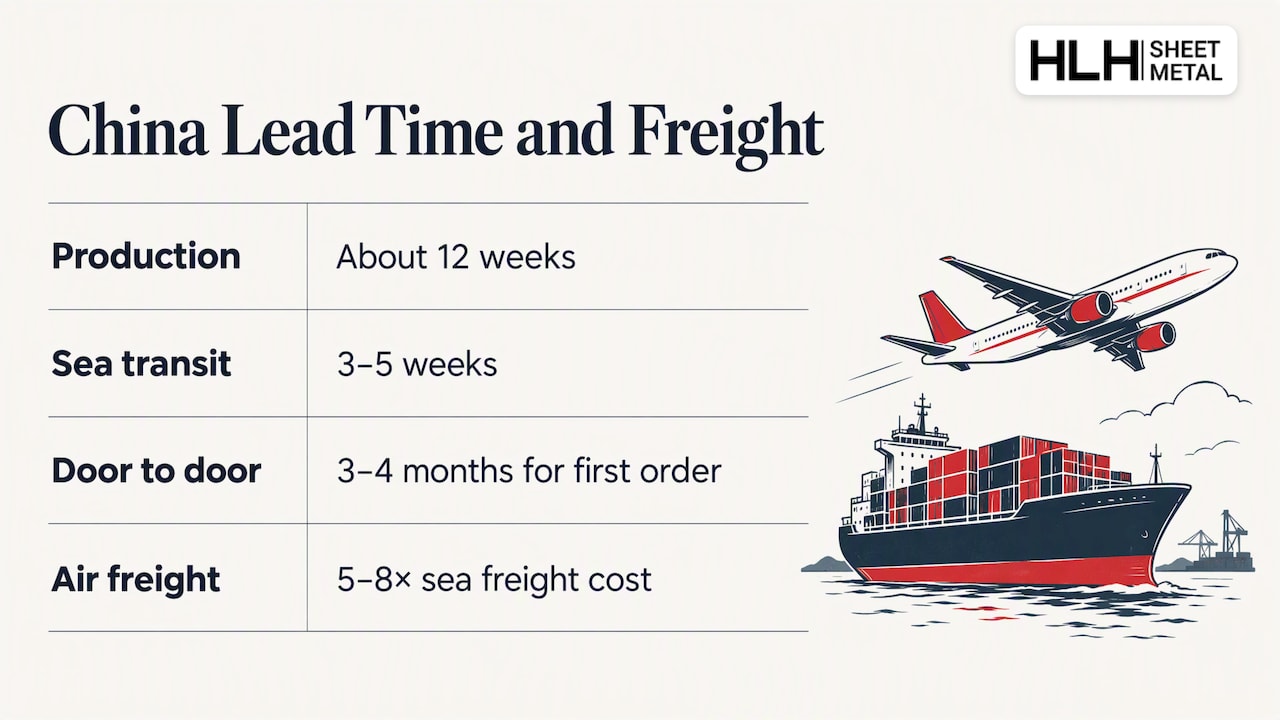
Sea freight is the cheapest way to move parts by weight, but air freight runs 5 to 8 times the cost of sea for the same shipment and is really only justified when a deadline is non-negotiable. If you’re weighing freight options against fixed delivery dates, a landed-cost calculation guide from a logistics operator walks through how freight mode affects per-unit profitability.
Lead-time pressure has a cost of its own. Compressing a schedule usually means paying for air freight, overtime at the factory, or both, and either one narrows the gap that made China attractive in the first place.
How To Decide Between China And Local Fabrication
Run your project through a short checklist before committing to a sourcing route.
- Annual volume: higher volumes amortize tooling faster and favor China.
- Acceptable lead time: if you need parts in under four weeks, local fabrication is usually the only option.
- Critical tolerances: tight, safety-relevant tolerances benefit from closer, faster iteration with a local shop.
- Weight and size: heavy or bulky parts can see freight costs erase any unit-price advantage.
- After-sales and warranty needs: frequent small reorders or field support favor a supplier you can reach quickly.
- Total landed-cost threshold: set a per-unit target that includes every line item from the breakdown above, not just the factory price.
As a rough sizing rule, tooling and MOQ economics tend to favor China once annual volume climbs into the thousands of units and the part design is stable. For prototypes, one-off runs, or parts still being refined, local fabrication or a small-batch supplier usually costs less overall once you count rework risk.
Once you’ve picked a route, the procurement sequence matters as much as the country: start with an engineered RFQ that spells out tolerances and finish requirements, run a sample round with written acceptance criteria, use staged payments tied to milestones, and schedule a pre-shipment inspection before the goods leave the factory.
How We Reduce Risk And Cost When You Source From China
We built our operation around the exact risks this guide covers. Our quality control runs on certified processes, with sample approval and pre-shipment inspection built into every production order rather than treated as an optional add-on. Multiple manufacturing plants give us room to run small prototype batches and large production orders without shifting you to a different facility mid-project.
Our standard engagement follows the staged approach recommended above: a DFM review before quoting, a managed sample round with documented acceptance criteria, inspection coordination at pre-shipment, and payment milestones tied to each stage rather than full payment upfront. Our support team works in English, so questions about tolerances or shipment status don’t wait on a time-zone gap.
If you’re ready to see how your drawing prices out, request an engineering review and we’ll walk through the landed-cost math with you.
A Procurement Take On China Vs Australia Sourcing
China is the right default once volume is steady and tooling pays for itself. Choose local fabrication when lead time is tight, tolerances are safety-critical, or the order is too small to amortize tooling. The most common mistake we see: comparing factory quotes instead of landed cost per accepted part.
— Nash
Get An Engineered Quote Before You Commit To A Sourcing Route
Running the landed-cost math from this guide against your own drawing is the fastest way to know whether China sourcing actually saves you money on your specific part. We handle that calculation alongside the fabrication itself: laser cutting, bending, welding, stamping, and finishing, all under the same quality process described above, with sample rounds and pre-shipment inspection built into the order.
If your project involves enclosures or chassis rather than a single part, our custom disconnect enclosure services follow the same staged, inspected process. For a direct comparison on how China sourcing stacks up against another market, see our cost comparison against Canadian fabrication.
Send us your drawing and target volume, and we’ll return a landed-cost estimate alongside the factory quote so you’re comparing the number that actually matters.
FAQ
Why Is Sheet Metal Fabrication So Expensive?
Cost comes from a mix of material price, labor for each cutting, bending, or welding operation, tooling for custom shapes, and finishing steps like coating or plating. Complex parts with many bends or welds take more processing time, which is the biggest driver of price differences between similar-looking parts.
What Are Some Structural Steel Fabrication Companies In Australia?
Australia has numerous structural steel fabricators serving construction and industrial clients, typically operating with higher labor rates than offshore suppliers. Rates in the range of $35 to $55 per hour are common for domestic fabrication labor, which is a major reason local quotes often run higher than offshore ones for comparable sheet metal parts.
How Much Does It Cost To Manufacture In China?
Factory (FOB) unit prices in China are often lower than domestic Australian quotes, partly because general cost-of-living and overhead differences between the two countries run substantially in China’s favor. The real cost to compare is landed cost, which adds tooling, inspection, freight, duty, and GST to that factory price.
How Do I Calculate Fabrication Cost Per Kilogram?
Divide total landed cost (FOB price plus tooling, inspection, freight, duty, and broker fees) by the total weight of accepted, conforming parts in the shipment. Using accepted parts rather than total parts shipped matters, since rework or rejected units change the real cost per kilogram even when the invoice price per kilogram looks unchanged.

