




Table Of Contents
For most low-to-mid volume sheet metal programs, the UK often equals or beats China on total landed cost once freight, duties, working capital and quality-driven rework are counted. China still tends to win for very high-volume, stable designs. The right comparison is total landed cost (TLC), not ex-works unit price, and quality parity is achievable in both markets if you verify certifications and build in lead-time trade-offs.
TL;DR:
- Below roughly 50,000 units annually, compare tooling, duties, freight, inventory financing, rework, and supplier oversight rather than relying on unit quotes alone.
- China’s 10 to 16 week lead time, compared with 2 to 6 weeks in the UK, compounds with each engineering change before a design stabilizes.
- Verify each factory’s current, sector appropriate certification and inspection records tied to your part; contract for first article approval and pre shipment inspection.
- Small batch estimates can vary by roughly 30% either way, so test different volumes, scrap rates, and freight modes rather than trusting one forecast.
- Keep prototypes and early revisions local, then shift frozen designs offshore only when annual volume can absorb tooling and dedicated line costs.
Total Landed Cost Breakdown: All Cost Lines Procurement Must Model
Unit price is the number everyone compares first, and it is also the number that misleads most procurement teams. Total landed cost captures unit price plus tooling and non-recurring engineering (NRE), freight and insurance, duties and broker fees, working capital tied up in transit, scrap and rework, and management overhead, and it is the correct comparator when choosing between onshore and offshore manufacturing.
Each line behaves differently depending on where you source:
- Unit price: typically lower ex-works in China due to labor cost and scale, but the gap narrows once other lines are added.
- Tooling and NRE: often comparable in absolute terms, but Chinese tooling can take longer to iterate if a design needs revision mid-program.
- Freight and insurance: a UK supplier shipping domestically has near-zero freight cost and risk; China freight (sea or air) adds a per-unit cost that scales with volume, weight and mode.
- Duties, broker fees and VAT: add a direct percentage cost on top of unit price for Chinese imports, and the applicable rate depends on HS code classification, so a customs broker should confirm it before you build a quote comparison.
- Working capital: inventory sitting in transit or in a warehouse for weeks ties up cash that a UK order, with shorter transit, releases faster.
- Scrap and rework: higher when quality variance or miscommunication causes parts to fail inspection after they have already crossed an ocean.
- Management overhead: time spent by your own engineers and buyers managing time zones, translation and supplier audits is a real cost even when no invoice captures it.
Comparative research into commercial and cost-management practices points out that UK and China cost and commercial management differ structurally in how contracts, change orders and overhead are handled, which matters when you try to put a number on management overhead rather than treating it as background noise. A UK supplier working under a framework agreement with standard change-order terms may resolve an engineering change in a single email thread. The same change with an offshore supplier can require a translated drawing package, a re-quote cycle and a new tooling check, each adding hours that your team has to staff.
When these lines are modeled end-to-end rather than compared on unit price alone, the apparent China advantage often narrows substantially for low-to-mid volume programs. For many UK-based buyers ordering under roughly 50,000 units a year, the UK option can land within 5% to 15% of China on total landed cost, and non-cost benefits such as faster engineering change turnaround often tip the decision toward the domestic supplier. That is not a universal rule. It is a pattern that shows up often enough in applied landed-cost comparisons that it deserves to be the starting assumption procurement tests against its own BOM, rather than an afterthought bolted onto a unit-price spreadsheet.
The practical takeaway is to build your comparison spreadsheet with one row per cost line, not one row per supplier quote. A supplier quote only addresses the unit-price question. Your spreadsheet needs to address the total landed cost question, and the two are rarely the same number.
Unit Price, Scale And Volume Thresholds: When China Keeps The Edge
Volume changes the math because several of the cost lines above are fixed or semi-fixed per order, not per unit. Tooling and NRE get amortized across the run, so a 5,000-unit order absorbs tooling cost very differently than a 500,000-unit order. Freight costs per unit also fall as container utilization improves, so a full container load of stamped brackets spreads its freight cost far more thinly than a part order that only fills a fraction of a pallet.
Labor and productivity scale effects compound this. A Chinese plant running a stable, high-volume stamping program can dedicate a press, a fixture and a trained line to that single part for months, driving down cycle time and defect rate through repetition. A UK job shop serving mixed, lower-volume work rarely gets that same repetition advantage on any single part number, even if its base labor rate and overhead structure are competitive.
- Under roughly 50,000 units a year, the UK answer is frequently close enough on total landed cost that non-cost factors decide the sourcing choice.
- At high, stable volumes with a mature, unchanging design, China’s amortized tooling and scale-driven labor efficiency usually produce a lower landed cost that is hard for a UK shop to match.
- High-mix, low-volume programs with frequent part number changes tend to favor UK or other local sourcing because changeover cost dominates and offshore shipping adds latency to every design iteration.
- Regulated industries such as medical device and aerospace often weigh audit access and traceability heavily enough that a small landed-cost premium for local or nearby sourcing is accepted as the cost of easier compliance oversight.
Sector matters here as much as volume. A regulated buyer that needs to walk a quality auditor through a production floor on short notice, or that needs rapid access to a supplier’s quality records during an FDA or notified-body audit, has a real cost attached to distance and time zone that a landed-cost spreadsheet does not always capture in a line item. That cost shows up later, as delay, if it is ignored upfront.
The practical filter procurement teams should apply is this: ask whether the design is stable and the volume is high enough that tooling amortization and labor scale will dominate the total landed cost calculation. If yes, China’s structural advantages are likely to hold. If the program is still evolving, or volumes sit in the tens of thousands rather than hundreds of thousands of units per year, the total landed cost comparison deserves a full workup before assuming offshore wins.
Quality, Standards And Compliance: What To Verify And How It Affects Cost
Quality is not a binary where one country is “better” and the other “worse.” It is a function of which certifications a specific factory holds, how rigorously it enforces its own quality system, and how much inspection access you build into the contract. Both UK and Chinese fabricators can hold ISO 9001 certification for general quality management, and sector-specific work, such as medical device enclosures, typically requires ISO 13485 regardless of which country the parts come from.
What differs is how easily you can verify and audit that certification in practice:
- Request the certificate directly from the supplier and confirm the certifying body and expiration date rather than accepting a logo on a website.
- Ask for process-specific test and inspection reports, such as first-article inspection reports, material certificates and dimensional reports, tied to the actual part number you are ordering.
- Clarify third-party inspection options, including pre-shipment inspection services that check a sample of a production run before it leaves the factory.
- Confirm sector certification separately from general ISO 9001, since a shop certified for general quality management is not automatically certified for medical, aerospace or automotive-specific standards.
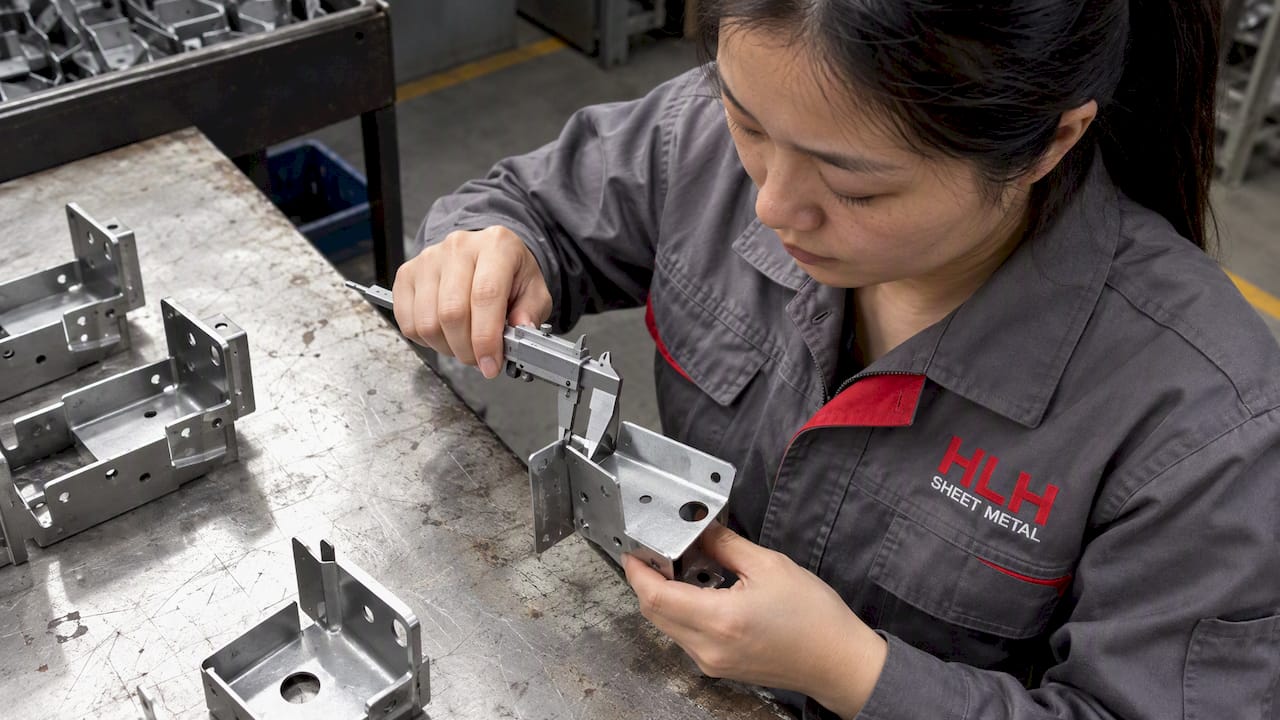
Factory quality assurance practices vary more within a country than between countries. A well-run Chinese plant with documented incoming material inspection, in-process checks and final inspection can produce defect rates that match or beat a mediocre UK shop with weaker process discipline, and the reverse is just as true. The determining factor is the specific factory’s documented practice, not its location on a map. That said, overseas sourcing adds a layer of risk because you cannot walk the floor on short notice, which is exactly why pre-shipment inspection and clear first-article approval steps matter more when the supplier is thousands of miles away. Our quality control practices in China article covers how inspection regimes at the factory level affect rework rates in more detail, and a review of common quality issues in Chinese sheet metal fabrication walks through specific failure modes worth checking for before you commit to a production run.
Quality failures convert directly into the total landed cost lines discussed earlier. A batch that fails inspection after it clears customs adds freight cost twice, since replacement parts have to ship again, adds scrap cost for the rejected units, and adds management overhead for the dispute and rework coordination. A single bad batch can erase the unit-price advantage that justified sourcing offshore in the first place.
Pro Tip: Build a first-article approval step and a pre-shipment inspection into every new supplier contract, regardless of country, so a quality problem is caught before freight and duties are spent on it.
Lead Time, Ecns And Logistics: Quantifying The Speed Penalty And Its Cost
Lead time is where the UK versus China comparison often swings hardest, because it compounds with every other variable in the model. Practical industry guidance on reshoring puts UK end-to-end lead times for comparable fabricated assemblies at roughly 2 to 6 weeks, against 10 to 16 weeks for China once production and transit are both counted. That gap of eight to ten weeks is not just an inconvenience. It is weeks of working capital tied up in parts sitting on a vessel, and it is weeks of delay every time a part needs to change.
Engineering change notices (ECNs) are where this gap turns into real money. A UK supplier close by can usually absorb a design tweak into the next production run with a quick phone call and a revised drawing. An offshore supplier handling the same change needs the revised drawing translated or clarified, a new tooling check if the change affects a die or fixture, and a new first-article approval cycle, often adding weeks before the change shows up in a shipped part. For a program that goes through three or four ECNs before the design stabilizes, that iterative cost multiplies quickly, and each cycle also restarts a 10 to 16 week logistics clock.
- Air freight cuts transit time sharply but adds a meaningful per-kilogram cost, usually justified only for low-weight, high-value or urgent parts.
- Sea freight is cheaper per unit but locks in the long transit window, which is where most of the working-capital cost in a China sourcing decision originates.
- DDP (Delivered Duty Paid) terms shift customs and duty handling to the supplier, simplifying your import process at a cost premium baked into the quote.
- DAP (Delivered at Place) terms leave duty and import clearance to you, which can lower the quoted price but adds management overhead and risk of delay at your own customs broker.
A practical checklist for cross-border logistics planning, including customs documentation and routing choices, is covered in ForwarderOne’s sourcing to delivery checklist, which is worth reviewing before finalizing freight mode and incoterms on a new offshore program. The short version: every week of transit time is a week of inventory sitting as cash on a balance sheet instead of revenue, and every ECN cycle offshore costs more than the same cycle would cost domestically.
How To Build A Practical Total Landed Cost Model For Your Sheet Metal BOM
A total landed cost model does not need to be complicated, but it does need to include every line that changes with sourcing location. Academic cost-estimation research on small-volume fabricated assemblies found that uncertainty in small-batch cost estimates runs around plus or minus 30%, which means a model built on point estimates alone will mislead you. Build in sensitivity testing from the start.
- Gather your inputs. Collect ex-works unit price from each candidate supplier, tooling and NRE cost, freight quotes for your likely shipping mode, duty rate based on the correct HS code for your part, estimated lead time, expected scrap or rework rate, estimated management hours per month for supplier oversight, and your exposure to currency fluctuation between your home currency and the supplier’s invoicing currency.
- Populate a per-unit landed cost template. Add unit price, amortized tooling per unit at your expected volume, freight and insurance per unit, duty and VAT per unit, a working-capital carrying cost based on your cost of capital and transit time, a scrap and rework allowance, and an allocated management overhead per unit.
- Run sensitivity checks. Recalculate the model at a lower and higher volume than your base case, at your current scrap rate and at a scrap rate 50% higher, and at both sea and air freight, then see which sourcing option wins across the range rather than at a single point estimate.
A per-unit cost estimate built on a single volume and a single scrap assumption can be off by around 30% in either direction for small-volume fabrication programs, which is why a sensitivity table matters more than a single bottom-line number.
Once the sensitivity results are in front of you, set a decision threshold rather than chasing a single “winner.” A common approach is to pick the sourcing option that wins across the widest range of your sensitivity table, not just at your best-guess volume, and to pilot a small production run locally before committing full volume offshore if the two options land within a narrow band of each other. Our DFM guidance on CAD settings that reduce tooling and per-unit cost is a useful reference when you are trying to close a small landed-cost gap through design changes rather than through a sourcing switch. A prior China versus Canada cost comparison also walks through the same template structure applied to a different market pair, if you want to see the framework used end to end.
Decision Checklist: Pick A Sourcing Option And Shortlist Suppliers
Once the total landed cost model is built, the sourcing decision usually comes down to a short list of qualitative factors layered on top of the numbers. Run through these before finalizing a shortlist:
- Expected annual volume: confirm whether your program sits below or above the volume band where tooling amortization and labor scale start favoring China.
- Design stability: a design still going through revisions favors a supplier close enough to absorb ECNs quickly, which usually points toward UK or regional sourcing during the early phase.
- Regulatory and audit needs: programs requiring frequent on-site audits or fast access to quality records weigh toward a supplier you can visit or reach within your own working hours.
- Acceptable lead time: a program with a hard delivery deadline has less room to absorb a 10 to 16 week offshore lead time if something goes wrong mid-production.
- Internal supplier-management capacity: confirm your own team has the bandwidth to manage time-zone communication, translated documentation and overseas quality disputes before committing to an offshore supplier.
- Target landed-cost delta: decide upfront how large a landed-cost gap you need to see before volume alone justifies the switch to offshore production.
Weight these factors based on your specific program rather than applying a universal formula. A regulated medical device enclosure with an unstable design and a hard compliance deadline should weight design stability and audit access heavily, even if China offers a meaningful unit-price advantage. A mature, high-volume bracket with a frozen design and no regulatory audit requirement can weight landed-cost delta and volume much more heavily, since the operational risks that favor local sourcing matter less once a design has stopped changing.
Many procurement teams land on a blended strategy rather than an all-or-nothing choice: prototype and pilot runs built locally or regionally while the design stabilizes, then a transition to offshore volume production once the part number is frozen and the volume justifies tooling investment. This captures the ECN-speed advantage of local sourcing during the riskiest phase of a program and the scale advantage of offshore production once that risk has been retired.
HLH Sheet Metal Perspective And Evidence
We built our own sourcing model around the same logic this article lays out: match the supplier to the phase of the program rather than picking one country for every part number. We operate multiple manufacturing plants, which lets us run small prototype batches and high-volume production runs without switching suppliers mid-program, and we maintain ISO certification across our quality system so the paperwork a regulated buyer needs is already in place rather than assembled after the fact.
Before committing to any supplier, whether that is us or another fabricator, ask for the specific documents that let you verify the claims in this article rather than taking a certification logo at face value: the current ISO certificate with its certifying body and expiration date, recent first-article inspection reports for a comparable part, and production capacity figures for the process you need, whether that is laser cutting, stamping, bending or welding. A supplier that answers these requests quickly and in plain English is already demonstrating the kind of communication speed that affects your ECN costs down the line.
Our support team works in English around the clock specifically to close the communication gap that drives up management overhead in offshore sourcing, and we can walk a procurement team through quality records and production capacity for a specific part number on request.
— Nash
Intellectual Property Protection Considerations In UK Vs China Fabrication
Intellectual property protection is a real factor in the sourcing decision, separate from cost, and it deserves its own line in your supplier evaluation rather than being folded into a general risk assessment. A UK supplier operating under UK contract law and UK intellectual property statutes gives you a familiar legal framework if a dispute over drawings, tooling ownership or design data arises.
Sourcing in China means your protection depends heavily on the specific contract terms you negotiate, including non-disclosure agreements, non-use and non-circumvention clauses, and clear tooling ownership language, since enforcement mechanisms and legal processes differ from what a UK-based legal team is used to. Reputable fabricators address this directly: confirm in writing who owns the tooling and the CAD files, require a signed non-disclosure agreement before sharing detailed drawings, and avoid sending full assembly drawings to a supplier during an early quoting phase when a simplified drawing would suffice.
The practical mitigation is less about which country you choose and more about how carefully you structure the agreement. Split sensitive sub-assemblies across suppliers where feasible, retain ownership of tooling in the contract language, and treat intellectual property protection as a line item to verify during supplier qualification, the same way you verify ISO certification or production capacity.
Communication And Language Barriers Affecting Project Timelines And Quality
Communication speed is one of the most underrated cost drivers in offshore sourcing, because it rarely shows up as its own line item on an invoice, yet it touches nearly every other cost line discussed above. A drawing note that gets misread due to a translation gap can turn into a batch of parts that fail inspection, triggering the scrap, freight and management overhead costs covered in the total landed cost section.
Time zone difference compounds the language gap. A clarifying question sent at the end of a UK workday to a Chinese supplier may not get answered until the next UK morning, and if the answer itself needs clarification, a single exchange that would take minutes with a local supplier can stretch into a multi-day cycle. Over the course of a program with several engineering changes, these delays add real weeks to the schedule.
The direct mitigation is to confirm, before placing an order, that your supplier’s technical staff, not just a sales contact, communicates fluently in your working language and is available during hours that overlap with your team. Request that critical dimensions and tolerances be confirmed in writing, in plain language, rather than relying on a drawing alone to carry the full intent of a specification. This single step prevents a large share of the quality disputes that turn into added cost later in the program.
Environmental Regulations And Compliance Costs Differences
Environmental compliance costs differ between the UK and China in ways that affect supplier pricing even when they are not broken out as a separate line. UK manufacturers operate under UK and retained EU environmental regulations covering waste handling, emissions and chemical use, and these compliance costs are generally built into a UK supplier’s overhead and therefore its quoted price.
Chinese manufacturing regions have tightened environmental enforcement over recent years, with stricter oversight of emissions and waste disposal at the provincial level in many industrial zones, and factories that fail to comply face shutdowns that can disrupt a production schedule with little notice. For a buyer relying on a single Chinese facility, an environmental enforcement action at that plant is a supply-chain risk worth asking about directly during supplier qualification, separate from the cost comparison itself.
The practical step is to ask prospective suppliers, in either market, for documentation of their environmental compliance status and any history of regulatory shutdowns or violations, and to factor the stability of that compliance record into your supplier risk assessment alongside the landed-cost numbers. A lower unit price from a facility with an unstable compliance history carries a hidden risk that a landed-cost spreadsheet will not capture until a shutdown actually delays your order.
Case Studies Or Examples Illustrating Cost Differences And Outcomes
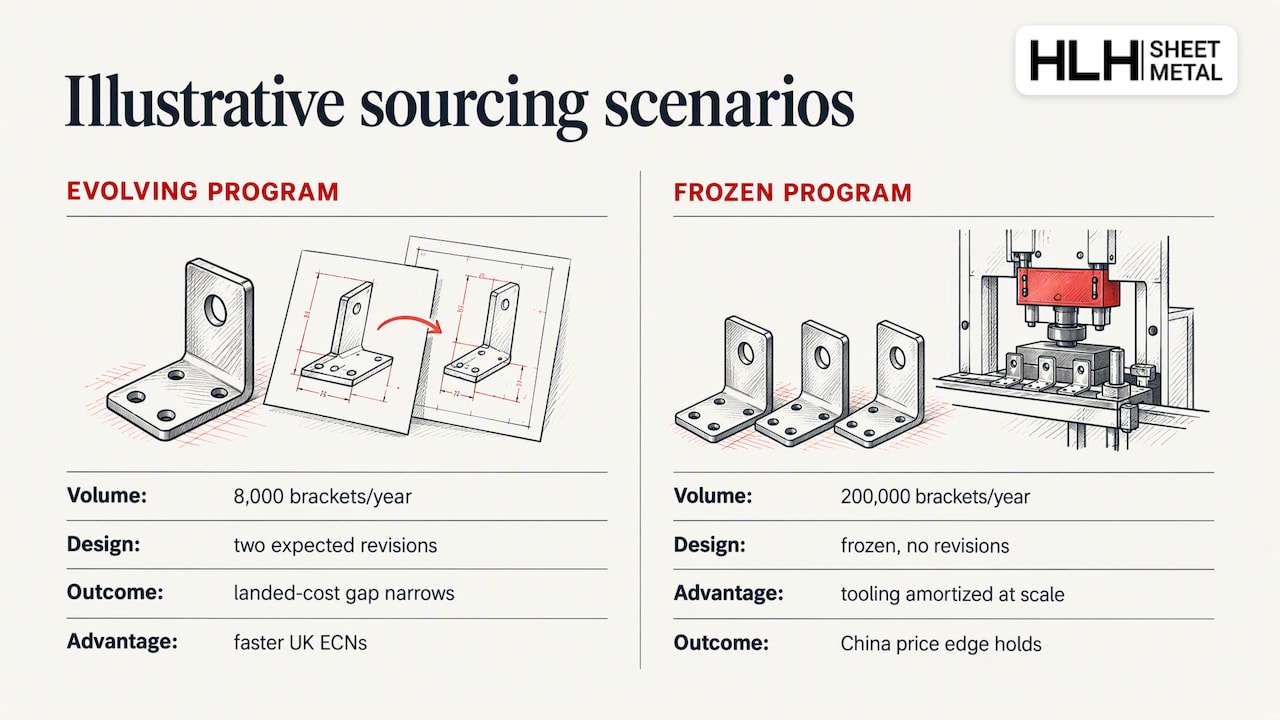
A useful way to see the total landed cost framework in action is to walk through an illustrative example. Say a UK buyer needs 8,000 stamped steel brackets a year for a product still going through two expected design revisions before the part number freezes. A Chinese quote comes in at a lower ex-works unit price, but once freight, duty, a 10 to 16 week lead time and the cost of two expected ECN cycles are added, the total landed cost narrows close to a UK quote, and the UK supplier’s faster ECN turnaround avoids a schedule delay that would have pushed the product launch back by several weeks.
Contrast that with a second illustrative scenario: a buyer needs 200,000 identical stamped brackets a year for a frozen, mature design with no expected revisions. Here, tooling amortizes across a much larger run, labor efficiency from a dedicated production line compounds, and the long lead time matters less because the design is not changing and replenishment can be planned well in advance. In this case, the offshore unit-price advantage tends to hold up all the way through to total landed cost.
These two illustrative scenarios are not universal outcomes. They show why the same cost framework can point toward opposite sourcing decisions depending on volume and design stability, which is exactly why a program-specific model, not a general rule of thumb, has to drive the final sourcing choice.
Market Outlook And Procurement Watchlist For 2026
Tariff and duty treatment has grown more complex, with rates increasingly tied to specific HS codes and subject to change based on trade policy shifts, which means a landed-cost model built a year ago may already be out of date. Currency exchange rate movement between your home currency and a supplier’s invoicing currency adds another layer of volatility that a static cost model will miss if it is not refreshed regularly.
The practical response is to build a refresh cadence into your procurement process rather than treating the total landed cost model as a one-time exercise. Review tariff classifications and freight rates at least quarterly, and immediately after any announced trade policy change affecting your product category. Freight forwarders and customs brokers track rate and quota changes in real time, and looping one into your sourcing review is far cheaper than discovering a duty increase after a shipment has already left the factory.
Vendor diversification is worth building into your sourcing strategy now rather than after a disruption forces the issue. Qualifying a second supplier, even one you do not use for the bulk of your volume, gives you a tested fallback if a primary supplier faces a shutdown, a tariff change or a quality failure mid-program.
How HLH Sheet Metal Can Help With Your Next Fabrication Program
Wherever your total landed cost model points, we can usually make that path shorter to execute. We offer sheet metal fabrication covering laser cutting, stamping, bending, welding and surface finishing, backed by ISO-certified quality assurance and multiple manufacturing plants that let us run a prototype batch and the resulting production volume without switching suppliers between phases.
To get a faster, more accurate quote from our team, send:
- Your current drawings and 3D CAD files, ideally with GD&T callouts already applied.
- A full bill of materials including material grade and finish requirements.
- Your target annual volume and expected order cadence.
- Any required certifications, such as ISO 13485 for medical applications.
Review our sheet metal fabrication capabilities for a full list of processes and materials we support, or go directly to our China fabrication service page to start a quote request for your specific part or assembly.
FAQ
What Is The Total Landed Cost Difference Between UK And China Sourcing?
Total landed cost adds freight, duties, working capital, scrap and management overhead on top of unit price, and for many programs under roughly 50,000 units a year, the UK can land within 5% to 15% of a Chinese quote once these lines are counted. The gap tends to widen in China’s favor only once volumes grow large and the design is stable enough to avoid repeated engineering changes.
How Much Do Fabrication Drawings Cost?
Fabrication drawing and tooling costs vary by part complexity, tolerance requirements and supplier, and no single published figure applies across the industry, so the cost is typically quoted per project based on your specific drawing package. Request a tooling and non-recurring engineering quote alongside your unit-price quote so both can be entered into a total landed cost model together.
Why Is Sheet Metal Fabrication So Expensive For Low Volumes?
Low-volume programs absorb set-up time, tooling and programming cost across fewer finished units, which pushes the per-unit cost up sharply compared to a high-volume run using the same equipment. Academic cost-estimation research on small-batch fabrication found that uncertainty in these small-volume estimates runs around plus or minus 30%, which is why set-up time and batch size deserve close attention in any low-volume quote.
How Much Does Sheet Metal Fabrication Work Typically Cost?
Cost depends on material, thickness, process (laser cutting, stamping, bending or welding), finish and volume, so there is no single industry-wide price; an accurate figure requires a quote against your specific drawings and bill of materials. We provide quotes based on submitted drawings, target volume and required certifications rather than a generic price list, since these variables change the cost line by line.
Is Chinese Manufacturing Better Than UK Manufacturing Overall?
Neither market is categorically better: China often wins on unit price and scale for high-volume, stable designs, while the UK often wins on total landed cost, lead time and engineering-change speed for low-to-mid volume or evolving designs. The right choice depends on your specific program’s volume, design stability and compliance requirements rather than a blanket preference for one country.

