





Table Of Contents

An engineering change order (ECO), sometimes called an engineering change notice or engineering release notice, is the formal record that authorizes and documents a change to a part, assembly, or product. Its job is to control bill of materials revisions and keep every affected department, drawing, and supplier record synchronized. The lifecycle runs from a change request through order creation, approval, implementation, and verification.
TL;DR:
- Most changes involving a released drawing or active bill of materials require an ECO to ensure proper documentation, approval, and traceability.
- An ECO should include detailed identification, reasons, impacted documents, approvals, implementation timing, and evidence such as photos or redlines to prevent downstream errors.
- Automating the ECO process with ERP or PLM tools helps prevent duplicate numbers, enforce effectivity dates, route approvals, and maintain a clear audit trail.
- Conducting early design reviews, grouping related changes, and verifying impact before production can significantly reduce late-stage ECOs and associated costs.
- In regulated industries, ECOs must meet strict compliance standards, including full traceability and formal sign-offs, to satisfy auditors and maintain product certification.
What Is An Engineering Change Order?
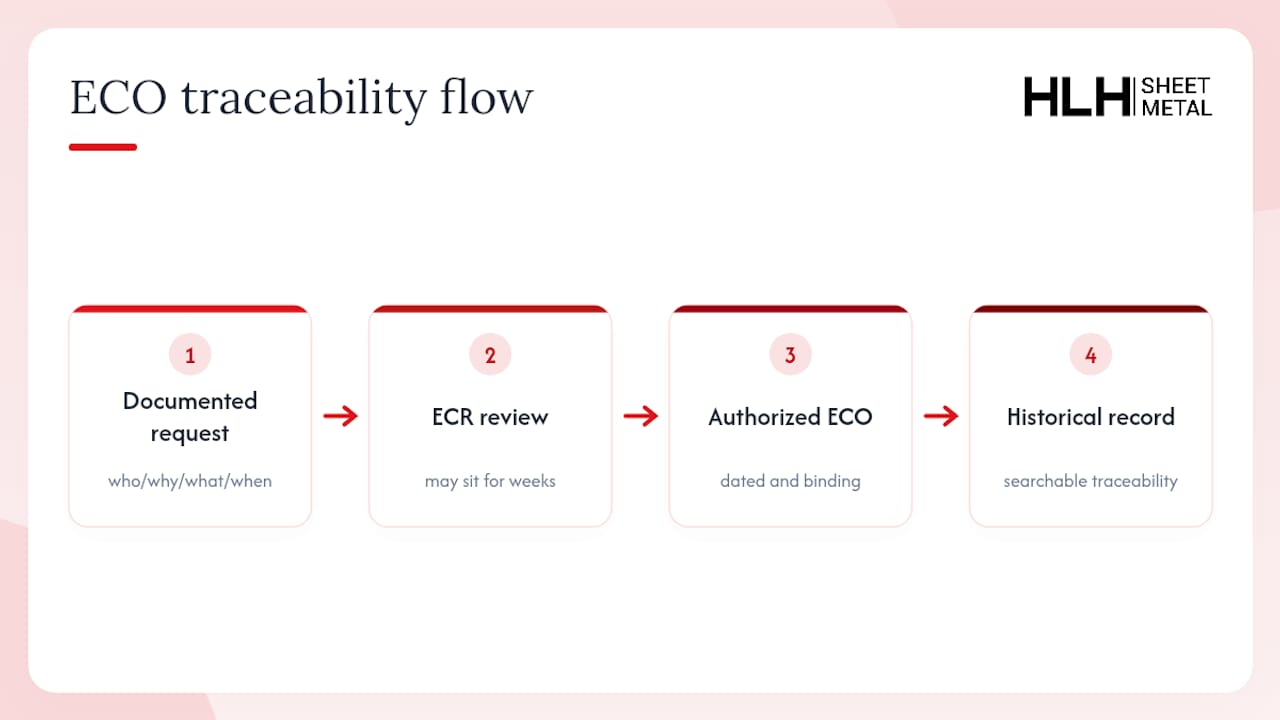
An ECO is a controlled document, not a hallway conversation or a marked-up print sent by email. It captures who requested a change, why, what it affects, and when it takes effect, so nothing gets implemented without a paper trail.
You will see the terms used almost interchangeably across industries: engineering change notice (ECN), engineering change (EC), and engineering release notice (ERN) all describe close variants of the same formal artifact. Some shops treat the ECR as the request and the ECO as the authorized instruction that follows it. That distinction matters more than it looks. An ECR can sit in review for weeks with no commitment. Once something becomes an ECO, it is authorized, dated, and binding on production.
Traceability is the real payoff. When a customer asks why a bracket changed thickness eighteen months ago, the ECO record answers that question in one lookup instead of a scavenger hunt through old emails.
When Do You Actually Need An ECO?
Not every tweak needs a formal order, but most changes that touch a released drawing or an active BOM do. Common triggers include:
- A design flaw discovered during production or field use
- A supplier substitution, material shortage, or component obsolescence
- A new regulatory or compliance requirement
- A cost-reduction initiative that alters materials or process
- A manufacturability fix identified during tooling or trial runs
Classify each change by impact before you route it. Form/fit/function changes (a new hole pattern, a different alloy, a dimensional shift) almost always require a full ECO because they affect interchangeability. Process changes, like switching a coating vendor with identical specs, may need a lighter version of the same paperwork. Purely cosmetic changes, a label reposition with no functional effect, sometimes only need an ECR-level note. If you are unsure which bucket a change falls into, default to the full ECO. Under-documenting is far more expensive to fix later than over-documenting now.
What Belongs In An ECO Document?
A usable ECO contains identification of the item changing, the reason for the change, a before-and-after description, and a list of every document or department it touches, along with approvals and implementation timing. Skip any of these and someone downstream inherits a guessing game.
At minimum, build your template around:
- ECO number and title for unique identification
- Affected part numbers, drawing revisions, and BOM lines
- Reason for change, stated specifically, not “quality improvement”
- Before/after description, including redlined drawings or CAD comparisons
- Effectivity, whether by date, model number, or serial/unit break
- Approvers, listed by role and required signature
- Implementation timing: immediate, next production run, or a specific milestone
- Inventory disposition: use existing stock, rework it, or scrap it
Pro Tip: Attach photos or redline PDFs directly to the ECO record instead of referencing “see email from last Tuesday.” Six months from now, nobody will remember which email.
Don’t leave inventory disposition as an afterthought. An ECO that changes a mounting hole without addressing the 400 old brackets sitting in a warehouse just created a second problem.

How Does The ECO Process Actually Flow?
The change order process runs in a predictable sequence, even though the paperwork varies by company:
- Identify the issue and scope an ECR. Someone flags a problem or opportunity and drafts a change request describing the proposed fix and its rough impact.
- Convert the approved ECR into an ECO, grouping related BOM changes into a single record rather than scattering them across five separate ones.
- Assess impact on open production orders, sales orders, and inventory before anything moves forward. Systems built for engineering change management let you search open transactions automatically instead of guessing what is exposed.
- Route for approval, tracking both approval status and implementation status as separate fields, since a change can be approved but not yet live.
- Implement, verify, and close. Confirm the change matches the intended design, run any required trial build or QA sign-off, then close the ECO with a timestamp.
Documentation-heavy industries like construction offer a useful parallel: category-based approval thresholds and mandatory supporting evidence, as laid out in state DOT change order manuals, keep changes from slipping through without the right sign-off. Manufacturing ECOs benefit from the same discipline. A change that skips verification and gets marked “complete” anyway is one of the most common sources of downstream defects, because nobody actually confirmed the fix worked before production scaled it.
What ERP And PLM Tools Should Govern Your Ecos?
Spreadsheets track ECOs until they do not. The failure point is usually duplicate numbering or a change that goes live without the right sign-off. ERP and PLM systems solve this with a few specific mechanisms:
- Uniqueness checks that block a second ECO from claiming a number or scope already in use
- Workflow automation that routes an ECO to the correct approver based on type or dollar impact
- Effectivity controls by date or by model/unit number, so a revision applies exactly where it should
- Status fields that separate approval status from implementation status, since the two rarely move together
- Electronic signatures and audit reporting for compliance review after the fact
Platforms like NetSuite and Oracle’s engineering module structure ECOs around fields like ECO Type, Approval Status, and Implementation Status, plus change actions (Add, Remove, Replace) applied to specific BOM or assembly items.
| Control | What it prevents |
|---|---|
| Uniqueness check | Duplicate ECO numbers colliding on the same part |
| Date/model effectivity | Applying a change to units already shipped |
| Approval routing | A change going live without the right sign-off |
| Audit reporting | Losing the trail when a customer asks “why did this change?” |
What Best Practices Cut Down On Late-stage Ecos?
Most costly ECOs are the ones that arrive after tooling is cut or production has already ramped. You reduce their frequency by tightening the front end of the design process, not by processing change orders faster.
- Build verification into the routing itself. An ECO should not close until a trial build or QA sign-off confirms the fix actually works, a principle Oracle’s engineering best-practice guidance applies directly.
- Use structured templates with required fields. A form that will not submit without a before/after description stops incomplete ECOs at the source.
- Group related BOM changes into one ECO instead of splitting them across several records. Oracle’s engineering documentation treats grouping as a core function precisely because fragmented changes get harder to track as volume grows.
- Run DFM reviews before release, not after the first production run exposes a manufacturability gap. A practical DFM guide can catch geometry and tolerance issues while they are still cheap to fix.
Pro Tip: If your team issues more than a handful of ECOs per part number in its first production year, treat that as a signal to revisit your DFM checklist, not just your change process.
How Do Ecos Work Differently Across Industries?
Chip design teams issue incremental ECOs constantly, often supported directly inside EDA tools that track logic and layout changes at the gate level, where a single-cell fix can ripple through timing closure.
Telecom hardware runs on Product Change Notices (PCNs), a close cousin of the ECO built around one added requirement: reporting the change’s impact to carriers before it ships, since a component swap can affect certification.
Regulated industries, medical devices and aerospace especially, treat ECOs as compliance artifacts first. Every revision needs documentation tight enough to satisfy an auditor, full traceability back to the original design intent, and, in many cases, formal regulatory sign-off before the change can ship. A precision manufacturing workflow built around tightly controlled process steps illustrates how change management and production discipline intersect once tolerances get demanding.
What Goes Wrong With Ecos, And How Do You Fix It?
Most ECO problems trace back to three failure points: approvals that stall, effectivity dates that get misapplied, and suppliers who never actually saw the change.
- Shorten approval SLAs. A 48 or 72 hour review window with automated reminders keeps ECOs from sitting untouched in someone’s queue.
- Test effectivity against MRP before go-live. Verify the date or model break actually lines up with the production schedule it is supposed to control.
- Require supplier acknowledgment, not just notification, and link that acknowledgment to the ECO record itself.
- Attach evidence and use electronic signatures. A revision control system built around clear ownership makes audits faster and disputes rarer.
How HLH Sheet Metal Handles Ecos On Fabricated Parts
When an ECO lands mid-production, the real test is whether design, prototyping, and the shop floor stay in sync without losing a revision along the way. The handoff is coordinated through ISO-backed QA checkpoints at each stage, so a revised drawing never reaches the line without a matching inspection plan. If you are submitting an ECO for a fabricated part, a quick DFM review or a rapid prototype run before full-scale production saves rework later.
— Nash
Get Your Eco-driven Fabrication Changes Built Right The First Time
A revised drawing is only as good as the shop that can execute it without a second round of ECOs. Prototyping and production are run side by side across multiple plants, so a design revision moves from trial build to full run without waiting on a separate quoting cycle for each stage. ISO-backed QA checkpoints catch fit and tolerance issues before they turn into another change order, and a support team helps keep communication clear when a revision needs a fast answer.
If you have an ECO in hand and need a manufacturing partner who can turn it into parts, start with a DFM review or quote request and share the affected drawings directly. For regulated or high-tolerance work, HLH’s aerospace fabrication services are built around the same traceability an ECO demands.
FAQ
What Is The Difference Between An ECO And An ECN?
They describe nearly the same artifact; some organizations use ECR for the request stage, ECO for the authorized order, and ECN for the notice confirming implementation. Usage varies by company, so check your own change management procedure for the exact definitions in play.
What Is An ECN In Manufacturing?
An engineering change notice documents and communicates an approved change to a part or product, functioning as a close variant of an engineering change order in most manufacturing environments.
What Is The Difference Between An ECN And An ECR?
An ECR (engineering change request) proposes a change and starts the review process, while an ECN or ECO documents the approved, authorized change ready for implementation.
What Is The Difference Between An RFI And A Change Order?
A request for information (RFI) asks a clarifying question about existing specifications or drawings, while a change order formally authorizes an actual modification to a part, assembly, or contract scope.
How Long Should An ECO Approval Take?
There is no universal standard, but shortening approval windows to 48 or 72 hours with automated reminders is a common practice for keeping the change order process from stalling in review queues.

