




Table Of Contents
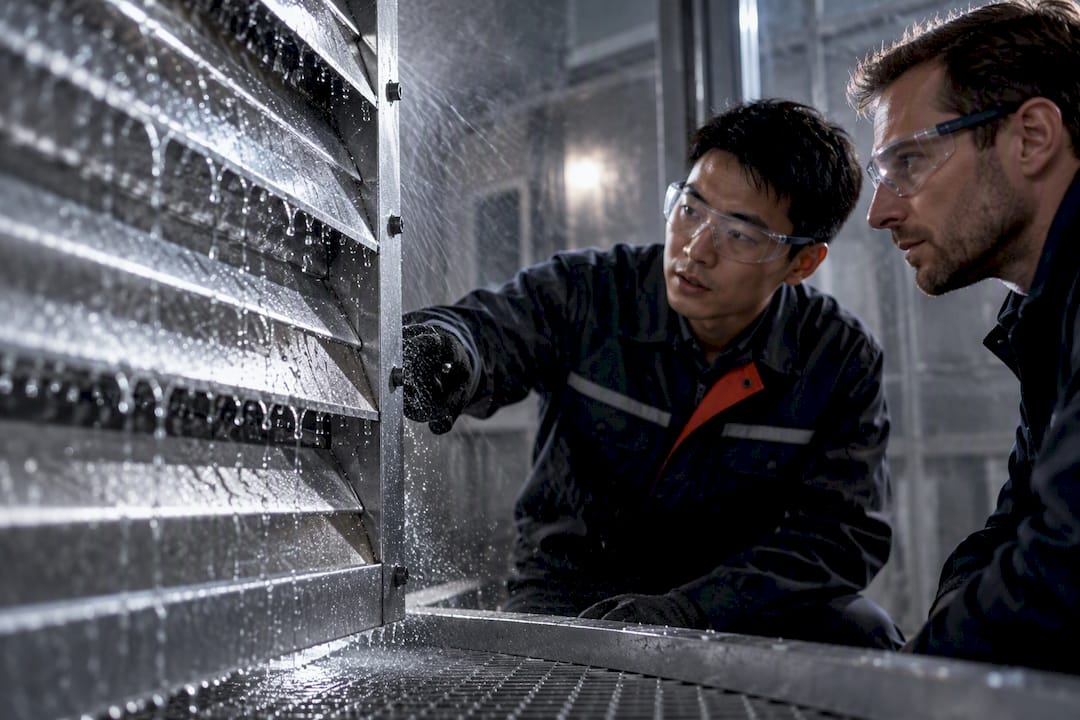
Successful louvered panel fabrication starts with performance targets, not aesthetics: free area and pressure drop determine whether a louver actually protects the opening it’s built for. Size the panel to its performance curve first, then choose a forming method and material to match. For coastal, high-wind, or wet-climate installations, insist on AMCA test data before signing off on a design, and route anything beyond simple prototyping to a certified fabricator rather than an in-house shop without tooling for the job.
TL;DR:
- Proper sizing of louvers should focus on free area and pressure drop, with performance data verified through AMCA test curves, especially for wind-driven rain or hurricane regions.
- Material choices vary from aluminum for general use to stainless steel for harsh environments, with forming methods like punch press or cut-and-bend impacting blade geometry and cost.
- Compliance requires requesting certified AMCA performance ratings, including water penetration and wind-driven rain resistance, to ensure real-world effectiveness beyond catalog claims.
- Design considerations include standard tooling limits, panel section sizes, and in-depth post-installation inspections to prevent leaks, corrosion, or performance drift over time.
- Cost factors include material, tooling, finishing, and shipping, with early performance specification alignment preventing costly modifications or mismatched expectations during fabrication.
Overview: What A Louvered Panel Is And Typical Applications
A louvered panel is a set of angled blades set into a frame that lets air pass while blocking rain, debris, or direct sightlines. The blade angle, spacing, and depth are tuned to the job: some panels prioritize airflow, others prioritize water rejection, and some are built mainly to control noise or hide equipment behind an architectural facade.
You’ll find them doing different jobs depending on where they sit:
- Exterior wall intakes and exhausts for HVAC systems, where airflow volume usually outranks weather protection.
- Penthouse and rooftop equipment screens, where wind-driven rain resistance often becomes the priority.
- Curtain wall and facade applications, where appearance and consistent blade lines matter alongside function.
- Ductwork transitions and acoustic enclosures, where blade geometry is adjusted to reduce noise transmission.
The application dictates the spec. An HVAC intake wants maximum free area to minimize fan load, while a coastal equipment screen trades some free area for water rejection under wind-driven rain, a distinction covered in the ANSI/AMCA 500-L testing framework.
Materials And Forming Methods For Sheet Metal Louvers
Material choice affects both durability and how the louver forms. Aluminum is the default for exterior architectural louvers because it resists corrosion and extrudes or forms cleanly. Stainless steel earns its place in marine or heavily polluted environments where aluminum’s oxide layer isn’t enough protection. Galvanized and galvanneal steel show up in budget-driven industrial jobs where appearance matters less than cost. Copper appears occasionally in architectural work for its patina, and specialty alloys get specified when a project has unusual chemical exposure.
Forming method depends on volume and blade geometry:
- Punch press tooling produces closed-end, straight-back louvers fastest, with clean repeatable cuts once the die is built.
- Press-brake forming adapts standard sheet metal equipment but needs a relief slit in the material to avoid tearing at the blade ends.
- Cut-and-bend fabrication using CNC or laser cutting followed by folding skips tooling cost entirely, but the resulting louvers lack closed sides and behave differently under wind load, a tradeoff sheet metal tooling references describe in detail.
Dedicated punch tooling pays off once a project moves past a handful of prototype units, since the per-part cost drops sharply at volume even though the upfront die cost is high. For a one-off mockup or a design still in revision, cut-and-bend keeps costs low while accepting a slightly different blade profile.
Pro Tip: Ask your fabricator whether the quoted forming method changes the louver’s free area or pressure drop rating before you approve a prototype as representative of the production part.
Sizing Louvers: Free Area, Face Velocity, And Pressure Drop
Two numbers govern whether a louver will actually work in its opening: free area and pressure drop. Get these wrong and the panel either starves the HVAC system of airflow or lets in more water than the building can tolerate.
- Free area is the ratio of open space between blades to the total face area of the panel, and it’s the starting point for every airflow calculation described in AMCA’s louver selection guidance.
- Face velocity is the airflow volume divided by the free area, and it drives both noise generation and the risk of water carrying through the blades under wind.
- Pressure drop rises as blade pitch tightens and blade depth increases, and it is the practical ceiling on how much water rejection you can add before the fan system can no longer push air through the opening.
- Blade geometry (pitch, depth, and profile) is the lever fabricators pull to trade free area against pressure drop and water rejection, and no single setting works for every application.
A still-air louver protecting a mechanical room can run a more open blade spacing and lower safety factor than a wind-driven rain louver on an exposed rooftop, where tighter spacing and a different blade profile are needed to hold back sprayed water at high velocity, as detailed in AMCA’s WDR testing reference. Don’t rely on a rule-of-thumb free area percentage carried over from a past project. Request the manufacturer’s AMCA lab curves for the specific blade profile you’re specifying, since pressure drop and water penetration numbers vary between product lines even at similar free area ratios.
Standards And Certifications That Matter For Spec Compliance
Louver performance claims are only as good as the test behind them. ANSI/AMCA Standard 500-L defines five separate test protocols that cover the ways a louver can fail in the field:
- Pressure drop testing, which produces the airflow-versus-resistance curve used to size fan systems.
- Airflow leakage testing, which measures how much air passes through a closed damper section.
- Water penetration testing under still-air conditions, a baseline that does not predict performance in wind.
- Wind-driven rain testing, which sprays water at velocity to simulate storm conditions on exposed sites.
- Wind-driven sand testing, relevant for arid or dusty locations where particulate infiltration is a concern.
AMCA CRP (Certified Ratings Program) seals mean the manufacturer’s published numbers were verified in an accredited lab rather than self-reported, and specifiers should require CRP-certified data for any critical system rather than accepting catalog claims at face value.
For hurricane-prone regions, AMCA 540 and 550 test methods address wind-borne debris and impact resistance. Some jurisdictions, including Florida, layer their own requirements on top: Miami-Dade and the Florida Building Code reference TAS 201, 202, and 203 for missile impact and cyclic wind pressure, with Notice of Acceptance (NOA) documentation required before installation.
One test result worth remembering: wind-driven rain louvers can achieve close to 99.7% rain resistance under specific lab test conditions, which is why WDR-rated blade geometry can sometimes shrink the required louver footprint compared to a standard still-air design covering the same opening.
Tooling Limits That Shape Louver Panel Design
Louver blades are functionally a one-shot feature once the punch tooling is built: the die geometry sets blade pitch, depth, and angle for every part run through it, and changing any of those later means a new die. That reality should shape design decisions from the start.
- Standard tooling sizes exist for common blade profiles, and designing within them avoids the cost and lead time of a custom die.
- Keeping a panel within a single standard section, rather than splicing two sections together, simplifies both fabrication and shipping.
- Larger single sections need intermediate blade supports or mullions to resist wind load and prevent blade flutter, and those supports interfere with the free area calculation if not accounted for early.
- Back-of-panel components, such as bird screens or actuator linkages for adjustable louver panels, compete with blade depth for the same physical space.
Adjusting a panel’s width or height by a small amount to fit a manufacturer’s standard maximum section size, as sheet metal design guidance points out, is a low-effort way to avoid a field splice altogether.
Pro Tip: Send your fabricator the rough opening dimensions before finalizing architectural drawings. A few inches of flexibility can be the difference between one shipped section and two spliced ones in the field.
Installation And Acceptance Checks Before Sign-off
Getting the panel right on paper doesn’t guarantee a clean installation. Verify these before crews leave the site:
- Confirm the submittal sheet dimensions, AMCA performance ratings, and blade orientation match what was actually shipped, not just what was ordered.
- Check drainage details and flashing at the sill, since a correctly rated louver can still leak if the surrounding wall assembly wasn’t detailed to shed water away from the opening.
- Verify clearances around adjacent equipment, particularly for adjustable louver panels where actuator hardware needs room to swing.
- Where a field splice was unavoidable, inspect the joint for continuous sealant coverage and confirm it wasn’t treated as a simple butt joint.
- Request a final visual and dimensional inspection against the submittal package, and where the project scope justifies it, ask for performance confirmation tied back to the original AMCA test data.
Sizing to a single section whenever the opening allows removes an entire category of field risk: splice leakage and the extra labor hours needed to seal a joint correctly on site.
What An Iso-certified Fabricator Brings To Complex Louver Projects
Complex or high-volume louver work benefits from a fabricator that already carries ISO certification and quality assurance protocols built for regulated industries. A fabricator running multiple manufacturing plants can support both rapid prototyping and larger production runs, ideally with an English-speaking support team for international procurement teams.
Before committing to any fabricator, ask about tooling ownership, how AMCA test data is handled and passed through on submittals, and what traceable QA documentation accompanies each production run.
Common Defects And How Quality Control Catches Them
The most frequent louver defects trace back to tooling wear, material handling, or rushed forming steps. Torn blade edges usually mean the press-brake relief slit was too shallow or the die was overdue for maintenance. Inconsistent blade pitch across a panel, visible as uneven shadow lines from a distance, points to die wear or operator error on a manual brake setup. Warped frames often result from welding heat distortion that wasn’t relieved before final assembly, a particular risk with thinner-gauge stainless.
Water penetration failures in the field frequently trace back to a mismatch between the tested blade profile and what actually shipped, sometimes because a substitution was made during production without re-testing. Corrosion showing up early, well before the expected service life, usually means the specified finish wasn’t applied correctly or a dissimilar-metal contact point was overlooked at the frame.
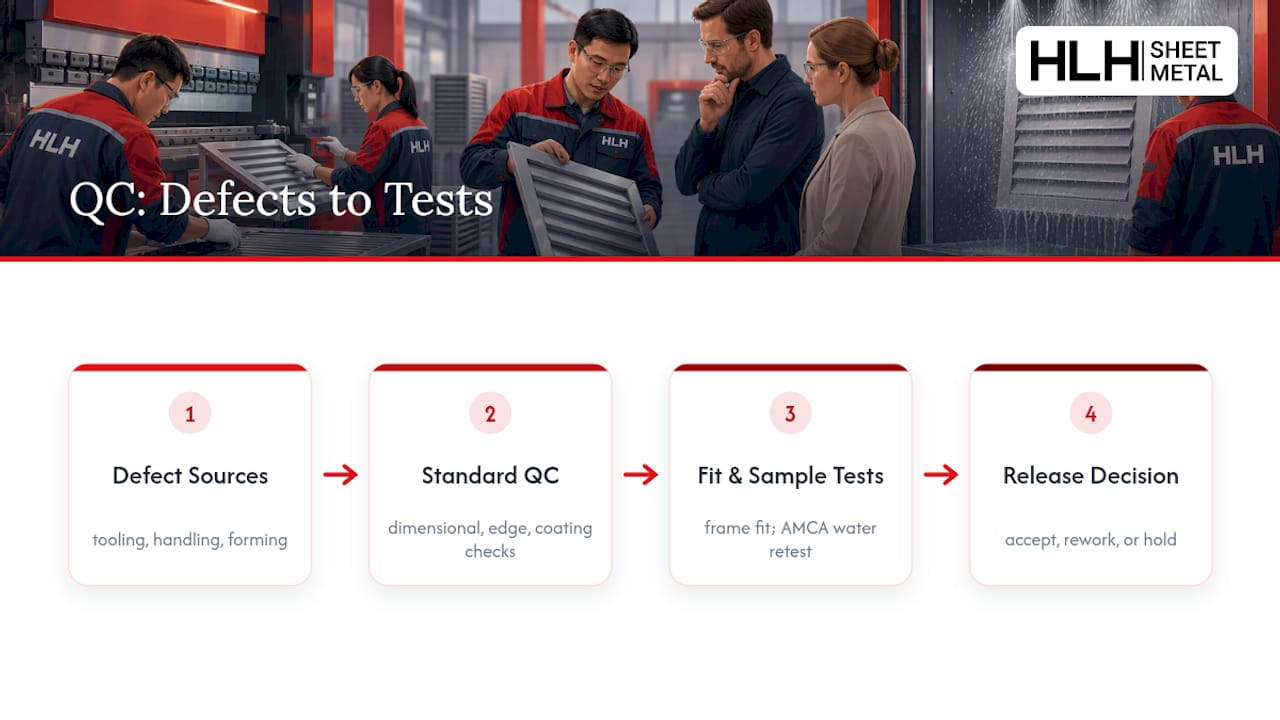
Quality control that catches these problems before shipment includes dimensional checks against the die specification, visual inspection of every blade edge for tearing or burring, coating thickness verification on finished panels, and a final fit check against the frame opening dimensions. For panels headed to coastal or high-wind sites, a batch sample pulled for water penetration retest against the original AMCA submittal data is worth the extra step, since a die that has run thousands of cycles can drift slightly from its original tolerance.
Budgeting For Louvered Panel Fabrication Projects
Cost on a louver project breaks into three buckets: material, tooling, and finishing. Material cost scales with the metal chosen and the gauge required to meet wind load, with stainless steel and specialty alloys sitting well above galvanized steel and standard aluminum. Tooling is the variable that catches procurement teams off guard: a dedicated punch die for a custom blade profile carries a real upfront cost that only makes sense once volume justifies it, while cut-and-bend prototyping avoids that cost entirely but at a higher per-unit price for larger runs.
Finishing adds its own line item. A mill finish or standard anodize costs far less than a custom powder coat color match, and marine-grade coatings for coastal projects cost more still.
Freight and section count matter too: a panel split into two spliced sections to fit shipping constraints adds labor cost on both ends that a single properly sized section avoids.
The most common budgeting mistake is pricing against a rule-of-thumb free area without accounting for the blade geometry actually needed to meet a wind-driven rain or hurricane rating. A WDR-rated or impact-tested louver with tighter blade spacing needs more material per square foot of opening than a basic still-air intake louver, and that difference should show up in the estimate before drawings are finalized, not after. Getting AMCA-referenced performance requirements settled early, before requesting quotes, keeps the bid comparison honest across fabricators.
Keeping Fabricated Louvers Working Over Time
A properly specified louver should last for decades, but that depends on matching the finish to the environment and keeping up with basic upkeep. Aluminum with a quality anodized or powder-coated finish holds up well in most climates; stainless steel earns its cost in marine or industrial settings where aluminum’s protective oxide layer would eventually break down under constant salt or chemical exposure.
Routine maintenance is straightforward: clear debris from blade surfaces and drainage channels periodically, since blocked drainage is what turns a properly rated water-rejection louver into a leak point. Adjustable louver panels with actuator linkages need periodic checks on the hardware itself, since a stuck or misaligned actuator can leave blades in a position that doesn’t match the tested configuration.

Corrosion at fastener points and dissimilar-metal contacts is the most common long-term failure mode, particularly where aluminum blades meet steel framing without an isolating gasket. Catching that early with a visual inspection costs far less than replacing a corroded section later. For coastal or industrial sites, a rinse-down schedule to remove salt or chemical buildup extends the finish life well beyond what the base coating alone would provide.
What Procurement Teams Get Wrong About Louver Specs
The conventional advice on louver specification leans hard on free area percentage as the headline number, and that’s a mistake. Free area alone tells you almost nothing about how a louver behaves under real wind and rain. Two louvers with identical free area ratios can perform completely differently once wind-driven rain enters the picture, because blade depth and pitch, not the open ratio, are what actually reject water.
The bigger gap I see is procurement teams treating AMCA-certified data as optional paperwork rather than the actual product spec. A catalog free area number without a CRP-certified pressure drop and water penetration curve behind it is a marketing figure, not an engineering one. If a fabricator can’t produce that data for the specific blade profile being quoted, that’s the moment to ask why, not the moment to assume it’s fine.
Prioritize the test data over the trim details. Blade color and frame profile are easy to change late in a project. A blade geometry that fails wind-driven rain testing on an exposed site is not, and fixing it after installation costs far more than getting the spec right before fabrication starts.
— Nash
How HLH Sheet Metal Supports Custom Louver Panel Projects
Once your free area, pressure drop, and AMCA test targets are settled, the fabrication side comes down to execution. HLH Sheet Metal offers sheet metal fabrication covering laser cutting, bending, welding, and surface finishing, with rapid prototyping available for testing a blade profile before committing to production tooling.
To get an accurate quote, share your drawings, the AMCA performance targets your project needs to meet, and your expected production quantity. Visit the capabilities page to start that conversation.
FAQ
How Can I Make My Own Louvers?
Small quantities can be cut and folded from flat sheet stock using a CNC router, laser cutter, or press brake, though this method produces open-sided blades that behave differently from tooled louvers. For production quantities or any application needing certified performance data, punch press tooling built to a tested blade profile is the reliable route.
What Is A Louvered Panel?
A louvered panel is a framed set of angled blades that allows air to pass through an opening while blocking rain, debris, or direct sightlines. Performance is measured mainly by free area and pressure drop, which together determine how much air moves through the panel and how much resistance that airflow meets.
What Are The Disadvantages Of Louvers?
Louvers reduce the effective open area of a wall opening compared to no barrier at all, which adds airflow resistance that fan systems must overcome. Water-resistant blade geometry, needed for wind-driven rain protection, further reduces free area, so a heavily weather-protected louver often needs a larger footprint than a basic ventilation louver to move the same amount of air.
What Is The Best Material For Louvers?
Aluminum is the standard choice for most architectural and HVAC louvers because it resists corrosion and forms cleanly at a reasonable cost. Stainless steel is worth the added expense in marine, coastal, or heavy industrial environments where aluminum’s protective layer would break down faster under constant exposure.
When Should I Request AMCA Test Data Instead Of Catalog Specs?
Request certified AMCA data any time the installation faces wind-driven rain, coastal exposure, or hurricane-related building code requirements, since catalog free area numbers alone don’t confirm water rejection performance. AMCA CRP-certified pressure drop and water penetration curves give you the verified performance data a submittal review actually needs.
Recommended
- The Most Corrosion-Resistant Metals and How to Choose One
- Engineers & Buyers: Verify IP Rated Enclosures Before Tooling
- Stop Rework: CAD First Sheet Metal Enclosure Design for Engineers

