




Table Of Contents
China is usually cheaper than France on raw fabrication rates, but the gap narrows once freight, duties and inventory carrying costs enter the quote. Treat China as the cost leader for stable, high-volume designs, and France as the better fit for short lead times and iterative R&D. The sections below give you the numbers and a checklist to apply to real quotes.
TL;DR:
- France’s nonwage labor costs are 32.3% of total labor costs, while Chinese loaded labor is about $7–$10 per hour; price identical drawings, quantities, and finishes.
- EU duties on certain Chinese tinplate imports ranged from 13% to 62% as of May 2025; check current TARIC rates before sourcing.
- Keep prototypes, urgent orders, and active design changes local; move stable, repeat production to China only after checking freight, duties, inventory, and inspection costs.
- Sea freight adds weeks, while each remote design revision adds another ship and review cycle; request stage by stage timelines and plan safety stock.
- For regulated or safety critical parts, require certificates whose scope covers the actual production plant, then verify documentation through a prototype or pilot lot.
Quick Cost Snapshot: What Do France And China Shops Charge Per Hour?
Start with labor context, because every shop-hour quote is built on it. Eurostat data show elevated hourly labor costs across the euro area, and France records a large non-wage share of total labor costs. Chinese manufacturing labor is frequently cited at roughly $7–$10 per hour including charges.
Use these reference points when benchmarking RFQs:
- France: shop-hour and laser-cut-hour quotes carry a heavy employer-charge load, so expect quotes well above your China baseline for the same process.
- China: loaded labor in the $7–$10 per hour range, which feeds directly into lower shop-hour quotes for cutting, bending and welding.
- Mapping your RFQ: compare like with like. Ask both suppliers to price the same drawing, material, quantity and finish, then compare unit price and hourly rate side by side.
France’s non-wage labor costs are 32.3% of total labor costs. That is Eurostat’s 2025 figure, and it explains why a French shop-hour rate climbs faster than the wage on the payslip suggests.
For a wider view, Eurostat’s hourly labour costs reporting shows EU hourly costs spanning €12.0 to €56.8 in 2025, with France sitting at the expensive end of that range.
What Drives The Cost Gap Between French And Chinese Fabricators?
The difference is structural, not a matter of one supplier padding a quote. Five drivers do most of the work, and knowing which ones apply to your part tells you how much of the saving is real.
- Labor and employer charges. France’s non-wage share of 32.3% (Eurostat) inflates every hour a technician spends on your part.
- Electricity. The IEA’s 2026 analysis finds electricity for energy-intensive industries in the EU averages roughly double U.S. levels and more than 50% above China. Laser cutting and press work are power-hungry, so this shows up in the per-part price.
- Machine amortization and utilization. A fiber laser that sits idle still costs money. Low utilization pushes the effective hourly rate up, while fabricators that own their lasers and keep them busy narrow the gap.
- Materials. Dense local supply of commodity metals in China typically lowers input costs for steel, aluminum and galvanized sheet.
- Overheads. Rent, insurance, compliance and certification administration are heavier fixed costs in Europe.
Pro Tip: Ask each supplier to split a quote into material, machine time, labor, finishing and overhead. The line where the two quotes diverge most tells you which driver is carrying the gap.
For a deeper look at how pricing is built on our side, see our guide to key factors affecting fabrication price in China.
How Do Landed Cost, Duties And Lead Time Change The Raw Price?
A processing quote is not a purchase price. Landed cost is what the part actually costs you at your dock, and it is the only fair basis for comparing a French and a Chinese offer.
Build your landed-cost model with these line items:
- Freight and cargo insurance
- Customs brokerage and clearance fees
- Import duties
- Anti-dumping duties where a product is covered
- Inventory carrying cost for stock in transit and safety stock
- Allowance for rework or engineering change orders
Anti-dumping duties on certain Chinese tinplate imports ranged from 13% to 62% as of May 2025, according to the EU’s trade announcement. On a tinplate part, a duty in that range can erase a processing advantage, so check current TARIC data for your specific material before you finalize sourcing.
Lead time matters in the math too. Longer transit ties up capital, increases inventory risk and can make a higher local rate the cheaper choice for urgent or low-volume work. Excluding logistics and duties overstates the saving from China, which is why we recommend one habit: always ask vendors for a landed-cost example on a representative bill of materials and a stated incoterm.
How Should You Decide Between China, France Or A Hybrid?
Score each project against five criteria: annual volume, engineering maturity, required lead time, certification needs and tolerance for iteration. Then apply these rules.
- Choose China when the design is stable, volumes are large and the supplier can show a landed-cost breakdown that stays competitive after duties and shipping.
- Choose France or a local shop for prototypes, rapid design iterations and regulated or safety-critical products where close collaboration and short turnaround reduce risk.
- Split the work with a hybrid pattern: run urgent iterations or pre-production locally, then scale production in China once the design freezes.
- Stagger tooling and ramp-up so a drawing change found at first article does not strand a full production batch.
- Re-score at each stage. A project that starts as R&D often becomes a volume program, and the right supplier changes with it.
Our comparison of China versus Canada fabrication costs applies the same logic to another high-cost market.
What Are The Practical Benefits Of Partnering With A Chinese Sheet Metal Fabricator?
When the project fits, a well-chosen Chinese partner changes more than the unit price. These are the advantages we see procurement teams value most:
- Lower unit processing cost at scale, driven by labor, energy and material access.
- A dense supplier ecosystem for hardware, coatings and finishing, which cuts the delays of sourcing secondary operations separately.
- Range from prototype to mass production. With multiple plants, we handle small prototype runs and large production volumes without moving your project to a new vendor.
- Less coordination friction. Our team is fluent in English and quality is backed by ISO certifications, so drawings, questions and corrections move quickly.
Pro Tip: Start with a prototype order and a full landed-cost quote for the same part. You will see both the quality and the real price before committing volume.
Our write-up on how China matches local quality covers the coordination practices that make this work.
How Do Fabrication Lead Times Compare In France And China?
Lead time is where France often wins on paper and China often wins on capacity. Here is how the pieces fit together, without pretending one number applies to every part.
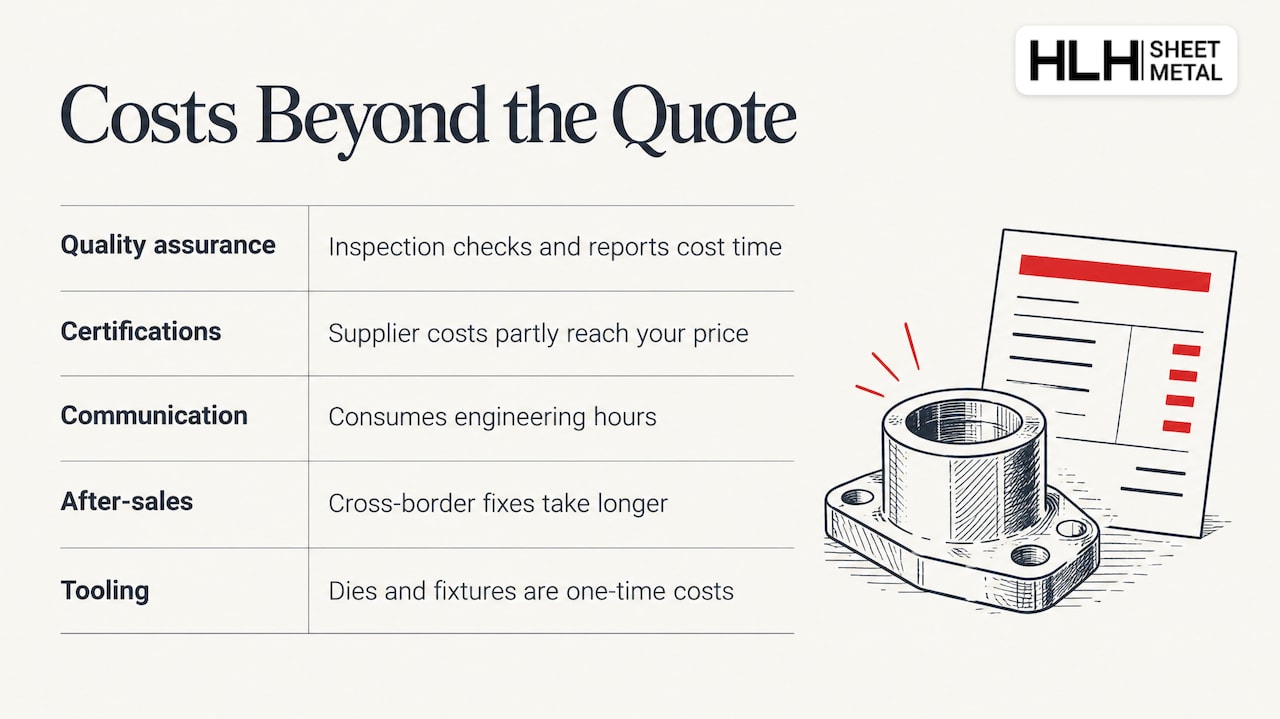
Production time. A local French shop with open capacity can often turn a simple prototype quickly, and you can walk the floor if something goes wrong. A Chinese supplier with several plants can run larger batches in parallel, so production time for volume orders is often shorter than a single regional shop can offer.
Transit time. This is the variable France does not carry. Sea freight from China adds weeks, while air freight shortens that at a much higher cost per kilogram. Either choice should appear in your landed-cost model, not be treated as an afterthought.
Iteration cycles. Each design change in a long-distance program costs a full ship-and-review loop. For a part still being refined, those loops compound quickly, which is why local suppliers suit early development.
Buffer stock. Longer, less flexible supply lines mean you hold more safety stock. That carrying cost belongs in the comparison.
A practical way to compare: ask both suppliers for a timeline broken into engineering review, material procurement, production, finishing, inspection and shipping. Place the two side by side and the true gap, and the stage that causes it, becomes visible. For stable, repeat orders, scheduled replenishment absorbs the transit time. For one-off urgent needs, local capacity is usually worth its premium.
What Costs Sit Beyond The Fabrication Quote Itself?
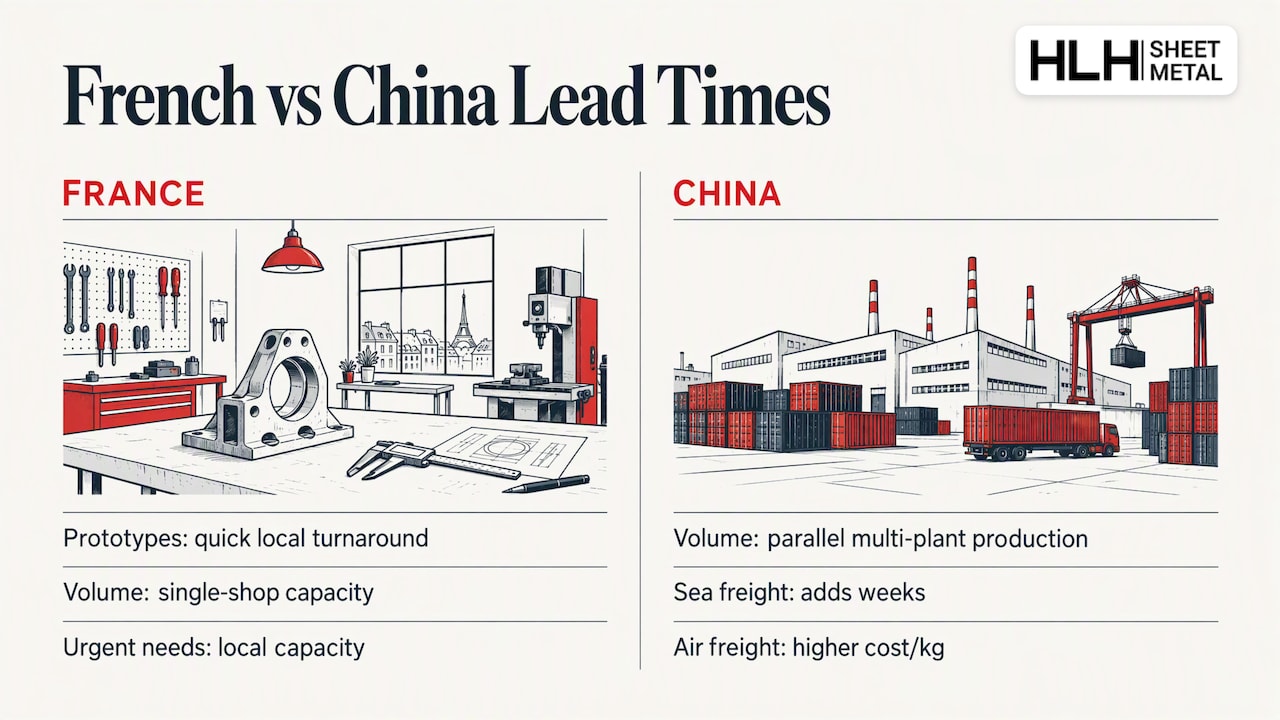
The quoted price covers cutting, bending and welding. The total cost of ownership includes a layer of work that rarely appears on the first quote.
Quality assurance. Inspection reports, first article approval, dimensional checks and material certificates all take time and money. In France you may attend inspections in person. With a Chinese partner, you specify the inspection plan and required documentation up front, and decide whether to add a third-party inspector for critical lots.
Certifications. Industry certifications cost suppliers money to obtain and maintain, and part of that cost reaches your price. Confirm which certificates you need before you request quotes so every supplier prices the same requirement.
Communication overhead. Time zones, drawing clarifications and change approvals consume engineering hours. A responsive, English-speaking support team shrinks this cost, and we run English-speaking project support for that reason.
After-sales support. Replacements, rework and warranty claims across borders take longer than a local fix. Agree the process for nonconforming parts before the first order, not after.
Tooling and fixtures. Stamping dies and welding fixtures are one-time costs that are easy to overlook when comparing per-unit prices. Clarify who owns them and where they are stored.
Add each item as a line in your landed-cost sheet. Once you do, the comparison reflects the full cost of getting a conforming part into your plant rather than just the shop-floor price.
How Do Quality Standards And Certifications Affect Cost And Vendor Choice?
Certification is a filter first and a cost factor second. If your end product requires a specific standard, any supplier without it is out of consideration, and the price comparison only runs among those that qualify.
In France, many fabricators work inside the European regulatory environment and hold certifications that customers in aerospace, rail and medical sectors expect. Maintaining those systems adds fixed overhead, which is part of why hourly rates run higher.
In China, quality varies widely across suppliers, so the certificate and the audit trail matter more than the country label. We hold ISO certifications and apply documented quality assurance protocols, and we serve sectors from aerospace to medical, where documentation expectations are strict. Whatever supplier you consider, ask for the certificate, check its scope against your part and confirm it covers the plant that will make your order.
Practical vendor-selection steps:
- List the standards your product requires before you request quotes.
- Request material certificates and inspection reports as standard deliverables.
- Run a prototype or pilot lot and inspect it against your drawing.
- Audit remotely or in person for programs above a size you define.
Treat certification cost as part of the quote, not an extra. A supplier that already carries the right certifications and quality procedures often costs less over a program than a cheaper one that must build them from scratch.
How Do Cultural And Communication Differences Create Cost Risk?
Most cross-border cost surprises trace back to misunderstanding, not to bad faith. A drawing note read differently, an unstated tolerance assumption or a silent “yes” to an unclear request can produce a full batch of wrong parts.
Common friction points:
- Ambiguous drawings. Gaps in tolerances, finish callouts or material grades get filled with the supplier’s assumptions.
- Time zones. A question asked at the end of your day may wait until the next to be answered, stretching approval cycles.
- Indirect confirmation. A supplier may be reluctant to say a requirement is impossible, so confirm understanding by asking for a written summary or a marked-up drawing.
- Change control. Informal changes by email or chat get lost. Use revision-controlled drawings and written change orders.
Mitigations are mostly procedural. Write complete drawings with a clear tolerance block. Ask for a manufacturing review before production and require the supplier to flag any feature they would change. Name a single point of contact on each side, and agree on response-time expectations at the outset.
This is where a partner with an English-speaking engineering and project team removes a real cost. Our team supports international clients, helping questions get answered promptly. Local French suppliers share your language and calendar, which lowers this risk by default, but a well-run China program with disciplined documentation closes most of the difference.
How Does Intellectual Property Protection Affect Cost And Vendor Choice?
Intellectual property risk is a legitimate concern in any outsourced manufacturing, and it should shape both how you share data and whom you choose. It rarely requires abandoning a low-cost region, but it does require a deliberate approach.
Practical measures, applicable in both countries:
- Contracts first. Sign a non-disclosure agreement and a manufacturing agreement that states ownership of drawings, tooling and any improvements before sending files. Have counsel in the relevant jurisdiction review enforceability for your situation.
- Share only what is needed. Send the manufacturing drawings the supplier needs, not your full assembly or source design files.
- Split critical know-how. Keep proprietary processes, firmware or sensitive subassemblies in-house or with a trusted local supplier, and outsource the sheet metal enclosure or bracket work.
- Control tooling. Specify that dies and fixtures belong to you and can be moved to another supplier.
- Choose established partners. A supplier with a track record serving international OEMs has a commercial reason to protect client data.
Cost enters in two ways. Legal review, tooling ownership clauses and any audits add modest upfront expense. For highly sensitive designs, the tolerance for risk may favor a local supplier even at a higher hourly rate. For commodity enclosures, brackets and chassis, where the design value lies elsewhere in your product, the protections above are usually enough to keep China competitive.
Author Perspective: Why Landed Cost Beats Headline Rates
My rule is simple: never award volume on the hourly rate alone. Score each project on landed cost and project fit, and the right answer usually becomes obvious. Before signing a large contract, run a pilot order and a full landed-cost exercise on the same part, with real freight, duties and inspection included. Then mix capacity: keep local suppliers for iteration and urgent work, and use China for stable, repeatable volume. That balance protects lead time, quality and unit cost together.
— Nash
How We Can Help You Source Sheet Metal Parts From China
If the numbers point you toward China, we can make the first step concrete. We provide precision sheet metal fabrication, laser cutting, bending, welding, stamping and surface finishing, from rapid prototypes to mass production, across multiple plants in China.
The practical next step is to send us a drawing or a sample bill of materials and ask for a tailored quote with a landed-cost breakdown for your destination and incoterm. Pricing is quoted per project, so we do not publish a rate card. Our quality system is built on ISO certifications, and our English-speaking support team answers questions around the clock, so you are not waiting a day for a clarification. Request your quote on our precision fabrication page and see the full cost before you commit to volume.
FAQ
How Much Does A Ton Of Steel Cost In China?
Steel prices move with the market, so there is no single fixed figure, and any number goes stale quickly. Check a current commodity index or ask your fabricator to quote material separately from processing so you can see the input cost on the day you order.
How Much Should You Charge For Metal Fabrication?
Price from the cost build-up: material, machine time, labor, finishing, overhead and margin. Compare the result with market benchmarks such as the Eurostat labor cost data for your region, then adjust for complexity and volume.
Why Is Manufacturing Cost Low In China?
Lower loaded labor costs, cheaper industrial electricity, nearby material supply and a dense supplier network all contribute. The IEA reports that EU industrial electricity runs more than 50% above China’s, which affects energy-heavy processes like laser cutting.
What Is The Difference Between Fabrication And Sheet Metal?
Sheet metal is the material: thin, flat metal stock. Fabrication is the set of processes that turns it into parts, such as cutting, bending, welding and finishing.

