




Table Of Contents
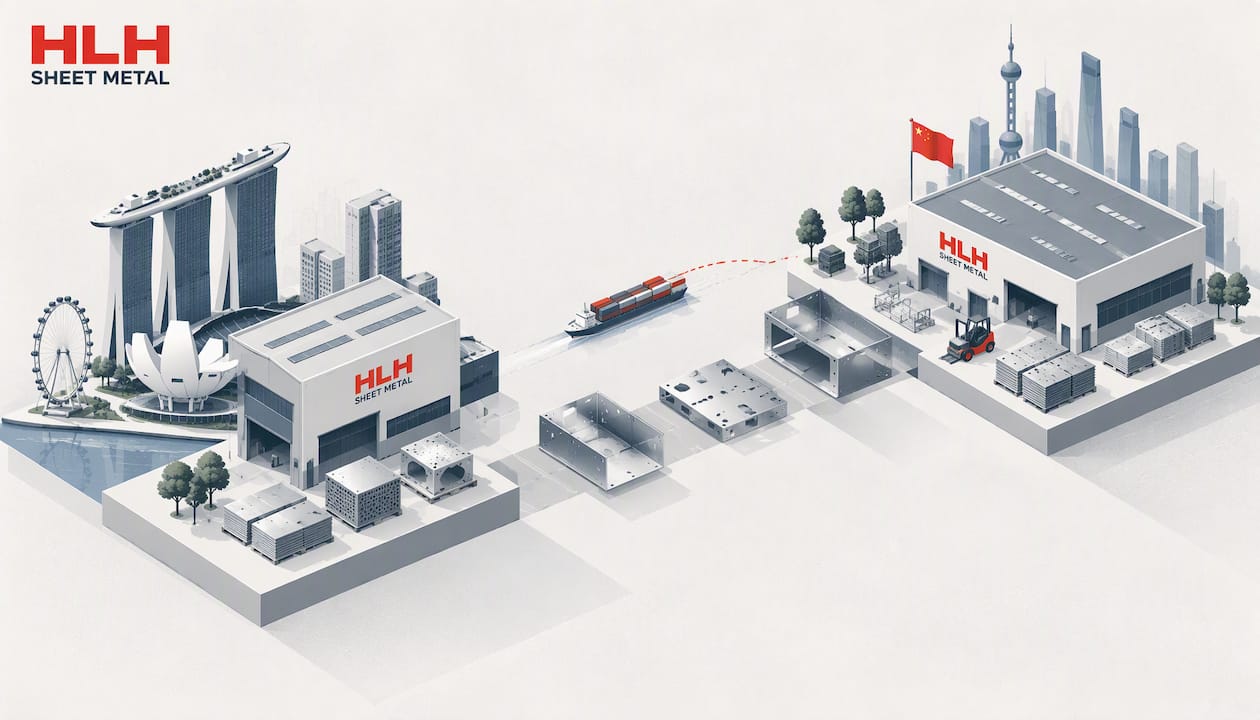
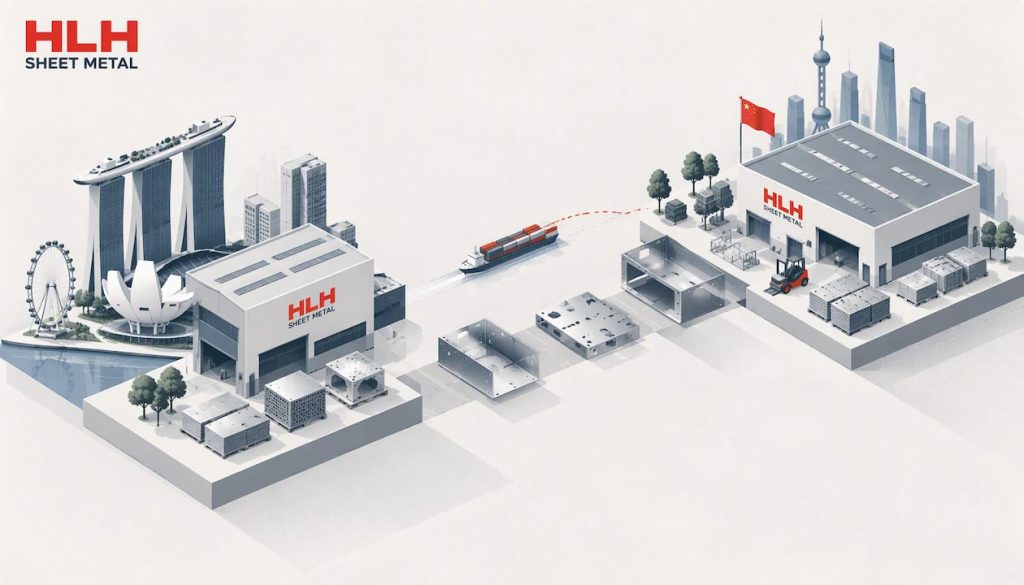
For most custom sheet metal parts, a Chinese fabricator will quote a lower unit price than a Singapore shop, and the gap usually survives freight, duty and GST. How wide it stays depends on part complexity, order size, finish and certification needs, not on the hourly rate alone. This guide shows where the cost difference comes from, what to add to a Chinese quote to get a true landed price, and when staying local still makes sense.
It is written for procurement managers, engineers and product designers who need to compare quotes on equal terms. We do not publish prices for our services, so you will not find invented Singapore or China unit prices here. You will find the cost drivers, the sourced numbers that exist, and a method for building your own comparison.
TL;DR
- Labor is the visible gap, but routing (bends, setups, hardware, welding, finishing) usually drives the total more than the plant’s location.
- Importing from China to Singapore is favorable: most industrial goods enter at near-zero duty with a Form E, and 9% GST applies on top.
- Freight is small next to the part value for most orders, so run a landed-cost sheet instead of comparing ex-works prices.
- Singapore suits very small, urgent or highly specialized work. China suits prototypes through six-figure runs where price and capacity matter.
- For aerospace and medical parts, compare certifications (AS9100, ISO 13485) before comparing price.
Why The Two Markets Price So Differently
Singapore and China have built different manufacturing roles. Singapore’s government describes its manufacturing competitiveness as increasingly driven by productivity and specialization in outward-oriented, high-tech sectors, with firms moving away from labor-intensive, low-margin work. That is a sensible strategy for a small, high-wage economy. It also means a general sheet metal job (enclosures, brackets, chassis) competes for capacity with higher-value work, and the price reflects it.
China’s position is the opposite: scale. Clusters of fabricators, tool makers, finishers and material suppliers sit close together, and the proximity of these businesses allows efficient supply chain integration, which cuts costs and speeds response. A part that needs laser cutting in one shop, powder coating in the next street and hardware from a third supplier moves in days, not weeks.
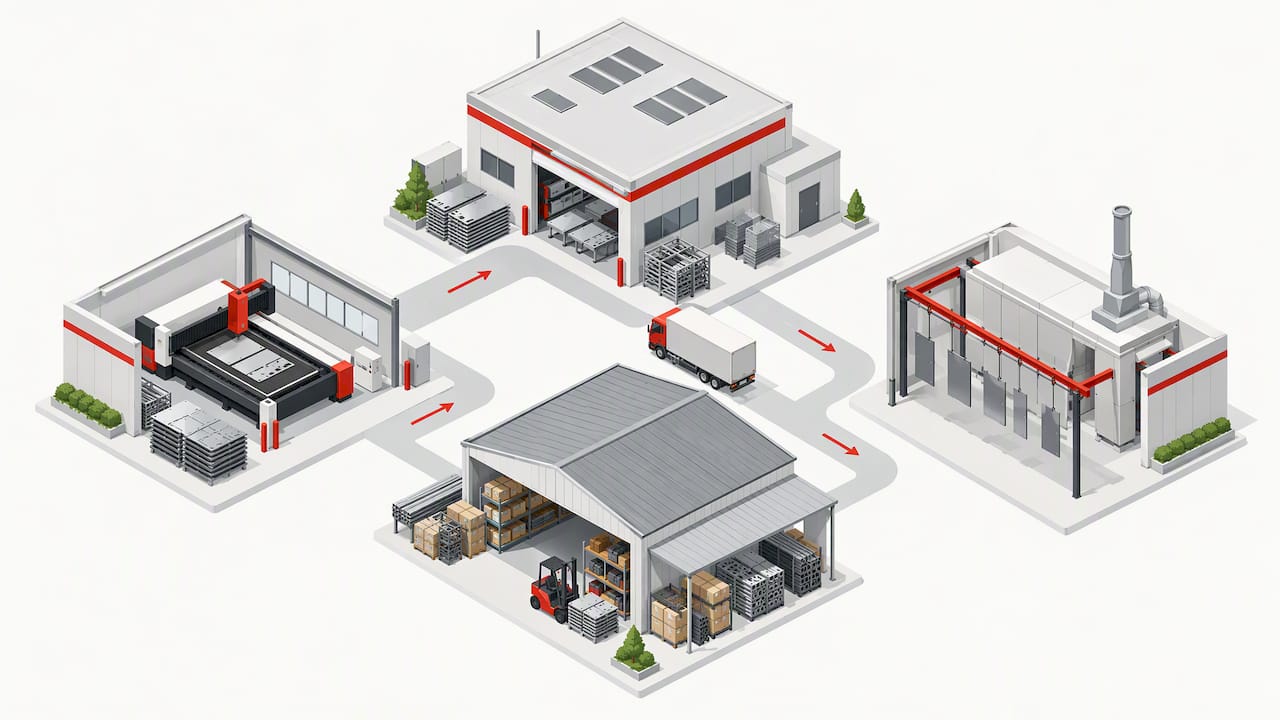
A comparable story shows up in other industries. One engineering firm’s article on how global delivery centers raise efficiency and cost-effectiveness shows the same logic: scale and specialization in one hub can beat doing everything locally, as long as you manage the interface well.
Labor: The Gap Is Real, But Narrower Than It Was
China is no longer the ultra-cheap labor market of 2005. According to a 2026 analysis, coastal manufacturing labor now runs about US$4.50 to $5.50 per hour in the private sector, and US$6.50 to $7.00 for public units, roughly triple 2005 levels. Official data tell a similar story: private-sector manufacturing wages averaged RMB 71,467 in 2024, a 0.4% decline from 2023.
Singapore is far higher. Across all sectors, the Ministry of Manpower’s figures put the median gross monthly income of full-time employed residents at SGD 5,775 in 2025. That is an economy-wide median, not a fabrication wage, so do not read it as a shop rate. It does show the scale of the difference in the cost base that every Singapore job has to carry.
Two cautions keep the comparison honest:
- Labor is only part of the unit price. On a laser-cut and bent part, much of the cost is machine time, material and finishing.
- Cheap hourly rates do not equal a cheap project. Rework, delays and miscommunication erase savings quickly. That is why plant quality systems and responsive engineering support matter as much as the rate.
What Actually Drives Sheet Metal Cost, In Either Country
Cost modeling specialists are blunt about this: modern estimating relies on physics-based models rather than simple hourly rates, and total cost is dominated by the manufacturing routing (how many setups, tool changes and secondary operations a part needs), wherever the plant sits. Regional rates then adjust the result.
That has practical consequences for your design:
- Material utilization. Nesting efficiency is among the most overlooked cost factors, and poor design can add 30 to 50% to material expense. Parts that nest tightly on a standard sheet cost less in Singapore and in China.
- Bends. Every bend is a press-brake operation and a setup. Fewer, consistent bend radii cut time.
- Hardware insertion. PEM nuts and studs, plus welding and finishing, often dominate total unit cost more than base material.
- Finish. Powder coat, anodize, plating and silk screening each add handling, masking and cure time.
- Volume. Setup cost spreads across the batch. A 20-piece run and a 20,000-piece run are different pricing problems.
Because labor-heavy steps (welding, grinding, hardware, manual finishing) are where wage differences bite hardest, welded and finished assemblies tend to show the biggest savings from China. Simple flat laser-cut parts show a smaller gap, because machine time and material dominate. Material also matters: China produces a very large share of the world’s steel and aluminum, so shops there generally buy close to the mill.
Building A Landed-cost Comparison
An ex-works price from a Chinese plant is not what you pay. Build the full figure with these lines, then compare it with the Singapore quote, which is typically delivered and already includes local GST treatment.
| Cost line | Singapore shop | China plant |
|---|---|---|
| Unit price (material, machine time, labor) | Quoted delivered | Quoted ex-works or FOB |
| Tooling and setup | Often folded into price | List separately, amortize over the run |
| Surface finishing | Local or subcontracted | Usually in-house or nearby |
| Freight and insurance | Local delivery | Sea, air or express |
| Import duty | None | Near-zero with Form E |
| GST | Included in invoice if registered | 9% on import value |
| Inspection and documentation | Local audit is easy | Request reports, first-article samples |
Duty And GST On The Way Into Singapore
The China-Singapore Free Trade Agreement is a major help. Most industrial goods enter at near-zero duty when you present a Form E certificate of origin. GST still applies: Singapore’s tax authority states that you must pay GST when you import goods, whether or not you are GST-registered/claiming-gst-(input-tax)/importing-of-goods), unless a relief applies. The rate is 9% as of 2026. A GST-registered business can generally claim that import GST back as input tax, so for many buyers it is a cash-flow item rather than a true cost. Confirm your own position with your accountant or a customs broker.
Freight
Shipping from China to Singapore is among the shortest and cheapest lanes in Asia. One 2026 rate summary lists 20-foot sea containers at roughly $306 to $374, with 5 to 10 days port to port. Rates move, so treat them as a guide and ask for a current quote. For a pallet of enclosures, freight is usually a small percentage of part value. For lightweight, high-value parts, air freight is workable and still fast.
A Worked Way To Compare
Take one drawing and ask both suppliers to quote the same revision, material grade, finish and quantity. Then:
- Convert both quotes to one currency.
- Add freight, insurance and any broker fee to the China quote.
- Add tooling (if any) divided by the lifetime quantity.
- Add 9% GST to the import value, then subtract it if you can reclaim it.
- Add a risk line for lead time: how many days of buffer stock the longer route needs.
When you do this, the pattern usually holds: the more labor, finishing and volume in the part, the larger the China advantage.
Where China’s Advantages Go Beyond Price
Capacity And Process Depth
A large Chinese fabricator runs laser cutting, punching, bending, welding, stamping and finishing under one management. That lets you move from prototype to volume without changing suppliers. Our guide on capacity for runs in the six figures explains how to check this before you commit.
Material Range
Steel, aluminum, stainless, galvanized steel, copper, brass, titanium and magnesium are all part of normal production at our plants. A broad material range in one place means you can compare alloys for weight and cost during the design stage without finding another vendor.
Speed
Fast prototyping is a cost issue as much as a schedule issue. Each design loop caught in a prototype is cheaper than one caught in production. With multiple plants in China, we can take small prototype batches and large runs, and our English-speaking team answers around the clock, so time zone gaps do not add days to a revision.
Quality Is A System, Not A Country
The old assumption that low price means low quality does not hold for plants with real quality systems. Our guide to how Chinese fabrication matches local quality goes through inspection methods and what to ask for. We work under ISO-certified quality assurance, with inspection and traceability built into production.
Certifications: The Cost That Decides Regulated Work
For aerospace and medical devices, supplier cost is defined by compliance. Frameworks such as AS9100 for aerospace and ISO 13485 for medical devices are risk-management systems that ensure traceability and defect-free delivery, not decorative badges. A cheap quote from a shop without the certificate your customer requires is not a quote you can use.
So for regulated parts, ask these questions first, in Singapore or China:
- Which certificates does the plant hold, and are they current?
- Can it provide material certificates, first-article inspection reports and lot traceability?
- Does the plant have prior experience with your industry’s documentation?
If you build medical equipment, start with our pages on medical sheet metal fabrication to see what we can support, and confirm certificate scope with our team for your specific project.
Perspective: What We See When Buyers Compare These Two Markets
We fabricate in China, so you should weigh our view accordingly. But the pattern we see across quotes is consistent, and we would rather you check it than take our word.
Buyers often start by comparing hourly rates. That is the wrong first question. The first question is how many operations the part needs. A bracket with two bends and no finish is a small gap between countries. An enclosure with forty bends, welded seams, hardware inserts and powder coat is where the difference becomes decisive, because each of those steps multiplies labor and handling.
The second thing we see is that the cheapest quote is rarely the cheapest project. Drawings with unclear tolerances, missing finish callouts or an unspecified material grade lead to quotes that cannot be compared. Fix the drawing first, and quotes from any country become useful.
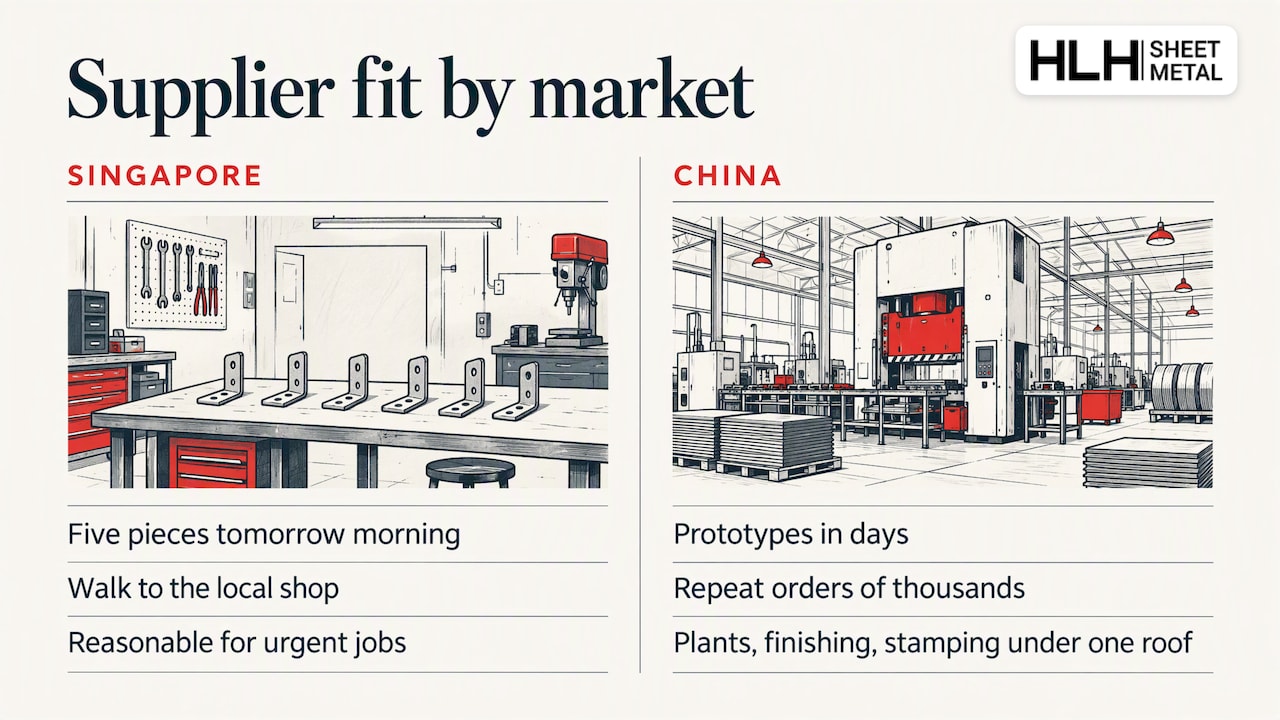
Third, we do not think China is right for everything. If you need five pieces tomorrow morning and can walk to the shop, a local Singapore fabricator is a reasonable choice. If you need prototypes in days, then a repeat order of thousands, a supplier with plants, finishing and stamping under one roof wins on total cost and on the number of vendors you have to manage.
Our advice: send the same package to both, compare landed cost, and decide on numbers.
— Nash
When Singapore Is The Better Choice
Being fair to the alternative helps you choose well. A local shop can make sense when:
- The quantity is a handful of pieces and the schedule is same-day or next-day.
- The part is still changing hourly and you need to be physically at the machine.
- Customs paperwork for a one-off cannot be justified.
- A customer contract requires in-country manufacture.
For everything else (iterating prototypes over a week, pilot runs, recurring production), the economics usually point to China. If you are comparing other regions too, our cost guides for the USA versus China, UK versus China and Canada versus China work through the same method with local duties and logistics.
Design Choices That Cut Cost Wherever You Build
These moves lower price in both markets, and they make quotes easier to compare:
- Standardize bend radii so one tool covers the whole part.
- Use standard sheet gauges and design the outline to nest well.
- Reduce hardware count or switch to self-clinching features that suit your volume.
- Replace welded seams with bent corners where strength permits.
- Specify tolerances only where they matter. Tight tolerances everywhere raise inspection and scrap costs.
- Choose the finish early. Changing from paint to plating late forces re-quoting.
For a deeper look at how pricing is built inside Chinese plants, see our breakdown of sheet metal fabrication pricing in China.
Get A Quote You Can Compare
If you are weighing Singapore against China, send us your drawing and the quantity you actually need. We quote sheet metal fabrication from prototypes to mass production, including laser cutting, bending, welding, stamping and surface finishing, with global shipping. Tell us the material, finish and certification requirements, and we will respond with a clear quote your team can set beside any local one.
FAQ
Is Sheet Metal Fabrication Cheaper In China Than In Singapore?
In most cases yes, especially for welded, finished or higher-volume parts. The gap narrows for simple flat parts and very small quantities. Compare landed cost, including freight and GST, rather than the ex-works price.
Do I Pay Import Duty On Parts From China To Singapore?
For most industrial goods the duty is near zero under the China-Singapore Free Trade Agreement if you present a Form E certificate of origin. GST of 9% still applies to the import value, and GST-registered businesses can generally claim it back as input tax. Check classification of your specific parts with a customs broker.
How Long Does Shipping From China To Singapore Take?
Sea freight is typically 5 to 10 days port to port according to a 2026 rate summary, and air freight is faster. Add time for production, packing and customs clearance. Ask your supplier to state lead time for production and transit separately.
Is Chinese Sheet Metal Quality Good Enough For Aerospace Or Medical Parts?
It can be, when the plant holds the right certifications and provides inspection reports and traceability. Verify certificate scope and request first-article samples before volume orders. Do not rely on the country of origin as a quality signal in either direction.
What Drives The Cost Of A Sheet Metal Part The Most?
The number of operations the part needs: bends, setups, hardware, welding and finishing, plus material use. These often outweigh the base material price. Simplifying the design lowers cost in any country.

