




Table Of Contents
Chromate conversion coating is a chemical passivation process that converts a bare metal surface into a thin, corrosion-resistant film by reacting the substrate with chromic acid or chromium salts. Also called chem film or Alodine on aluminum, it protects against corrosion, gives paint and adhesives something to grip, and keeps electrical contact points conductive. The tradeoff engineers actually have to manage: hexavalent chromium (Cr6+) formulations perform better, especially in scratch and filiform corrosion resistance, but they carry real worker-safety and regulatory weight that trivalent alternatives don’t.
TL;DR:
- Hexavalent chromium coatings provide superior corrosion resistance and self-healing properties but require extensive safety and waste management measures.
- Proper process control, including bath chemistry, temperature, pH, and fluoride management, is critical to achieving uniform, durable films.
- Aluminum alloys vary in chromate coating performance, with cleaner alloys like 6061 producing more consistent films compared to copper-rich variants.
- Coating thickness ranges from 150 to 350 nanometers generally, with visual color only a rough indicator of film weight; measurement is necessary for critical applications.
- Specifying the correct type (I or II) and documentation, along with verifying process consistency, ensures compliance and performance in aerospace and defense parts.
What Is Chromate Conversion Coating And How Does The Chemistry Work?
The reaction is a redox process. When the metal surface contacts an acidic chromate bath, the substrate dissolves slightly, and that dissolution reduces hexavalent chromium (Cr6+) to trivalent chromium (Cr3+). The result is a mixed-valence film sitting on the metal, part Cr6+, part Cr3+, bonded to the surface it just etched. This isn’t a coating applied on top of the metal the way paint is. It grows out of the metal itself.
Right after immersion, the film is a soft, gelatinous hydrogel. It has to lose water over time to become a hard, protective xerogel, and that dehydration step is where a lot of finishing shops cut corners they shouldn’t. According to Wikipedia’s technical overview of the process, full cure typically occurs within about a day at room temperature, though heat up to roughly 70°C speeds it up. Push the temperature higher than that and you risk cracking or degrading the film before it sets.
A typical chromating bath contains a few key players, each doing a specific job:
- Chromic acid or chromate salts supply the hexavalent chromium that drives the redox reaction and gives the film its structure.
- Fluoride sources dissolve the native oxide layer on the metal so the chromate can actually attack bare substrate, and they also help solubilize part of the growing film to keep ion transport moving.
- Accelerators such as ferricyanide speed up the reaction rate, which shortens immersion time and improves uniformity on complex geometries.
Pro Tip: Fluoride does two jobs in the same bath, and they pull in opposite directions. It has to strip oxide fast enough to start the reaction, but not so aggressively that it over-etches the film once it forms. Shops that don’t track free versus complexed fluoride separately tend to see bath performance drift within a few weeks, even when total fluoride concentration looks fine on paper.
Bath pH, dwell time, and temperature all interact to determine film weight and structure, and drifting any one of them changes the outcome even if the other two stay in spec. According to NIST’s materials review of chromate conversion coatings, the presence of residual Cr6+ in the finished film is what gives it self-healing corrosion resistance when scratched, which is the single biggest reason Type I formulations still get specified on critical hardware.
Color is a rough proxy for film thickness. A clear or light gold film generally means a thinner deposit, while an amber to olive-drab or brown finish signals a heavier film. Color is not a reliable pass/fail metric on its own, though. Two panels can look identical and carry meaningfully different coating weights, which is why any serious quality program measures weight directly rather than trusting eyeballs.
How Does Chromating Behave On Aluminum, Zinc, Magnesium, And Plated Steel?
Substrate chemistry changes everything about how the film forms, how thick it gets, and how it fails. Treating every metal the same way in a chromate line is a mistake that shows up months later as unexpected corrosion.
Aluminum is the most common substrate for chromate conversion, particularly in aerospace and defense work. Film composition and thickness depend heavily on alloy content. Copper-bearing alloys like the 2000 series tend to produce thinner, less uniform films because copper interferes with the etch reaction, while cleaner alloys like 6061 or 5052 chromate more evenly. This is a real specification concern: a process qualified on one alloy family doesn’t automatically transfer to another without revalidation.
Zinc and cadmium plating respond to chromating with a visible color progression tied directly to corrosion performance:
- Clear or blue-bright chromate offers the least protection but preserves conductivity and appearance for indoor hardware.
- Yellow chromate is the workhorse for general-purpose corrosion resistance on fasteners and brackets.
- Olive drab and black chromate give the heaviest protection, often specified for military or outdoor exposure.
Magnesium chromates differently than aluminum because magnesium is far more chemically reactive, which means bath dwell times and rinse steps need tighter control to avoid over-etching a substrate that corrodes fast once the process window is missed.
Bare carbon steel cannot be chromate converted directly. Chromate conversion depends on the specific redox chemistry of aluminum, zinc, cadmium, and a handful of other metals. Steel needs a phosphate coating first, and chromate is sometimes applied as a sealing rinse over that phosphate layer to reduce porosity, not as a standalone treatment. Engineers who spec “chromate conversion” on a bare steel part on a drawing are asking for something that isn’t chemically possible without an intermediate step. For parts that combine aluminum finishing with broader fabrication needs, it helps to understand how chromate conversion fits into a full aluminum finishing workflow before locking in a drawing callout.
What Application Methods And Process Controls Actually Matter?
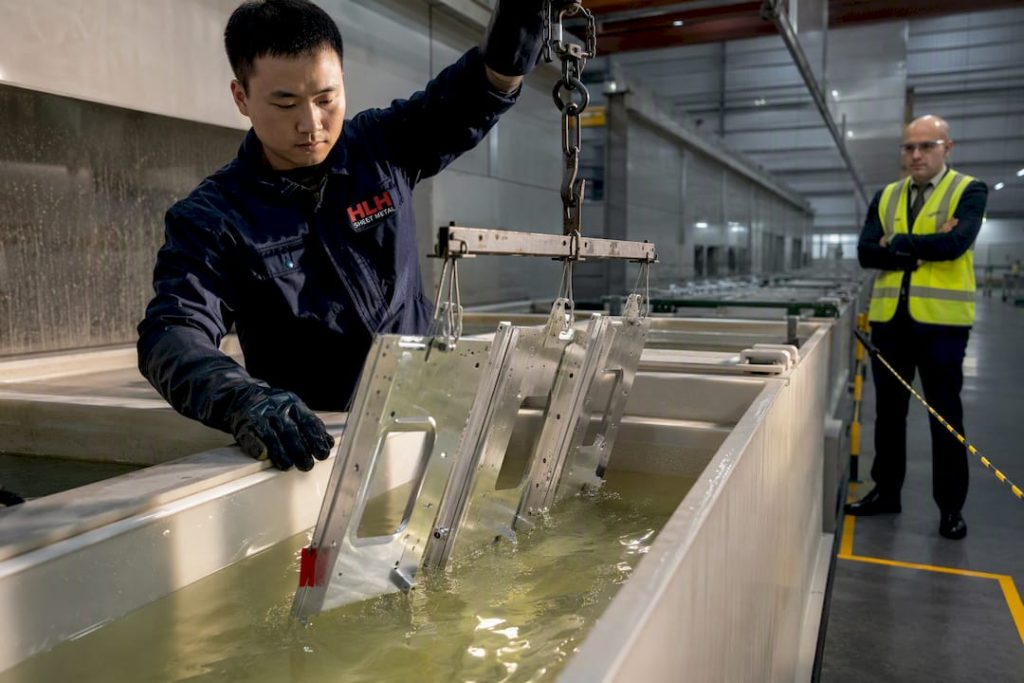
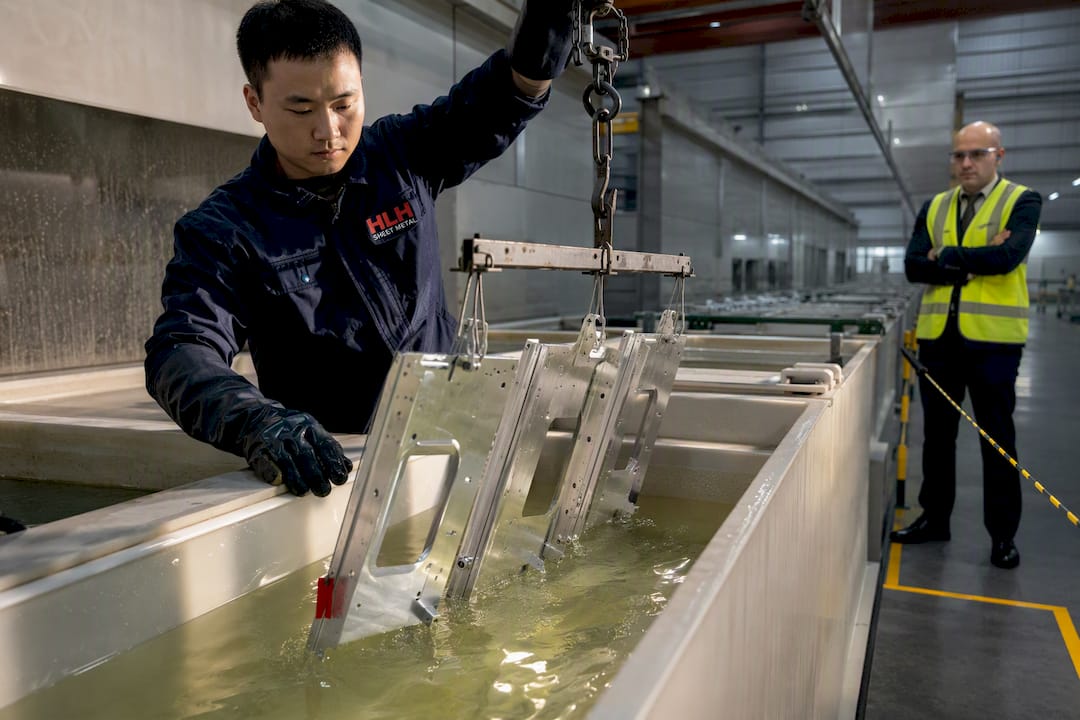
Immersion is the standard method for production volume, and it follows a fairly rigid sequence:
- Alkaline clean to strip oils and shop residue from the surface.
- Deoxidize/etch to remove the native oxide layer and any smut left from prior machining.
- Rinse thoroughly, since carryover chemistry from the deoxidizer contaminates the chromate bath fast.
- Immerse in the chromate bath, typically for a period ranging from under a minute to several minutes depending on desired film weight and alloy.
- Rinse again, using controlled, low-agitation rinsing to avoid stripping the still-soft film.
- Air dry or force dry at controlled temperature, respecting the hydrogel-to-xerogel cure window.
Spray and brush application exist, but they’re restricted uses, not defaults. Spray works for large panels where immersion tanks aren’t practical. Brush application is typically reserved for touch-up on assemblies that already passed through the main line, or for field repair. Under the NASA PRC-5005 process specification, manual brush application is only acceptable when the engineering drawing explicitly permits it. If a drawing is silent on method, immersion or spray is assumed, and a supplier defaulting to brush application without that callout is out of spec, even if the part looks fine.
Bath management is where consistent film quality actually gets won or lost. Titration checks track total chromate concentration, pH meters or strip tests hold the bath in its working window, and fluoride analysis distinguishes free fluoride (which drives etching) from complexed fluoride (which is chemically tied up and less active). Letting free fluoride drift too high accelerates over-etching and produces thin, patchy films even when everything else in the bath looks correct.
Pro Tip: Track fluoride replenishment against part throughput, not just calendar time. A line running high-alloy aluminum consumes fluoride faster than one running mostly zinc-plated fasteners, so a fixed weekly dosing schedule can quietly run a bath out of window between titration checks.
Rinse water contamination is the most common cause of blotchy, non-uniform film. Cross-contaminated rinse tanks carrying residue from an upstream alkaline clean or deoxidizer will produce visible streaking on the finished part, even when the chromate bath itself is perfectly in spec.
What Thickness, Color, And Performance Should You Expect?
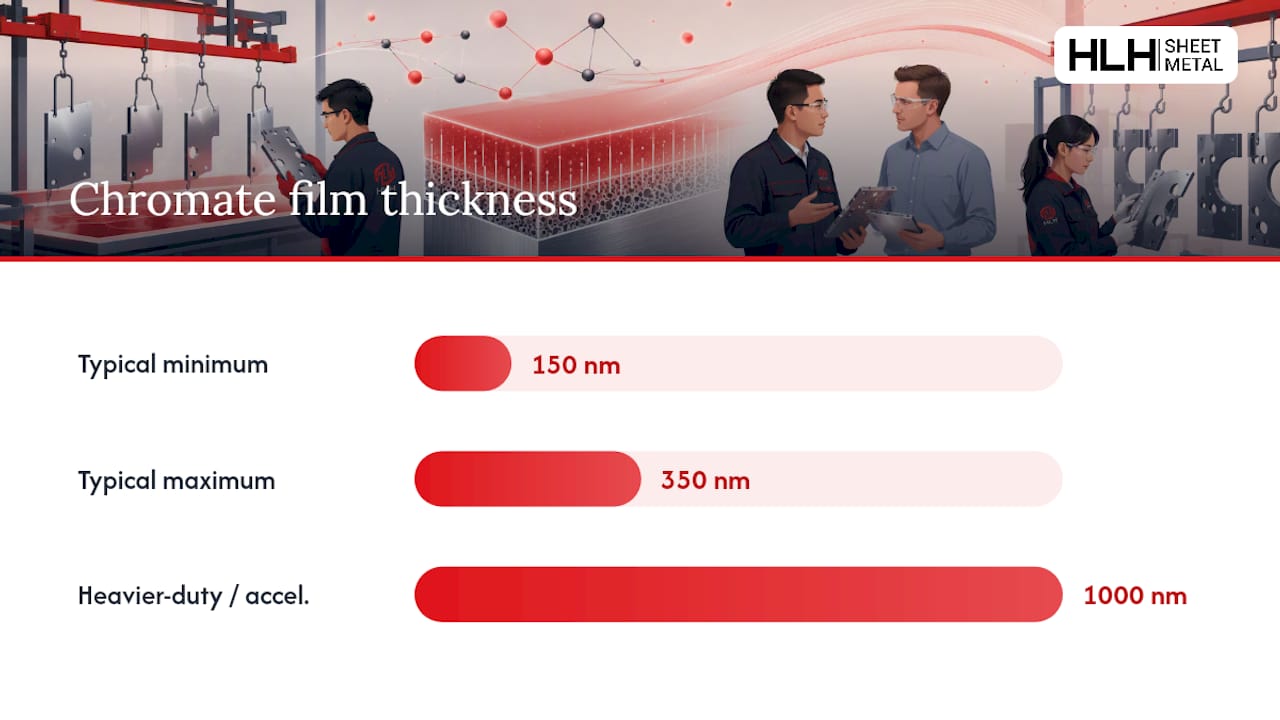
Dry film thickness on most chromate treatments falls in the range of about 150 to 350 nanometers, though some accelerated bath chemistries and heavier-duty processes push thickness up toward 1,000 nanometers, according to technical literature reviewing current chromate conversion applications. That’s a wide spread, and it means a drawing that just says “chromate coating” without a class or thickness target is leaving film weight entirely up to the supplier’s default process.
Color gives you a directional read, not a measurement. The same nominal bath chemistry can produce visually similar panels with different coating weights depending on dwell time and part geometry, particularly on parts with tight internal features where bath exchange is slower than on open flat stock. Coating-weight testing, done gravimetrically or by controlled chemical stripping, is the only reliable acceptance method when thickness actually matters to the application.
Self-healing is one of the more misunderstood properties of chromate film. When the surface is scratched, residual hexavalent chromium in the film redistributes and re-passivates the exposed metal, which is a real, measurable effect documented in NIST’s review of the chemistry. It has limits, though:
- Self-healing depends on there being enough residual Cr6+ left in the film, which is why aged or heavily-cured films sometimes heal less effectively than freshly applied ones.
- Trivalent (Type II) coatings largely lack this mechanism, since there’s little to no Cr6+ present to redistribute.
- Deep scratches that expose bare substrate over a large area will still corrode, regardless of coating type.
For paint or adhesive bonding, chromate conversion coating is typically applied as a pretreatment step, and painting should follow within a reasonable window after cure rather than sitting exposed indefinitely, since surface contamination between chromating and painting undermines the adhesion benefit the process was meant to deliver.
What Standards Govern Chromate Conversion Coating Callouts?
Two specifications dominate aerospace and defense drawing callouts: MIL-DTL-5541 and NASA PRC-5005. Both distinguish between Type I (hexavalent chromium, higher corrosion performance, includes self-healing behavior) and Type II (no hexavalent chromium, reduced performance but far lower toxicity and regulatory burden).
Within each type, class designations refine the requirement further, generally distinguishing coatings optimized for maximum corrosion protection from coatings optimized for maintaining low electrical resistance or minimal added thickness where dimensional tolerance matters.
A drawing callout needs to specify, at minimum:
- Type (I or II) and class
- Application method, if anything other than immersion or spray is acceptable
- Acceptance testing, such as salt fog exposure duration or coating weight range
If a drawing omits type entirely, PRC-5005 defaults to Type I for critical hardware, which matters a great deal if a supplier assumed Type II would be acceptable on cost or availability grounds. Related references like SAE AMS chemical conversion coating standards often point back to MIL or PRC specs rather than duplicating requirements, so tracing the actual governing document matters more than citing whichever standard happens to be handy. For shops sourcing aluminum parts overseas, understanding how specification requirements translate across manufacturing regions avoids surprises at incoming inspection.
What Safety And Environmental Rules Apply To Chromate Processing?
Hexavalent chromium is a recognized occupational carcinogen, and that single fact drives most of the regulatory pressure pushing the industry toward alternatives. OSHA’s hexavalent chromium guidance sets exposure limits and requires specific workplace controls anywhere Cr6+ is processed, including local exhaust ventilation, respiratory protection where exposure can’t be controlled by engineering means, and regular air monitoring.
Waste handling adds another layer of cost and complexity. Chromate rinse water and spent bath solution can’t go down a drain untreated. Facilities running Type I lines typically operate closed-loop rinse recovery or contracted waste treatment to keep hexavalent chromium out of wastewater discharge, and that infrastructure cost is a real factor in whether a shop can offer Type I processing competitively at all.
Regulatory frameworks outside the US, particularly RoHS restrictions on hexavalent chromium in consumer electronics, have pushed a lot of commercial (non-aerospace) manufacturing toward Type II trivalent processes over the past two decades. Aerospace and defense have moved more slowly, largely because Type I’s self-healing performance edge is still hard to fully replicate.
Practical controls a shop running Cr6+ processes should have in place:
- Enclosed process tanks with local exhaust ventilation
- Air monitoring on a defined schedule, not just annual compliance checks
- Documented PPE protocols specific to chromate handling, not generic chemical-handling PPE
- A qualified waste treatment or disposal contract, verified periodically
Weighing performance against compliance cost isn’t abstract. A Type I line requires more safety infrastructure and disposal cost than Type II, and that delta needs to be justified by an actual performance requirement on the part, not habit or a legacy drawing note nobody has revisited.
What Are The Best Alternatives To Hexavalent Chromate Coating?
Trivalent chromium (Type II) is the most direct substitute, and it closes most of the corrosion-resistance gap with hexavalent formulations in general salt-spray testing. Where it still lags is deep-scratch and filiform corrosion resistance, since it lacks the self-healing mechanism that residual Cr6+ provides in Type I films. For a lot of commercial and even some defense applications, that gap doesn’t matter enough to justify the added regulatory burden of Type I.
Beyond trivalent chromium, several other approaches fill similar niches:
- Rare-earth conversion coatings (cerium-based, in particular) offer chromium-free corrosion protection with growing acceptance in aerospace research, though qualification data is thinner than for chromate.
- Silane and ceramic conversion coatings work well as a paint pretreatment layer, especially where electrical conductivity isn’t a requirement.
- Anodizing builds a thicker, harder oxide layer directly from the aluminum substrate, offering better wear resistance than chromate, but at the cost of electrical conductivity, since anodize is an insulator unless specifically processed for conductivity (conductive anodize).
- Phosphate coatings remain the standard pretreatment for steel, sometimes sealed with a chromate rinse to reduce porosity.
Post-treatment sealers can meaningfully close the performance gap on Type II coatings, adding a thin topcoat that improves corrosion resistance without reintroducing hexavalent chromium. The right choice usually comes down to what the part actually needs: if electrical conductivity at a contact point matters, chromate or thin conductive anodize wins; if abrasion resistance matters more than conductivity, anodizing is usually the better call.
How Do You Specify, Inspect, And Audit A Chromate-converted Part?
Getting consistent chromate performance from a supplier starts well before the part hits the tank. A surface prep checklist should cover:
- Verify alloy and temper match the qualified process, since alloy content changes film behavior.
- Confirm mechanical finish (machining marks, burrs) has been addressed before deoxidizing, since surface roughness affects film uniformity.
- Check for oil, coolant, or handling residue before the alkaline clean step; contamination here is the single most common root cause of patchy film.
- Verify deoxidizer dwell time matches the alloy’s specification, since over-etching thins the eventual chromate film.
According to a PubMed Central review of surface preparation practices, inadequate deoxidation before conversion coating is a recurring cause of localized corrosion failures that show up well after the part passes initial visual inspection.
Pro Tip: Ask your supplier for their bath titration log, not just a certificate of conformance. A cert tells you the part passed; a titration log tells you whether the bath was actually in spec when your part went through it, which matters if you’re troubleshooting an intermittent failure months later.
Curing and handling rules matter just as much as the wet process. Minimum cure time before handling should follow the hydrogel-to-xerogel window (up to 24 hours at room temperature, or accelerated with controlled heat), and parts shouldn’t be stacked, masked, or painted before that cure completes.
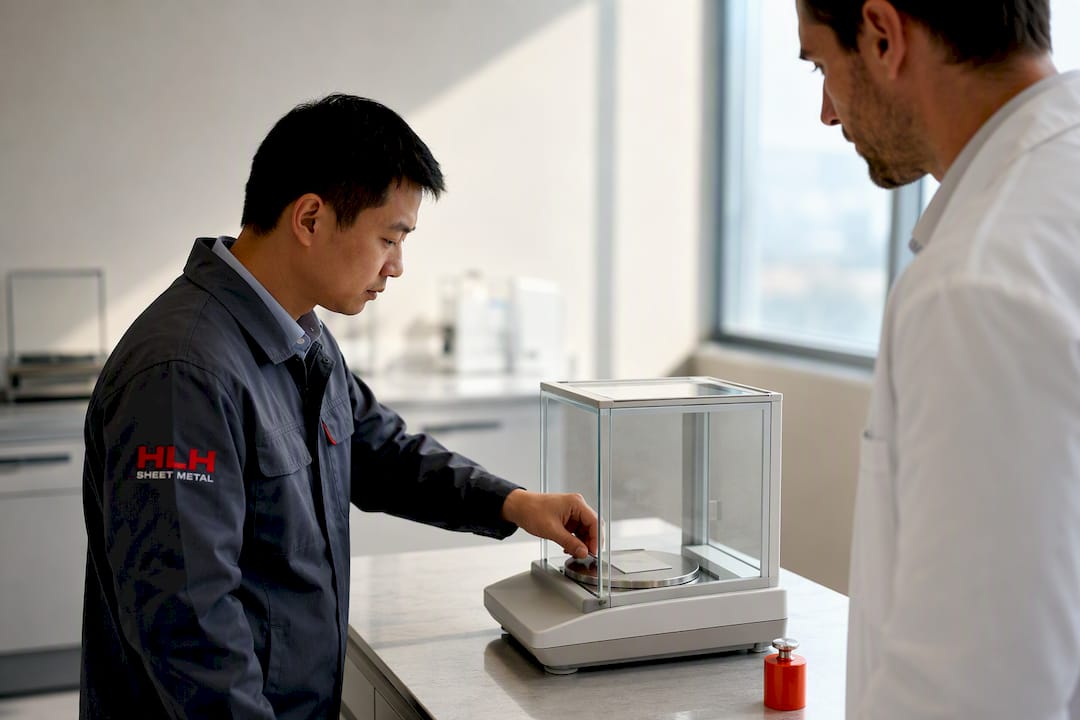
Inspection and acceptance testing should include coating weight measurement, visual comparison against an approved standard panel, salt fog or cyclic corrosion testing per the governing spec, and electrical resistance testing where the part’s function depends on conductivity. Procurement documentation should mandate the exact spec and type/class on the purchase order, not just “chromate finish,” along with a requirement for lab documentation showing bath composition and test results at the time of processing. Parts requiring tight thickness control should reference the same acceptance logic used for powder coat thickness QC, where measurement replaces visual judgment as the deciding factor.
HLH Sheet Metal’s Experience With Finishing And Fabrication
Chromate conversion coating is one piece of a bigger fabrication puzzle, and it only performs well when the parts underneath it are made right. The company runs fabrication and finishing operations across multiple manufacturing plants, backed by ISO-certified quality assurance protocols that carry through from prototyping to full production runs. A multi-plant setup matters for finishing consistency in particular, since chromate performance depends on tight process control, and juggling capacity across several facilities can keep production moving without pushing a job onto a poorly qualified line just to hit a deadline.
For engineers managing prototypes and production volume on the same part number, having a fabrication partner that handles both under one quality system can reduce the risk of a finish that qualifies in prototype but drifts once volume ramps up. Reviewing HLH’s technical guide on aluminum finishing workflows is a reasonable next step for engineers scoping a new part that needs both fabrication and controlled surface treatment.
Why Most Engineers Overthink The Type I Versus Type II Decision
Most of the disagreement over chromate coating comes from treating it as a religious choice instead of a spec-driven one. If a part has a genuine deep-scratch or filiform corrosion exposure risk, and the application can absorb the regulatory and disposal cost, Type I earns its place. If the part sits in a controlled indoor environment or the corrosion risk is moderate, Type II with a decent sealer usually closes the gap enough that the added compliance burden of Type I isn’t worth it.
Document the decision on the drawing itself, not in an email thread or a supplier’s internal process notes. Type, class, and acceptance test method belong on the print, because that’s the only place the requirement survives a supplier change five years later.
The bigger failure mode I see isn’t picking the wrong type. It’s picking a type once and never auditing whether the supplier is still running the process the same way. Bath chemistry drifts. Fluoride ratios shift. Ask for titration logs on a schedule, not just at qualification.
— Nash
Get Chromate Conversion Coating And Fabrication Under One Roof
Sourcing fabrication from one supplier and finishing from another creates exactly the kind of process gap this article just walked through, where a part passes inspection at the fabricator and then fails at the finishing house because nobody owns the whole process. The company runs laser cutting, bending, welding, stamping, and surface finishing under one ISO-backed quality system, so the same team that machines a part controls how it gets chromate converted, powder coated, or otherwise treated before it ships. That single point of accountability is the practical advantage over splitting fabrication and finishing across separate vendors.
Explore HLH’s surface finishing capabilities to see how chromate conversion and other treatments fit into a full production run, or start with a fabrication quote request to get your prototype or production part scoped by engineering directly.
Where To Verify These Specifications Yourself
Drawing callouts and safety controls should always trace back to the primary document, not a summary of it. These are the sources worth bookmarking:
- NASA PRC-5005 for Type I/Type II process requirements and application method restrictions on aluminum.
- OSHA’s hexavalent chromium guidance for exposure limits and required workplace controls.
- A PubMed Central review of surface preparation for the link between deoxidation quality and coating failure modes.
FAQ
Is Chromate Conversion Coating The Same As Chem Film?
Yes. Chem film, Alodine, and chromate conversion coating all refer to the same chemical passivation process; the names vary by industry and by brand, not by chemistry.
What Is The Difference Between Conversion Coating And Anodizing?
Chromate conversion coating grows a thin film through a redox reaction with the substrate and preserves electrical conductivity, while anodizing builds a thicker, harder oxide layer that’s electrically insulating unless specifically processed for conductivity. Anodizing generally offers better wear resistance; chromate offers better conductivity and a lighter dimensional footprint.
How Thick Is Chromate Conversion Coating On Aluminum?
Most chromate conversion coatings on aluminum fall between roughly 150 and 350 nanometers, though certain accelerated bath chemistries can push film thickness closer to 1,000 nanometers depending on alloy and process parameters.
What Is A Conversion Coating?
A conversion coating is any thin protective film formed by a chemical reaction that converts part of the metal’s own surface into a new compound, rather than depositing a separate layer on top of it. Chromate, phosphate, and certain trivalent chromium treatments are all examples of the same underlying concept.
Should I Specify Type I Or Type II On My Drawing?
Specify Type I when the part faces genuine deep-scratch or filiform corrosion risk and your process can absorb the added regulatory and disposal cost; specify Type II when moderate corrosion resistance is sufficient and lower toxicity and compliance burden matter more. Leaving type unspecified on critical aerospace hardware defaults to Type I under PRC-5005.

