





Table Of Contents

The single most effective way to prevent galvanic corrosion in enclosures is to treat it as a system design requirement, not an afterthought: avoid mixing dissimilar metals wherever possible, and where mixing is unavoidable, combine area-ratio control, complete electrical isolation, and layered coatings with drainage designed to prevent electrolyte pooling. NASA-STD-6012A and MIL-STD galvanic compatibility guidance both frame corrosion prevention this way, and These controls can be built directly into enclosure fabrication rather than treated as a finishing step.
TL;DR:
- Using a single alloy family for enclosures minimizes galvanic potential and prevents localized corrosion damage.
- Proper area ratio control requires keeping the anodic surface area equal to or larger than the cathodic surface, especially in mixed-metal contact points.
- Isolation hardware like dielectric washers, gaskets, and sleeves must be specified and verified during assembly to prevent direct metal contact.
- Drainage, enclosure slope, and venting are critical design features to prevent standing water and electrolyte pooling that accelerate corrosion.
- Coatings and sacrificial layers are supplementary; their effectiveness depends on correct application, intact films, and environment-specific re-coating intervals.
Galvanic Corrosion Enclosures: The Engineering Checklist
Most galvanic failures in fielded enclosures trace back to a spec sheet that never addressed metal compatibility in the first place. Building corrosion-resistant enclosures starts on paper, long before a supplier picks up a laser cutter.
Here’s the order of operations that actually holds up in production:
- Specify a single alloy family for the enclosure body, hinges, and latches wherever the application allows it. Identical or closely ranked metals eliminate the driving voltage entirely.
- When dissimilar metals are unavoidable, define the area ratio in the drawing: keep the anodic (less noble) component’s surface area equal to or larger than the cathodic component’s. A small steel fastener in a large aluminum panel can create conditions for accelerated, localized attack.
- Call out isolation hardware by part number: nylon or PTFE washers, dielectric sleeves, and non-conductive gaskets at every dissimilar-metal joint.
- Specify torque values and backing washer requirements so isolation sleeves don’t crack or extrude under load during assembly.
- Require sealant coverage at faying surfaces (the mating faces of a joint) to block electrolyte entry, not just at the visible seam.
- Add drainage callouts: minimum slope, drain hole diameter and placement, and gasket compression specs to prevent standing water.
- Write acceptance criteria into the purchase order, not just the drawing, so incoming inspection actually checks for these features.
Pro Tip: Put the isolation hardware part numbers directly in the bill of materials, not just as a note on the drawing. Assembly technicians follow the BOM. Notes get skipped when the line is running behind schedule.
How Galvanic Corrosion Actually Works
Galvanic corrosion needs exactly three things to happen at once: two dissimilar metals, direct electrical contact between them, and an electrolyte bridging the two. Remove any one of the three and the reaction stops. That’s the entire mechanism, and it’s why isolation and drainage do the heavy lifting in any real prevention strategy, according to the ASSDA technical FAQ on dissimilar metal corrosion.
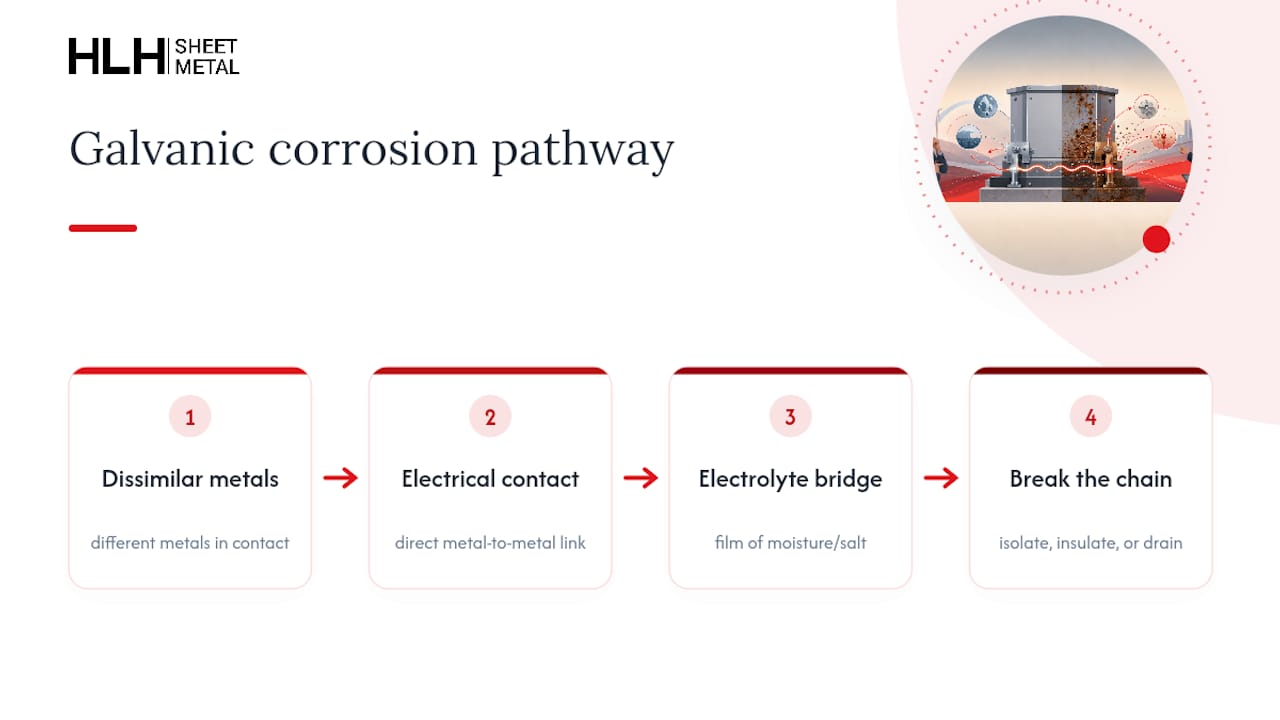
The electrolyte doesn’t have to be seawater. Condensation, road salt residue, or a thin film of humidity can conduct enough current to drive galvanic corrosion. Conductivity scales with contamination, which is why an enclosure that performs fine in a dry warehouse can fail within a season on a coastal rooftop.
Area ratio is where the math gets unforgiving. When a small anodic area sits in contact with a large cathodic area, the corrosion current concentrates onto that small spot, and the metal loss rate accelerates well beyond what you’d predict from the metals’ galvanic ranking alone. A steel bolt through an aluminum sheet can corrode rapidly; conversely, a steel sheet with an aluminum rivet tends to corrode more slowly, reflecting the impact of area ratios. Industry guidance often cites a rough 10:1 wetted-area ratio as a design target, though the right number shifts with the specific environment, per Atlas Steels’ technical note on galvanic corrosion.
Crevices make everything worse. A tight gap between a gasket and a housing wall traps moisture, and as that trapped film evaporates and rewets over daily temperature cycles, dissolved salts concentrate. That concentrated electrolyte becomes far more aggressive than the ambient environment around it, which is exactly why threaded joints, lap seams, and gasket edges fail before open, exposed surfaces do.
Choosing Enclosure Materials That Resist Corrosion
Material selection sets the ceiling on how much a coating or isolation scheme can realistically achieve. Pick the wrong base alloy and no finish saves the joint long-term.
For coastal or industrial (C5-M classification) environments, 316L stainless steel is commonly selected for structural and fastener components in chloride-exposed environments due to better pitting resistance than 304 grades. Duplex stainless steels step up further for applications with mechanical load plus chloride exposure, offering higher strength alongside strong corrosion resistance. Marine-grade aluminum alloys (the 5000 and 6000 series) work well for lightweight enclosure panels but need careful pairing at fastener points, since aluminum sits low on the galvanic series and corrodes preferentially next to almost any stainless or carbon steel hardware.
High-risk pairings to flag in any design review:
- Carbon steel fasteners in aluminum enclosures, unless fully isolated with sleeves and washers.
- Copper or brass fittings in direct contact with aluminum or galvanized steel, a pairing that drives some of the fastest attack rates in outdoor hardware.
- Stainless steel hardware on galvanized steel panels, where the zinc coating sacrifices itself rapidly around the contact point.
- Uncoated dissimilar metals in any application with condensation cycling, even indoors, since HVAC condensate carries enough dissolved minerals to act as an electrolyte.
Zinc and zinc-nickel plating can help extend carbon steel’s service life, and powder coating adds a second, thicker barrier layer, though coatings only work as long as the film stays intact. A scratched or chipped coating over one metal in a mixed-metal joint can create a small exposed anode next to a large cathodic area, which produces localized attack that’s worse than leaving both surfaces bare, according to a breakdown of powder coating versus paint performance. HLH Sheet Metal’s guide to corrosion-resistant metals covers the trade-offs between these alloy families in more depth.
Fastener And Joint Rules That Prevent Most Failures
Fasteners, cable glands, and seams account for the majority of galvanic failures in fielded enclosures, and the fix is almost always a detail that got skipped during assembly, not a design flaw on paper.
- Match fastener alloy to the base metal whenever the application allows it; a 316 stainless fastener in a 316 stainless panel introduces zero galvanic risk.
- Where fastener and panel metals must differ, use isolation sleeves through the bore and insulating washers under both the head and the nut, not just one side.
- Keep the fastener’s exposed area small relative to the panel it penetrates. Oversized washers on the cathodic side worsen the area ratio.
- Verify electrical isolation after assembly with a simple continuity check across the joint, not just a visual inspection of the parts on the shelf.
Pro Tip: Perform a resistance check with a multimeter across isolated joints before shipment. Insulating kits can be compromised during assembly, and a quick check helps catch issues pre-shipment.
Grounding adds a wrinkle. When code or function requires electrical continuity across a joint that would otherwise be isolated, run a dedicated bonding strap instead of relying on the fastener stack itself to carry ground current. That keeps the mechanical joint electrically isolated while still meeting grounding requirements elsewhere in the assembly.
When To Use Coatings, Isolation, Or Sacrificial Protection
These three strategies solve different problems, and using the wrong one for the situation is a common design mistake.
- Dielectric isolation (sleeves, washers, gaskets) is the right first move at any joint where two dissimilar metals must physically connect. It breaks the electrical contact condition directly and costs almost nothing compared to a coating failure years later.
- Coatings work well as a supplementary barrier but only when applied to both surfaces in a dissimilar-metal joint, not just one. Coating a steel fastener while leaving the aluminum panel bare just relocates the failure point to the first scratch or pinhole.
- Sacrificial coatings and anodes (zinc, zinc-nickel, magnesium) make sense in high-exposure environments like coastal racking or marine hardware, where the sacrificial layer corrodes preferentially and protects the base metal, per Wikipedia’s overview of galvanic action. The sacrificial layer’s lifetime depends on exposure severity; plan re-coating intervals accordingly rather than assuming a one-time application lasts the full service life.
- Impressed-current cathodic protection is generally reserved for large, high-value, continuously submerged, or buried structures. It rarely makes sense for standard equipment enclosures, where isolation and coatings handle the risk at a fraction of the cost.
Designing Enclosures To Avoid Trapped Electrolyte
Geometry prevents more corrosion than any coating does, because a coating protects a surface that water can no longer reach.
Slope enclosure floors and equipment shelves toward drain ports rather than leaving flat pans where condensation collects. Size and place breather and drain ports at the lowest point of each compartment, and screen them to keep out debris without blocking flow. Gasket geometry matters more than gasket material in most failures: a compressed gasket with a continuous, uninterrupted seal line keeps electrolyte out of the faying surface entirely, while a gasket with gaps or uneven compression creates exactly the crevice conditions that concentrate salts during wet-dry cycling. Ventilation needs a careful balance, too. Some airflow reduces condensation buildup, but a poorly placed vent in a coastal environment can pull salt-laden air directly onto internal components, according to Top Cabinet’s guidance on coastal and offshore enclosure protection.

Standards And Test Criteria Worth Citing In A Spec
Turning standards language into pass/fail criteria is what separates a spec that gets followed from one that gets ignored.
- NASA-STD-6012A requires documented qualification of corrosion-prevention materials and processes, a useful model for specifying coating and sacrificial-protection approval before production starts, per NASA’s corrosion control standard.
- MIL-STD galvanic compatibility guidance flags pairings with a corrosion rate above roughly 0.009 mil per year in seawater testing as requiring active protection, giving engineers a concrete threshold rather than a vague “avoid dissimilar metals” instruction, per MIL-STD-889D excerpts.
- ASTM’s galvanic series reference ranks alloys by nobility and supports pairing decisions during material selection.
- For factory acceptance testing, specify continuity checks across all isolated joints, torque retention checks after one or more thermal cycles, and salt-spray context testing where the enclosure targets coastal or industrial exposure.
Keeping Fielded Enclosures Ahead Of Corrosion
Regular inspection catches galvanic attack while it’s still a coating touch-up, not a structural replacement.
- Inspect fastener heads, cable glands, and seams first for white or reddish staining, powdery deposits, or pitting, since these interfaces fail before flat surfaces do.
- Run a continuity check across isolated joints during scheduled maintenance, matching the same test used at the factory.
- Set inspection cadence by environment: quarterly for coastal or industrial sites, annually for indoor, climate-controlled installations.
- Triage repairs by severity: minor surface staining gets a recoat, a failed isolation sleeve gets full fastener replacement, and heavy pitting near a joint may call for adding a sacrificial anode rather than a like-for-like repair.
Publisher Perspective: What Production Actually Teaches You About Corrosion Control
Most galvanic corrosion problems get designed in long before anyone talks about coatings. HLH Sheet Metal builds isolation and area-ratio checks into design-for-manufacturability review from the start, across ISO-certified production lines and rapid prototyping runs, because catching a mismatched fastener spec on a drawing costs nothing compared to catching it in a failed field unit. The pattern holds across nearly every project: enclosures that fail early almost always skipped a detail on paper, not in the metal itself.
— Nash
Work With A Manufacturer That Builds Corrosion Control Into Every Enclosure
Most engineering teams don’t have a dedicated corrosion specialist on staff, which means these details either get caught in design review or they don’t get caught at all. HLH Sheet Metal builds galvanic isolation, area-ratio checks, and coating specifications directly into its custom disconnect enclosure manufacturing process, backed by ISO-certified quality control and multiple production plants that handle both prototype runs and full production volume. Surface finishing options, including powder coating and plating covered on the surface finishing services page, get specified alongside the base metal rather than bolted on afterward. If you’re specifying an enclosure for a coastal, industrial, or mixed-metal environment, request a quote through the sheet metal fabrication capabilities page and get material and isolation recommendations before the drawing gets locked.
FAQ
What Two Metals Should Not Be Used Together?
Copper or brass in direct contact with aluminum or galvanized steel produces some of the fastest galvanic attack rates seen in outdoor hardware, because copper sits far apart from aluminum and zinc on the galvanic series. Steel fasteners against aluminum panels are the other common failure pairing, especially with an unfavorable area ratio.
When Should You Worry About Galvanic Corrosion?
Worry whenever an enclosure combines two different metals, physical contact between them, and any source of moisture, including condensation, not just seawater spray. Coastal, industrial, and outdoor installations carry the highest risk, but indoor equipment exposed to HVAC condensate cycling isn’t immune.
Can Zinc And Galvanized Steel Be Used Together?
Yes. Zinc and galvanized steel are compatible because galvanizing is itself a zinc coating, so pairing them introduces no new dissimilar-metal contact. Galvanized steel next to a more noble metal like stainless steel or copper is the pairing that causes problems, since the zinc layer sacrifices itself to protect the more noble metal.
What Is A Common Example Of Galvanic Corrosion?
A steel bolt passing through an aluminum enclosure panel is a common real-world example, especially outdoors where moisture provides the electrolyte. The small steel fastener acts as a concentrated cathode relative to the larger aluminum panel, accelerating pitting around the bolt hole within a season or two if left unisolated.
Does HLH Sheet Metal Build Corrosion-resistant Enclosures?
Yes. HLH Sheet Metal fabricates custom enclosures using compatible alloy selection, isolation hardware, and surface finishing under ISO-certified quality control, with pricing available through a project quote request.
Recommended
- Galvanic Corrosion Enclosures: Sourcing Outdoor Enclosures in China
- The Most Corrosion-Resistant Metals and How to Choose One
- Specify Chromate Conversion Coating: Standards, Bath Controls, Shop QA

