




Table Of Contents
Manufacturability wins over aesthetics every time in server rack cabinet design: get the 19-inch rack datum, hole-to-bend tolerances, and finish stack right, or expect rework at EVT. Before you send an RFQ, lock down three things: material and finish spec, thermal budget (TDP and CFM), and defined EVT/DVT/PVT gates. Custom rack cabinet fabricators build against exactly this checklist, and the guidance below comes from industry experience observing where these projects actually break.
TL;DR:
- Ensuring proper datums and alignment, especially for rail mounts, rear I/O, hinges, and fan walls, is critical to avoid rework during engineering validation testing.
- Material choice should prioritize structural and grounding requirements, with cold-rolled steel as default, while aluminum and stainless steel suit weight or corrosive environments, respectively.
- Tolerances must chain together hole-to-bend measures, springback, and coating buildup to prevent assembly issues, especially on critical features like mounting holes and I/O cutouts.
- Thermal management relies on precise vent placement, airflow validation, and sealing, with design features like serviceable filters and gasketed cables vital for efficiency and EMC.
- A comprehensive RFQ should include detailed drawings, bill of materials, finish and thermal specs, target quantities, and clear acceptance criteria to streamline production and reduce delays.
What Makes Server Rack Cabinet Design Different From Generic Enclosure Work
A server rack cabinet lives or dies on a handful of critical datums, not overall aesthetics. Get these wrong and you’ll find out during EVT, when a fixture reveals that your rails don’t line up with the mounting holes on a customer’s blade server.
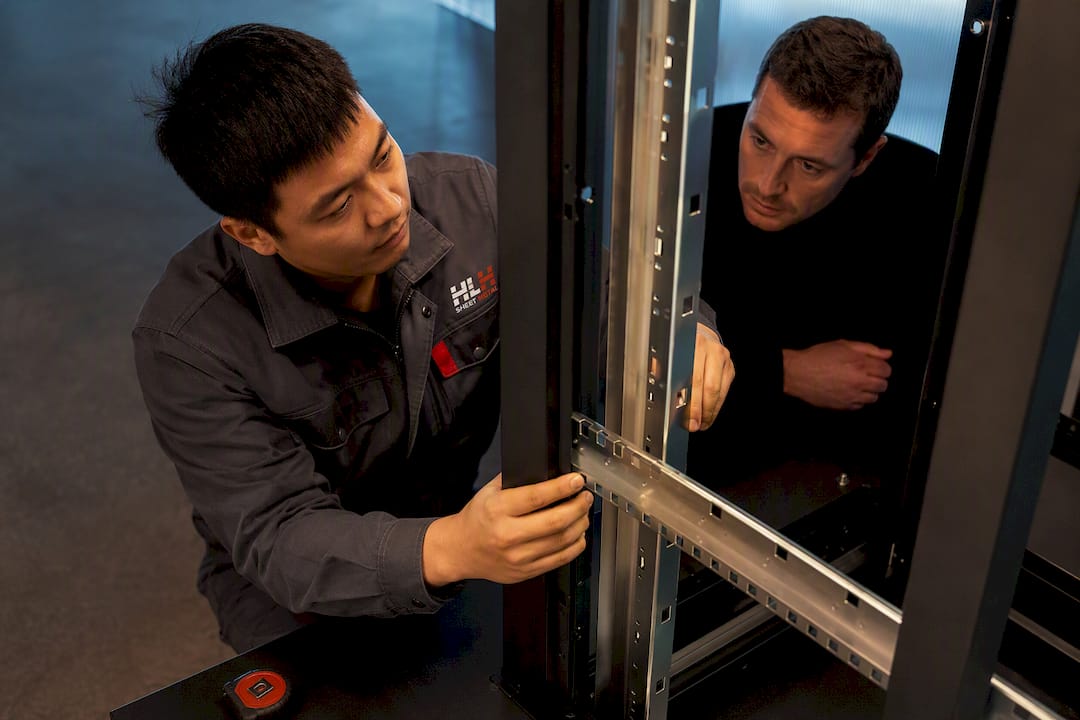
Start by sorting every dimension into three buckets. Function-critical dimensions include rail mounting hole positions, the 19-inch rack standard spacing (482.6 mm, or 1.75 inches per rack unit), and rear I/O cutout alignment to motherboard trays. Assembly-supporting dimensions cover door hinge planes and fan wall mounting, where a millimeter of drift causes binding but won’t strand a customer’s server. Cosmetic dimensions, like bezel gaps or logo plate placement, matter for appearance only and should carry the loosest tolerances in your drawing.
Four datums decide whether a cabinet assembles cleanly:
- Rail mounting plane: ties directly to EIA-310 rack unit spacing and determines whether third-party servers slide in without shimming.
- Rear I/O reference: must align to the customer’s board layout, not just the sheet metal’s own centerline.
- Hinge and door plane: controls whether doors close flush across a production run, not just on the first sample.
- Fan wall plane: dictates airflow path and whether replacement fans from a different vendor will still fit.
Stiffness comes from rib geometry and hem flanges, not just gauge thickness. A common failure mode: engineers spec heavier steel to fix a flex problem that a formed flange would have solved for less money. Require serviceability features in the drawing itself: tool-less rail adjustment, cage nuts sized for standard rack screws, and hinge pins accessible without disassembling the frame.
Choosing Metals And Processes: Impact On Cost, EMI, And Finish
Cold-rolled steel remains the default for server chassis because it balances stiffness, forming consistency, and grounding behavior better than most alternatives, and material choice should follow structural and grounding requirements rather than habit. Aluminum cuts weight and resists corrosion but forms less predictably at tight bend radii and costs more per kilogram. Stainless steel earns its place in corrosive or medical-adjacent environments, though EMI shielding behavior and welding heat input both change compared to steel.
Coating stack matters more than most engineers expect:
- Powder coat adds 60 to 120 microns per surface, which alters mating tolerances on doors and panel seams.
- Zinc plating adds minimal thickness but changes grounding continuity at bolted joints.
- Galvanized steel needs weld-through primer consideration if welding happens after coating.
Laser cutting delivers the hole and edge precision that rack mounting demands, while bending needs bend relief cut into the flat pattern to avoid tearing at flange corners. Welding sequence affects distortion, especially on longer frame rails.
Pro Tip: Specify coating thickness on every mating surface in your drawing, not just the general finish callout. A door that fits before powder coat can bind after it if the drawing doesn’t account for buildup.
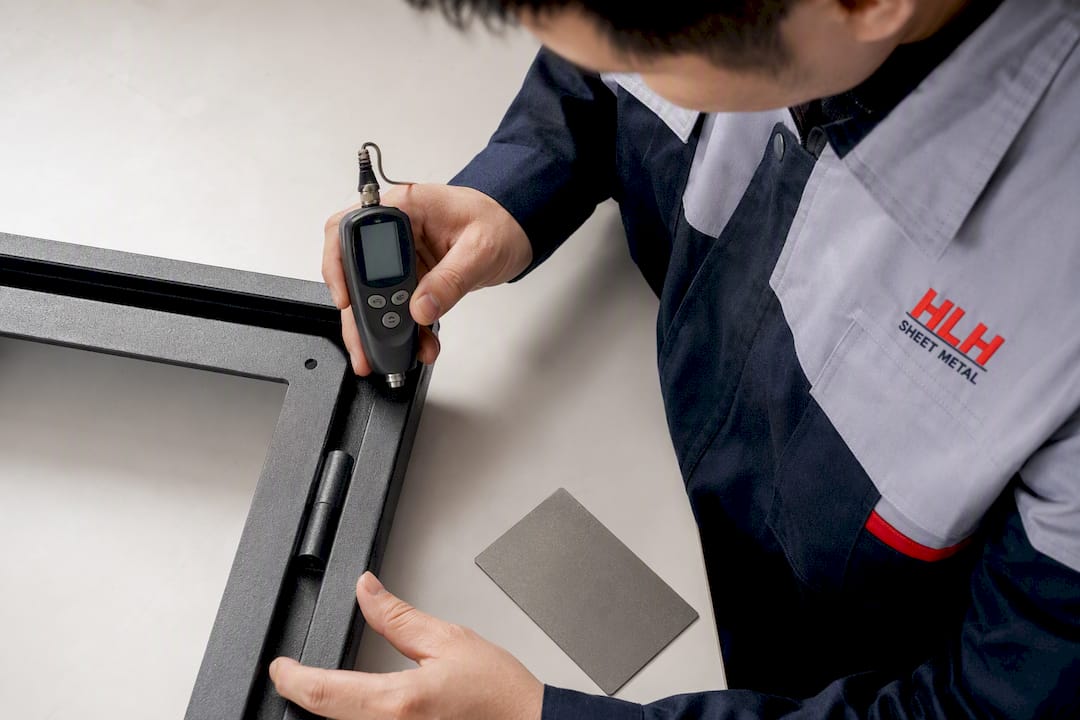
HLH SHEET METAL runs laser cutting, bending, welding, and surface finishing in-house, which keeps tolerance chains under one roof instead of split across three vendors.
How Do You Set Tolerances That Prevent Assembly Failures?
Treat hole-to-bend distance, springback, and coating buildup as one tolerance chain, not three separate notes on a drawing. Design errors that ignore this relationship are the single most common cause of parts that measure fine flat but fail to assemble.
- Set hole-to-bend minimums. A hole placed too close to a bend line distorts during forming; a general rule is keeping holes at least two to three times material thickness away from the bend’s inside radius.
- Call bend relief geometry explicitly. Flanges near a corner need a relief cut, or the material tears during bending, especially at 90 degree returns.
- Budget for springback. Steel and aluminum spring back differently after bending; your drawing should note target angle plus the process compensation, not just the final angle.
- State material thickness in decimals, not gauge numbers alone. “16 gauge” varies by material family; a decimal callout like 1.5 mm removes ambiguity between vendors.
- Define inspection criteria for first articles. Require dimensional reports against the drawing, not just a visual check, plus photos of mating assemblies rather than flat blanks alone.
Reasonable defaults for function-critical features: ±0.1 mm on rail mounting holes, ±0.25 mm on rear I/O cutouts, and ±0.5 mm on cosmetic gaps. Cosmetic tolerances can loosen further without affecting fit.
Thermal Management, Airflow, And EMC Design Checkpoints
Vent field placement and fan wall position determine whether your cabinet actually cools what’s inside it, not just whether it looks ventilated. A perforated front door with 60% open area behaves very differently from one with 40%, both in airflow and in acoustic leakage.
Your RFQ should state thermal budget in real numbers: total TDP of the equipment load, required CFM at a given static pressure, and airflow direction (front to back is now close to universal in rack equipment). Ask for thermal validation, not just a fan spec sheet, when the cabinet houses high-density compute.
- Grounding path continuity across panel seams matters as much as material selection for EMC performance.
- Gasketing at doors and seams closes gaps that would otherwise leak both airflow and radiated emissions.
- Filters need to be serviceable without opening the full enclosure; a slide-out filter tray beats a fixed mesh.
- Cable entry points should be sized and gasketed, not left as raw cutouts, since unsealed openings undercut EMC performance and airflow control both.
HLH SHEET METAL’s guide on maximizing airflow in server rack cabinet design covers perforation patterns and vent placement in more depth if your project needs a deeper thermal review before RFQ.
What Should Your RFQ And Timeline Actually Include?
A complete RFQ removes the back and forth that stretches timelines by weeks. At minimum, provide 2D and 3D drawings, a full bill of materials, finish specification, test requirements, target quantities for prototype and production, and delivery terms. Accurate pre-quotation information reduces clarification cycles significantly, and vague specs are the most common reason quotes come back with wide price ranges.
Server enclosure projects tend to follow a predictable sequence, and clear RFQs paired with platform reuse shorten the schedule:
- RFQ and concept: define requirements, get initial quotes, align on budget.
- DFM review: fabricator flags tolerance, forming, or cost issues before tooling starts.
- EVT (engineering validation test): first functional samples confirm the design works.
- DVT (design validation test): samples go through more rigorous testing, including thermal and EMC where relevant.
- PVT (production validation test): pilot run confirms the process is repeatable at scale.
- Mass production: full-volume manufacturing begins.
Your quote request should also cover NRE and tooling costs, sample quantities at each gate, acceptance criteria, repair or rework terms, and packaging and documentation requirements for export.
Pro Tip: Require golden-sample photos at PVT sign-off and lock an ECO (engineering change order) process for anything after that. Without it, a “minor tweak” on a repeat order can quietly drift from the approved sample.
Load Capacity And Structural Strength For Server Equipment
A 42U cabinet loaded with high-density compute servers can carry well over 1,000 kg once you stack blade chassis, storage arrays, and cabling. Structural design needs to account for that weight distributed across rail mounting points, not just resting on the cabinet floor.
Static load capacity, the weight the frame supports at rest, differs from dynamic load capacity, which accounts for shock during shipping or rolling the cabinet on casters. A frame rated for static loads alone can fail during transport if rib geometry and base frame welds weren’t designed for movement.
Base frame construction matters more than most buyers realize. A welded steel base with reinforced corner gussets handles concentrated loads far better than a bolted frame relying on sheet metal alone for rigidity. Rail mounting rigidity matters too: rails need enough stiffness to prevent sag under a fully loaded server, since sag over time can misalign connectors and stress cabling.
Specify load rating requirements based on actual equipment weight, not generic assumptions. A cabinet built for networking gear at 200 kg total load has a very different frame design than one built for a fully populated storage array approaching 1,500 kg. State the intended equipment mix in your RFQ so the fabricator can size the frame, casters, and leveling feet correctly instead of guessing at a standard spec.
Cable Management Features That Belong In The Cabinet Design
Cable routing decided after the frame is built almost always looks like an afterthought, because it is one. Vertical cable managers, horizontal routing channels, and cutouts for power and data cables need to appear in the drawing before fabrication, not bolted on after the fact.
Rear cable channels should be sized for the cable bundle diameter your equipment mix actually needs, with enough depth to close the rear door without pinching. Brush strip or grommet cutouts at cable entry points keep the enclosure closer to sealed for both airflow and EMC purposes, rather than leaving raw holes that leak both.
Vertical management rails mounted at the sides of the frame separate power from data cabling, which matters for both organization and EMI isolation. Horizontal managers between rack units keep patch cables from blocking airflow through the fan wall, a detail that gets missed when cable management is treated as a hardware afterthought instead of a design input. HLH SHEET METAL’s overview of rack cable management fabrication options walks through when custom routing channels are worth the extra tooling cost versus standard managers.
Specify cable entry point locations relative to the equipment layout in your RFQ, not just “cable management included.” A cabinet designed for top cable entry serves a different data center layout than one designed for bottom entry through a raised floor.
Locks And Access Control In Server Rack Design
Physical security on a server cabinet usually comes down to three layers: door locks, side panel security, and access logging where compliance requires it. A basic cam lock on front and rear doors stops casual access; a keyed-alike system across an entire deployment fleet reduces the number of keys facility staff need to track down.
Electronic access control, RFID or keypad entry tied to a logging system, matters more in colocation and multi-tenant data centers where compliance frameworks require an audit trail of who opened a cabinet and when. That requirement almost always shows up late in a project if it’s not called out in the initial RFQ, which then forces a redesign of the door and frame to accommodate the reader hardware.
Side panel security matters more than buyers often assume. A cabinet with lockable doors but panels that lift off without a tool defeats the purpose of the lock. Specify panel fastening method, whether that’s a keyed latch or a tamper-resistant screw, alongside the door lock spec.
If your deployment needs electronic access control, say so in the RFQ before the frame design is finalized. Retrofitting a keypad or RFID reader onto a cabinet built without wiring provisions for it means drilling into a finished enclosure, which compromises both the finish and any EMC gasketing around that panel.
Integrating Power Distribution Units And Electrical Considerations
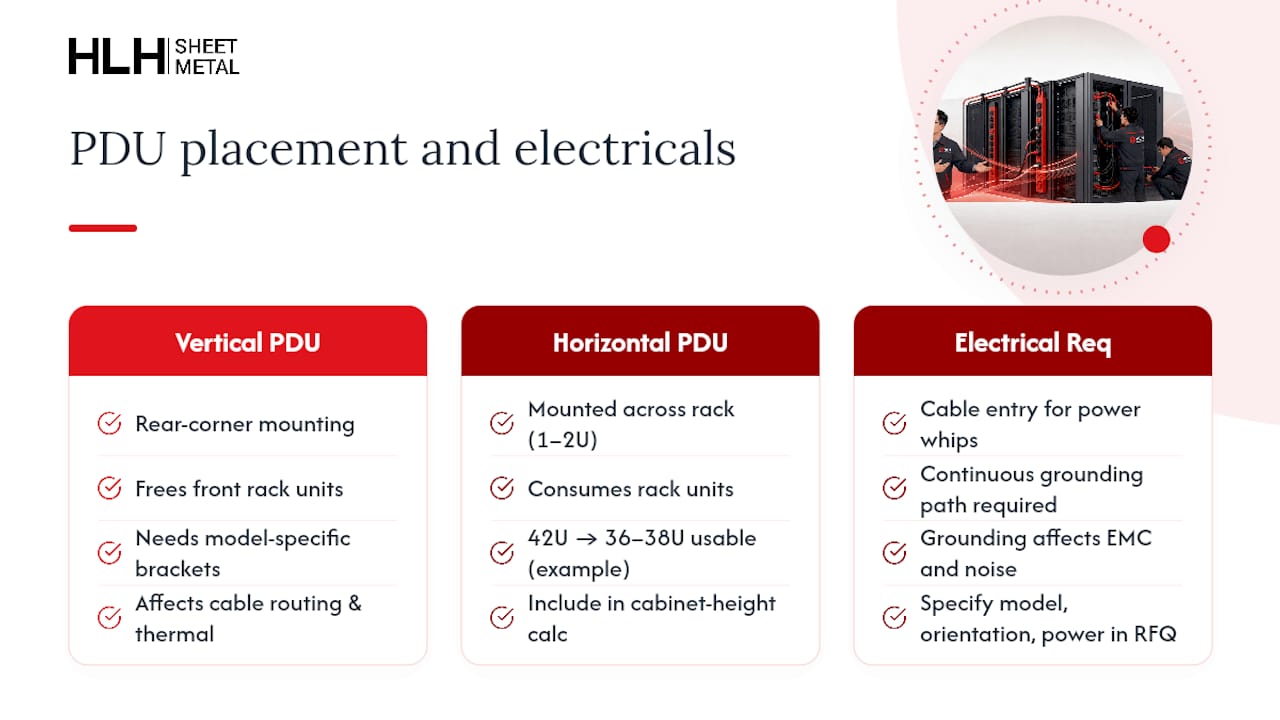
PDU placement affects both cable routing and thermal performance, so it belongs in the frame design conversation early, not as a last-minute accessory decision. Vertical PDUs mounted in the rear corners of the cabinet free up rack unit space at the front but need mounting brackets sized for the specific PDU model your customer standardizes on.
Horizontal PDUs consume rack units directly, typically one or two U per unit, which needs to factor into your total usable rack space calculation before finalizing cabinet height. A 42U cabinet with two horizontal PDUs and cable management channels might only offer 36 to 38U of usable equipment space, a detail procurement teams sometimes miss when comparing rated height across vendors.
Electrical considerations extend beyond mounting. Cabinets need adequate cable entry for power whips or conduit, and the frame’s grounding path needs to tie the PDU chassis, the cabinet frame, and any bonded rails into one continuous ground reference. This matters for both electrical safety and EMC performance, since a poorly grounded PDU chassis can become a source of noise that couples into nearby data cabling.
Specify PDU model, mounting orientation, and power requirements in your RFQ. A fabricator designing blind to these details will build generic mounting provisions that may not match your actual hardware, especially with high-amperage three-phase PDUs that need reinforced mounting points.
Noise Reduction In Enclosed Cabinet Design
Fully enclosed server cabinets trap fan noise more than open racks, which matters when the cabinet sits in an office-adjacent space rather than a dedicated data center. Acoustic foam lining on interior panels absorbs some noise, but it also blocks airflow if placed without planning, so foam placement needs to avoid vent paths and fan wall clearance.
Perforation pattern choice trades off noise containment against thermal performance. A denser perforation pattern with smaller holes reduces noise escape somewhat but also raises static pressure, which can force fans to run faster and louder to maintain the same airflow. This is one of the clearer tradeoffs in server rack cabinet design: tighter acoustic control on one side of the ledger, more fan work and more noise generated internally on the other.
Vibration damping mounts under fan trays reduce the mechanical noise that transmits through the frame itself, separate from the airborne fan noise. Door seal gaskets that improve EMC performance also happen to reduce noise leakage as a side benefit, which is one case where thermal, EMC, and acoustic goals line up rather than compete.
If noise matters for your deployment location, state a target decibel level in the RFQ rather than leaving fan and perforation selection entirely to the fabricator’s default spec.
When Speed, Cost, And Risk Actually Trade Off
Full custom OEM design makes sense when your equipment mix is unusual enough that no existing platform fits. Most projects aren’t that unusual. Platform-based ODM customization, starting from a proven frame and adjusting mounting, venting, and finish, often cuts schedule risk because the airflow and rail behavior are already known quantities rather than open questions to validate at EVT.
Where I’d never cut corners: DFM review before tooling, and a shared drawing checklist between your engineering team and the fabricator’s. Every re-spin I’ve seen traced back to a datum or tolerance nobody flagged early. QA policies that catch problems at first article, not at PVT, are the cheapest insurance in the entire project.
— Nash
Request A Server Rack Cabinet Quote Backed By Iso-certified Production
Some manufacturers run custom fabrication, laser cutting, bending, welding, finishing, and prototype-to-mass-production capability under one roof across multiple plants, which helps keep tolerance chains in one vendor’s hands instead of splitting them across subcontractors. Builds often run through ISO-certified quality control with EVT/DVT/PVT gates before mass production, and project support teams may work in English across time zones to address RFQ questions promptly.
Use the checklist in this article, drawings, BOM, finish spec, thermal budget, and target quantities, to request a quote through HLH SHEET METAL’s fabrication capabilities page. If your project needs precision cutting work scoped separately, the laser cutting services page covers tolerance capability in more detail.
Sources
Further reading on supplier evaluation and export readiness: Eterna Global Solutions’ sourcing guide. On timelines and DFM: iSTONECASE’s OEM/ODM project timeline and Bogong Laser’s chassis design guide. For 19-inch rack standards, see HLH SHEET METAL’s enclosure standards guide and its sheet metal DFM guide. For data center power context, DataCenterFuels’ tier classification guide is a useful companion reference.
- Design Considerations for Laser-Cut Server Chassis Parts
- Rack Cabinet Manufacturing: From Requirement to Repeatable Production – HJ Server Racks
FAQ
What Is The Standard Server Rack Width?
The 19-inch rack standard measures the common commercial width measured across the mounting rail centerline, and it governs hole spacing for nearly all commercial server and networking equipment.
How Long Does Custom Server Rack Cabinet Production Take?
Timelines vary by complexity, but most projects move through RFQ, DFM, EVT, DVT, and PVT before mass production, with platform-based designs typically moving faster than fully custom builds since the airflow and rail behavior are already validated.
What Tolerance Should I Specify For Rail Mounting Holes?
Function-critical features like rail mounting holes typically need tight tolerances suitable to ensure rack equipment compatibility, often within a small fractional millimeter range, since rack equipment compatibility depends on precise hole-to-hole spacing.
What Should I Include In A Server Rack Cabinet RFQ?
Include 2D and 3D drawings, a complete bill of materials, finish specification, thermal and test requirements, target quantities, and delivery and packaging terms to avoid clarification delays during quoting.

