





Table Of Contents

Design every cabinet for front-to-back airflow, seal every bypass gap with blanking panels and brush strips, and specify a high open area on perforated doors. Match cooling to actual rack density: air cooling handles most racks under moderate density, rear-door heat exchangers or in-row units cover higher density ranges, and liquid cooling takes over above that. When you outsource fabrication to China, the RFQ has to carry drawings, open-area percentages, and a request for a sample prototype plus ISO documentation before you commit to a production run.
TL;DR:
- Accurate airflow sealing and blanking panels are the most cost-effective way to improve energy efficiency and maintain proper inlet temperatures.
- Perforated metal doors with 70-80% open area balance airflow and security, while mesh doors suit high-density racks but lower dust protection.
- Properly specifying open-area percentages, tolerances, and inlet temperature targets in detailed drawings ensures Chinese fabricators build cabinets that meet performance expectations.
- Cooling methods should match rack density: air cooling under 15 kW, rear-door heat exchangers for higher loads, and liquid cooling for above 85 kW per rack.
- Implementing airflow monitoring and leak detection from the start safeguards against performance degradation and equipment risks over time.
Server Rack Cabinet Design Decisions That Control Airflow
Airflow problems rarely come from bad cooling equipment. They come from cabinets that leak air where it shouldn’t leak and starve it where it’s needed. Every open rack unit without a server or panel is a hole in your containment strategy, and hot air finds it.
Blanking panels and gap sealing close unused rack spaces so hot exhaust air can’t recirculate back into the cold aisle. Energy Star’s airflow management guidance identifies properly deployed blanking panels and sealing as one of the most direct ways to cut energy use in a data center, mostly by lowering peak intake temperatures rather than by upsizing the cooling plant.
Door selection matters just as much as what’s inside the frame:
- Perforated steel doors in the 65 to 80% open-area range balance airflow with physical security and structural rigidity.
- Mesh doors offer higher open area for very high-density rows but sacrifice some cable and dust protection.
- Glass or solid doors look clean in a showroom but choke airflow and belong nowhere near production racks running above a few kilowatts.
Cable entry points are the quiet killer of airflow budgets. Unsealed cable cutouts at the top or bottom of a cabinet act exactly like an open rack slot, pulling conditioned air around equipment instead of through it. Brush strips at every cable pass-through and disciplined vertical cable management channels keep that bypass air closed off. Internal baffles and smart PDU placement, especially keeping power distribution units out of the direct exhaust path, reduce the recirculation pockets that quietly raise inlet temperature by a few degrees across a whole row.
Cooling Strategies By Rack Power Density
The right cooling technology depends entirely on kilowatts per rack, not on what looks impressive in a vendor’s brochure.
Air cooling with hot aisle/cold aisle containment remains the standard for racks under roughly 10 to 15 kW. Containment alone, done right, delivers measurable efficiency gains because it stops the mixing that forces cooling systems to overcompensate for hot spots that shouldn’t exist in the first place.
RDHx capacity spans a wide range. Vertiv’s CoolLoop technical documentation shows rear-door heat exchangers supporting a wide range of rack loads, from lower to high densities, with passive units relying on server fans and active units adding their own EC fans for higher loads.
Rear-door heat exchangers earn their spot once density exceeds what open-aisle air handling can effectively manage. They’re room-neutral: the heat gets captured at the rack and moved to chilled water before it ever reaches the room, which is a very different design philosophy than dumping hot exhaust into a shared aisle and hoping the CRAC units keep up.
For rows that need more predictability than open-aisle air cooling but don’t yet require full liquid infrastructure, in-row and close-coupled units fill the gap. Products in this class typically deliver capacities in the range documented by manufacturers like Rittal’s LCP Inline systems, which cite modular capacity up to about thirty kilowatts per unit with water-side delta-T control and built-in leak detection.
Trade-offs worth weighing before you commit:
- Air cooling has the lowest upfront cost but the worst PUE at high density.
- RDHx and liquid systems shift heat capture to the rack, which reduces facility-level cooling load variability but adds plumbing, leak management, and a maintenance skill set most facilities teams don’t yet have.
- In-row units sit in the middle: more predictable than open-aisle air, less infrastructure-heavy than a full liquid loop.
Designing For Manufacturability When Building Cabinets In China
Airflow performance is decided on the drawing, not on the factory floor. If the specification is vague, the factory will build to whatever tolerance is easiest, and that’s usually not the tolerance your thermal model assumed.
Material choice sets the baseline. Cold-rolled steel at 1.0mm to 1.5mm is standard for frame and door panels on 42U cabinets; aluminum trims weight for smaller enclosures but costs more and flexes more under load, which matters for door-mounted perforated panels carrying real static pressure differentials.
Key specs to lock down before quoting:
- Sheet thickness: 1.0mm minimum for structural panels; heavier gauges for base frames carrying rack rail loads above roughly 800kg.
- Perforation pattern: round-hole or hexagonal patterns both work; the pattern matters less than hitting the target open-area percentage consistently across the panel.
- Tolerances and bend radii: specify these explicitly. A reliable factory in China will hold tight tolerances on CNC and laser-cut panels, but only when the drawing states them, not when it’s assumed.
- Welds and fasteners: call out weld locations on structural joints and specify captive nut hardware for door hinges that see repeated open/close cycles.
- Packaging notes: corner protection and rigid crating prevent door panels from racking out of square in transit, which quietly ruins a perforation pattern’s fit against the frame.
Specifying And Quality-assuring Rack Cabinets Built In China
An RFQ that only asks for “a 42U cabinet” invites a factory to make dozens of small decisions you never intended to delegate. The specification needs to answer every question a factory could otherwise guess at.
- State the essentials up front: overall dimensions, U height, rail type, load capacity, target inlet temperature, door open-area percentage, and finish (usually powder coat, RAL color specified).
- Attach drawings and CFD targets where density is high. Research from Lehigh University on CFD analysis shows that giving fabricators airflow targets and detailed drawings lets them optimize perforation and baffle placement before metal gets cut, avoiding the far more expensive fix of reworking a finished cabinet.
- Request a sample prototype before committing to a production run, especially for door assemblies and perforation patterns you haven’t used with that supplier before.
- Audit the factory’s actual capability: ISO 9001 certification, a documented machinery list (CNC punching, laser cutting, bending), a working powder coat line, and demonstrated export packaging experience. A supplier evaluation guide for Chinese network cabinet manufacturers lists these as the baseline checks before placing volume orders.
- Set an incoming inspection checklist: dimensional accuracy, measured perforation percentage against spec, coating thickness readings, and a functional door swing and lock test on every batch.
Pro Tip: Ask the factory for their perforation open-area calculation method before you approve a sample. Some suppliers quote nominal hole diameter and spacing without accounting for the metal removed by bend flanges near the edges, which quietly drops your actual open area below what the drawing implied.
Material Specs, Perforation Values, And Finish Guidance
Sheet steel at 1.2mm to 1.5mm covers most 42U cabinet frames without excess weight; drop to 1.0mm only on non-structural side panels.
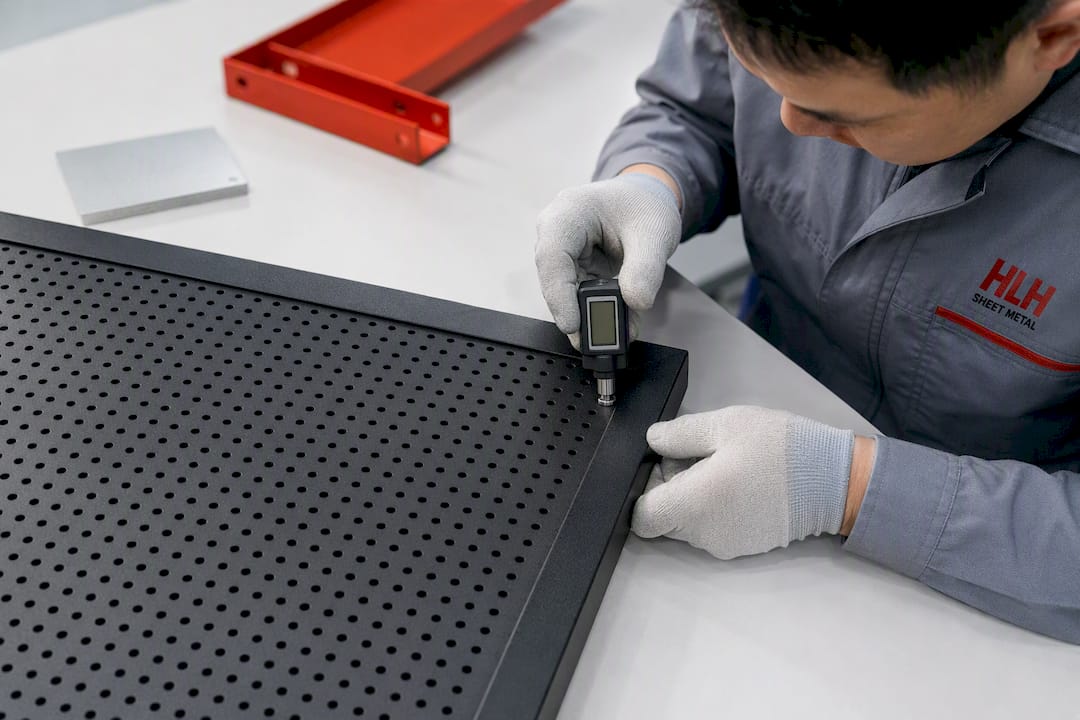
Powder coat at 60 to 80 microns gives solid corrosion resistance for indoor data center environments without adding meaningful thickness that would interfere with tight door-to-frame tolerances. Reliable Chinese OEM cabinet suppliers generally list this thickness range alongside documented ISO certification and export packaging standards as part of their standard capability sheet.
Hardware details close the remaining gaps: heavy-duty hinges rated for repeated cycling, cam locks or three-point locking on doors carrying security requirements, and a dedicated earthing stud on the frame, not just the rails, to keep grounding continuity intact through vibration during shipping.
Server Rack Design Checklist And Minimum Spec Template
Use this as a starting point for an RFQ, then adjust to your specific density and site conditions.
- Mechanical: 42U, 19-inch rail standard, static load rating in the range of several hundred kilograms, approximately one to one and a half millimeter cold-rolled steel frame.
- Airflow: perforated front and rear doors at 70 to 80% open area, blanking panels for all unused U space, brush-strip cable entries.
- Electrical accessories: PDU mounting rails positioned outside the primary exhaust path, dedicated earthing stud.
- Finish and certification: powder coat 60 to 80 microns, ISO 9001 manufacturing, factory test report included.
- Packaging and testing: export-rated crating, dimensional and perforation QC report per batch.
Plan on a prototype build, a formal approval sign-off, a small pilot run of 5 to 10 units, and only then full production. Skipping the pilot step is where most airflow specification errors turn into a warehouse full of cabinets that don’t perform as modeled.
Why HLH Sheet Metal Handles Airflow-optimized Cabinets Well
HLH SHEET METAL runs ISO-certified plants in China with CNC punching, laser cutting, bending, and in-house powder coating on the same production floor. That means prototype requests and QC checkpoints happen without shipping parts between vendors, and an English-speaking support team keeps drawing revisions and CFD-informed perforation changes from getting lost in translation.
ASHRAE Guidelines And Airflow Compliance Standards
There’s no single global code that mandates rack cabinet airflow design, but ASHRAE functions as the de facto reference standard the entire data center industry designs against. ASHRAE’s Technical Committee 9.9 publishes recommended and allowable inlet temperature ranges for IT equipment classes, and those ranges are what determines whether a given cooling strategy, air, RDHx, or liquid, is even viable for a target rack density.
Compliance here isn’t regulatory in the way a building code is. It’s practical: if your rack design pushes inlet temperatures outside ASHRAE’s recommended envelope, you risk equipment warranty issues and reduced hardware lifespan, since most server manufacturers write their environmental specs directly against ASHRAE’s classes. A cabinet with poor sealing or insufficient open area can meet every structural spec on the drawing and still fail this standard in practice, because the temperature at the server inlet is a function of the whole airflow path, not just the door.
For outsourced fabrication, this means the RFQ should reference target inlet temperature explicitly, not just leave it to the cooling system to sort out later. State the number, and the design decisions downstream, perforation pattern, baffle placement, door material, follow from it logically instead of by guesswork.
How Ambient Data Center Conditions Should Shape Cabinet Design
A cabinet spec that works perfectly in a purpose-built, climate-controlled data hall can fail in a converted warehouse space or a colocation facility with inconsistent humidity control. Ambient conditions set the baseline that rack-level design has to work against, not the other way around.
Facilities running higher ambient temperatures, common in warmer climates or in sites using economizer cooling to cut energy costs, need more aggressive containment at the rack level to compensate. If the room’s baseline cold-aisle temperature runs a few degrees warmer than a traditional tightly controlled hall, every gap and bypass path in the cabinet becomes more costly, because there’s less thermal margin before equipment hits its allowable inlet limit.
Humidity swings affect material choice more than most specifications acknowledge. Facilities near coastal environments or in regions with high ambient humidity should specify galvanized steel or add extra corrosion protection on door hardware and hinges, since condensation cycling on cabinet metal accelerates wear on moving parts faster than in a stable, low-humidity data hall.
Altitude and air density matter for fan-cooled equipment too, though this affects server-level cooling more than cabinet design directly. What the cabinet design can control is minimizing the resistance air has to fight through to reach the equipment, regardless of what the room’s baseline conditions are doing. A cabinet built for a pristine, climate-controlled data hall and then deployed into a converted industrial space with wider ambient swings needs the same rigorous sealing and containment approach, sometimes more, not less, because the room isn’t doing the extra work for you.
Controlling Dust And Contaminants Without Choking Airflow
Every perforated door that lets air through also lets in whatever’s suspended in that air. Dust, fibers, and airborne particulates settle on server intake fans and heat sinks, and over time that buildup insulates components exactly where you need heat to escape fastest.
The fix isn’t sealing the cabinet tighter, that just recreates the airflow restriction problem you designed the perforated doors to solve. Instead, contaminant control works at the room level first: positive pressure in the data hall relative to surrounding spaces, MERV-rated filtration on make-up air handlers, and sealed raised floors or overhead cable pathways that don’t dump construction or ceiling dust directly into the cold aisle.
At the cabinet level, a few design choices help without adding resistance. Brush strips on cable entries, which you’re already specifying to block bypass airflow, do double duty by reducing the gap where airborne particulates enter through the back of the cabinet. Door gaskets on the frame-to-door seal keep dust from settling in the gap between panels, which is a common spot for buildup that goes unnoticed until a maintenance inspection.
Filtration integrated directly into perforated doors exists as a product category, but it’s a trade-off: any filter media adds static pressure resistance, which works against the open-area percentage you spent so much design effort achieving. For most standard data center environments, room-level filtration handles contaminant control adequately, and cabinet-level filtration should be reserved for genuinely dusty industrial environments, manufacturing floors, or facilities near active construction, where the ambient particulate load is high enough to justify the airflow trade-off.
Adding Airflow Monitoring And Sensors To The Cabinet Design
A rack designed for 70% open area and sealed correctly on day one doesn’t stay that way forever. Cable additions, forgotten blanking panels after a hardware swap, and gradual gasket wear all erode the airflow performance you specified, and none of it shows up until someone notices a temperature alarm.
Building in monitoring from the start catches this drift early. Temperature sensors at the top, middle, and bottom of the rack, both cold-aisle intake and hot-aisle exhaust, give a real picture of stratification across the cabinet height rather than relying on a single point reading that misses hot spots forming near the top U positions, a common failure mode as heat naturally rises within a sealed rack.
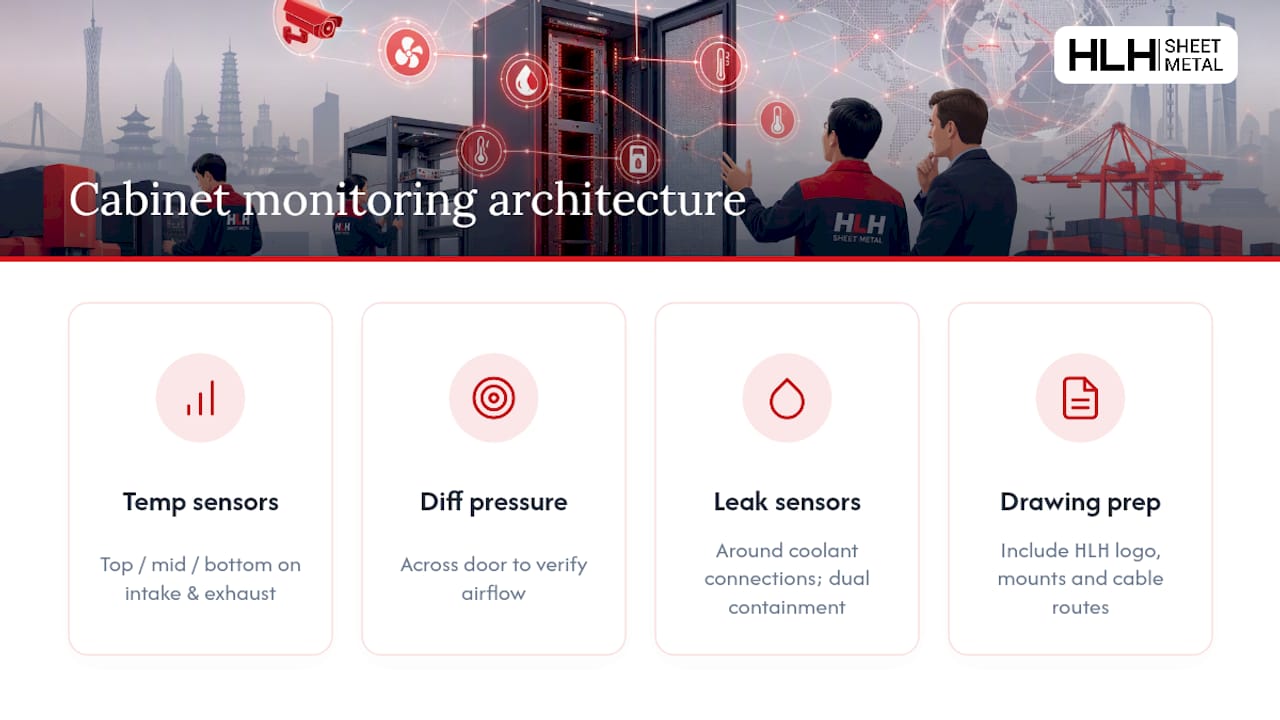
Differential pressure sensors across the door add a layer most designs skip entirely. A pressure reading tells you whether air is actually moving through the perforated area at the rate the design assumed, which catches problems like a partially blocked door or degraded fan performance well before temperature sensors would flag it as a crisis.
For high-density racks running RDHx or liquid cooling, leak detection sensors around coolant distribution connections aren’t optional. The same rear-door heat exchanger documentation that covers capacity ranges also recommends leak detection and dual containment for coolant lines, plus service access that doesn’t require pulling adjacent racks during maintenance. Building sensor mounting points and cable routing for this monitoring into the original cabinet drawing costs far less than retrofitting it after a leak event forces the issue.
What Actually Matters In Rack Airflow Design
Most rack airflow advice treats sealing and containment as a compliance checkbox, something you do once and move past. That’s backward. The data consistently points to sealing and blanking as the highest-leverage, lowest-cost intervention available, more impactful per dollar than most cooling upgrades, yet it’s the first thing skipped when a project is behind schedule.
The bigger blind spot is treating outsourcing to China as a risk to manage rather than a design decision to make well. Cabinets built from vague specifications fail not because Chinese fabrication quality is inherently unreliable, but because the drawing never told the factory what mattered. A supplier with real CNC, laser, and powder coat capability will build exactly what the drawing says, including its ambiguities.
If you take one thing from this guide, make it this: put the open-area percentage, the tolerance, and the target inlet temperature on the drawing before you send the RFQ, not after the first sample arrives wrong. Everything else, cooling technology selection, monitoring, contaminant control, works better once that foundation is locked down instead of guessed at.
— Nash
Get A Prototype And Drawing Review For Your Rack Cabinet Project
Specifications only matter if the factory building them can actually hit the tolerances on the page. HLH SHEET METAL runs ISO-certified production lines in China with the CNC punching, laser cutting, bending, and powder coating equipment needed to hold tight perforation and dimensional tolerances on server rack cabinets, without the back-and-forth delays that come from working across multiple disconnected vendors.
If you have drawings ready, HLH SHEET METAL’s team can run a technical review and quote a prototype before you commit to a full production order. If you’re still finalizing specs, the sheet metal fabrication services page walks through what to include in an RFQ to get an accurate quote on the first pass. Upload your drawings or send your target open-area and load requirements, and get a prototype quote back with export-ready packaging built into the plan from the start.
FAQ
What Companies Build Server Racks?
Server rack cabinets are built by a mix of large thermal management vendors and specialized sheet metal fabricators. HLH SHEET METAL manufactures custom server rack cabinets and enclosures in ISO-certified plants in China, handling both prototype runs and full production for international clients.
Which Type Of Rack Provides The Best Cooling Capabilities?
No single rack type wins outright; the best option depends on rack density. Racks with 65 to 80% perforated door open area handle standard air cooling well, while rear-door heat exchangers support far higher densities, up to roughly 85 kW per rack, with room-neutral performance.
What Is The Best Way To Cool A Server Rack?
Start with hot-aisle/cold-aisle containment, blanking panels, and sealed cable entries, since these measures directly reduce peak intake temperatures before you add mechanical cooling capacity. Above roughly 10 to 15 kW per rack, add rear-door heat exchangers, in-row units, or liquid cooling depending on density.
What Is The Purpose Of A Server Rack Cabinet?
A server rack cabinet organizes IT equipment into a standardized 19-inch mounting format while controlling airflow, physical security, and cable management. Its design, door perforation, sealing, and internal layout, directly determines whether the equipment inside runs within safe thermal limits.
Why Outsource Server Rack Manufacturing To China?
Chinese fabricators with ISO certification and full CNC, laser, and powder coating capability can produce custom rack cabinets at lower cost and with faster turnaround than many domestic shops, provided the RFQ includes detailed drawings, open-area specs, and a required prototype step before production.

