





Table Of Contents

RoHS restricts ten hazardous substances in electrical and electronic equipment, measured against each homogeneous material inside a part. REACH is a broader chemical-management regime that can impose obligations even after a product clears RoHS testing cleanly. The two immediate moves for any compliance team: confirm whether the product qualifies as EEE under RoHS scope, then screen every bill of materials against the REACH Candidate List to see if notification or communication duties apply.
TL;DR:
- RoHS limits apply per homogeneous material and can be passed even if internal coatings exceed restricted substance thresholds.
- REACH obligations trigger based on substance concentration in articles and tonnage, independent of RoHS compliance status.
- Companies must verify each component at the article level for REACH, especially for complex assemblies with multiple parts.
- Exemptions for RoHS are narrowly defined, time-limited, and require renewal applications well before expiry to avoid production gaps.
- Maintaining detailed, batch-linked documentation and conducting early screening helps prevent costly compliance issues and surprise obligations.
What Does Rohs Compliance Actually Cover?
RoHS compliance applies to electrical and electronic equipment falling under the categories defined in Directive 2011/65/EU, from industrial tools to medical devices and monitoring instruments. The directive’s Annex II restricts ten substances, including lead, cadmium, mercury, and several phthalates, and every limit is assessed by weight within a single homogeneous material rather than the finished product as a whole. That distinction trips up a lot of engineers: a cable assembly might pass RoHS overall while one internal coating exceeds the limit on its own.
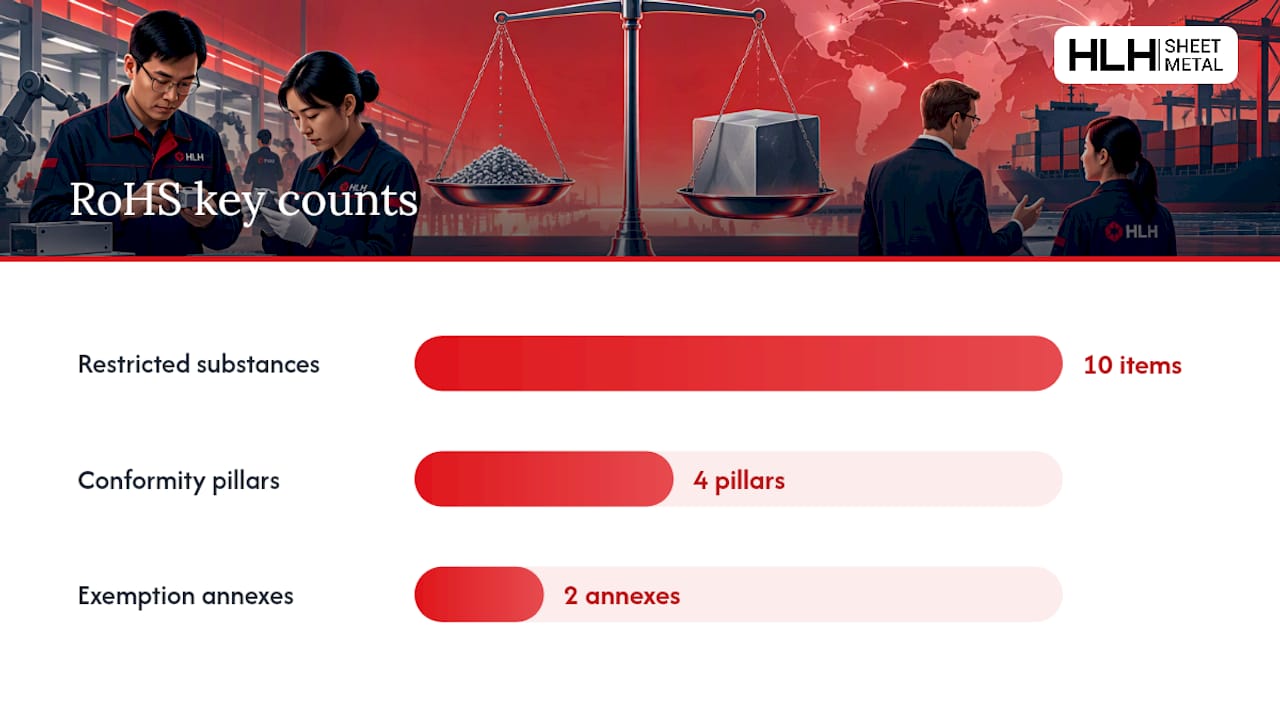
Exemptions live in Annexes III and IV, and they’re narrow by design. Each one applies to a specific application, carries an expiration date, and requires industry to file for renewal well ahead of that date to avoid a manufacturing gap.
Conformity itself rests on four pillars:
- A technical file documenting materials, test data, and design decisions
- An internal production-control procedure that catches deviations before shipment
- An EU Declaration of Conformity signed by the manufacturer
- CE marking affixed once all requirements are satisfied
Market surveillance authorities check all four during spot audits, and a missing technical file is one of the fastest ways to fail one.
What Does REACH Actually Require From Suppliers?
REACH governs substances on their own, in mixtures, and inside finished articles, and it spreads responsibility across manufacturers, importers, and downstream users rather than resting it on one party. Anyone manufacturing or importing a substance at 1 tonne or more per year into the EU generally has to register it with the European Chemicals Agency, and higher tonnage bands trigger a full chemical safety assessment.
Articles containing a Substance of Very High Concern above 0.1% by weight carry their own obligations, independent of tonnage. The key thresholds:
- 0.1% w/w per article: triggers a duty to communicate safe-use information down the supply chain
- 1 tonne per year, aggregated across all articles containing that substance: triggers a formal notification to ECHA
- SCIP database reporting: required for articles placed on the EU market that contain Candidate List substances above the threshold
ECHA maintains the Candidate List, the registration database, and the guidance documents that make these thresholds enforceable in practice.
How Are Rohs And REACH Actually Different?
RoHS behaves like a vertical gate: it applies to one product category, restricts a fixed list of substances, and either clears a product for the EU market or blocks it. REACH works horizontally across every chemical substance in commerce, regardless of what product it ends up in, and its obligations don’t stop once a substance clears a concentration test.
The practical differences compliance teams need to internalize:
- Different measurement basis. RoHS limits apply per homogeneous material; REACH’s SVHC threshold applies per article, and a “complex object” may contain dozens of separate articles that each need individual assessment.
- Different triggers. RoHS compliance is about concentration alone. REACH adds a tonnage trigger on top of concentration, so the same substance can require action in one supply chain and not another purely based on volume.
- Independent obligations. A connector assembly can pass every RoHS test and still contain a Candidate List substance above 0.1% w/w, which means Article 33 communication duties apply regardless of the RoHS result.
- Timing mismatch. RoHS exemptions are reviewed on multi-year cycles; REACH’s Candidate List updates twice a year, so a compliant product today can acquire new REACH duties without any design change at all.
Teams that treat RoHS clearance as proof of full regulatory compliance are the ones who get caught flat when ECHA adds a new substance to the Candidate List.
How Do You Build A Rohs And REACH Compliance Process?
Sequencing this work correctly saves weeks of rework later. Here’s the order that avoids the most common dead ends:
- Scope the product. Confirm it meets the EEE definition under RoHS, then map out every distinct article inside it, down to fasteners, coatings, and connectors, since REACH assesses each one separately.
- Test for RoHS. Sample each homogeneous material, not just the finished assembly, and prioritize plated or coated surfaces where restricted substances tend to concentrate.
- Screen suppliers for REACH. Collect safety data sheets and substance declarations for every component, and flag anything matching the current Candidate List for follow-up.
- Decide on notification. If a Candidate List substance exceeds 0.1% w/w and the aggregated tonnage across your product line tops 1 tonne per year, prepare an ECHA notification.
- Assemble the technical file. Combine RoHS test reports, supplier declarations, and the EU Declaration of Conformity into one traceable record set tied to batch or lot numbers.
Pro Tip: Run REACH screening before RoHS lab testing, not after. Catching an SVHC flag early lets you decide whether a substitution is worth it before you’ve already paid for a full test report on a design you might scrap.
What Counts As Proof Of Compliance?
Regulators don’t accept a verbal assurance that a part is compliant. They want a paper trail, and the depth of that trail depends on risk. Accredited lab testing is expected for new suppliers, novel materials, or any component flagged during a prior audit; established suppliers with a track record can sometimes rely on documented declarations, though a declaration only covers the specific scope it states.
A complete RoHS technical file typically includes:
- Test reports covering each homogeneous material
- A bill of materials with supplier certifications attached
- The internal production-control procedure
- The signed EU Declaration of Conformity referencing the applicable directive
Enforcement reviews have flagged labeling gaps, incomplete documentation, and restricted-substance exceedances in test sampling as recurring noncompliance findings. Keep records for at least the product’s expected service life, and tie every document to a specific batch so you can trace a failure back to its source in hours, not weeks.
When Do REACH Notification And Communication Duties Kick In?
The 0.1% w/w threshold is the trigger for Article 33 communication: once a Candidate List substance crosses that line in an article, you have to pass safe-use information down the supply chain, whether or not you also hit the 1 tonne notification trigger. The two thresholds are separate, and it’s a common mistake to think one automatically implies the other.
Practical minimums to have ready:
- Enough information to allow safe use of the article, at minimum the substance name and the reason it’s on the Candidate List
- A response process for consumer requests, which must be answered within 45 days
- A notification to ECHA when the aggregated tonnage across all your articles containing that substance exceeds 1 tonne per year
- A check for whether the substance also falls under authorization or restriction requirements, which can apply independent of the article thresholds
Registration itself generally isn’t triggered by article-level SVHC presence. It applies when you manufacture or import the substance itself above the 1 tonne threshold, a different question from the communication and notification duties above.
What Should You Expect From Exemption Renewals And Enforcement?
RoHS exemptions are application-specific, time-limited, and reviewed against whether a substitute has become technically feasible. Renewal requests need to go in well before expiry. Commission guidance points to decision timelines running 18 to 24 months, so waiting until six months out is a real risk to production continuity.
REACH works on a different clock. The moment ECHA adds a substance to the Candidate List, communication duties apply immediately, and if the notification trigger is met, companies generally have a six-month window to notify ECHA.
A few planning points worth building into your review cadence:
- Enforcement reviews have repeatedly flagged documentation and labeling gaps as the most common noncompliance findings, not substance exceedances themselves
- Candidate List updates happen twice yearly, so a semiannual internal review catches new obligations before an auditor does
- Products with long service lives need a standing process, not a one-time compliance check at launch
How Should You Manage Supplier Data For Both Regimes?
A supplier questionnaire should ask for substance declarations against both the RoHS Annex II list and the current REACH Candidate List, plus safety data sheets, test reports, and manufacturing location for traceability. Treat a single supplier certificate as evidence for a defined scope, not a blanket guarantee. A generic RoHS statement doesn’t tell you anything about SVHC content, and the two need to be verified separately.
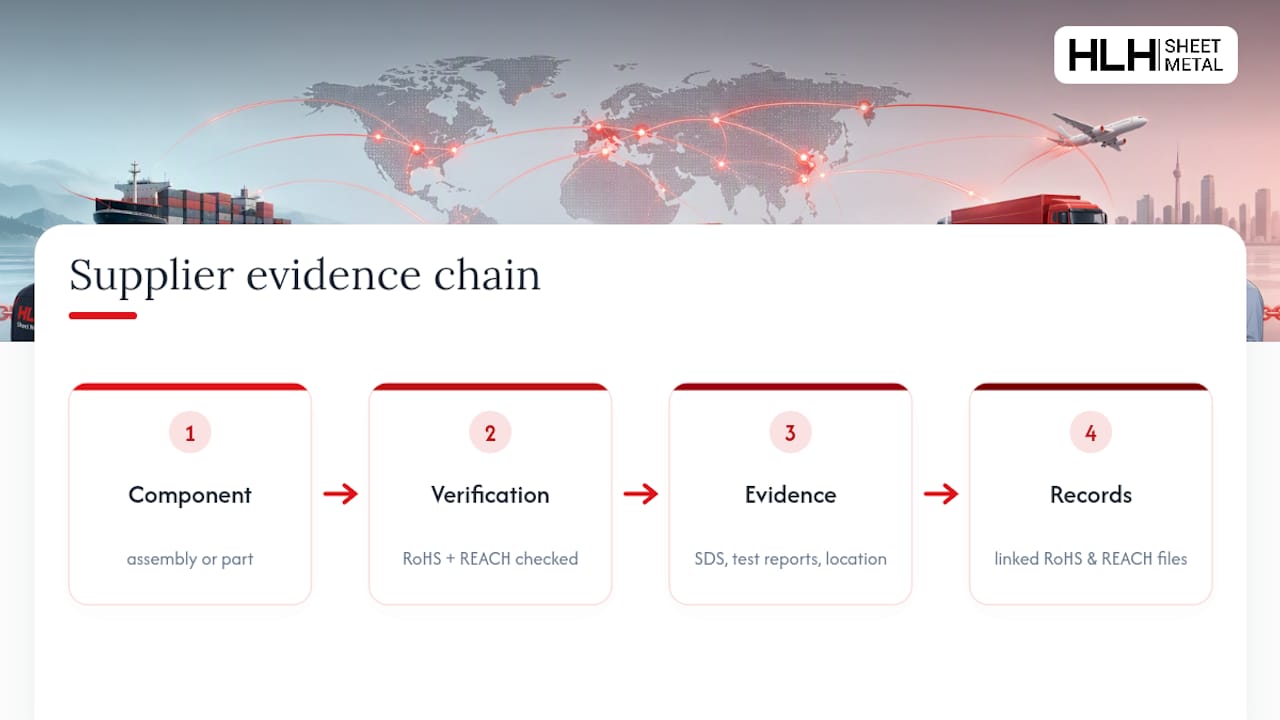
Verification should escalate when declarations don’t match, when a component involves plating, or when a supplier can’t produce component-level data for a complex assembly. Component-level detail matters more than most teams expect: ECHA’s own guidance on complex objects makes clear that each constituent article needs its own 0.1% assessment, not an averaged figure across the whole assembly.
Fabrication partners with ISO-certified quality systems and multi-plant production tend to have this traceability built into their process already, which shortens the verification cycle considerably.
Pro Tip: Store supplier evidence with a direct file reference inside your RoHS technical file and REACH communication records, not in a separate folder. Auditors ask for the connection between the claim and the proof, not just the proof itself.
Which Regulation Should Compliance Teams Prioritize First?
RoHS is the gate: fail it and the product can’t legally enter the EU market. REACH is ongoing risk management that keeps generating obligations after launch. My rule of thumb: clear RoHS first for market access, then build REACH screening into procurement so it runs continuously, not once at product launch.
— Nash
How HLH SHEET METAL Reduces Compliance Friction For Fabricated Parts
Sourcing compliant enclosures gets harder when a supplier can’t produce traceable documentation on demand. HLH SHEET METAL runs ISO-certified quality control across multiple manufacturing plants, which means test records and material certifications stay tied to specific batches from prototype through production, exactly the kind of traceability a RoHS technical file or REACH communication record needs. That structure matters most when a design moves fast: rapid prototyping doesn’t have to mean losing the paper trail once a part scales into a full production run.
For teams sourcing custom sheet metal fabrication or precision-engineered enclosures, HLH SHEET METAL’s support team works directly with engineering and procurement to hand over the documentation compliance reviews actually ask for. Request a quote through the capabilities page and specify your compliance documentation needs up front.
Where To Verify Rohs And REACH Requirements
Legal text and official guidance should always be the final word, not a blog post. Start with the RoHS Directive itself for exact substance limits and category scope, then check the European Commission’s RoHS implementation pages for exemption status. For REACH, ECHA’s guidance on substances in articles and the Candidate List database are the two resources worth bookmarking for ongoing monitoring.
FAQ
What Is The Meaning Of Rohs Compliance?
RoHS compliance means an electrical or electronic product stays under the Annex II concentration limits for ten restricted substances, measured within each homogeneous material rather than the assembled product. It also requires a technical file, an EU Declaration of Conformity, and CE marking under Directive 2011/65/EU.
Is Rohs Compliance Required In The US?
RoHS is an EU directive, so it doesn’t apply as federal law in the United States. Manufacturers exporting to the EU market still have to meet it, and several US states plus major retailers require RoHS-equivalent limits as a condition of sale, so most global electronics makers treat it as a de facto standard regardless of destination.
Is REACH Mandatory In The EU?
Yes. REACH is a binding EU regulation covering substances manufactured, imported, or present in articles placed on the EU market, with registration required above 1 tonne per year and communication duties triggered at 0.1% w/w for Candidate List substances in articles.
Is There Going To Be A REACH Revision In 2026?
The European Commission has signaled ongoing REACH reform discussions, though the scope and final timing of any revision are still developing at the regulatory level. Compliance teams should monitor ECHA and Commission publications directly rather than relying on a fixed date, since the Candidate List itself already updates twice a year independent of any broader revision.
Can A Product Be Rohs Compliant But Still Fail REACH?
Yes, and it happens more often than most teams expect. A part can meet every RoHS concentration limit and still contain a Candidate List substance above 0.1% w/w in one constituent article, which triggers REACH communication or notification duties that RoHS testing never checks for.
Recommended
- Design Enclosures to 19-Inch Rack Standards for China
- Quality Control Plan for China Fabrication: Managing Tolerances
- Aerospace Metal Fabrication in China | Essential QA Standards
- ISO Certified Metal Parts Manufactures – A Comprehensive Guide

