




Table Of Contents
Brass Vs Copper
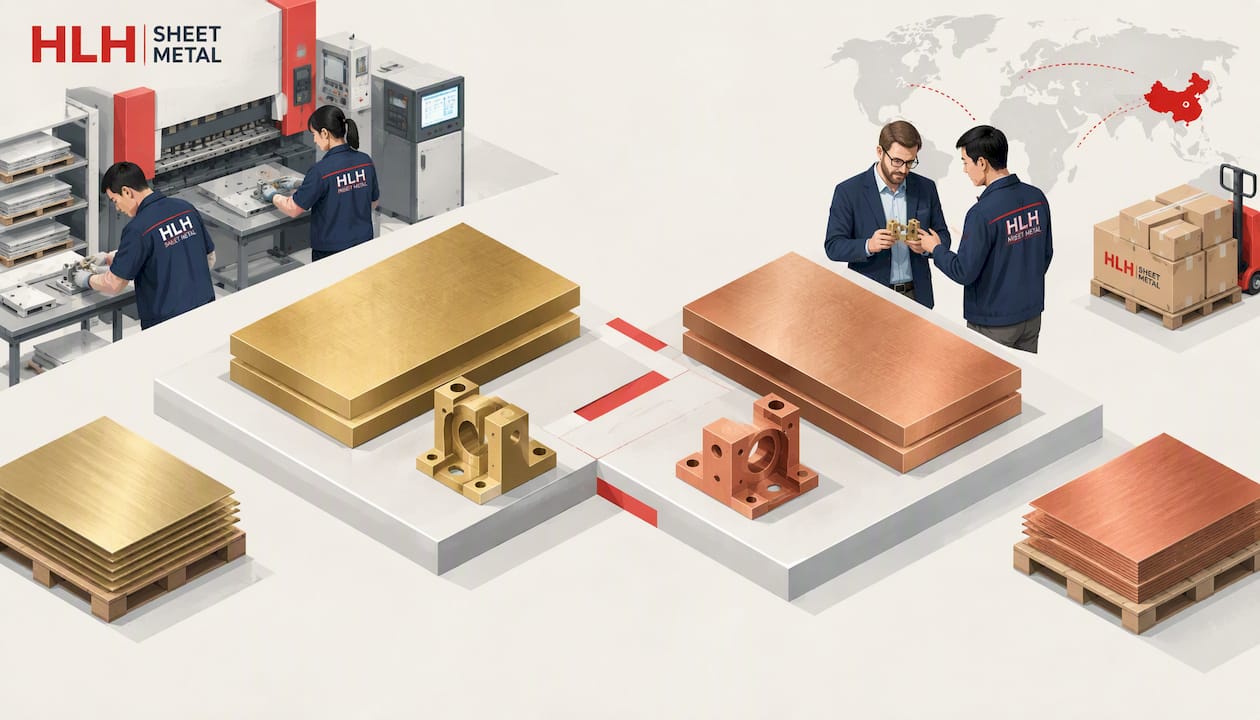
Choose copper when electrical or thermal conductivity drives the design. Choose brass when the part is turned, threaded, formed or cost-sensitive and conductivity is secondary. Most disputes with overseas suppliers come later, when “brass” or “copper” on a drawing turns out to mean different alloys to different people. This guide covers how the two metals differ, how that changes manufacturing, and how to write an RFQ that gets comparable quotes from Chinese suppliers.
TL;DR
- Copper is the benchmark for conductivity. Brass is a copper-zinc alloy family that trades most of that conductivity for machinability, strength and lower raw-material cost.
- Never RFQ a color. Specify the UNS grade, product form, temper, standard and certificate, for example C26000 or C36000.
- Leaded free-machining brass is the easiest metal to turn at volume, but check lead limits for your destination market before you order.
- Two China quotes are only comparable when they share the same grade, temper, inspection, packing and Incoterm.
- For sheet metal brass and copper parts (enclosures, brackets, contacts, shields), we fabricate both at HLH Sheet Metal.
What Actually Separates Brass From Copper
Copper is a near-pure element. Brass is an alloy. The Copper Development Association describes brasses as mainly copper and zinc, and bronzes as copper with tin, aluminum, silicon or beryllium. That one fact explains most of what follows.
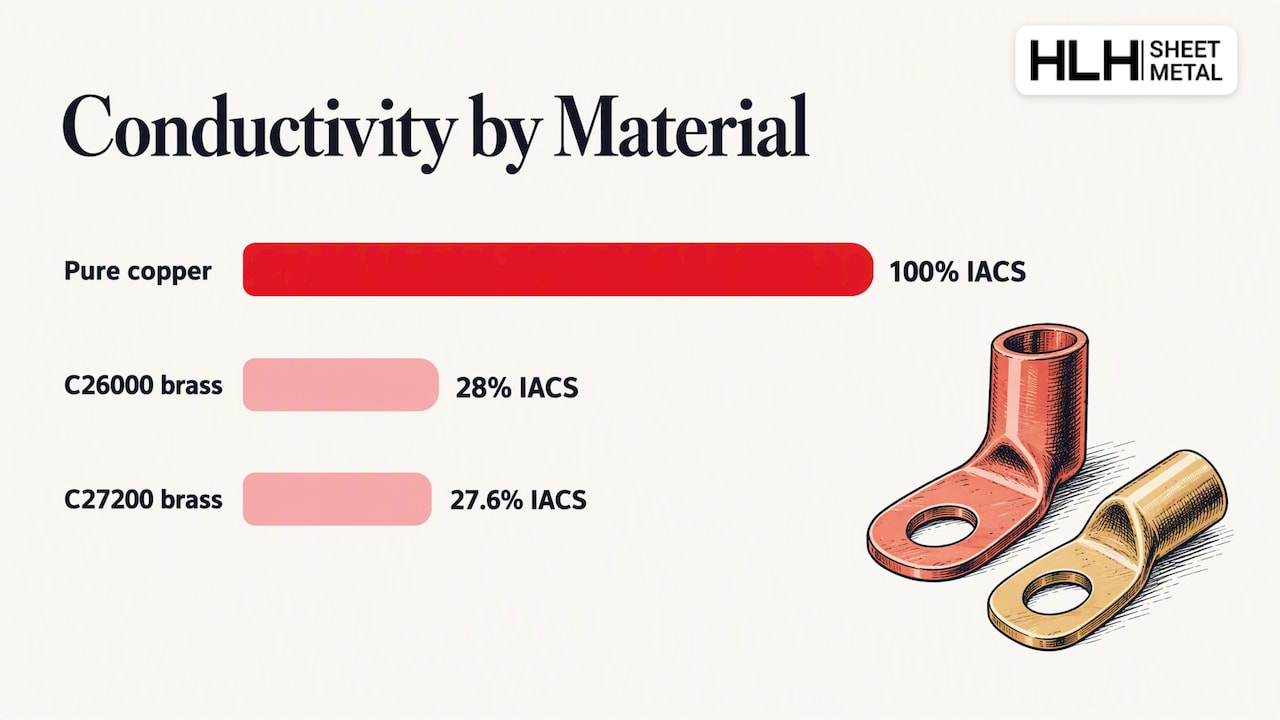
Zinc raises strength and hardness and makes chips break cleanly in a lathe. It also costs conductivity. According to the CDA, C26000 cartridge brass sits at 28% IACS conductivity, against the 100% benchmark for pure copper. The CDA record for C27200 yellow brass lists 27.6% IACS, a typical hard-drawn tensile strength of 74 ksi and a density of 0.305 lb/in³.
NIST makes the same trade-off point in its review of copper alloys: strengthening by cold work, alloying or precipitation generally raises strength and lowers electrical conductivity. There is no free upgrade. Pick the property that matters most and accept the cost on the others.
Side-by-side Comparison
| Criterion | Copper (e.g. C11000, C10100) | Brass (e.g. C26000, C36000) |
|---|---|---|
| Composition | Near-pure copper | Copper plus zinc; free-machining grades add lead |
| Electrical conductivity | Benchmark, highest | Roughly 28% IACS for common grades |
| Machinability | Gummy, stringy chips, harder to hold finish | C36000 is the benchmark standard for machinability |
| Formability | Very ductile, soft | Good, varies by temper and zinc content |
| Strength and hardness | Lower in soft tempers | Higher for typical grades |
| Raw-material cost | Higher | Lower, since zinc dilutes the copper content |
| Typical use | Busbars, heat sinks, grounding, contacts | Fittings, valve bodies, threaded parts, connectors, hardware |
| Main sourcing risk | Wrong purity or conductivity | Lead content, wrong grade substitution |
Grade numbers are examples. Your application decides the real choice.
Machinability: Why Brass Wins On The Lathe
The CDA identifies C36000 leaded yellow brass as the benchmark standard for metal machinability. For high-volume turned fittings, valve bodies, instrument components and threaded parts, that means faster cycle times, cleaner chip control and longer tool life. Pure copper behaves differently: it is soft and smears, so it takes sharper tooling, more careful feeds and often a slower cycle.
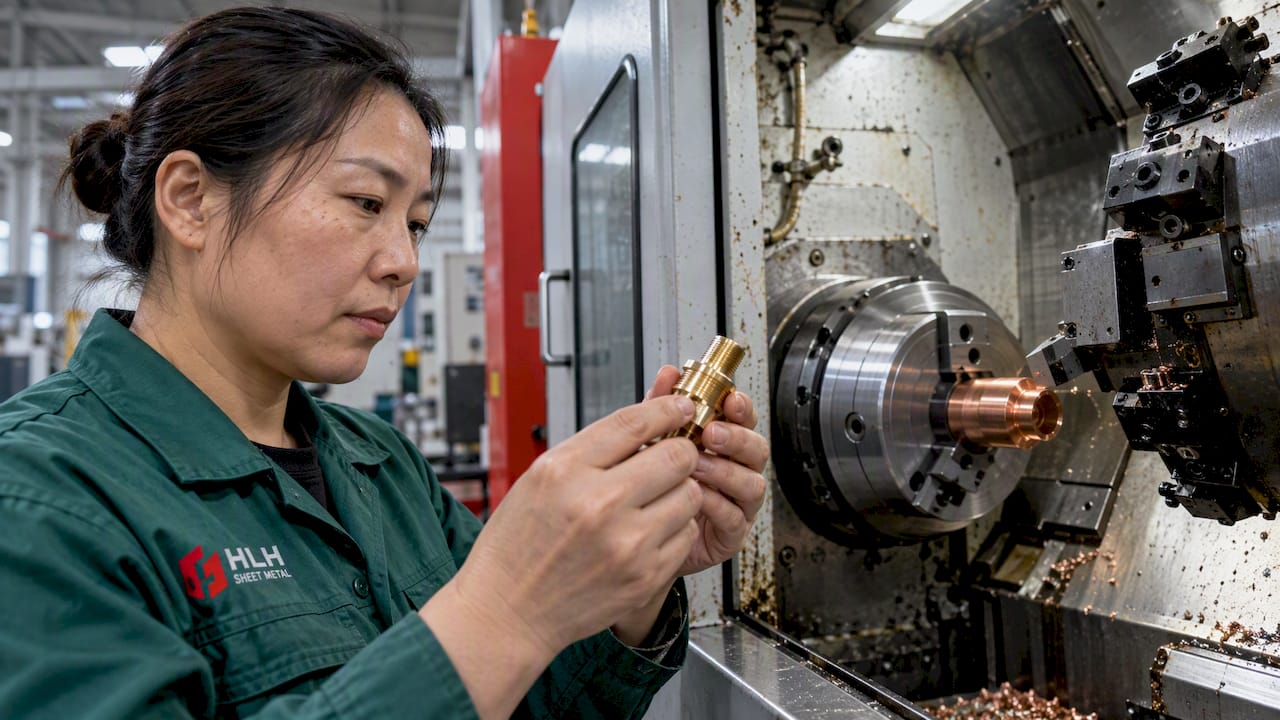
That gap is why a design that suits copper electrically can still cost much more than expected when turned. If the part only needs moderate conductivity, a brass or a copper-alloy alternative may be the better engineering answer. If it needs high conductivity and complex geometry, consider whether a stamped or formed copper part replaces a machined one. Sheet processes such as stamping and bending suit copper’s ductility well.
Precision turning also depends on machine condition. Spindles, ways and fixtures loaded with oil and chip buildup drift out of tolerance, so shops that hold tight tolerances on brass keep their equipment clean, for instance with dry ice cleaning for CNC machines. Ask a prospective supplier how they maintain machines, not only what machines they own.
Lead Is A Sourcing Decision
Free-machining brass gets its speed from lead. The CDA source identifies C36000 as a leaded free-machining brass and its lead content must be checked against end-use and destination-market requirements. Potable water parts, consumer products and electronics each face different limits. One example: a supplier-side briefing says the EU RoHS exemption for leaded copper alloys is due to expire on 30 June 2027 unless renewed. Verify any rule with the regulator before you design around it.
If you ship into the US, state and federal rules on lead in plumbing and consumer goods may apply. Confirm them with a compliance specialist for your product before you pick the alloy, and write the lead limit into the RFQ.
Cost: Copper Costs More Per Pound, But Part Cost Is Another Story
Copper trades above brass per pound because brass contains zinc. A 2026 scrap-market guide puts bare bright copper at about $4.70 to $5.10 per pound, with standard brass grades well below that. Treat scrap prices as an indicator of direction only. Mill prices for sheet, rod or tube carry fabrication premiums and move with the market, so ask for a dated quote.
Raw material is only one line of the part price. Three other factors often outweigh it:
- Machining time. A brass part that turns in half the time can beat a copper part even when you ignore the metal price.
- Scrap and yield. Soft copper burrs and deforms, which raises rejects on tight features.
- Finishing. Plating, passivation or lacquering on copper to stop tarnish adds a step that some brass parts skip.
The cheapest quote is not always the cheapest landed cost. We cover how inspection scope and quality control change what you finally pay in our piece on quality control and cost in China.
Where Each Metal Belongs
Choose Copper When
- The part carries current or moves heat: busbars, grounding straps, heat sinks, cold plates, welding contacts.
- Conductivity must be certified, not assumed. Specify oxygen-free grades only if the design needs them.
- The geometry is simple, or the part can be stamped or bent rather than turned.
Choose Brass When
- The part is turned, threaded or tapped in volume: fittings, nozzles, valve bodies, instrument parts.
- You want a stiffer part with a clean machined finish and good corrosion behavior.
- Conductivity around 28% IACS is enough for a connector, terminal or electrical hardware.
- Cost matters and the complexity would make copper expensive to machine.
Check The Temper Before The Alloy
Temper changes behavior as much as grade does. CDA data on C27400 shows that the same alloy family can ship in different conditions with materially different strength and elongation. C27200 and C27400 hard-drawn material is listed at 55 ksi yield and 10% elongation. A drawing that states alloy and dimensions but not temper is incomplete for formed, spring-loaded or fatigue-sensitive parts.
For aerospace, cryogenic or high-temperature service, a room-temperature datasheet is not enough. NIST notes that property values depend on temperature and metallurgical variables, so write acceptance criteria for conductivity and mechanical properties into the purchase specification.
How To Write A China RFQ That Gets Comparable Quotes
The single most useful habit is to treat alloy names as procurement controls. The CDA states that the Unified Numbering System is the accepted designation system in North America for wrought and cast copper alloys. A supplier who cannot state the UNS number and the product standard cannot reliably show that its “brass” matches your requirement.
Include all of this in every RFQ:
- Product form: sheet, strip, coil, plate, rod, bar, tube, wire or a machined or fabricated part.
- Exact grade and standard: UNS number plus ASTM, EN or JIS reference.
- Dimensions and tolerances, with the critical features marked, not a blanket tolerance.
- Temper and surface or edge requirements.
- Quantity and annual volume, plus prototype versus production.
- Application, including any conductivity, lead or corrosion requirement.
- Destination and Incoterm, so freight and export scope are not silently left out.
- Inspection documents: material test certificate, inspection report, certificate of conformity.
- Export packing: moisture protection, pallet or wooden case, shipping marks.
On tolerances, a blanket tight number is a cost trap. Our progressive die stamping checklist explains why you should tighten only the features that need it.
Align The Paperwork Before The Purchase Order
In our experience the failure point in overseas sourcing is usually documents, not cutting capability. Before you release the PO, make sure the quotation, material test certificate, packing list, inspection plan and certificate of conformity all repeat the same grade, standard, temper, heat or lot number, dimensions and quantity. A mismatch caught before shipping costs an email. A mismatch caught at your dock costs weeks.
Vetting A Chinese Supplier For Brass And Copper Work
China offers scale, many product forms and stable manufacturing routes for copper alloys, as sourcing guides such as this 2026 buyer checklist note. The question is whether a particular supplier fits your part. Ask:
- Can they name the UNS grade and standard on every quote, and will they refuse to substitute without written approval?
- Do they provide mill or material certificates traceable to a lot number?
- What inspection happens in-process and at final, and who signs the report?
- Do they hold ISO certification relevant to your industry, and can you see the certificate?
- Do they have engineers who communicate quickly in English?
- Can they handle both a 20-piece prototype and a production run without changing process?
For a deeper checklist, read our guides on choosing a metal parts fabricator in China, precision metal parts quality control and common quality issues. If your parts are threaded and finished, see powder coat masking for threaded parts. For regulated sectors, the aerospace quality standards article shows what documentation looks like.
Our Perspective
Buyers usually come to us having already chosen a metal by habit: copper because it “conducts,” brass because it “machines.” Our advice is to rank requirements first. List conductivity, strength, forming, joining, operating temperature, weight, finish and budget, then see which grade survives. Often a brass grade covers a connector perfectly and a copper grade covers a busbar perfectly, and the pair share an assembly.
The second thing we push is early drawing review. A temper, a bend radius or a tolerance fixed before the quote is far cheaper than one discovered on the shop floor. We work from multiple plants in China, which lets us handle a small prototype batch and a larger run with the same quality system, and our support team answers international clients in English, around the clock. When a customer’s drawing says only “brass,” we ask which one before we cut anything.
— Nash
Brass And Copper Sheet Parts From HLH Sheet Metal
If your design calls for enclosures, brackets, shields, contacts or chassis in brass or copper sheet, we fabricate in both metals, along with steel, aluminum, stainless steel, titanium, magnesium and others. Our processes include laser cutting, bending, welding, stamping and surface finishing, with ISO-certified quality assurance and global shipping. Send a drawing with grade, temper and quantity through our sheet metal fabrication page and our team will come back with a quote, or start with laser cutting for prototype blanks. For finishing questions such as tarnish protection, see our surface finishing services.
FAQ
Which Is Better, Brass Or Copper?
Neither wins outright. Copper is better when conductivity or heat transfer dominates. Brass is better when machinability, formability, corrosion resistance, threaded features or cost matter more. Rank your requirements and choose from there.
Is Brass Cheaper Than Copper?
Usually yes per pound, because brass contains zinc. Scrap-market data for 2026 shows copper trading well above standard brass. Finished part cost also depends on machining time, scrap rate and finishing, so compare quotes on the same specification.
What Should I Put In An RFQ For Brass Parts From China?
Name the UNS grade, product form, temper, standard, tolerances on critical features, quantity, lead or conductivity requirements, destination and Incoterm, inspection documents and export packing. Without these, quotes from different suppliers are not comparable. Ask each supplier to repeat the grade and standard on the quote and the certificate.
Does Leaded Brass Cause Problems For Export?
It can. Free-machining grades such as C36000 contain lead, and limits vary by destination and product type. Check the rules for your market with a compliance specialist before choosing the alloy, and write the limit into the RFQ.
Recommended
- Precision Brass Sheet Metal Fabrication – China | Custom Brass Parts – Get Free DFM & Quote
- Copper Sheet Metal Fabrication – China | Custom Copper Parts Manufacturer
- Metal Fabricators in China – How to Choose The Right Manufacturer
- Understanding Quality Control Influences in Metal Parts Costs In China

