



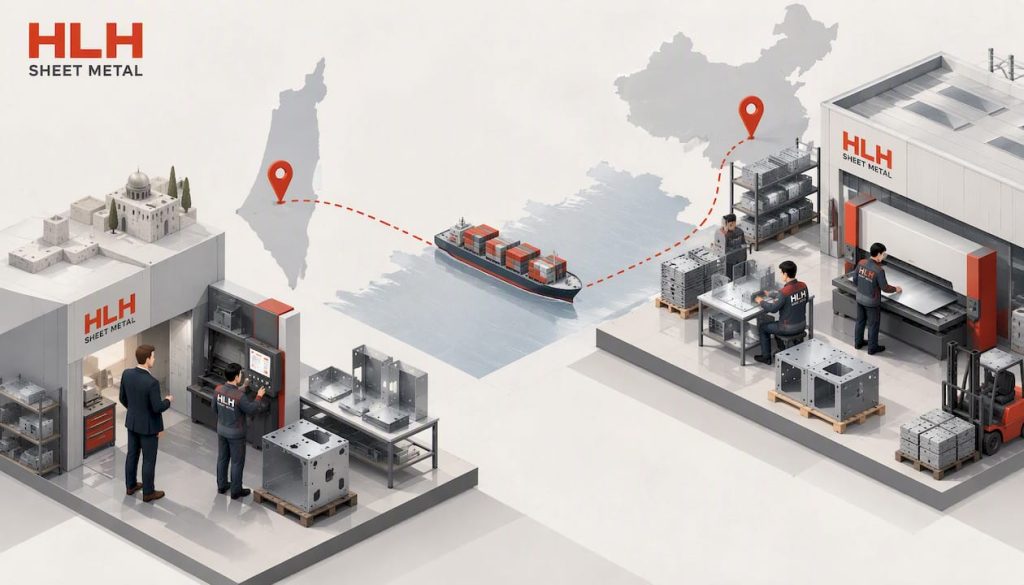

Table Of Contents
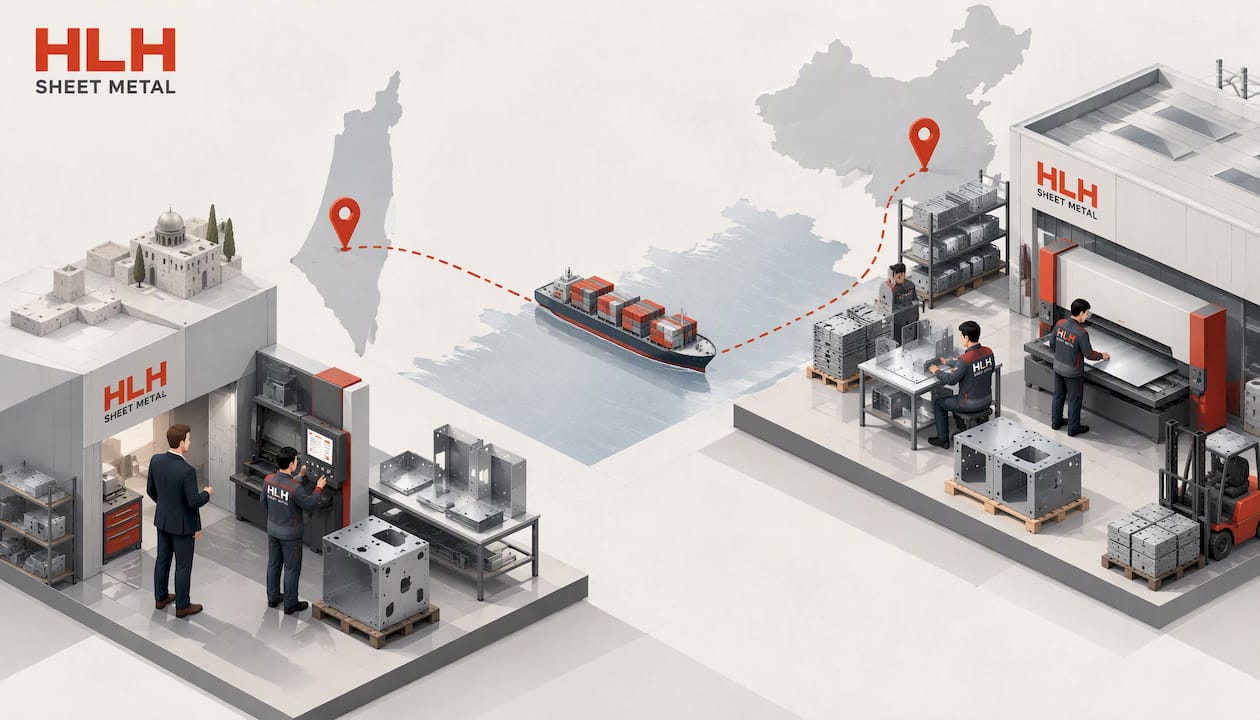
China usually wins on unit price for sheet metal parts, and the gap widens as quantity grows. Israel wins on proximity, speed of iteration and simple logistics for small, urgent jobs. The real answer for your project depends on volume, part complexity, and what the part costs once it is delivered to your dock, not what it costs leaving the factory.
This guide shows where the difference comes from, which public data you can rely on, which costs buyers forget when they import, and how to compare an Israeli quote with a Chinese one fairly.
TL;DR
- A published cost model for an identical laser-cut aluminum part puts China at $1.3611 per part against $2.1151 in the United States, with tooling of $840 against $2,400. Use it as a direction, not as a quote.
- China’s advantage grows with volume, because setup, programming and fixtures are spread over more parts and a deep local supply chain keeps material and finishing close.
- Israel is strongest for prototypes, short runs, design changes and anything needed in days rather than weeks.
- Compare quotes on landed cost: freight, customs value, duties, VAT, inspection, packaging and currency risk all belong in the number.
- Ask each supplier to price cutting, bending, welding and finishing as separate lines so the two quotes can be compared line by line.
What Actually Drives Sheet Metal Cost
Before comparing countries, it helps to know what a quote is made of. Quoting guidance from a fabrication-software company lists the main drivers: material grade, thickness and scrap; cut length and pierce count; number of bends and how accessible they are; tolerances and inspection; setup and programming; welding or assembly; finishing; quantity; packaging; and schedule.
Two of these decide most country comparisons.
Quantity. Programming, setup and fixtures are fixed costs. At 10 parts they dominate the price. At 10,000 they almost disappear. The same source notes that quantity lowers unit cost for exactly this reason, while tight tolerances and special finishes add process and inspection steps.
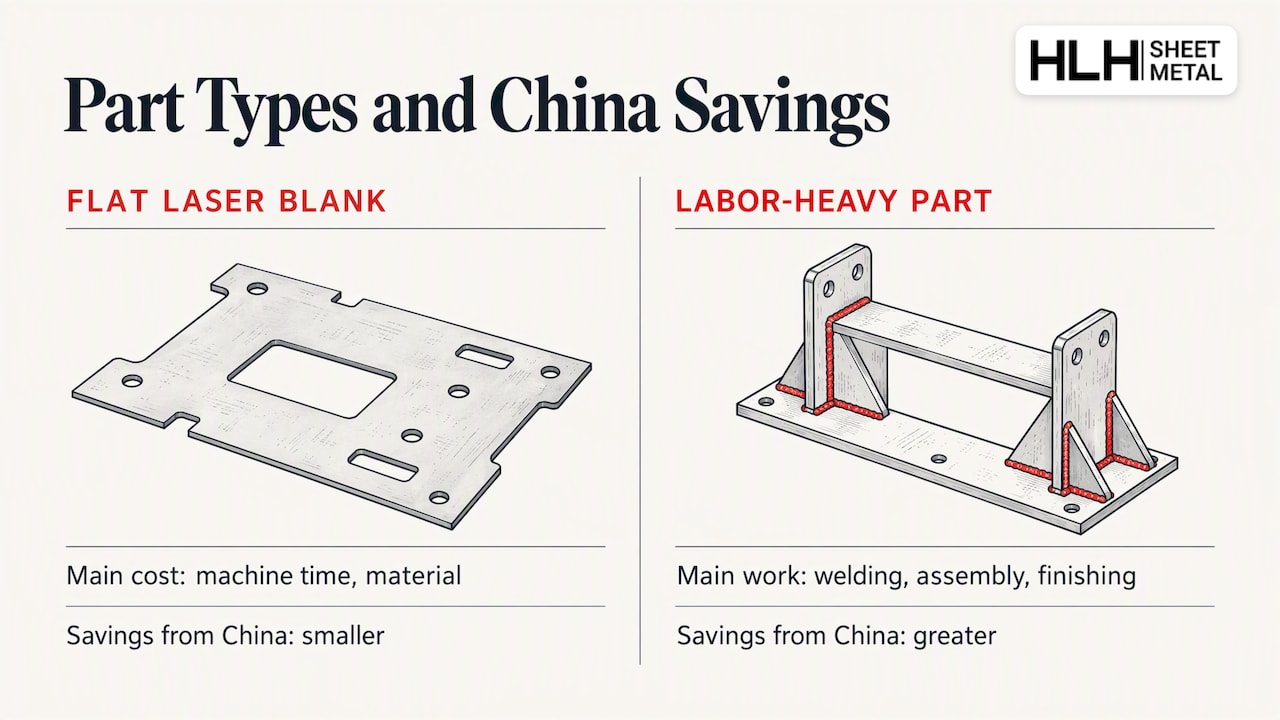
Labor-heavy operations. Welding, manual deburring, assembly and hardware installation consume hours. Where hourly rates are lower, these operations show the biggest savings. A flat laser-cut blank, by contrast, is mostly machine time and material, so the country gap is smaller.
That last point matters for the Israel versus China question: the cheaper your part is in labor, the less you gain from moving production. The more welded, assembled and finished it is, the more you gain.
What The Public Data Says About Israel And China
Honest numbers for Israel specifically are scarce. Most free cost guides compare China with the US or Europe, and Israeli job shops rarely publish rate cards. What we can rely on is a primary source that covers both countries.
Boothroyd Dewhurst’s global costing brochure states that its sheet-metalworking data covers 22 countries, Israel and China among them, with machine, labor, material, energy, tooling and ancillary costs for each. The same document models an identical AL7075-T6 laser-cut sheet metal part:
| Item (modeled, 25,000-part life volume, 3,125-piece batches) | United States | China |
|---|---|---|
| Total cost per part | $2.1151 | $1.3611 |
| Initial tooling investment | $2,400 | $840 |
Read this carefully. It is a model of one part, not a market price list, and it compares the US, not Israel, with China. We are not going to invent an Israeli figure to fill the gap. What the model does show is the mechanism: lower per-part cost and a much smaller upfront tooling bill in China, about 36% less per part and roughly 65% less tooling in this case.
The practical conclusion for an Israeli buyer: if you are paying prices anywhere near Western levels, expect a similar direction of difference. Verify it with two real quotes on your own drawing, which costs you nothing and is the only number that counts.
Labor Rates, With A Caveat
A 2026 industry blog estimates Chinese manufacturing labor at roughly $7 to $10 per hour fully loaded. Treat that as a rough range for planning and not as a rate any specific shop will charge you. We do not have a comparable, documented Israeli sheet metal shop rate, so ask Israeli suppliers for their quoted hourly welding and assembly rates and compare them with the labor content inside the Chinese price.
Cost By Order Size: Prototype, Small Batch, Production
This is where the choice usually flips.
Prototypes And One-offs
A single prototype carries the full setup cost with nothing to spread it over. Domestic fabrication saves you shipping time and lets you walk into the shop. For a one-off bracket you need on Thursday, a local Israeli shop is hard to beat.
But for prototypes that are part of a larger development cycle, such as a chassis, an enclosure or a server rack cabinet with several revisions, a Chinese supplier with fast prototyping can deliver a working part at a lower cost and still ship by air in days. We run exactly this model: rapid prototyping on the same lines and with the same quality system that later handle production, so the prototype tells you what the production part will cost.
Small Batches, 50 To 500 Pieces
This is the grey zone. Setup is still a large share of the cost, so the unit price gap is moderate. Freight is a visible fraction of the order value. Here the comparison is genuinely close, and the deciding factors are lead time, design stability and how many different parts you buy together. Consolidating several part numbers into one Chinese order spreads freight and setup and often tips the balance.
Production Runs
Above a few thousand pieces, the modeled advantage matters most. Tooling is amortized, material buying power increases, and labor-heavy steps such as welding and finishing are priced at lower local rates. Stamping is the extreme case: a progressive die is a fixed investment, and the lower the tooling cost, the sooner the stamped part beats laser cutting on price.
The Costs That Are Not On The Factory Quote
A factory price in China is usually ex-works or FOB. An Israeli supplier’s price is usually delivered. Comparing them directly is the most common mistake we see. Add these before you decide.
- Freight. Air for urgent or light parts, sea for heavy or bulky ones. Sheet metal enclosures are bulky, which is why packaging design matters.
- Customs value. Under the Israel Customs Ordinance, imported goods are valued on the transaction value, meaning the price paid or payable, plus certain additions such as commissions, containers and packing. So packing and certain fees you pay the supplier raise the dutiable base.
- Duties and VAT. Rates depend on the tariff classification of your part. Check the classification and any trade-agreement treatment in the official Israeli customs tariff or with your customs broker before you commit, because a finished enclosure and a bare part may fall under different headings.
- Inspection and certification. Third-party inspection before shipment, material certificates and first article reports cost money in any country. In China you should budget them explicitly and ask for them in the quote. In a domestic shop they are often included, so make sure you are comparing like with like.
- Currency. Contracts priced in dollars or yuan move with exchange rates. A sensible rule from the industry is to model at least two currency scenarios before committing volume.
- Inventory cost. A longer supply line means holding more stock. Cash tied up in safety stock is a cost even though it never appears on an invoice.
For help with the shipping and customs side, a China sourcing to delivery checklist walks through the document and routing steps that buyers commonly miss.
The Sourcing Trade-off In General
Economic research on firms’ sourcing decisions (Grossman and Helpman) suggests that companies often keep production and assembly in the same country to save transport costs and avoid the fixed costs of managing foreign suppliers. It is a useful reminder: offshoring pays only when savings clearly exceed the coordination and logistics overhead. A discussion of domestic versus offshore production frames the same balance between offshore savings and sourcing costs for another product category, and the logic carries over to metal parts.
Lead Time, Quality And Certification
Price without delivery and quality is meaningless, so compare these three together.
Lead time. A domestic job may ship in days. A Chinese job adds transit: air freight takes days, sea freight takes weeks. Plants with in-house laser cutting, bending, welding and finishing, as ours are, remove the hand-offs between subcontractors that cause most delays. For ongoing production, place orders on a rolling forecast so the transit time is hidden in the schedule.
Quality systems. Ask any supplier, in either country, for its ISO certificate, its inspection plan, and sample inspection reports from similar parts. Aerospace and medical work will require specific additional standards, and those requirements, not the country, decide who qualifies. A certified Chinese plant with documented inspection is a safer choice than an uncertified local shop, and the reverse is equally true.
Communication. The old objection to China was slow, unclear communication. It is solvable: you need engineers who read drawings in English and a project contact who answers within hours. Judge it during the quote stage. If a supplier takes three days to answer a simple question before you order, it will not improve after.
Israel Vs China At A Glance
| Factor | Israeli fabricator | Chinese fabricator |
|---|---|---|
| Unit price at volume | Typically higher | Typically lower (modeled gap about 36% in a published US vs China case) |
| Tooling and setup | Higher | Lower (modeled $840 vs $2,400 in the same case) |
| One-off prototype, urgent | Strong: days, local visits | Good with air freight, but transit adds time |
| Design revisions | Fast, face to face | Fast on the factory side, slower on the shipping side |
| Material and finishing choice | Good, limited by local suppliers | Very wide: steel, stainless, aluminum, galvanized, copper, brass, titanium, magnesium, all near the plant |
| Logistics and customs | Little or none | Freight, duties, VAT, broker |
| Inspection | Often included | Request and budget explicitly |
| Best fit | Short runs, urgent, fast-changing designs | Stable designs, repeat orders, large or mixed-part programs |
How To Compare Two Quotes Fairly
Follow this sequence and the choice usually becomes clear.
- Send the same package to both. Same drawing revision, same material and thickness, same tolerances, same finish, same quantity tiers (for example 10, 100 and 1,000).
- Ask for a line-by-line breakdown. Material, cutting, bending, welding, finishing, setup, inspection and packaging. Quoting guidance recommends separating these rather than hiding them in one blended rate, since it makes scope risk visible. It also shows you immediately which lines the savings come from.
- Convert to landed cost. Add freight, customs value additions, duty, VAT, broker fees and inspection to the Chinese quote. Use two exchange rate scenarios.
- Price the time. Add the cost of waiting, of holding stock, and of rework if something comes out wrong.
- Run a pilot. A small order with inspection tells you more than any sales presentation.
For how this works against other markets, our guides to the USA versus China, Germany versus China and Italy versus China apply the same method with local numbers. For the factors behind Chinese pricing in particular, read what affects sheet metal pricing in China.
Design Choices That Cut Cost In Either Country
Some savings do not depend on geography at all, and they stack with the China advantage.
- Reduce the number of bends. Every bend is a handling and setup step. Combine features where you can.
- Standardize materials and thickness. Fewer different sheets mean less scrap and quicker buying.
- Loosen tolerances that do not matter. Tight tolerances add process and inspection steps, as the quoting guidance notes. Reserve them for mating surfaces.
- Use standard hardware. Common fasteners and inserts are cheaper and in stock everywhere.
- Choose the right finish. Powder coating, plating, anodizing and passivation all have different costs. Specify what the part needs, not the most premium option. Our surface finishing team can advise on options by environment.
- Nest parts efficiently. Good nesting lowers scrap, which matters most for expensive metals like stainless and titanium.
For a laser-cutting-specific breakdown, see how laser cutting cost varies with material and thickness.
Our Perspective: Where China Is The Right Call
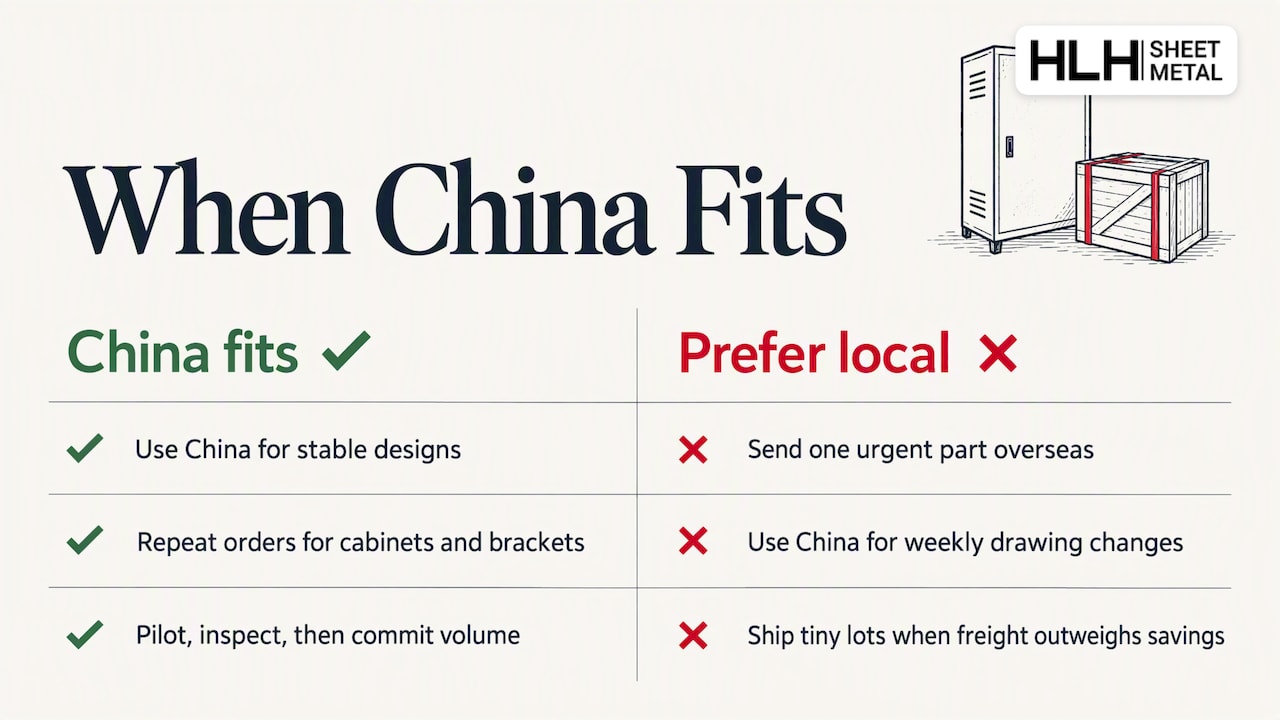
We fabricate in several plants in China, so we are not neutral, but we try to be straight. In our experience, the buyers who benefit most from Chinese production are the ones with a stable design and a repeating need: server rack cabinets, enclosures, chassis, brackets and welded assemblies that they will order again and again. For those parts, lower tooling cost, a supply chain for every common metal, and plants that cut, bend, weld and finish under one roof give a price advantage that survives freight and duty.
What holds the advantage together is process, not just labor rates. ISO-certified quality control, documented inspection, and engineers who answer in English at any hour are what make an overseas order feel like a domestic one. We would rather a customer do a pilot order, inspect it hard and then commit volume than take our word for it.
We also tell customers when a local shop is the better choice: one urgent part, a drawing that changes weekly, or a lot so small that freight outweighs the savings. Be honest with yourself about which category your project is in.
— Nash
Get A Landed-cost Comparison From Us
If you are weighing an Israeli shop against a Chinese one, send us your drawings and target quantities. We will quote cutting, bending, welding and finishing as separate lines so you can set them beside your local quote. Start with our sheet metal fabrication capabilities, or look at individual processes such as laser cutting, bending and welding. You can also request a quote directly.
FAQ
Is Sheet Metal Fabrication Cheaper In China Than In Israel?
For most production quantities, yes, on unit price. A published cost model shows a laser-cut aluminum part about 36% cheaper in China than in the US, and the same logic applies to Israel. For one-off urgent parts, a local shop can be cheaper once you add freight and waiting time.
What Does Laser Cutting, Bending And Welding Usually Cost?
One 2026 industry guide gives example ranges of $0.10 to $5.00 per cut, $0.50 to $10.00 per bend and $1 to $20 per part for powder coating. These are starting points, not rates to copy, because material, thickness and part geometry move them a lot. Get a quote on your own drawing.
What Extra Costs Should I Add When Importing From China To Israel?
Add freight, packing, any commissions, customs duty and VAT based on the part’s tariff classification, inspection, and a currency buffer. Customs value is based on the price paid or payable plus certain additions, so packing and fees count. Confirm the classification with your customs broker.
Does Ordering From China Mean Lower Quality?
No. Quality depends on the plant’s systems, not the country. Ask for the ISO certificate, inspection plan and sample reports, and run a pilot order before committing volume.

