




Table Of Contents
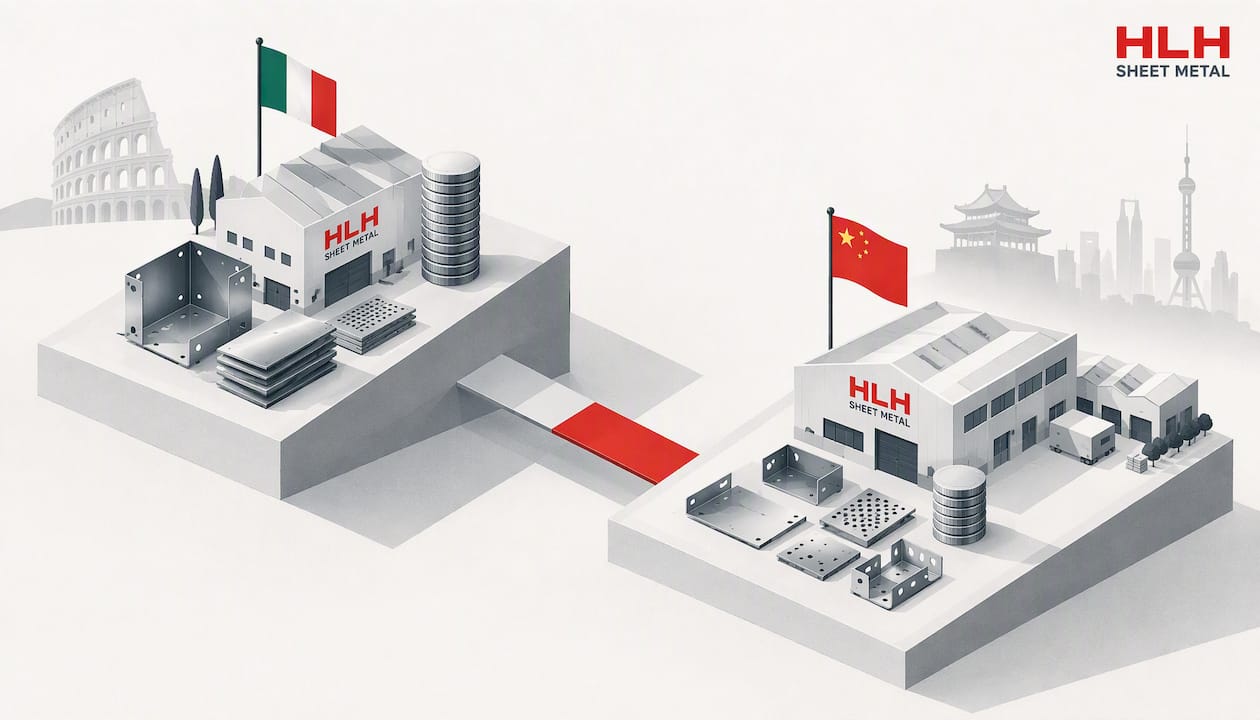
China is usually the cheaper place to fabricate sheet metal parts, and the gap is largest on labor-intensive work: brackets, enclosures, chassis and welded assemblies. Italy competes on proximity, a strong aerospace and machinery tradition, and shorter shipping. The honest answer for any given part is a landed-cost comparison, not a country label. This guide shows which cost lines drive the difference, where the savings are real, and what to add to a Chinese quote before you compare it with an Italian one.
TL;DR
- Fully loaded shop labor in export-oriented Chinese factories is commonly cited at $8 to $18 per hour, against $70 to $110 for European shops, Italy included. Your part’s labor content decides how much of that you keep.
- Energy and material costs push European fabrication prices up further, and the European Commission itself names energy as a heavy burden for the metals sector.
- Compare landed cost: piece price, tooling, freight, duty, VAT (where it applies), customs classification and, for the EU, CBAM paperwork on steel and aluminum.
- Certifications matter more than geography. AS9100, ISO 13485 and IATF 16949 are available from top Chinese fabricators, just as from Italian ones.
- For US buyers, the Italy vs China question also includes US tariffs, which change often. Quote both and recheck before you commit.
Where The Price Gap Comes From
Sheet metal pricing breaks into four blocks: material, machine time, labor and overhead, and logistics plus compliance. Italy and China differ most in the middle two.
Labor And Shop Rates
A benchmark in our research puts fully loaded labor at export-quality Chinese factories at $8 to $18 per hour, and European shop rates (Italy, France, Germany) at $70 to $110 per hour. Treat these as ranges, not quotes. Wage statistics are defined differently from country to country, and the same databook warns that comparisons are distorted by exchange rates and by differences in establishment size and industry.
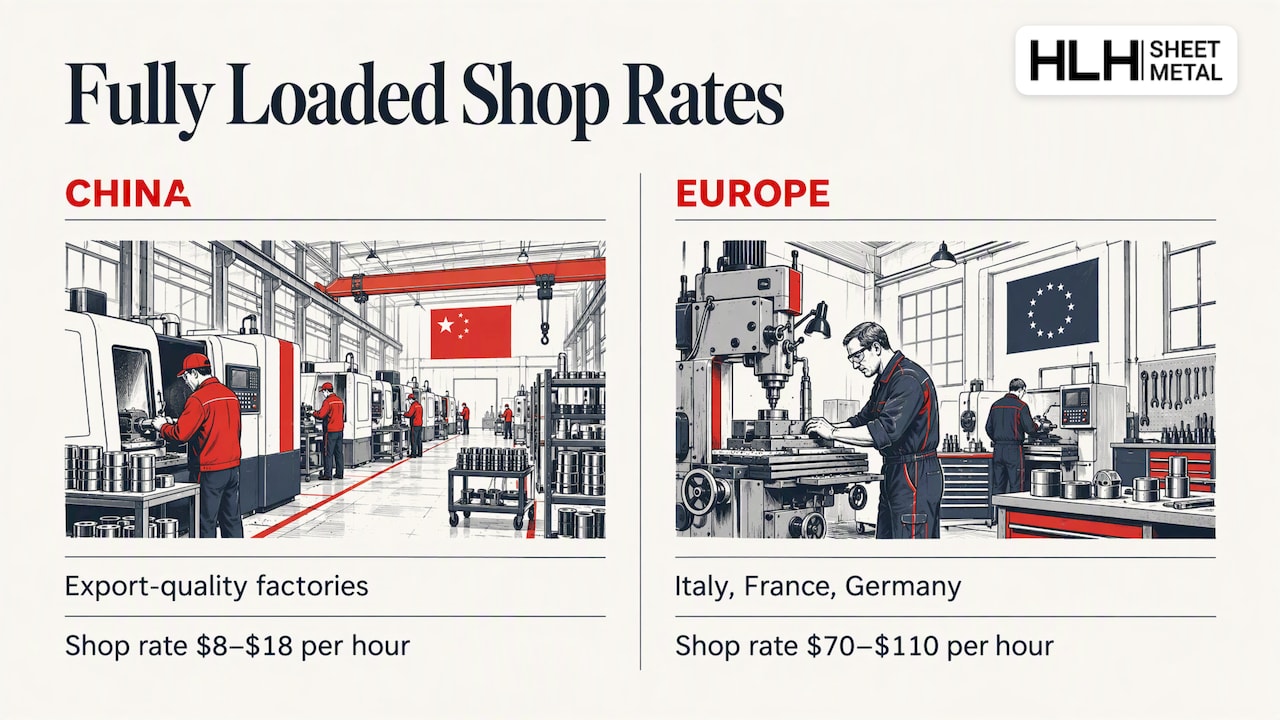
Two things are worth keeping apart. First, wages: salary data for Italy shows an average metal fabricator earning about €18 per hour. That is what the worker is paid. Second, the shop rate a customer sees on a quote, which adds social charges, machine depreciation, programming, inspection, rent and margin. That second number is the one that reaches $70 to $110.
If you want to see how labor costs get built up on the employer side (payroll, insurance and similar loads), this walkthrough of how workers’ compensation insurance costs are calculated is a useful primer. It is a US example, but it shows why the hourly wage is only part of what a shop pays.
Energy
Laser cutting, press brakes, welding and powder coating ovens all use electricity or gas. The European Commission’s steel and metals action plan states that energy represents a larger share of production costs for metals than for other sectors and sets out measures to make supply more affordable. The same pressure is why European buyers have been re-examining where they source semi-finished metal parts. We would not claim a precise per-part energy saving from China, but the direction is consistent.
Scale And Supply Chain
Chinese fabrication clusters sit next to sheet suppliers, hardware makers, plating and powder coating shops, and tooling makers. A part that needs laser cutting, bending, welding, a surface finish and a few purchased fasteners can often be completed within one industrial region. Italian industry guidance on doing business in China points to integrated local supply chains as a reason companies choose to produce there, not only labor cost. Fewer handoffs mean fewer margins stacked on top of each other, and faster iteration when a drawing changes.
A Worked Example: How A Quote Moves From Ex-works To Landed
We will not invent a quote for you, because the real numbers depend on the drawing. What we can show is the structure, using a placeholder part and percentages that you should replace with your own.
| Cost line | Italian fabricator | Chinese fabricator |
|---|---|---|
| Material and purchased hardware | Local sheet, often higher mill and distributor pricing | Local sheet, broad grade availability |
| Cutting, bending, welding labor | Highest share of the difference | Typically the lowest share of piece price |
| Tooling or fixtures (one-time) | Quoted per job | Quoted per job, often lower for stamping dies |
| Finishing (powder coat, plating, anodize) | Local or subcontracted | Often in the same cluster |
| Freight | Low within Europe | Sea or air, adds time and cost |
| Duty and VAT | Not applicable inside the EU | Applies on import |
| Compliance (customs, CBAM) | Minimal | Your responsibility as importer |
| Lead time | Short transit | Production time plus transit |
The rule of thumb: the more cutting, bending, welding and finishing hours inside the part, the more the Chinese quote wins. Thick plate, heavy material, tiny quantities or very light, simple parts narrow the gap because material or freight dominates.
Our research puts the saving on labor-intensive components at roughly 30 to 50 percent before landed costs. It is an indicative figure, not a promise, and it falls as you add the lines below.
The Landed-cost Items Buyers Forget
For EU And Italian Buyers
If you are importing into Italy, the cost sheet needs more rows than the quote shows:
- Duty. China trades with the EU on standard Most-Favoured-Nation terms: there is no free trade agreement and no preferential rate.
- VAT. Import VAT in Italy is 22 percent, generally recoverable by a VAT-registered business but a cash-flow item.
- The end of the low-value exemption. The same source notes that the €150 duty-free threshold ends on July 1, 2026, which matters mostly for small sample shipments.
- CBAM. Importers of iron, steel and aluminum products face reporting obligations, with an annual threshold of 50 tonnes tied to authorized declarant status. The bill is due later, but the data from your supplier has to be collected now.
- Customs classification. Wrong tariff codes are flagged as a leading cause of post-import audits, with back taxes and interest that can wipe out unit-price savings. Verify codes independently against the EU’s TARIC database.
For a practical look at shipping costs, customs fees and documents when sending goods across borders, see this overview of the EU rule changes affecting cross-border parcels (in Italian).
For US Buyers
You are reading this on the US market, so be clear about the frame: Italy is not your domestic alternative, and China is not tariff-free. US duties on Chinese goods have changed repeatedly and can move again. We cover the current picture, and how much of the saving survives, in our guide to sheet metal fabrication cost in the USA vs China. Whatever your destination, ask each supplier to quote the same Incoterm, and ask your forwarder or customs broker for the duty line on your actual part.
Quality And Certifications: Country Is The Wrong Filter
Buyers who hesitate over China usually worry about quality. For regulated sectors the answer is paperwork you can check, not national reputation. Each high-spec industry has its own standard: AS9100 for aerospace, ISO 13485 for medical devices and IATF 16949 for automotive. One source estimates initial certification for a typical shop at $15,000 to $30,000, with annual surveillance costs after that. That is a real barrier to entry in any country, so it is also a fair signal: a shop that holds a certificate has paid to be audited.
What to ask either an Italian or Chinese supplier:
- A copy of the current certificate, with the scope and the certifying body, not just a logo on a website.
- Their inspection process: first article inspection, CMM or optical measurement, and what reports ship with the parts.
- Material certificates and traceability for the grade you specified.
- Their typical tolerance on your feature type, and what they hold on bends versus cut features.
- A sample or pilot lot before the first production order.
If you buy aerospace parts, our article on aerospace metal fabrication in China and its QA standards goes through what to verify in more detail.
Where Italy Still Makes Sense
We make sheet metal parts in China, so it is easy to oversell. A fair comparison names the cases where an Italian shop can win:
- Very small runs of one or two pieces where freight, customs paperwork and your own time cost more than the saving.
- Urgent repairs or line-down parts where a day or two of transit matters more than unit price.
- Programs with in-person engineering needs, such as a team that wants to walk the shop floor weekly.
- Projects with Italian or EU origin requirements in the contract or customer specification.
- Heavy parts with high freight per piece, where shipping erodes the labor saving.
Beyond that, the pattern is consistent: repeat orders, medium to large volumes, assemblies with many operations and enclosures with finishing are where a Chinese supplier’s price advantage tends to remain after landed costs.
Our Perspective
We hear the same question from procurement managers and engineers: “Is the saving real after everything is added?” Our answer is that it is real when three conditions hold.
First, the drawing is ready for manufacturing. The 30 percent price spreads you see for the same drawing across Chinese suppliers mostly come from different assumptions about tolerances, material and finish. A clean drawing with a clear tolerance block, a defined finish and an inspection requirement gets comparable quotes. We would rather ask you three questions on day one than quote a number that moves later.
Second, the supplier can cover the whole process. We run multiple manufacturing plants in China, so a prototype and a production run can sit with the same team, with laser cutting, bending, welding, stamping and finishing under one roof of coordination. The fewer handoffs, the fewer surprises in price and lead time.
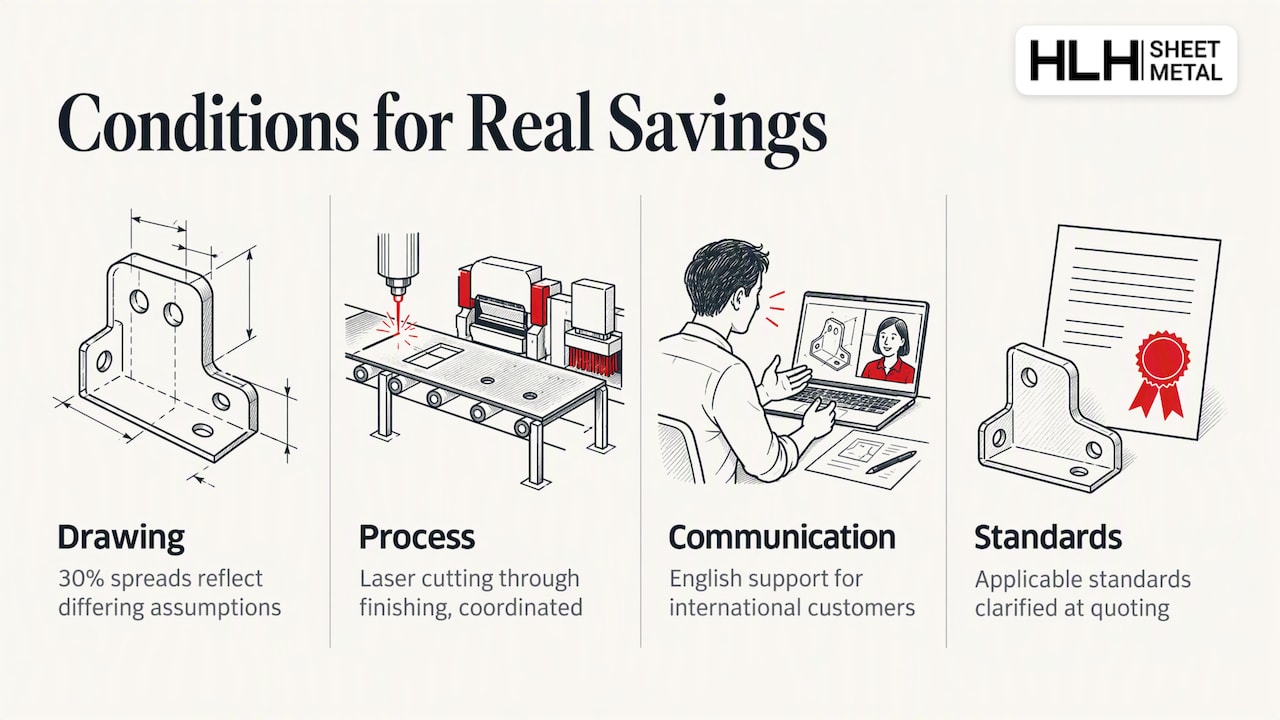
Third, communication works. Our team supports international customers in English, so questions about a bend relief or a hole tolerance are answered by someone who understands the drawing, not relayed through a chain. In our experience, slow communication costs more than a few cents on the piece price.
We hold ISO certifications and we will tell you plainly which standards apply to your part and what we can and cannot document. If your project needs a specific certificate we do not hold, you will hear that from us at the quoting stage.
— Nash
How To Run A Fair Italy Vs China Comparison
- Freeze the package. One drawing revision, one material callout, one finish, one quantity break (for example 10, 100 and 1,000 pieces).
- Request quotes in the same format. Ask both suppliers to separate tooling, piece price, finishing and packaging, and to state the Incoterm.
- Add logistics. Get freight, insurance and local delivery from your forwarder, not from the supplier’s estimate.
- Add duties and tax. Confirm the tariff code with a customs broker. Add VAT in the EU or any applicable duties in your own country.
- Add compliance time. For EU imports of steel and aluminum products, factor in CBAM data collection.
- Add inventory carrying cost. Sea freight means weeks of stock in transit. Price that capital, or choose air for the first lot.
- Order a pilot. Compare the first article against your drawing with the same measurement method.
The comparison for other markets follows the same logic. If you want to see the pattern in other regions, we have written about sheet metal fabrication cost in the UK vs China, Australia vs China and Singapore vs China. For the drivers of price inside China itself, read what affects sheet metal fabrication pricing in China.
Get A Chinese Quote You Can Compare
If you have an Italian quote in hand, send us the same drawing and we will quote it for sheet metal fabrication in China: laser cutting, bending, welding, stamping and surface finishing, in steel, stainless steel, aluminum, galvanized steel, copper, brass, titanium and more. We handle prototypes and larger production runs, with ISO-certified quality control and English-speaking project support. Our capabilities page lists the processes and materials, and you can ask for a quote from there or at hlhsheetmetal.com.
FAQ
Is Sheet Metal Fabrication Really Cheaper In China Than In Italy?
For labor-intensive parts, usually yes. Benchmarks put loaded labor in export-oriented Chinese factories far below European shop rates, and Italian energy and overhead add to the gap. The size of the final saving depends on freight, duties, VAT and the part’s material content, so compare landed cost.
What Hidden Costs Should I Add To A Chinese Quote?
Add freight, insurance, import duty, VAT where applicable, customs broker fees, tooling or sample costs and the time cost of transit. EU importers of steel and aluminum products must also prepare for CBAM reporting. Check your tariff codes independently, because errors can lead to back taxes.
Can Chinese Fabricators Meet Aerospace Or Medical Standards?
Many can, if they hold the right certificates: AS9100 for aerospace, ISO 13485 for medical devices and IATF 16949 for automotive. Ask for the current certificate and its scope, then verify inspection reports on a pilot order. The standard matters more than the country.
When Should I Stay With An Italian Fabricator?
Choose Italy for one-off sheet metal parts, urgent repairs, heavy parts with high freight per piece, or when a contract requires EU-origin supply. For repeat orders or medium to large runs, a Chinese supplier often keeps a meaningful advantage even after landed costs.

