




Table Of Contents
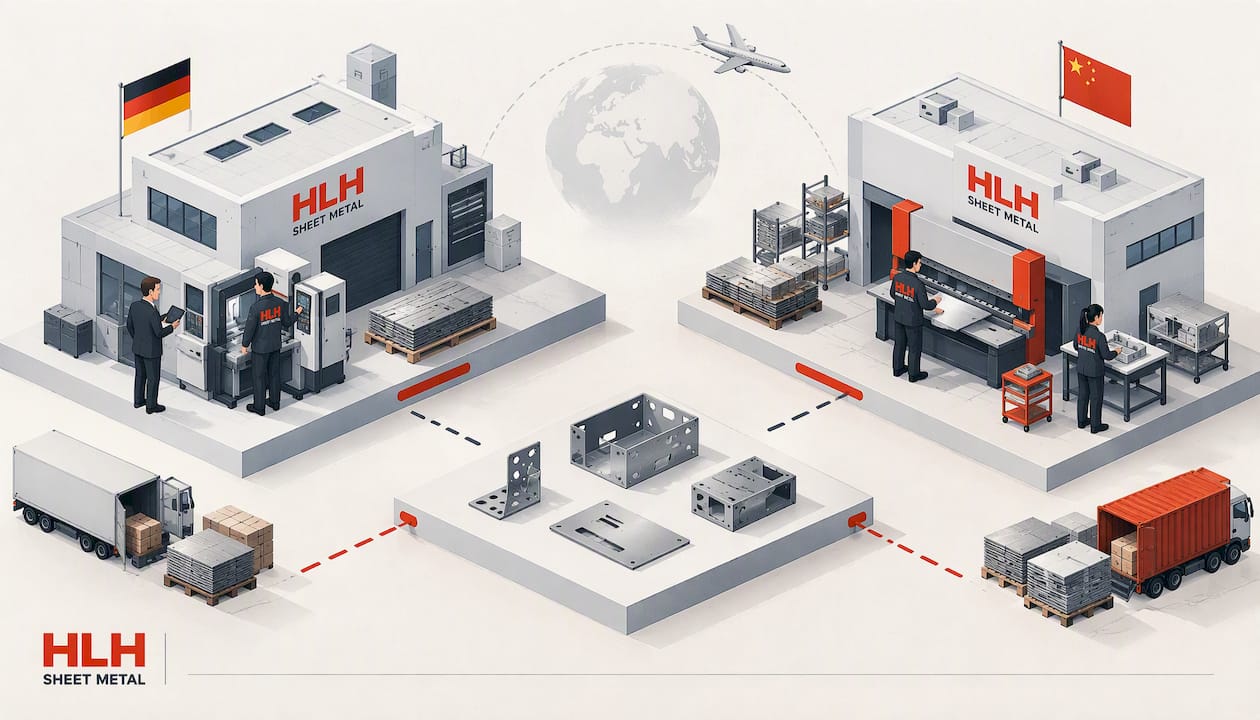
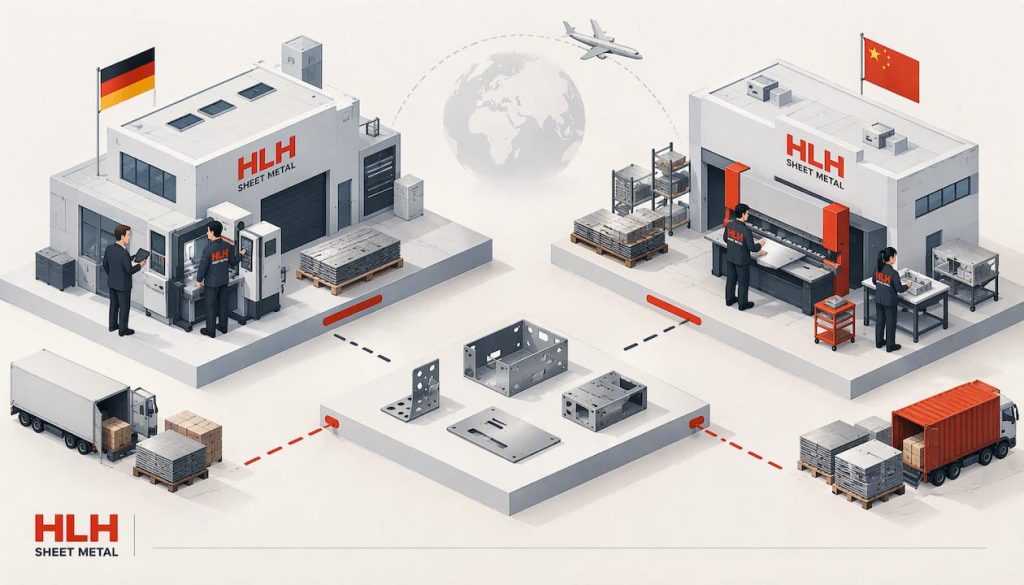
China is usually the lower-cost source for sheet metal parts, and Germany is usually the higher-cost one. The gap is not a single number, though. It depends on labor, energy, material, tooling, order volume, freight and how much rework you expect. This guide shows where the two countries differ, which of those differences are documented, and how to compare quotes so the cheaper one is also the cheaper one on delivery.
We do not publish price lists, because a fabrication price depends on your drawing. Where we cite numbers below, they come from public statistics. Where we describe how quotes behave, that is our experience of how this kind of work is priced, not a market statistic.
TL;DR
- German labor is expensive by European standards: 45.00 euros per hour worked in 2025, about 29% above the EU average of 34.90 euros.
- Energy and scale also tilt costs toward China. The Bundesbank points to subsidized Chinese industrial production as a factor in Germany’s competitiveness problem.
- Compare landed cost, not ex-works price. Add freight, duties, tooling, inspection and rework to every quote.
- Germany still makes sense for very small urgent lots, tight local supervision and design work that changes weekly. China wins on prototypes-to-production programs, repeat orders and volume.
What Makes Up The Price Of A Sheet Metal Part
Before comparing countries, separate the cost lines. Most quotes, from any country, combine the same elements:
- Material: the sheet itself, which varies by alloy and thickness. Steel is cheaper than aluminum, stainless costs more again, and titanium or copper are specialist budgets.
- Machine time: laser cutting, punching, bending and welding, charged by the minute or by the part.
- Labor: programming, setup, manual welding, deburring, assembly and inspection.
- Tooling and fixtures: punch and die sets for stamping, bending tools, welding jigs and gauges.
- Finishing: powder coat, anodizing, plating, passivation or polishing.
- Overhead and margin: energy, rent, certification, software, profit.
- Logistics: packaging, freight, insurance, import duty, customs handling.
Labor and energy are the lines where Germany and China differ most. Tooling and finishing follow because both are labor-heavy. Material is the line where the gap is usually smallest, since steel and aluminum are traded globally.
For a deeper look at each factor on the China side, see our guide to sheet metal fabrication pricing in China. For the per-unit arithmetic that sits behind any contract manufacturing quote, this walkthrough of per-unit math for procurement is a useful companion.
Labor: The Documented German Disadvantage
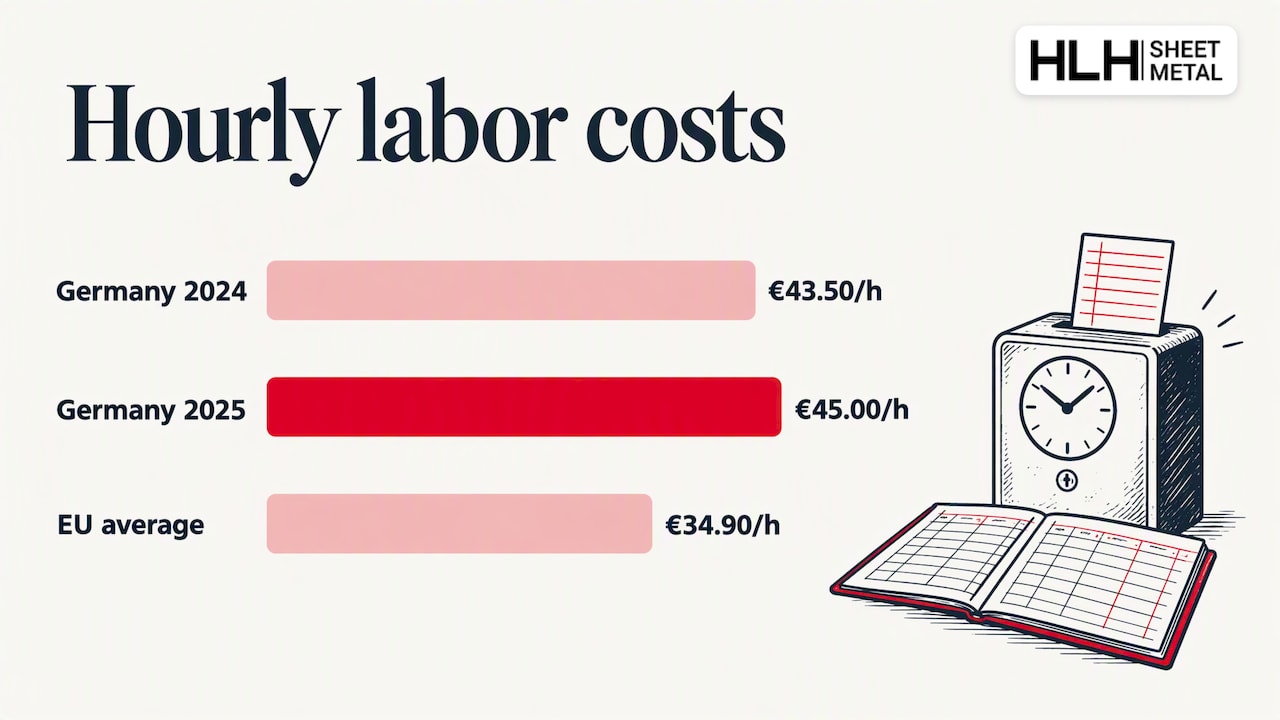
The cleanest public figure is from the German Federal Statistical Office. In 2025, companies in German production and services paid an average of 45.00 euros per hour worked, up 3.6% from 43.50 euros in 2024. The EU-wide average was 34.90 euros, so Germany sits roughly 29% above it.
Two cautions apply when you turn that into a fabrication estimate:
- The figure covers production and services combined, not welders or press brake operators specifically. Skilled metalworkers in Germany are well paid and scarce, so it is a reasonable proxy for direction, not a quote input.
- It is the total employer cost per hour, which includes social contributions. That is the number that ends up inside a shop’s hourly machine rate.
We will not quote a Chinese hourly wage here. Wage levels vary a great deal between coastal and inland provinces and between trades, and we have no single reliable figure to cite. The practical point is simpler: in a labor-heavy process like manual welding, assembly or finishing, the labor share of the part price is large, so the country with lower total labor cost has the structural advantage. Highly automated work, like laser cutting nested sheets, narrows the gap, because machine time rather than people time drives the price.
Energy And Scale
Laser cutters, press brakes, furnaces and powder coat ovens all run on electricity or gas. The Bundesbank has argued that German industry faces a gap here: industrial energy costs have climbed since 2013, while China subsidizes parts of its industrial production and undermines a level playing field. That is a central bank’s macro view, not a line item on a sheet metal quote, but it explains why the gap persists even for automated processes.
Scale is the second structural driver. Chinese fabrication clusters concentrate laser cutting, stamping, plating, powder coating and hardware suppliers in the same regions. A part can move from cutting to bending to finishing without leaving the supplier network. That shortens lead time and removes the margin stack you pay when a German shop subcontracts finishing or galvanizing to another company.
If energy cost is a theme you track for your own plant, this explainer on business energy tariffs covers the UK market, so treat it as a reference for how tariff structures work rather than as German data.
Germany Vs China At A Glance
The table summarizes how the two sourcing options usually compare. It is a qualitative guide based on the documented labor and energy factors above and on common fabrication practice, not a price benchmark.
| Factor | Germany | China |
|---|---|---|
| Labor cost | 45.00 euros per hour average, rising 3.6% in 2025 | Generally lower, varies by region |
| Energy cost | High, a recognized competitiveness issue | Lower for industry, per the Bundesbank’s view |
| Prototype speed | Fast for local lots | Fast when the supplier runs prototyping in-house |
| Large volume | Capacity and price limits | Broad capacity for large runs |
| Tooling | Higher cost, local control | Lower cost; ownership terms must be agreed |
| Logistics | Short transit inside Europe | Ocean or air freight, plus duties |
| Communication | Same time zone for EU buyers | Needs English-fluent support and clear drawings |
| Typical sweet spot | Very small urgent lots, on-site collaboration | Prototype-to-production, repeat orders, volume |
Tooling And Setup: Where Volume Changes The Answer
One-off parts are priced mostly on programming, setup and machine time. Spread over a handful of pieces, setup is a big share of each unit. As quantity rises, setup shrinks per part and tooling becomes the question.
For stamped parts, a progressive die is a significant upfront investment. A supplier with lower labor and in-house tool shops can usually build it for less, and that is where the China cost advantage compounds with volume. The condition is clarity on who owns the tool. Agree in writing that the die belongs to you, that it can be moved, and how maintenance is billed. Our piece on sourcing auto sheet metal with owned tooling walks through the requoting trap that appears when that is left vague.
For laser-cut and bent parts, there is no hard tooling, so the comparison comes down to rates and efficiency. Nesting, sheet utilization and bend count matter more than country. A design with 14 bends will cost more in either country than one with 6.
Freight, Duties And The Landed Cost
The factory price is not what you pay. Build a landed-cost view for every quote:
Landed cost per part = unit price + tooling amortized per part + packaging + freight per part + import duty and fees + inspection + expected rework or scrap allowance
For a German or other European buyer, a domestic order skips most of the freight and duty items. A China order adds them, but they are predictable, and they shrink per part as order size grows. A pallet of dense steel brackets weighs a lot, so freight has more impact on heavy steel than on light aluminum covers.
For US readers, tariffs change the picture sharply and change often. Check the current rates for your part’s classification before you commit. Our analysis of US vs China sheet metal costs and the tariff question covers that scenario. If you buy in another market, we have written similar comparisons for the UK vs China, Canada vs China and Australia vs China.
Quality: The Question Behind The Price Question
Buyers who hesitate over China are rarely worried about the unit price. They worry that cheap parts will fail inspection. That risk is real with an unvetted supplier and manageable with a vetted one. A rejected lot erases the price advantage quickly, so ask for the following before you award work:
- Current ISO certificates, with the scope that matches your parts.
- A first article inspection report against your drawing, with measured dimensions.
- Material certificates for each lot.
- A written tolerance and finish specification, with photos or samples for cosmetic parts.
- A clear process for non-conforming parts: who pays for rework and reshipment.
Welding deserves a specific mention. Distortion on thin or long weldments is a common source of rework in any country, and it is one of the largest hidden costs. This article on controlling welding distortion explains why fixturing and sequence matter. Ask any supplier, in Germany or China, how they fixture and verify weldments.
We also compare Chinese output with domestic work in how China’s sheet metal fabrication matches local quality.
Why Partnering With A Chinese Fabricator Pays Off
Price is the headline, but the benefits of working with a Chinese fabricator go beyond it:
- One-roof manufacturing. Cutting, bending, welding, stamping and finishing can sit in the same supplier network, which cuts handoffs and shortens lead time.
- A range of materials. Steel, stainless, aluminum, galvanized steel, copper, brass, titanium and magnesium can all be sourced from one supplier, so you do not manage a separate vendor per alloy.
- Prototype to volume with the same supplier. A prototype made in the factory that will run production means the process learned on the first ten parts carries into the first ten thousand.
- Capacity for surges. Multiple plants give room to absorb a larger release without moving the job. We cover this in our guide to Chinese fabricators with capacity for six-figure runs.
- Speed. A concentrated supply base for hardware, plating and coating often means shorter internal lead times.
These benefits show up most with repeat programs, such as enclosures, chassis, brackets and housings that you reorder.
Our Perspective
We build sheet metal parts in China for engineers and buyers in aerospace, medical, automotive and data center work. Here is what we tell people who ask us about Germany versus China.
First, do not decide on the unit price alone. We have seen buyers choose a quote that looked low and then add tooling changes, freight surprises and rework. Ask every supplier for the same package: the same drawing, the same finish, the same inspection report, the same incoterm. Then compare.
Second, design for manufacturing before you request quotes. A drawing with consistent bend radii, standard hole sizes and realistic tolerances lowers cost anywhere. Our guide to DFM settings that cut China production costs lists the changes that matter.
Third, communication is part of the price. A supplier that answers in your working hours, in English, with a named project contact, saves you days of delay. That is why we run an English-speaking support team, and why our plants work under ISO-certified quality systems.
Fourth, be honest about when Germany is the better call. If you need ten parts tomorrow and an engineer standing at the machine, a local shop is the right answer. If you plan a program that runs for years, a Chinese partner will usually give you a better total cost.
— Nash
Request A Quote That Lets You Compare
If you are weighing a German quote against a Chinese one, send us the same drawing package you sent to the German shop. We can quote laser cutting, bending, welding, stamping and surface finishing as separate lines or as a finished assembly. To see everything we make in one place, start from our sheet metal fabrication capabilities, or request a quote through our main site.
To make the comparison clean, include material and thickness, quantities for the first order and the annual forecast, finish, tolerances, and your destination.
A Short Checklist For Comparing Quotes
- Convert every quote to the same currency and incoterm.
- Add tooling, split into one-time and per-part amounts.
- Add freight, duty and customs handling for the China quote.
- Add a rework allowance based on the supplier’s track record and certifications.
- Compare lead time from order to your dock, not from order to factory release.
- Check payment terms and the cost of tied-up cash during transit.
- Weigh price against the risk of a stoppage on your line.
FAQ
Is Sheet Metal Fabrication Cheaper In China Than In Germany?
Usually yes, mainly because of labor and energy. German labor averaged 45.00 euros per hour in 2025, and the Bundesbank describes a competitiveness gap tied to energy and subsidies. The size of the saving depends on the part, the volume and the freight.
How Much Does Sheet Metal Fabrication Cost Per Part?
There is no honest flat answer. Price depends on material, thickness, cut length, number of bends, welding, finish, quantity and tolerances. The only reliable way to know is to quote your drawing, ideally with a few quantity breaks.
Does Shipping From China Erase The Savings?
Not for most programs. Freight and duty are predictable and shrink per part as volume grows. They hit heavy steel parts and very small orders hardest, so calculate landed cost before you decide.
When Should I Still Choose A German Supplier?
Choose Germany when you need very small urgent lots, frequent in-person design changes, or a supply chain that must stay inside Europe. For repeat production and larger volumes, a vetted Chinese fabricator usually delivers a lower total cost.
How Do I Reduce The Risk Of Quality Problems With A Chinese Supplier?
Verify ISO certificates, require first article inspection and material certificates, and put tolerances and finish in writing. Start with a prototype or small lot before releasing a large run.

