





Table Of Contents

Salt Spray Requirements
If you’re writing a corrosion test spec, cite ASTM B117 or ISO 9227 as your baseline, ASTM G85 for cyclic or modified exposures, and the matching national variant where required. None of these standards define exposure hours or pass/fail criteria on their own, so your spec has to add those.
TL;DR:
- Standard salt spray tests do not specify duration or pass/fail criteria, so these must be added in the product specification for meaningful results.
- ASTM B117 and ISO 9227 form the base, mainly defining chamber setup and reagent preparation, but not exposure time or specimen size.
- Cyclic modifications in ASTM G85 are recommended when testing environments involve drying cycles, marine conditions, or sulfur dioxide exposure.
- Consistent solution chemistry, chamber controls, and specimen preparation are crucial to produce reliable and comparable test outcomes.
- Clear, detailed acceptance criteria and thorough documentation, including logs and photographs, are essential to prevent disputes and ensure test validity.
Which Standard Should You Reference And How Do They Differ?
ASTM B117 and ISO 9227 are the two baseline documents almost every salt spray spec traces back to. Both set out chamber design, reagent preparation and equipment requirements for neutral salt spray testing, but neither one specifies how long to run a test or how big your specimen should be. That’s left to the product specification, which is exactly where a lot of RFQs fall short.
ASTM G85 covers a different problem: continuous salt fog doesn’t always match what happens in the field, where parts dry out between exposures or sit near seawater. G85 packages five modifications (A1 through A5) for more corrosive or cyclic environments, including acetic-acid salt spray, cyclic wet/dry forms, SWAAT, SO2 salt spray and dilute-electrolyte cyclic testing. Reach for a G85 modification when your failure mode involves drying cycles, marine exposure or sulfur dioxide rather than constant fog.
A few things to check before you finalize a spec:
- National and industry variants exist: GB/T 10125, JIS Z 2371, AAMA specs and GMW automotive standards often reference the same core chemistry with regional procedural tweaks.
- Always cite the exact clause or annex, not just the standard number, since B117 and G85 both contain multiple sub-procedures.
- Confirm which version your lab is accredited against, since standards get revised and older editions sometimes have different tolerances.
What Solution, Ph, Temperature, And Collection Rate Should You Specify?
This is where most disputes between buyers and labs actually happen: not in the standard’s title, but in the numbers underneath it. ASTM B117 requires a salt solution made from 5 ± 1 parts sodium chloride by mass in 95 parts Type IV water, with impurities and copper tightly limited, and a collected spray pH of 6.5 to 7.2 when atomized at 35°C. GB/T 10125-2021 expresses the same concentration as 50 g/L ± 5 g/L and adds procedural pH adjustment steps for each method variant, plus a CuCl2 target of 0.26 g/L ± 0.02 g/L for CASS testing.
| Parameter | NSS | AASS | CASS |
|---|---|---|---|
| NaCl concentration | 5% (50 g/L ± 5 g/L) | 5% (50 g/L ± 5 g/L) | 5% (50 g/L ± 5 g/L) |
| Collected spray pH | 6.5-7.2 | 3.1-3.3 | 3.1-3.3 |
| CuCl2 addition | None | None | 0.26 g/L ± 0.02 g/L |
Equipment controls matter just as much as chemistry:
- Collection rate typically runs 1 to 2 mL per 80 cm² per hour, measured with funnel-and-graduated-cylinder collectors placed around the chamber.
- Compressed air feeding the atomizer must be oil- and dirt-free to avoid contaminating the fog.
- Spray distribution should be even across the chamber, with no direct impingement on specimens and no drip paths from the lid onto test panels, a design requirement called out specifically in GB/T 10125.
- Chamber-contact components must themselves be corrosion-resistant, since a degrading chamber interior will skew results over repeated runs.
How Do You Prepare Specimens So Results Hold Up?
A perfectly run chamber still produces garbage data if the specimens are wrong. Standards generally distinguish between flat reference panels, used to characterize a coating or plating process in isolation, and finished parts, used to validate how geometry and assembly affect corrosion. You often need both: a flat panel proves the finish works, and a finished part proves it survives in the shape your product actually ships in.
Specimen prep details that get overlooked:
- Inclination angle: panels are commonly mounted at roughly 15 to 30 degrees from vertical so runoff doesn’t pool on the face.
- Scribe or scratch rules: many coating specs require a single scribe line of a defined width down to base metal, since creepage from the scribe is often the real pass/fail indicator rather than the open face.
- Masking: cut edges and mounting holes are frequently masked or excluded from evaluation, since raw edges corrode faster than coated surfaces and can mask a coating’s true performance.
- Fixture spacing: panels need enough clearance that drip from one specimen doesn’t contaminate another, and support materials should not introduce a dissimilar metal that triggers galvanic corrosion at the contact point.
- Witness samples: for assemblies with sharp edges or mixed materials, ask the lab to run manufacturer-supplied reference panels alongside your actual parts.
Which Test Method And Exposure Duration Fit Your Coating?
Matching the method to the coating family is the single biggest lever you have over whether a test actually tells you anything useful.
- NSS fits general QC on paints, phosphates and most conversion coatings where you’re checking basic process consistency.
- AASS and CASS fit decorative electroplates (nickel-chrome, for example) and anodized aluminum, where the acidified, copper-accelerated environment reproduces failure modes neutral fog misses.
- G85 cyclic variants fit parts with a known real-world wet/dry cycle, coastal exposure or sulfur dioxide environment.
Exposure durations should track the coating, not a round number someone picked for the RFQ. Short QC screens commonly run 8 to 24 hours, paint and phosphate checks run 24 to 96 hours, plated and zinc systems often run 96 to 720 hours, and high-performance aerospace or marine coatings can extend past 720 hours. Always pair an hour count with the specimen configuration and the evaluation method you intend to apply at the end, since “500 hours” means nothing without a defined pass/fail standard attached to it.
Pro Tip: Ask suppliers for periodic revalidation runs on their actual production process instead of relying on a single long-duration test from years ago; process drift is a more common failure cause than a bad original qualification.
How Do You Set Acceptance Criteria That Hold Up In A Contract?
Vague acceptance language is the fastest way to end up in a dispute. A workable clause reads something like “no red rust on the panel surface or within 2 mm of the scribe after 96 hours of NSS exposure,” evaluated against ISO 4628 visual rating criteria for blistering, cracking and rust coverage.
Labs should hand back more than a pass/fail stamp. Require:
- Solution batch ID and preparation records
- pH logs taken at collection
- Collection-rate logs from each run
- Chamber temperature logs
- Calibration certificates for the chamber and instruments
- Dated, scaled photographs of each specimen
White rust versus red rust matters in the acceptance language itself. White rust (zinc oxide) on galvanized or zinc-plated parts is often treated as a cosmetic, lower-severity finding, while red rust signals base-metal attack and almost always triggers rejection. ISO 9227 is explicit that these methods exist to detect discontinuities in a coating, not to rank materials or predict long-term field life, so write your acceptance criteria as a QC gate rather than a durability guarantee.
What Belongs In Your RFQ Or Supplier Contract?
A reusable checklist keeps this out of email threads and into the purchase order itself.
- Standard and clause: name the exact document, edition year and annex (for example, “ASTM G85 Annex A5”).
- Numeric parameters: salt concentration, collected pH range, chamber temperature and collection rate.
- Specimen details: panel type versus finished part, scribe method and width, mounting angle, masking rules.
- Exposure hours tied to acceptance language: hours plus the specific rust/blister/crack criteria that define pass or fail.
- Lab deliverables: pH and collection-rate logs, calibration certificates, dated photographs, and a written summary tied to the panel IDs.
What Should You Ask Fabricators And Finishers For Before You Trust A Result?
Most salt spray failures trace back to pre-treatment, not the chamber. Rinse conductivity after cleaning and etching stages, and tight control over bath temperature, concentration and pH in the conversion or plating line, catch problems long before a panel ever enters the fog.
What we ask suppliers to track as a matter of course:
- Incoming salt and water purity checks before each test batch
- Bath chemistry logs (concentration, pH, temperature) at defined intervals
- Regular reference panel runs alongside production parts, not just at initial qualification
Ask for ISO certification documentation and witness panels whenever a new finish or process is being qualified, not only when something goes wrong.
Pro Tip: Request control charts for key bath chemistries rather than a single pass/fail report; a chart shows you whether a process is drifting toward a failure before it actually produces one.
What Safety Precautions Apply When Handling Salt Spray Chemicals And Chambers?
Salt spray testing involves corrosive solutions, pressurized atomizers and heated chambers, so basic lab safety discipline matters as much as the test procedure itself.
Handle the salt solution with chemical-resistant gloves and eye protection, since concentrated sodium chloride solutions and the acidified variants used in AASS and CASS testing can irritate skin and eyes on contact. CASS solutions contain copper chloride, which carries its own handling and disposal considerations separate from plain NaCl brine, so check your facility’s chemical safety data sheet before mixing a batch.
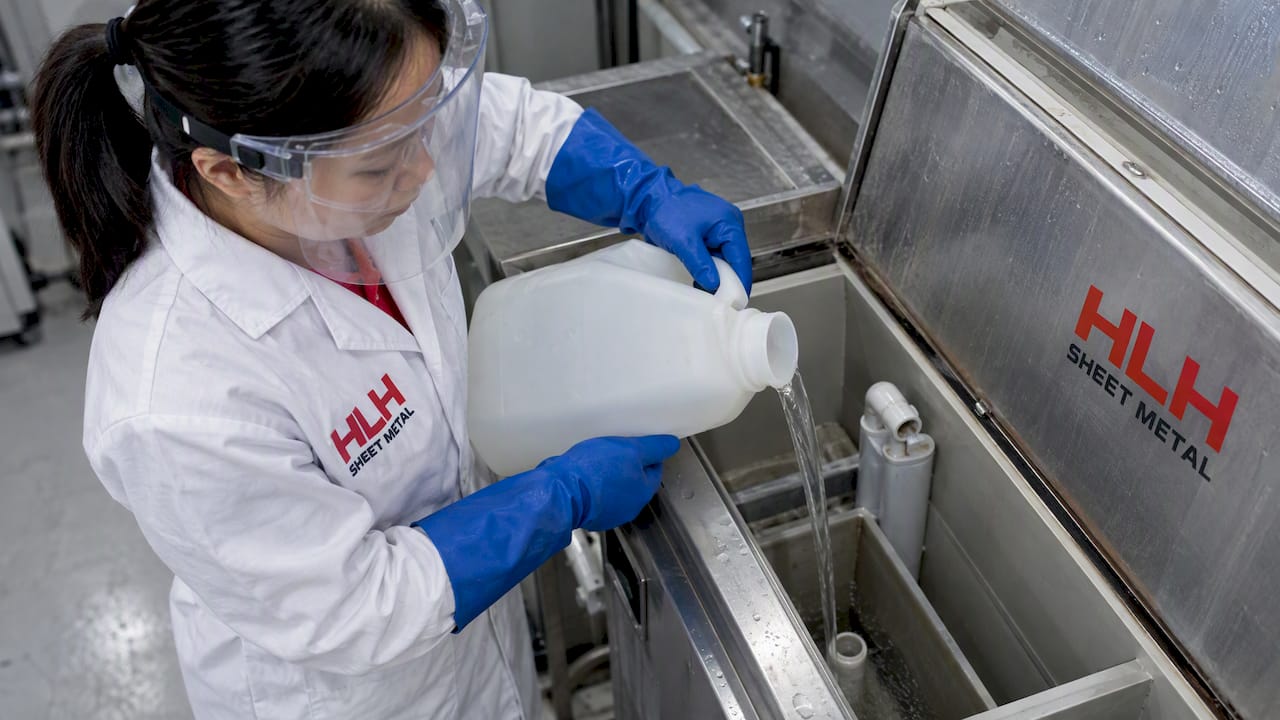
Chamber ventilation matters because salt fog, especially the acidified forms, can corrode nearby equipment and irritate airways if the chamber leaks or is opened before the fog clears. Most labs run chambers in a dedicated area with local exhaust or a fume hood connection rather than open bench space.
Pressurized air supply lines feeding the atomizer should be checked for leaks and rated for the pressures the standard specifies, since a failed line under pressure is a mechanical hazard independent of the chemistry involved.
Disposal is the piece that gets missed most often. Spent salt solution, particularly CASS solution with copper chloride, generally cannot go down a standard drain without treatment, depending on local wastewater regulations, so confirm your disposal pathway before you run a test program, not after a drum is full. Keep a written procedure for solution mixing, chamber loading, and shutdown so the same safety steps happen whether a senior technician or a new hire is running the test.
How Should You Maintain And Calibrate A Salt Spray Chamber?
A chamber that drifts out of calibration will quietly produce results that look fine on paper but don’t match what the standard actually requires.
Daily or per-run checks should cover chamber temperature, collection rate at multiple points, and visual inspection of the atomizer nozzle for salt buildup, since clogged nozzles change droplet size and skew fog distribution. Collection rate is measured with clean funnel-and-cylinder collectors placed in at least two locations, since uneven spray distribution is one of the more common sources of inconsistent results between specimens in the same run.

Periodic calibration, typically on a schedule set by the lab’s quality system rather than the standard itself, should verify temperature sensors against a certified reference thermometer and confirm air pressure gauges against a calibrated source. Keep calibration certificates on file and tied to date ranges so you can match any test run back to a chamber that was in-spec at the time.
Reagent reservoirs and supply lines need periodic cleaning to prevent salt crystal buildup, which otherwise clogs atomizer orifices and changes spray pattern over time. Replace or clean interior chamber surfaces that show their own corrosion, since a corroding chamber interior can contaminate the fog with metal ions the standard never intended to be present.
Document every maintenance action with a date and technician initials. When a result gets disputed months later, a maintenance log is often the only way to confirm the chamber was actually performing correctly on the day in question.
What Causes Salt Spray Test Failures And How Do You Troubleshoot Them?
Most “coating failures” in a salt spray report are actually test setup failures, not real material problems, and it pays to rule those out first.
Uneven corrosion across replicate panels usually points to spray distribution problems: check collection rate at multiple chamber locations before blaming the coating. Premature rust at panel edges rather than the coated face often means masking or edge prep was inadequate, not that the coating itself failed, since raw cut edges corrode faster than any intact finish.
pH drift outside the 6.5 to 7.2 NSS range or 3.1 to 3.3 AASS/CASS range during a run invalidates the result under ASTM B117, so pH logs should be checked before results are accepted, not after a dispute arises. Contaminated salt solution, whether from impure salt, dirty water, or a poorly cleaned reservoir, produces inconsistent results between otherwise identical specimens and is one of the more common hidden causes of a “failed” batch that passes on retest with fresh solution.
Specimen contamination from fixtures, like a steel clip touching an aluminum panel, introduces galvanic effects that have nothing to do with the coating being tested; non-reactive mounting materials avoid this. Compressed air contaminated with oil or moisture changes fog chemistry and can introduce false corrosion sites unrelated to the coating.
When a result looks wrong, check the logs before the coating: pH, collection rate, temperature and solution prep records usually explain an anomaly faster than re-running the entire test.
What Are The Limitations Of Salt Spray Testing Compared To Other Corrosion Tests?
Salt spray testing is a process-control tool, not a life-prediction model, and treating it as the latter is the most common misuse of the method; engineers should understand detailed guidelines in salt fog testing to select the right method and interpret results properly. ISO 9227 states directly that NSS, AASS and CASS methods are intended to detect discontinuities in coatings, not to rank materials against each other or predict how long a part will last in actual service.
The continuous-fog environment in standard NSS testing doesn’t reproduce the wet/dry cycling, temperature swings, or UV exposure that real-world corrosion usually involves, which is exactly why ASTM G85 cyclic modifications exist. A coating can perform well in constant fog and poorly in the field, or the reverse, because the failure mechanisms simply differ.
Correlation between salt spray hours and real-world years is not fixed and varies by coating chemistry, substrate, and environment, so treating “96 hours NSS” as equivalent to a specific number of years outdoors is a common but unsupported assumption. Many procurement teams use a fixed hour count, like 96 hours NSS, as a production acceptance gate rather than a durability claim, which is a reasonable use of the test within its actual scope.
Cyclic corrosion tests, humidity tests and outdoor exposure panels each capture different failure modes salt spray misses, which is why serious qualification programs often combine salt spray with at least one other test method rather than relying on fog exposure alone.
A Standards-first Take On Salt Spray Specs
The standards do their job when you cite the exact clause and attach real numbers. Where specs fail is the hours-only habit: a number with no specimen definition and no evaluation method attached is not a test requirement, it’s a placeholder. Reference panels and documented lab logs turn a vague request into evidence either side can actually stand behind.
— Nash
How We Support Your Salt Spray Specification And Finishing Program
We build custom sheet metal parts and finishes to the exact standard and clause you specify, and can supply flat reference panels alongside finished-part witness samples so your test program covers both. Our quality process includes documented bath chemistry and process logs, the kind of records a salt spray acceptance clause actually depends on.
When you send us an RFQ, ask for our process logs, sample reference panels, and ISO certification documents up front so your spec and our production controls match from day one. Start with our surface finishing services page or request a quote through our fabrication capabilities page.
FAQ
Is Salt Spray Damaging To Hair?
This question refers to cosmetic salt spray hair products, not corrosion test chemistry, and falls outside the scope of industrial salt spray testing standards. Cosmetic salt sprays use different formulations entirely from the 5% NaCl test solutions specified in ASTM B117 or ISO 9227.
When Should You Apply Salt Spray Testing In A Product Program?
Apply salt spray testing during coating or plating process qualification and as a recurring production acceptance check, not as a one-time final sign-off. Many manufacturers run it at defined intervals, such as a 96-hour NSS gate on production batches, to catch process drift early rather than relying on a single qualification test years earlier.
What Is The Purpose Of Salt Spray Testing?
Salt spray testing detects discontinuities and weaknesses in a coating or plating system under accelerated corrosive conditions, functioning as a quality control check rather than a life-prediction tool. ISO 9227 specifically notes these methods are not intended to rank materials or forecast real-world service life.
What Are The ASTM Salt Spray Test Standards?
The two primary ASTM documents are ASTM B117, which covers standard neutral salt spray (fog) apparatus and procedure, and ASTM G85, which adds five modified practices (A1 through A5) for more corrosive or cyclic exposures like acetic acid salt spray, SWAAT and SO2 salt spray. Neither standard sets exposure duration or pass/fail criteria; those must come from the product specification.
How Do Collection Rate And Ph Affect Test Validity?
Collection rate and pH are the two parameters most likely to invalidate a salt spray run if they drift outside tolerance during the test. ASTM B117 requires a collected spray pH of 6.5 to 7.2 for neutral salt spray and a collection rate typically in the 1 to 2 mL per 80 cm² per hour range, logged throughout the exposure period.

