




Table Of Contents
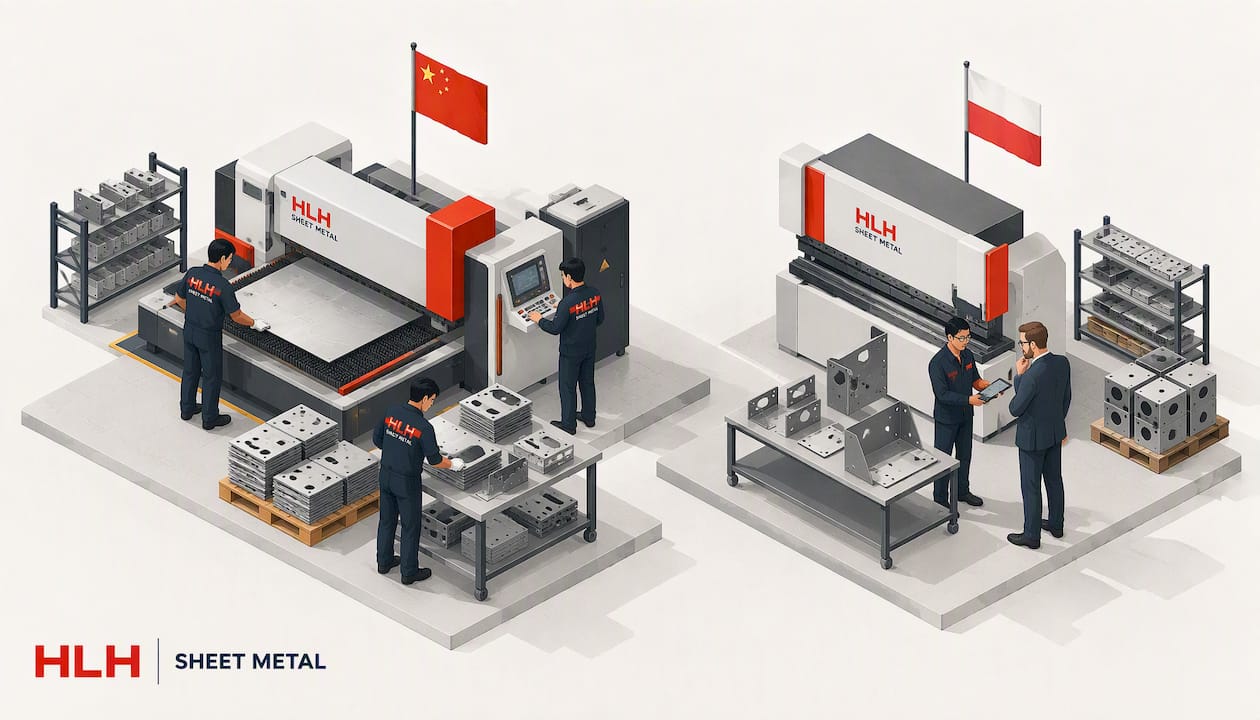
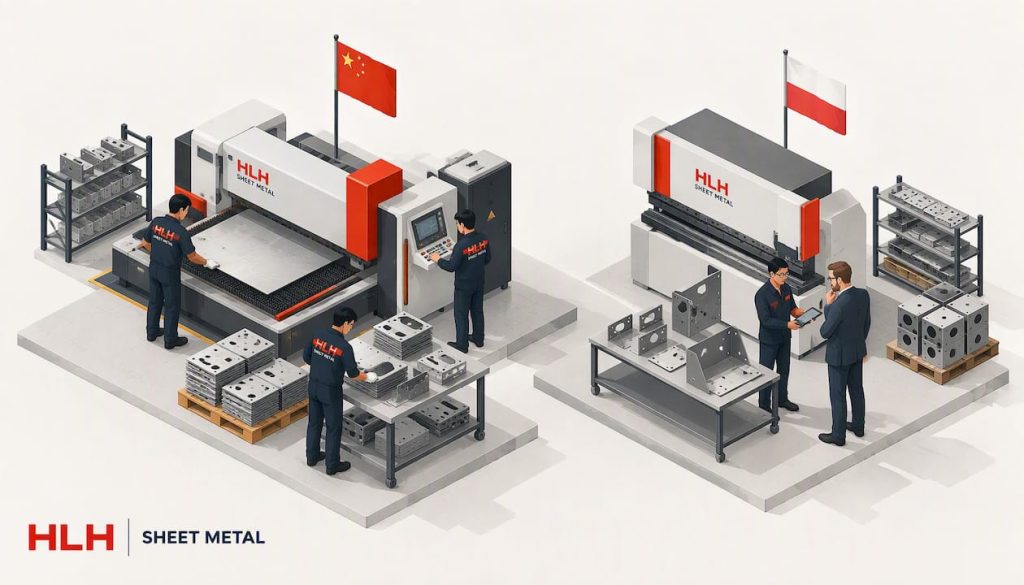
China is usually the cheaper place to make sheet metal parts, and Poland is usually the faster, closer one. How big the gap is depends on your part, your volume and where it ships. A bracket that is mostly steel may show little difference. A welded, finished enclosure with heavy labor content can come out well ahead from a Chinese plant, even after freight. This guide shows how to compare the two on landed cost, not on the unit price in the quote.
TL;DR
- Compare landed cost per part: unit price plus tooling, freight, duty, inspection, and the cost of carrying inventory in transit.
- Raw metal is bought at broadly similar market prices, so the gap between Poland and China sits mostly in conversion cost: labor, energy, machine time and overhead.
- China tends to win on labor-heavy, finishing-heavy and medium-to-large runs. Poland tends to win on urgent, small and repeat orders that need short transit.
- Sea freight from China takes weeks, trucking within Europe takes days. Price that time into the decision.
- Ask for quotes from both countries on the same drawing, material, finish and Incoterm, then compare the totals.
What Actually Drives The Price Of A Sheet Metal Part
Five inputs set what an hour of sheet metal work costs in any country: labor, energy, machine amortization, materials, and overhead plus compliance. Poland and China differ on every one of them, but not by the same margin.
Material is the smallest difference. Steel and aluminum trade on global markets, so material-dominated parts may show little benefit from relocating. The country effect shows up in conversion cost: the hours of programming, laser cutting, bending, welding and finishing between the flat sheet and the finished part.
That has a practical meaning. A thick plate part cut from expensive stainless, with a few bends, is a material problem. A thin-gauge enclosure with 40 bends, welded seams, and powder coat is a labor problem. China’s advantage grows with the second type.
Labor And Energy: Where Poland And China Differ
Poland is one of the lower-cost labor markets in the EU, but it is still an EU market. Eurostat puts the average hourly labor cost in 2025 at €34.9 in the EU, and a payroll-sector summary of the same Eurostat series lists Poland at €19.10 per hour. That is whole-economy labor cost, including employer contributions, not a shop rate for a fabricator.
China’s published hourly figures vary by province and are rarely comparable to EU statistics. Be careful with any calculator that shows a single number. One costing model uses illustrative rates of €12 per hour for Poland and €8 for China, and the same page warns that labor rate alone is not enough: labor time, machine productivity, energy, overhead and the actual plant’s rates decide the factory cost. We agree with that warning. A plant that programs nesting well, runs lights-out laser cutting and keeps press brakes busy can beat a cheaper plant that does not.
Energy matters more than buyers expect. A 2022 academic study of Poland’s steel industry found that energy accounts for 20% to 40% of steel production cost. That is steel mills, not fabrication shops, but it explains why European energy prices feed into sheet prices and into the electricity-hungry parts of fabrication such as fiber lasers and furnaces.
Poland Vs China At A Glance
| Factor | Poland | China |
|---|---|---|
| Labor content | Higher cost per hour, strong skills | Lower cost per hour, deep fabrication workforce |
| Energy and overhead | Exposed to EU energy and compliance costs | Typically lower overhead per machine hour |
| Raw material | Market-priced, similar to China | Market-priced, similar to Poland |
| Transit to EU customer | 2 to 7 days by truck | 30 to 45 days by sea |
| Duty and VAT for EU buyer | Intra-EU, no customs duty | Customs duty and import VAT apply |
| Best fit | Urgent jobs, small lots, frequent design changes | Labor-heavy parts, mid and high volume, finished assemblies |
| Communication | Same time zone for European buyers | Depends on the supplier’s support setup |
Note that the table speaks in direction, not in euros per part. No credible public source publishes a Poland-versus-China price per part for sheet metal, because the answer depends on drawing, material, finish and volume. Boothroyd Dewhurst’s global costing brochure shows that its model covers sheet metalworking for both China and Poland, including machine, labor, material, energy and tooling costs, but it publishes no head-to-head rate table. The only way to get your number is to quote your part.
A Worked Example: How A Quote Becomes A Landed Cost
Published examples show how small a sheet metal unit cost can be. In one dated costing example, a laser-cut AL7075 end plate made in China had a material cost of $0.2335 per part, a process cost of $0.7669 and a total of $1.3611 at a 25,000-part life volume. That example did not include Poland, so it is not a comparison. It does show why the unit price is only the start: at those levels, a freight or inspection line can matter as much as the cutting.
Here is the structure we suggest for your own comparison. The numbers are placeholders for your own quotes, not market data.
| Cost line | Poland quote | China quote |
|---|---|---|
| Unit price (ex works) | Your quote | Your quote |
| Tooling and fixtures, amortized | Your quote | Your quote |
| Packaging and export crating | Often small | Usually itemized |
| Freight to your dock | Truck | Sea or air |
| Duty and import VAT | None inside the EU | Depends on destination and HS code |
| Pre-shipment inspection | Optional | Recommended |
| Inventory carrying cost | Days in transit | Weeks in transit |
| Rework or scrap allowance | Your history | Your history |
Add the lines, divide by the number of good parts, and you have the number that matters.
Landed Cost: Freight, Duty And Inspection
Total landed cost, not raw unit price, is the correct metric for comparison, and it covers logistics, duties, capital costs and quality risk.
Freight. Sea freight is cheap per part for dense, stackable parts and expensive for bulky enclosures that ship mostly air. In 2025, estimated 40-foot container rates from China were $3,600 to $4,200 to Germany and $3,700 to $4,300 to France. Spread across a full container of finished parts, that is often a small share of the part value. Spread across a half-empty container of large cabinets, it is not. Freight rates move, so ask your forwarder for a current quote.
Duty and VAT. A Polish or other EU buyer paying a Chinese plant adds goods, freight, port charges, duty, VAT and domestic transport to reach landed cost. VAT is usually recoverable for a registered business, but duty is a real cost, and the classification of your part decides the rate. A US buyer faces a very different picture because of tariff layers on steel and aluminum content. We cover that in our USA vs China cost breakdown.
Inspection. Defects found after arrival cost more to correct, which is why pre-shipment inspection is standard practice for overseas orders. A Polish supplier near you may let you visit in a morning. That convenience has value, but it is cheaper to buy an inspection report than to buy a plane ticket for every order.
Currency. Exchange rate swings can significantly change the cost competitiveness of a contract. Poland quotes in zloty or euros, China often in US dollars or renminbi. Model at least a best case and a worst case before you commit to a yearly contract.
Lead Time And The Cost Of Waiting
Sea freight from China to the EU takes 30 to 45 days, against 2 to 7 days by truck from Eastern Europe. Add production time at both ends. Time costs money in three ways: inventory you have to hold, cash tied up in transit, and the risk that your design changes while parts are on the water.
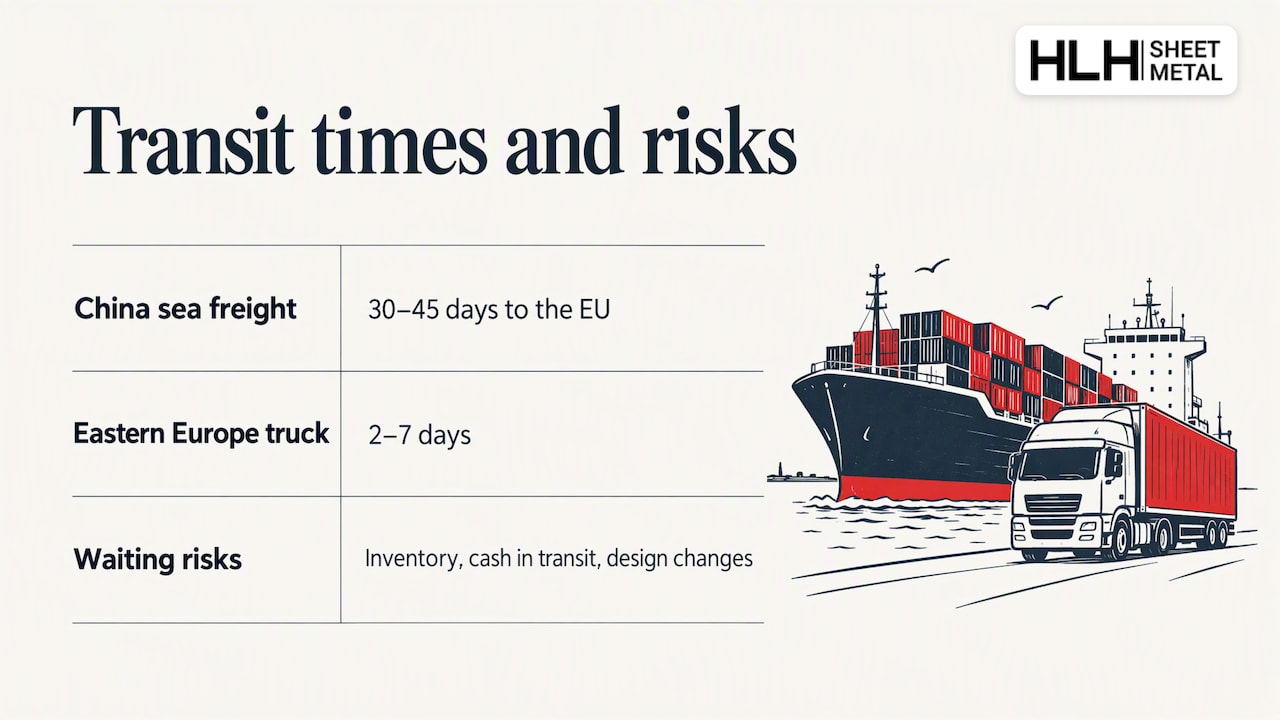
There are ways to shrink the gap. Air freight for first articles and urgent replacements moves a prototype in days. Sea freight for the bulk order keeps the unit cost low. A blanket order with scheduled releases, and a safety stock near your line, covers the gaps. Buyers who run lean, with small orders every week, will find Poland easier. Buyers who place a large order a few times a year will find China’s price advantage easy to capture.
How Order Size, Complexity And Certification Change The Answer
Three factors tilt the choice, and each cuts differently.
Order size. Prototypes and small lots are about programming, setup and speed. Poland can be strong when you need five parts next week. As volume rises, setup is spread thinner and labor and machine hours dominate, which is where Chinese plants with multiple lines and stamping capacity usually pull ahead. If a part moves from laser and brake to a stamping die, the tooling cost is paid once and the unit price drops sharply. Ask what a die modification costs and how long it takes, because that question separates good quotes from bad ones.
Complexity. Multi-bend, welded and finished assemblies carry the most labor, so they benefit most from lower labor cost. Simple flat parts carry little labor, so the gap narrows. Design choices count as much as country: consistent bend radii, standard hole sizes and sensible tolerances take cost out anywhere. Our guide to CAD settings that cut China production costs covers the details, and the same rules apply to a Polish shop. On tolerances in particular, a measurement-side view of tolerance selection to cut scrap helps you avoid paying for precision the part does not need.
Certification. Aerospace, medical and automotive parts need documented quality systems, material certificates and traceability. Both countries have certified plants, and both have uncertified ones. Do not compare a certified Polish shop with an uncertified Chinese one, or the other way round. Ask each supplier for its current certificates, check them with the issuing body, and make sure the certificate scope covers sheet metal fabrication.
Where Each Country Makes The Most Sense
Choose Poland when:
- You need parts within days, or your demand is hard to forecast.
- Volumes are small and designs change often.
- Your customer requires European origin.
- You want to visit the shop regularly and speak in your own time zone.
Choose China when:
- The part is labor-heavy: many bends, welds, hardware inserts and finishes.
- Volumes are medium to high, or you can place scheduled blanket orders.
- You need a single supplier for cutting, bending, welding, finishing and assembly.
- You work with a wide range of metals, from aluminum and stainless steel to copper, brass and titanium.
- Your cost target leaves no room for a local premium.
Many buyers use both. They run prototypes and urgent replacements in Poland, then move stable production to China.
Why Buyers Choose Chinese Fabrication
China’s advantage is not only price. It is breadth. A single industrial region can supply the sheet, the laser cutting, the press brake work, the powder coating and the hardware within a few hours of each other. That density shortens supplier chains and keeps subcontracting cost low. A plant that already owns laser, bending, welding, stamping and finishing lines does not need to send your part to three other shops, which reduces handling, damage and delay.

Scale is the second advantage. Plants that handle thousands of parts a week can absorb a rush order or a change in volume without repricing the whole job. And a supplier with several plants can move work between them when one line is full.
Communication has been the traditional objection, and it is a fair one. It is a supplier-by-supplier question, not a country-level one. Look for a team that answers drawings quickly, in your language, and sends a design-for-manufacturing review with the quote. That is a better signal than any price.
Our Perspective: What We See In Real Quotes
We make sheet metal parts, enclosures and chassis in China for customers in aerospace, medical, automotive and data center markets. Across those projects we see the same pattern. The buyers who save the most are not the ones who chase the lowest unit price. They are the ones who send a complete drawing package, agree on tolerances early, and ask for the landed cost.
On labor-heavy parts, the difference between a Chinese and a European quote is usually large enough to survive freight, duty and inspection. On simple, material-dominated parts, it is small, and a nearby supplier can be the sensible choice. We would rather tell you that than win an order that does not suit you.
What we put behind the price is process: ISO-certified quality control, prototypes that move fast, several plants for both small batches and large runs, and an English-speaking support team available around the clock. If a part is better made closer to you, we will say so on the first call.
— Nash
How To Compare Quotes From Poland And China
- Send the same package to both. Same drawing revision, material and grade, thickness, finish, quantity tiers and tolerance notes.
- Fix the Incoterm. Compare ex works to ex works, or delivered to delivered. Mixed terms hide thousands of euros.
- Ask for breakdowns. Material, cutting, bending, welding, finishing, tooling and packaging as separate lines.
- Add landed cost lines. Freight, duty, VAT, inspection and the cost of capital over transit time.
- Test with a first article. Pay for a small pilot lot from each supplier and measure parts yourself.
- Model currency. Run the total at two or three exchange rates.
- Check the certificates. Match scope and validity to your industry.
- Review rework terms. Who pays for nonconforming parts, and how fast is the remake?
If you want a view of how the cost story changes for other buyers, we have written the same comparison for Germany, Italy and the UK. For what moves price inside China, see our pricing factors guide.
Get A China Quote To Set Against Your Polish One
If you already have a Polish quote, the quickest way to test it is to send us the same drawings. We quote laser cutting, bending, welding, stamping and surface finishing under one roof, in steel, stainless steel, aluminum, galvanized steel, copper, brass, titanium and magnesium, and we ship worldwide. Start from our sheet metal fabrication capabilities, or go straight to the HLH Sheet Metal site to submit a drawing for a quote. We do not publish fixed prices, because every part is different, but you will get an itemized quote you can compare line by line.
FAQ
Is Sheet Metal Fabrication Cheaper In China Than In Poland?
Usually yes at the factory, especially for labor-heavy parts such as welded and finished enclosures. Raw material costs are similar in both, so the difference comes from labor, energy and overhead. Whether China is cheaper after freight, duty and inspection depends on your part and volume, so compare landed cost.
How Much Does Metal Fabrication Cost Per Hour In Poland And China?
There is no single reliable shop rate, and published figures differ by date and method. Eurostat data puts Poland’s whole-economy labor cost at about €19.10 per hour for 2025, which is not a fabricator’s machine-hour rate. Ask each supplier for a part price, not an hourly rate, because productivity changes the result.
Does Shipping From China Erase The Savings?
Not for most parts. A full container costs a few thousand dollars on a Europe route, and that is spread over every part inside. The savings shrink for bulky, low-value parts that fill a container with air, and for very small orders. Duty and inspection also count, so add them before deciding.
How Long Does Delivery Take From Each Country?
Trucking from Eastern Europe to the EU takes 2 to 7 days, and sea freight from China takes 30 to 45 days, before production time. Air freight shortens the Chinese route to days for urgent lots, at a higher cost.
Can A Chinese Supplier Meet Aerospace Or Medical Quality Requirements?
Yes, when the plant holds the relevant certification and can show traceability, inspection records and material certificates. Ask for the certificate, verify it with the issuing body, and order a first article before you commit to volume.

