





Table Of Contents
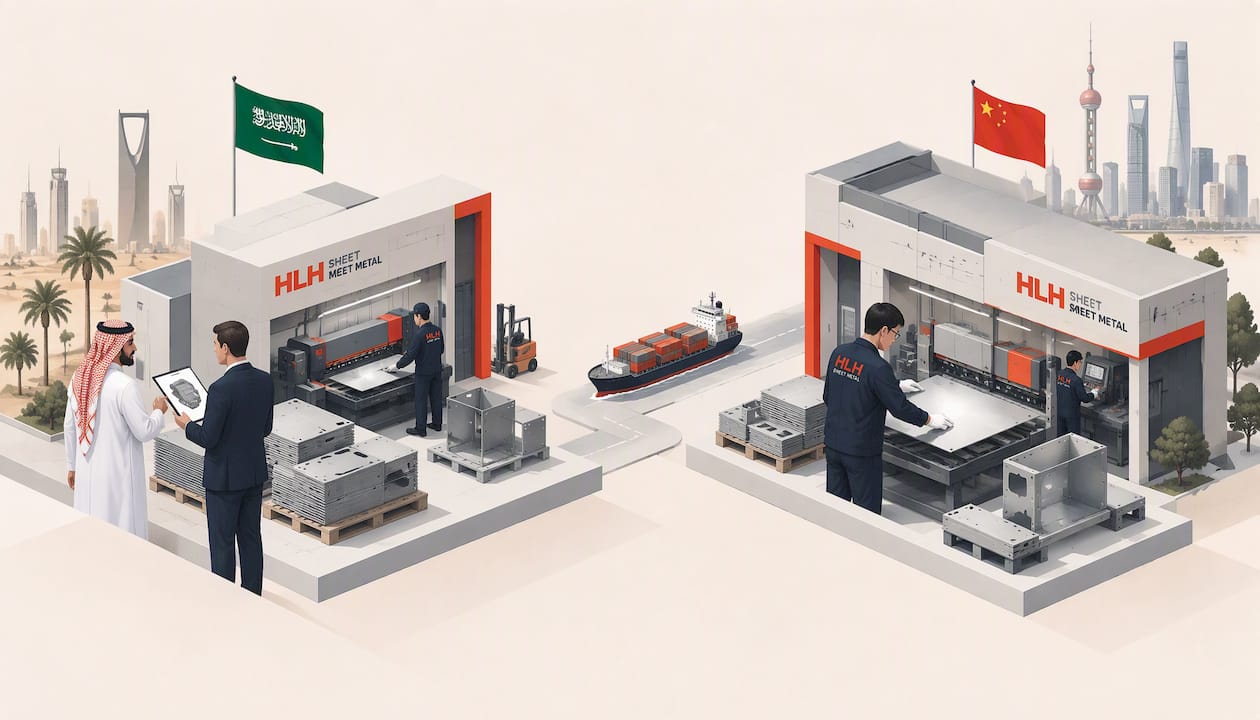
For most custom sheet metal parts, China is cheaper per piece than Saudi Arabia, mainly because of labor, shop density and the supply chain around the factory floor. The gap shrinks, and sometimes reverses, once you add freight, duties, lead time and the cost of a bad first batch. This guide shows where the difference comes from, how to build a fair comparison, and when each country makes sense.
TL;DR
- Labor is the clearest gap: Saudi manufacturing employees average about $2,406 a month before tax, and employers carry extra permit and recruitment costs. Chinese fully loaded shop labor is commonly cited at $7 to $10 per hour.
- Material, process and quantity decide most of a quote. Labor is only one line, so compare identical drawings, grades and quantities.
- Landed cost, not ex-works price, is the number to compare: add freight, import duty, VAT, packaging and inspection.
- China wins on prototypes-to-production range, many processes under one roof and cost at volume. Local Saudi supply wins on very urgent, low-volume or bulky jobs.
- Ask both sides to quote the same package, then compare the total delivered price per good part.
What A Sheet Metal Quote Actually Contains
Before comparing countries, know what you are comparing. A sell price is built from the shop’s sell rate, the material and any outside processing, and a fully burdened price may add operational overhead, according to The Fabricator. Shops derive department rates from direct labor plus fixed and variable overhead, then estimate production time from the part and its processes.
In practice a quote for a bent and welded enclosure usually breaks down like this:
- Material: the flat blank plus nesting scrap, not the weight of the finished part.
- Cutting: laser or punching time and setup.
- Forming: press brake setup and time per bend.
- Welding and assembly: hardware insertion, fixturing, deburring and handling.
- Outside services: powder coating, plating, anodizing.
- Markup and minimum charges.
QuotedPart’s worked example lists the same elements: blank and nesting scrap, cutting, press brake time, deburring, outside services, hardware, markup and minimum charges. When two quotes differ by 30%, the difference is usually hiding in one of these lines, not in a single hourly rate.
Labor And Overhead: Where The Gap Starts
Labor is the first reason Chinese quotes land lower. A Chinese-language official country guide for Saudi Arabia, published in 2026 with facts through September 2025, puts average pre-tax pay for Saudi manufacturing employees at $2,406 a month. On a standard 173-hour month that is roughly $14 an hour in wages alone, before the employer’s other costs.
Those other costs matter. The same guide notes that employers also bear work-permit, recruitment, occupational-change and repatriation costs for foreign workers. It also explains that private enterprises must hire enough Saudi nationals to qualify for foreign-worker quotas, and that company ratings affect work-visa approvals and government services. For a fabricator, that means skilled press brake operators and certified welders carry a compliance overhead that shows up in the shop rate.
In China, fully loaded labor for fabrication is commonly cited at $7 to $10 per hour. Our own breakdown for European buyers explains why that figure is only the start of the comparison. A lower hourly rate matters most on labor-heavy parts: many bends, manual welding, hardware insertion and finishing.
Labor is not the whole story, though. A shop with fiber lasers, automated bending and good nesting software can produce a part in a fraction of the minutes, whatever the wage. That is why equipment and process depth matter as much as the rate.
Why Shop Density Lowers Cost In China
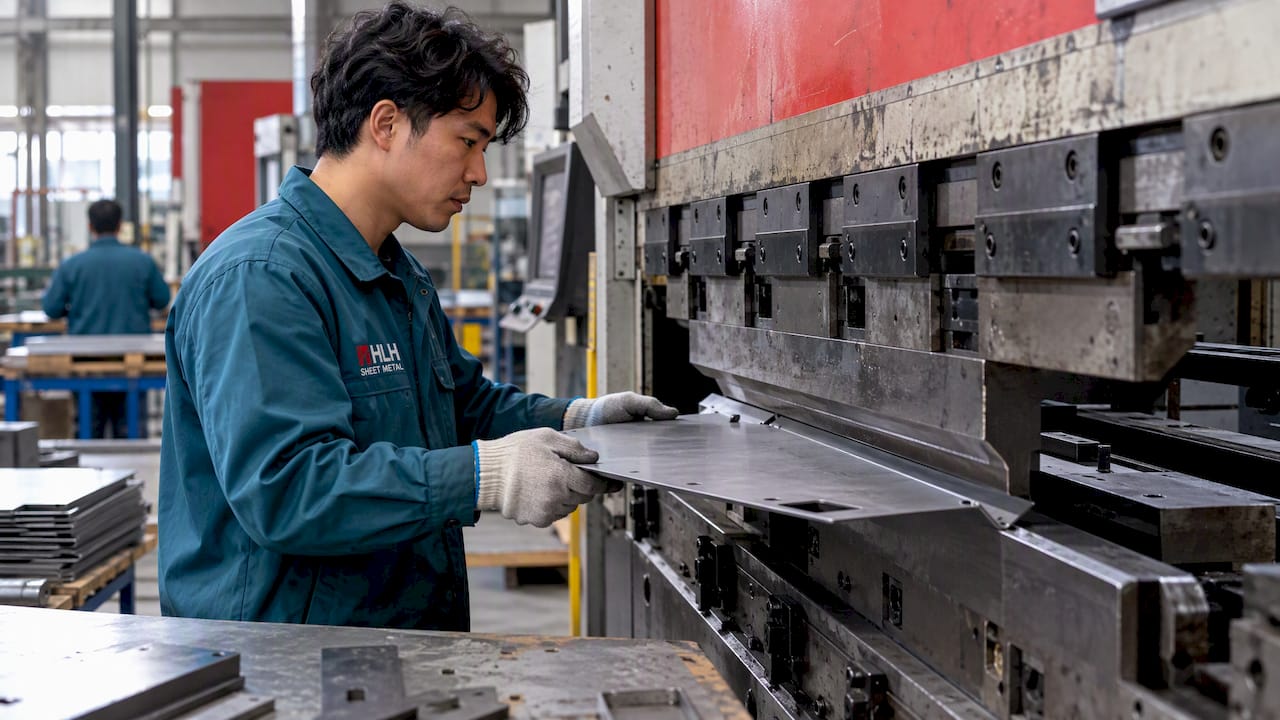
A sheet metal part rarely stays in one process. It is cut, bent, welded, finished, assembled and packed. In China’s major manufacturing regions, those steps often sit within a short drive of each other: laser cutting, stamping, powder coating, plating, hardware suppliers and tooling shops.
This changes cost in three ways:
- Less outside-processing markup. When finishing is done in-house or next door, you avoid long transport loops and a middleman’s margin.
- Faster iteration. A revised flat pattern can be cut, bent and finished within days, which cuts the cost of design changes.
- Better nesting and material yield. Steady volume across many customers lets shops buy sheet in bulk and nest efficiently.
This is the structure behind our own work. HLH Sheet Metal runs multiple manufacturing plants in China, so small prototype runs and large production orders can be handled with fast turnaround, and the process list on our sheet metal fabrication capabilities page covers cutting, bending, welding, stamping and surface finishing under one quote.
Material Cost: The Line That Does Not Follow Labor
Material is usually the largest single line on a quote, and it moves independently of labor. Price it by weight of the flat blank, not the formed part. QuotedPart’s method multiplies adjusted flat dimensions by thickness and density, divides by nesting utilization, then multiplies by the material price. Its example assumes 80% utilization. The takeaway is that a part that nests poorly pays for scrap whichever country cuts it.
A simple cost per kilogram figure helps for budgeting, but it has limits. Material scales with weight. Labor does not: two parts of equal weight can have very different cut lengths, pierce counts and bends, so pricing labor per kilogram misleads.
For buyers comparing the two countries, the practical points are:
- Specify the exact grade. 304 versus 316 stainless, 5052 versus 6061 aluminum, and galvanized versus cold-rolled steel can swing the price more than the country does.
- Ask for material certificates. For aerospace, medical and data center work, mill certificates should travel with the parts.
- Check the range. A supplier that works routinely in steel, aluminum, stainless, galvanized steel, copper, brass, titanium and magnesium can quote unusual materials without a long sourcing delay. We fabricate in all of these, and also nickel, tinplate and carbon steel.
What Drives A Quote More Than The Country
The country sets the rates. The drawing sets the hours. Seven drivers do most of the work: material and grade, gauge, part size and complexity, bend count and setup, quantity and nesting, finishing, and file preparation. The Fabricator adds that setup time is divided by quantity, so the same part costs far more per piece at 10 than at 1,000.
Three examples show why this matters for a Saudi versus China comparison:
- Quantity. At 5 pieces, setup dominates and the cost gap between countries is small in absolute dollars. At 5,000 pieces, labor and machine time dominate and the gap widens.
- Tolerances. Tight flatness or position tolerances add inspection and rework. Specify only what the function needs.
- Edges and finishing. Deburring and edge finishing can be a hidden labor line, especially on laser-cut aerospace and medical parts. A guide to edge finishing for aerospace engineers explains why edge condition deserves a line in the specification and not an afterthought.
If you want the detail on how each factor moves price in our shops, our guide to sheet metal fabrication pricing in China walks through them one by one.
Landed Cost: Freight, Duty, VAT And Inspection
An ex-works price from China is not what you pay. For delivery to Saudi Arabia, add:
| Cost line | What to ask |
|---|---|
| Freight | Sea or air, container or LCL, quoted to the Saudi port or to your door |
| Insurance | Cargo insurance on the invoice value |
| Import duty | Tariff code for your part, on the CIF value |
| VAT | Charged on the dutiable amount at the current Saudi rate |
| Clearance and inland delivery | Broker fees, port handling, trucking |
| Packaging | Export crating, protective film, corrosion protection for sea freight |
| Inspection | Pre-shipment inspection report, first article, certificates |
We do not quote a single duty percentage here, because duty depends on the tariff classification of the part and the rate changes. Some online duty calculators show specific rates for China-to-Saudi shipments, but treat those as a starting point only. Confirm the code and rate with your customs broker or the Saudi customs authority (ZATCA) before you commit to a price.
The same logic applies to exports in the other direction. If you are comparing a Saudi-made part with a Chinese one for a project outside the Kingdom, the destination’s duties and tariffs matter more than either origin. For example, our analysis of US versus China fabrication cost and tariffs shows how duties can erase or preserve China’s price advantage depending on the market.
A fair rule: if the Chinese ex-works price is 30% to 50% below the Saudi quote, freight and duty rarely cancel it for compact parts. For bulky, light, low-value enclosures, where freight is charged by volume, run the numbers carefully.
Lead Time And Volume: The Part Of Cost That Is Not On The Invoice
Turnaround is a cost. A line waiting on a bracket loses more than the bracket costs.
Where Saudi fabrication helps. A local shop can deliver a one-off repair part or a small urgent batch in days, without ocean freight. For on-site modifications and structural work, proximity is hard to beat.
Where China helps. For repeat production, prototypes followed by volume, or assemblies with many components, Chinese shops combine short fabrication lead times with deep capacity. Ocean freight adds weeks, but you can plan around it: keep safety stock, split shipments, and air freight the first articles.
A sensible pattern for many buyers is:
- Approve prototypes quickly with a supplier who turns them around in days, shipped by air.
- Place the first production order with a ship-ready date aligned to your schedule.
- Move to repeating blanket orders with scheduled releases, so freight is booked early and cheaper.
Supplier capability affects cost too. A shop that must outsource laser cutting or powder coating adds lead time and margin. Check whether cutting, bending, welding, stamping and finishing are done in-house.
How To Get Quotes You Can Compare
The best way to compare Saudi and Chinese suppliers is to send both an identical package. QuotedPart recommends a drawing with clear flat or formed dimensions, bend allowances and hole positions, quantity breaks, and open questions clarified with the estimator. Build on that:
- Drawings: a 2D PDF with tolerances plus a STEP file or DXF flat pattern.
- Material: exact grade, thickness and certificate requirement.
- Finish: coating type, color code, thickness, plating standard, masking.
- Quantities: price breaks, for example 10, 100 and 1,000.
- Incoterms: ask both suppliers for delivered prices to the same address, or compare ex-works plus your own freight estimate.
- Quality: inspection level, first article, certifications such as ISO 9001.
- Packing and lead time: state the date you need parts on your dock.
Then compare cost per good part delivered, not the headline unit price. Add an allowance for scrap and rework, since a cheap part that fails inspection costs more than a fair quote that passes.
Our Perspective
We build parts in China every day, so we see where the savings are real and where buyers get caught. The savings are real when the drawing is clear, the supplier owns the processes, and the buyer plans freight. They disappear when files are incomplete, finish requirements change after the quote, or the supplier outsources half the job.
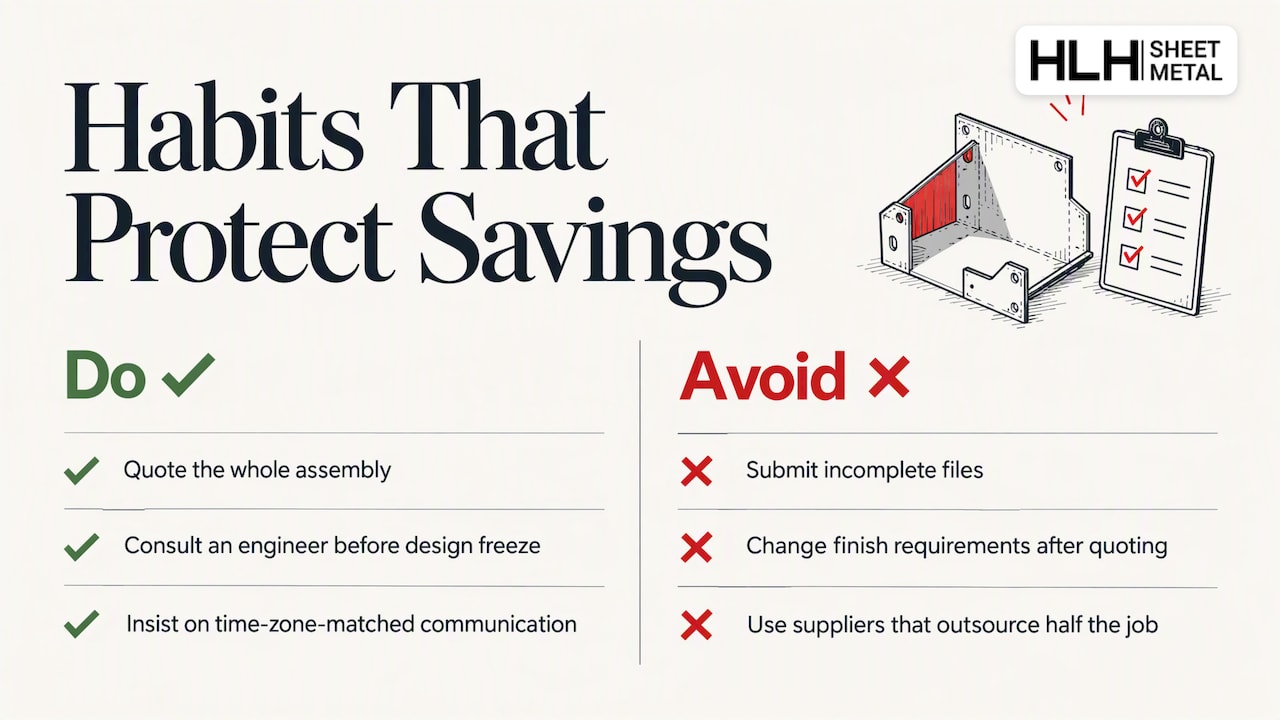
Three habits protect the saving. First, quote the whole assembly and not single parts, so cutting, forming, welding and finishing are optimized together. Second, talk to an engineer before you freeze the design: a relief cut, a standard bend radius or a different hardware choice can remove cost without changing function. Third, insist on communication that matches your time zone. That is why we run an English-speaking project team with round-the-clock support, so a question on a drawing does not cost you a day.
If your volumes are modest and the part is simple, a local Saudi shop may be the right call. If you need repeat production, many processes, or certified quality at a lower delivered price, China deserves a serious quote.
— Nash
Get A Quote For Your Own Parts
If you are weighing Saudi against China for a real project, send us the drawings and we will quote the full process chain: laser cutting, bending, welding, stamping and surface finishing. We make enclosures, cabinets and chassis, and ship worldwide. Start from our sheet metal fabrication page and request a quote with your target quantities and delivery location.
Other markets face the same question. Our cost comparisons for Australia, Germany and the UK show how the same logic plays out elsewhere.
When Saudi Arabia Still Makes Sense
Being fair to the alternative helps you decide:
- Urgent one-offs and repairs, where a few days matter more than a lower price.
- Very large or heavy fabrications, where freight and handling consume most of the saving.
- Projects with local-content requirements, where buying from a Saudi shop can be part of the contract or evaluation.
- Site-fit work, where the fabricator must measure, adjust and install on location.
For precision enclosures, server racks, chassis, brackets and housings in repeat volumes, the economics usually favor a capable Chinese supplier, provided you control quality through clear drawings, certificates and inspection.
FAQ
Is Sheet Metal Fabrication Cheaper In China Than In Saudi Arabia?
For most precision parts in repeat quantities, yes. Labor, process density and nesting efficiency all favor Chinese shops, and the gap grows with volume. The delivered price depends on freight, duty and VAT, so compare landed cost per good part.
How Do I Calculate Fabrication Cost Per Kilogram?
Price the material by blank weight and the current price per kilogram, adjusted for nesting scrap. Price labor separately by cut length, pierces, bends and handling, because parts of equal weight can need very different amounts of work. A per-kilogram figure is useful for a rough budget, not for a final quote.
What Import Costs Should I Add To A Chinese Quote For Saudi Arabia?
Add freight, cargo insurance, customs duty on the CIF value, VAT, broker and port fees, inland delivery and export packaging. The duty rate depends on the tariff code of your part, so confirm it with your customs broker or the Saudi customs authority before you place the order.
What Should I Send To Get Comparable Quotes?
Send a 2D drawing with tolerances, a STEP or DXF file, the exact material grade and thickness, finish specification, quantity breaks, certification needs and delivery address. Ask each supplier to quote the same package, then compare delivered cost and lead time side by side.

