




Table Of Contents
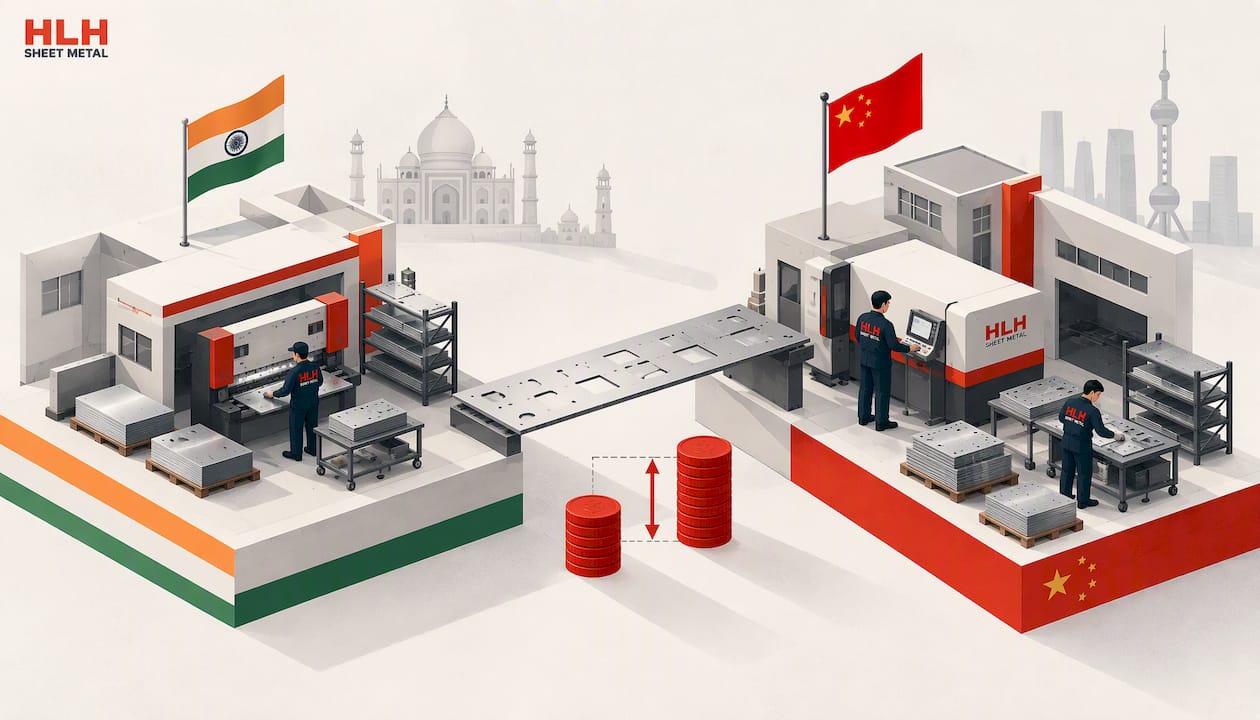
For most US buyers, China still delivers the lower or equal total cost on standardized sheet metal parts, while India can win on customized, moderate-volume work. The gap is narrower than the headlines suggest, and a quote comparison that looks only at the unit price will mislead you. Below we walk through what the published costing data says, which cost lines to compare, where landed cost changes the answer, and how to run a fair quote comparison for your own drawings.
TL;DR
- A Boothroyd Dewhurst costing analysis put a representative laser-cut aluminum end plate at $1.36 per part from China and $1.55 from India, tariffs included.
- China tends to benefit from high-volume standardized production. India can compete when customization or moderate volume lowers development, logistics or management cost.
- Unit price is one line. Tooling, samples, payment terms, rework risk, MOQ, freight, duties and lead time decide the real cost.
- Tariff rules for both countries change often, so price every quote on a landed basis and check current rates before you commit.
- Ask each supplier for the same drawing, material, finish and Incoterm, then compare line by line.
What The Cost Data Says About India Vs China
Public, like-for-like numbers on sheet metal are scarce, which is why one data point deserves attention. DFMA’s September 2025 costing brochure models a laser-cut aluminum end plate at $1.36 per part in China versus $1.55 in India, factoring in regional manufacturing profiles and tariffs. That is a difference of 19 cents, or roughly 14% on the India figure.
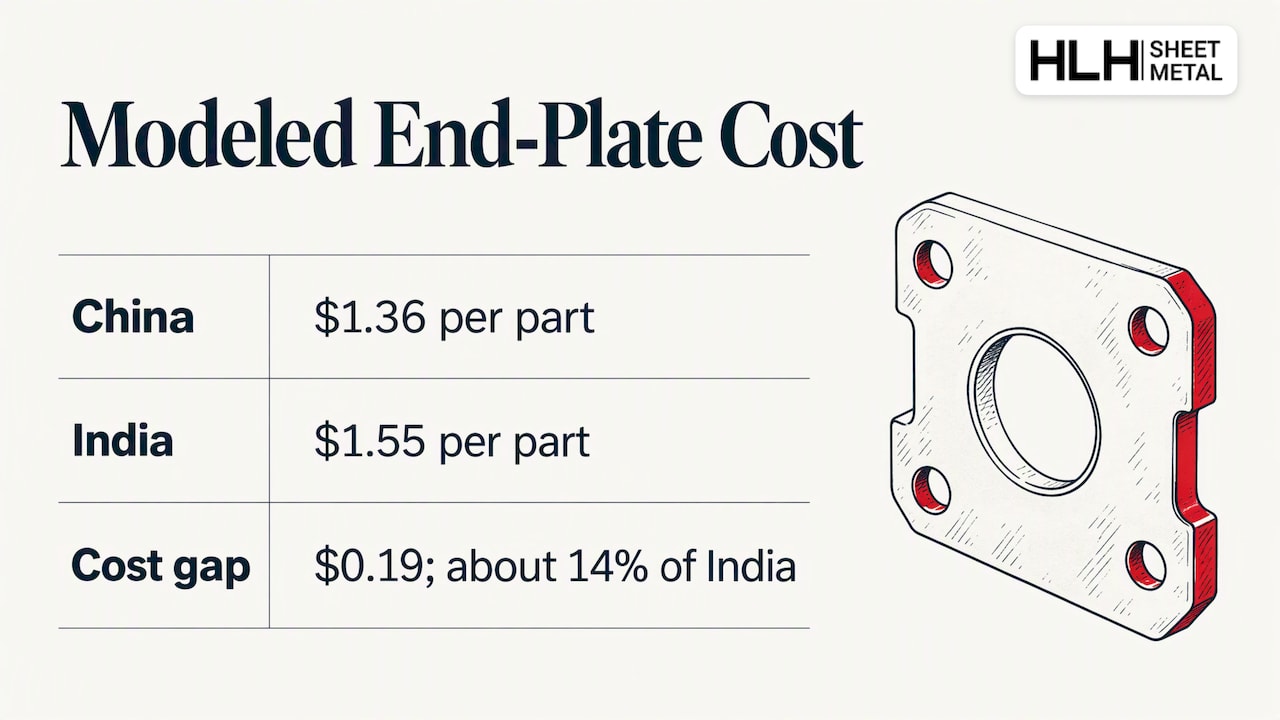
Two cautions apply. First, this is one simple part, a flat plate with minimal forming. Second, it is a model, not a quote. It tells you the direction and scale of the difference for a simple, repeatable part. It does not tell you what a welded, powder-coated enclosure will cost.
The inputs matter as much as the result. DFMA says its regional figures draw on machine rates, labor, materials, energy, tooling, supplies, and tariffs or duties. That is a useful reminder: a hourly wage comparison alone is incomplete. India’s labor rates are often quoted as lower, yet the finished part cost is also driven by machine capacity, material pricing, scrap and how much of the supply chain sits near the factory.
Where China Tends To Be Cheaper
China’s strongest advantage is depth. A fabrication cluster can source sheet, hardware, powder coating, plating and packaging within a short drive of the plant. That compresses material handling, waiting time and transport between processes.
An India-versus-China framework from Altus Exports notes that China commonly benefits from high-volume standardized production. In practice that means:
- Laser cutting and bending at scale. Plants with many fiber lasers and press brakes keep machines loaded, so the hourly rate spread across each part is small.
- Stamping and progressive tooling. Tool shops and stamping lines sit close together, which shortens tooling lead time and lowers tooling cost for repeat volume.
- Secondary processes. Anodizing, powder coating, plating and silkscreen can usually be done in the same region, so there is less freight and fewer handoffs.
- Material range. Steel, aluminum, stainless, galvanized steel, copper, brass and titanium are all commonly available, which matters for mixed-material assemblies.
This is the profile we work in. HLH Sheet Metal runs multiple manufacturing plants in China, which lets us take a prototype quantity and a large production run through the same engineering team.
Where India Can Compete
India is not simply the more expensive option. The same framework says India can be competitive when customization or moderate volume reduces development, logistics or management costs. Three situations come up most often:
- Smaller, customized runs where a supplier is willing to work with flexible MOQs and hands-on changes.
- Supply-chain diversification. Some buyers split volume between two countries to reduce single-country exposure, accepting a small cost premium for resilience.
- Specific tariff or customer requirements where a program wants non-Chinese origin.
India also faces its own cost headwinds. The World Bank has observed that higher tariffs on key intermediary inputs have raised production costs and reduced export competitiveness in India. For a fabricator, imported specialty alloys and components are exactly that kind of input.
India Vs China At A Glance
This table summarizes how the two sourcing options typically differ across the lines that move your price. Use it as a checklist for what to ask, not as a quote.
| Cost line | China | India |
|---|---|---|
| Simple laser-cut part (DFMA model) | $1.36 per part | $1.55 per part |
| High-volume standardized parts | Typically strongest | Competitive only with the right supplier |
| Customized, moderate volume | Competitive with good engineering support | Can be competitive |
| Tooling and stamping | Dense tool-making base | Available, confirm lead time |
| Secondary finishing nearby | Broad, often same region | Varies by supplier, confirm in-house or outsourced |
| Tariff exposure | Check current US rates | Check current US rates |
| English-language project support | Confirm hours and named engineer | Generally strong, confirm hours |
The Cost Lines That Decide Your Quote
The Altus framework recommends comparing unit price, tooling, samples, payment terms, rework risk, quality evidence, MOQ and lead time together. Here is how we would break that down for a sheet metal order.
Material
Sheet metal is often the largest single line. Specify grade and thickness exactly (for example 5052 aluminum, 1.5 mm, or 304 stainless, 2 mm), because a supplier that quotes a cheaper substitute is not giving you a lower price, just a different part. Ask whether the price includes mill certificates.
Machine Time And Labor
Laser cutting, bending, welding and finishing each carry a rate. Ask for a breakdown of cutting time, number of bends, weld length and finishing area. If one quote has no breakdown, you cannot tell whether it is cheap or just incomplete. Our laser cutting and bending pages explain what we need from a drawing to price each step.
Tooling And Samples
Bending fixtures, stamping dies and welding jigs are one-time costs. Make sure they are listed separately and that you know who owns them afterward. Sample cost and freight for samples should also be on the quote. If your design is going to be bent on a standard press brake, you may need no tooling at all.
Finishing
Powder coating, anodizing, plating and passivation can add as much as the fabrication itself on enclosure work. Compare finishing on the same spec: color, thickness, salt-spray requirement. See our surface finishing services for the options we handle.
Volume And MOQ
Price breaks differ widely. Ask for quotes at three quantities, for example 10, 100 and 1,000, so you can see the curve instead of a single point. A supplier with a lower price at 1,000 and a higher price at 10 may not be the right fit for a prototype program.
Quality And Rework Risk
A rejected lot is the most expensive line on any quote. Ask for the inspection plan, the measuring equipment used and the certifications held. Tolerance choices also drive scrap: tighter than you need means higher cost, looser than you need means fit problems. If you want a primer on how tolerance and equipment choices affect scrap, this piece on selecting equipment tolerances is a practical starting point.
Landed Cost: Where The Ranking Can Flip
The factory price is not what you pay. The US International Trade Administration describes total price as including insurance, freight, tariffs, taxes and other fees, and says to identify the HS code, tariff rate and taxes for the importing country and to use the Incoterm to decide who pays duties and taxes.
For a US buyer that means building a landed cost for each country:
- Product price at the agreed Incoterm (EXW, FOB, DDP).
- Freight and insurance from the origin port to your dock. Sea freight from China and India uses different lanes and transit times.
- Duties and tariffs based on the HTS code of the finished part. US tariff policy toward both countries has changed repeatedly in recent years, so confirm the current rate with your customs broker rather than relying on an old article.
- Brokerage, port and inland fees. Destination handling, customs clearance and trucking to your facility add up, and storage, inspections, demurrage and detention can add hidden charges, as SeaRates points out.
For a practical walk-through of the final leg, see this guide to port to door costs and US entry. It helps you estimate the part of the bill that lands after the ship docks.
On the tariff question, we have covered how duties change the equation in more depth in our article on US vs China sheet metal fabrication cost and 50% tariffs. If you are comparing other regions, we have also published similar breakdowns for Germany, the UK and Canada.
A Worked Way To Compare
Take one drawing: a 2 mm aluminum enclosure, laser cut, bent, welded and powder coated, 500 pieces. Ask both suppliers for a quote on the same Incoterm. Then add, for each:
- the unit price multiplied by 500,
- one-time tooling and sample charges,
- freight and insurance to your door,
- duty and broker fees at the current rate for the HTS code,
- an allowance for rework, say the cost of replacing a small share of the lot,
- the carrying cost of longer lead time.
The cheapest quote on the first line is not always the cheapest total. Sometimes a higher unit price from a supplier with an inspection plan and faster sampling wins on total cost.
Lead Time, Communication And Delivery Risk
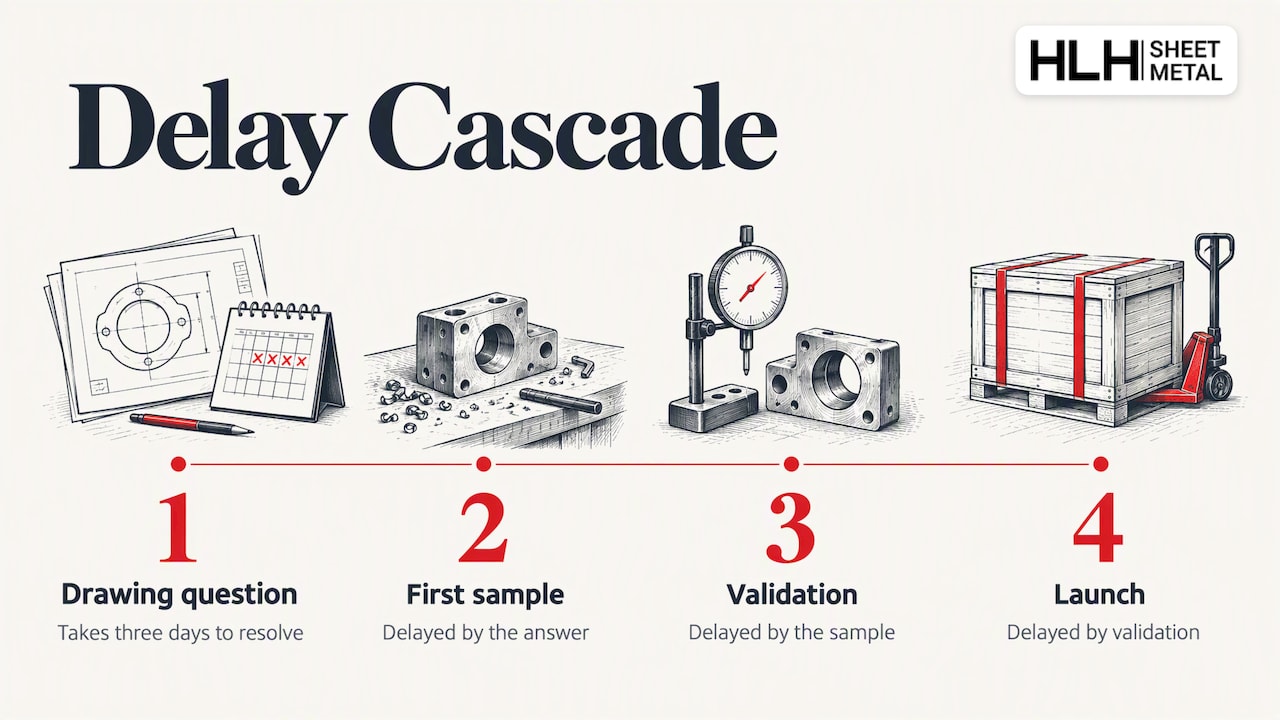
Slow answers cost money. A drawing question that takes three days to resolve delays the first sample, which delays your validation, which delays launch. The World Bank notes that global value chains need resilient, efficient goods flows, and says firms can support this with third-party logistics providers offering integrated end-to-end solutions. For a buyer, that translates into two practical questions: who is your named engineer, and who owns the shipment from the factory door to your dock?
Time zones matter too. A supplier on the other side of the world who answers within hours is more useful than a closer one who answers next week. Our project support team is English-speaking and available around the clock, so a drawing question sent from the US in the afternoon is not waiting overnight.
Quality, Certification And Inspection
Both countries have capable shops and weak ones. Do not choose by country; choose by evidence. Ask each supplier for:
- a current ISO certificate, and check that the scope covers sheet metal fabrication,
- a first article inspection report on your sample,
- the measuring tools used (CMM, height gauge, calipers) and calibration records,
- material certificates for each lot,
- a written process for handling nonconforming parts.
For aerospace, medical or automotive programs, add your customer’s own requirements to the quote request, since certification needs differ by program. If you are weighing Chinese output against local shops, our article on how China’s fabrication matches local quality goes through what to check.
The Case For Fabricating In China
Based on what we see in daily production, these are the reasons buyers keep choosing China for sheet metal.
- Scale without a change of supplier. The same group can run a few prototypes this month and thousands of units later, so you do not re-qualify a new vendor at each stage.
- A complete process chain. Cutting, bending, welding, stamping and finishing happen close together, which shortens the path from drawing to box.
- Material breadth. From steel, aluminum and stainless to copper, brass and titanium, one supplier can quote mixed-material assemblies.
- Speed on prototypes. Rapid prototyping lets design teams validate a fit before releasing a production tool.
- Documented quality. ISO certifications and inspection protocols give procurement teams records they can audit.
Our Perspective
We get asked this question often, usually by a buyer who already has a quote from India in one hand and one from China in the other. Our honest view: do not pick the country first. Pick the part. A flat or lightly formed part at volume is where Chinese plants are hard to beat on total cost. A heavily customized part at modest volume deserves quotes from both.
What we would insist on is the same drawing, the same Incoterm and the same finish on every quote. We see buyers pay more later because a cheap quote left out finishing, packaging or inspection. When you send us a drawing, we price each process separately so you can see where the cost sits and decide what to change.
— Nash
Get A Comparable Quote From Us
If you want a China-side number to set against your India quote, send us your drawing and target quantities on our sheet metal fabrication page. We quote cutting, bending, welding, stamping and finishing in one package, with project support that answers in English, so you can compare line by line against any other supplier. For enclosures, see our custom disconnect enclosure manufacturing page.
How To Choose: A Short Decision Guide
- Prototype under 50 pieces: quote both, weigh sample speed and communication above unit price.
- Repeat production above a few hundred: China usually leads on unit cost, so confirm the landed number.
- Custom, low-volume, changing design: India can be competitive, especially with a supplier that tolerates revisions.
- Origin-sensitive program: let the customer or contract requirement decide, then optimize cost within that country.
- Regulated industry: start from certification and inspection evidence, then price.
If you want to compare process choices before you request quotes, this overview of laser cutting versus CNC routing covers production requirements that influence cost.
FAQ
Is Sheet Metal Fabrication Cheaper In India Or China?
For a simple laser-cut aluminum plate, DFMA’s model shows $1.36 per part from China and $1.55 from India. Complex or low-volume parts can reverse the result, so compare quotes on your own drawing. Always compare on a landed basis, not factory price.
What Hidden Costs Should I Add To A Fabrication Quote?
Add tooling, samples, freight, insurance, duties, broker fees, port charges and an allowance for rework. Storage, inspections and demurrage can also appear if shipments are delayed. The Incoterm tells you which of these the supplier carries.
Does A Lower Hourly Wage Mean A Lower Part Price?
Not necessarily. Part cost also depends on machine rates, material prices, energy, tooling, consumables and tariffs. A wage-only comparison leaves out most of these.
How Do I Compare Quotes From Different Countries Fairly?
Send the same drawing, material, finish, quantity and Incoterm to every supplier. Ask for a breakdown by process and for three quantity tiers. Then add freight, duties and rework risk to reach one landed figure for each.

