




Sheet Metal Fabrication Cost: Switzerland vs China
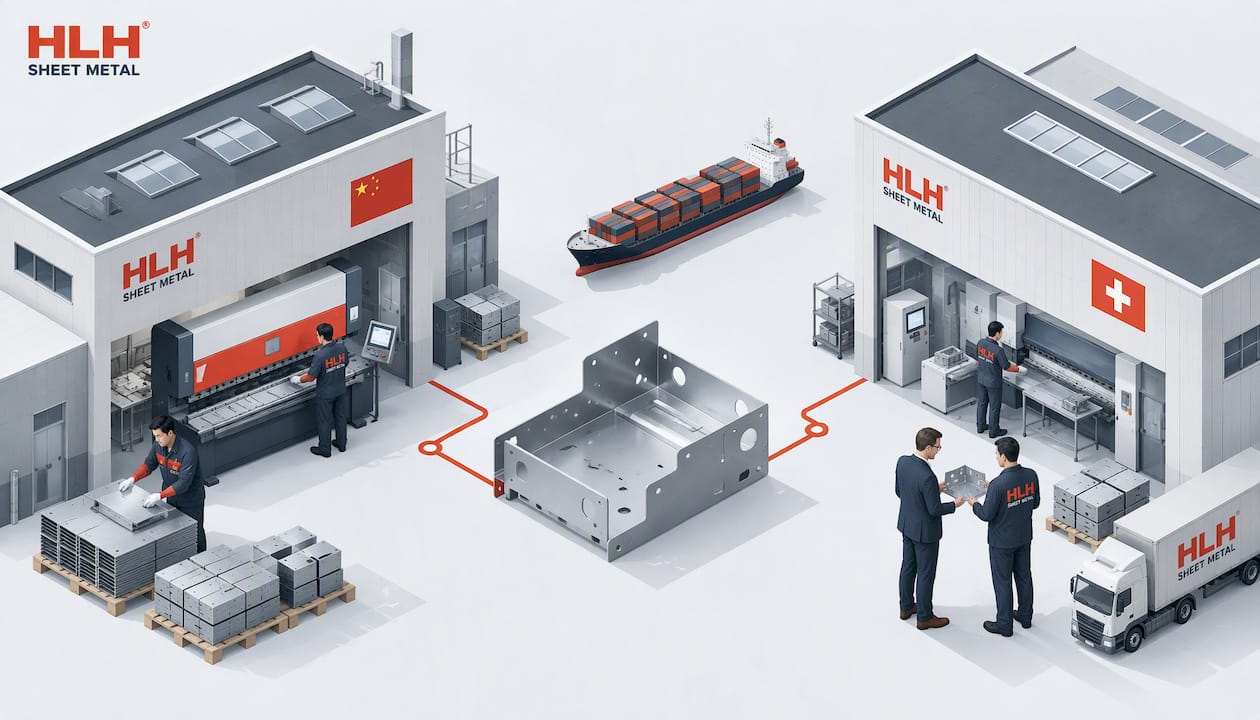
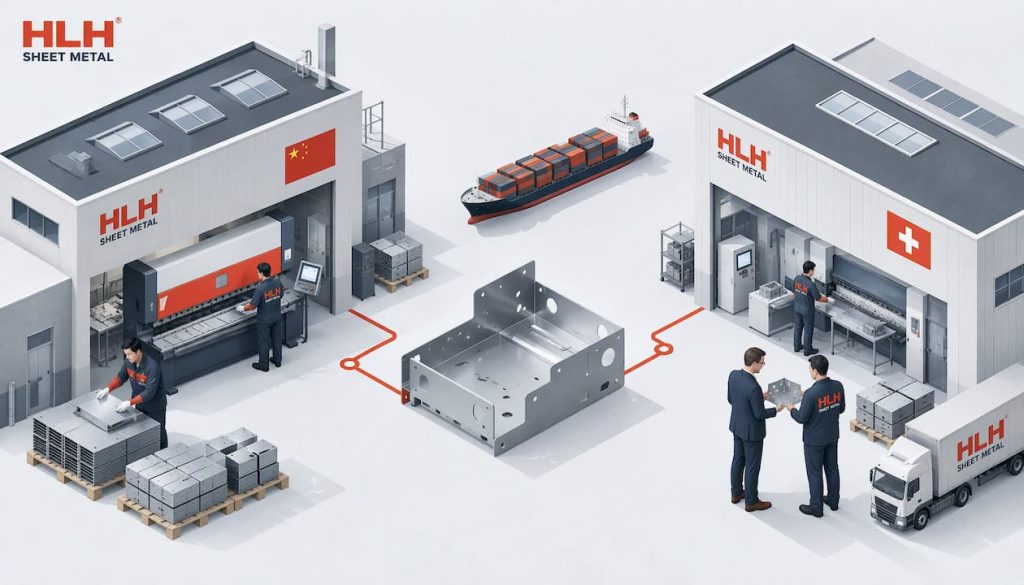
Chinese sheet metal fabrication usually quotes well below Swiss work, and the gap comes mostly from labor, overhead and scale. The honest comparison is not factory price against factory price. It is landed cost: what the part costs once it is inspected, shipped, cleared through customs and sitting in your warehouse. This guide walks through each cost layer so you can compare a Swiss quote and a Chinese quote line by line, and decide which fits a prototype, a pilot batch or a production run.
TL;DR
- Labor is the biggest structural gap: AlixPartners puts industrial labor at about US$70 per hour in Switzerland versus US$12 in China (2026 study).
- Sourcing guides commonly estimate that China prices sheet metal work roughly 40 to 60% below the European average, depending on volume, alloy and finish. Treat that as a range, not a promise.
- Compare landed cost, not ex-works price: add freight, insurance, duties, taxes, inspection and working capital.
- Switzerland wins on proximity and very small, urgent runs. China wins on repeat production, multi-process assemblies and price-sensitive volume.
- Design for manufacturability cuts cost in either country, often more than the choice of country does.
Why The Same Drawing Gets Such Different Prices
A sheet metal part is priced from four things: material, machine time, labor and finishing, plus overhead and margin on top. Switzerland and China differ on almost every one of them.
Swiss shops run excellent equipment and tight processes, but they pay Swiss wages, Swiss rent and Swiss energy. Chinese fabrication clusters run similar CNC laser cutters, press brakes and robotic welding cells, but with lower labor cost, dense local supply chains for sheet, hardware and coatings, and plants sized for volume. That combination explains most of the spread.
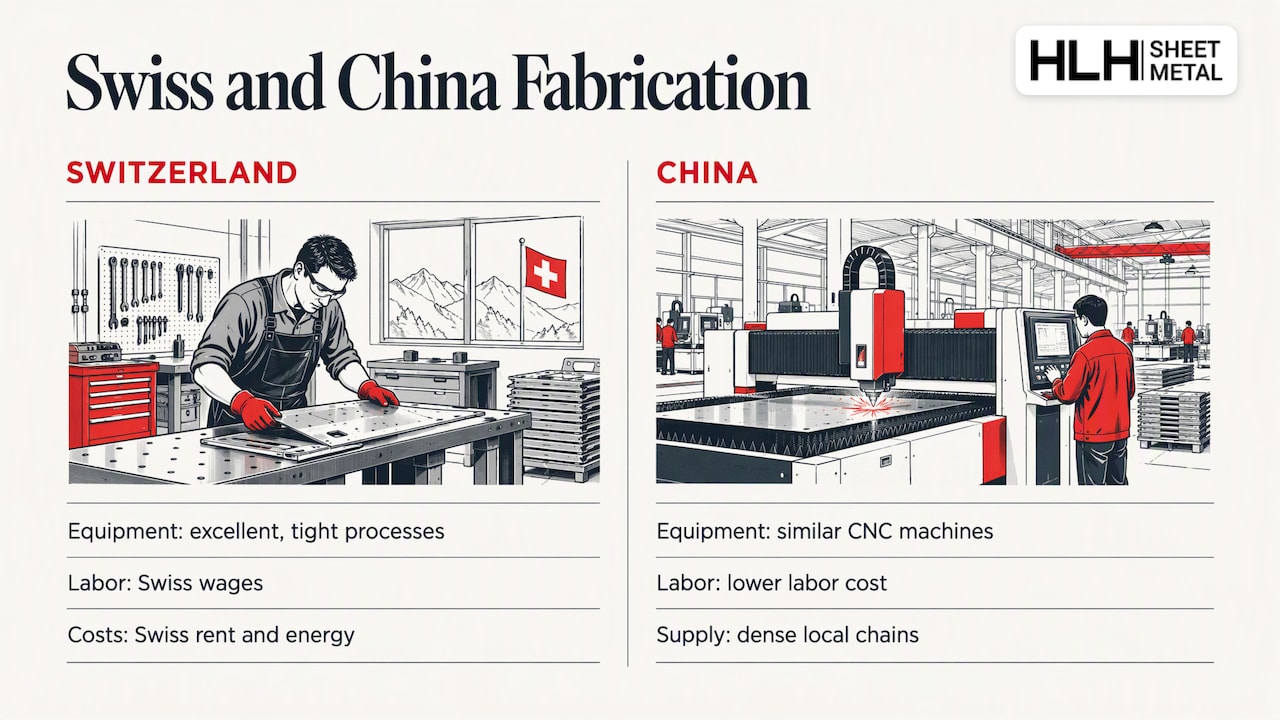
To see how wages alone look on the ground, ERI’s salary data shows an average metal fabricator in Switzerland earning about CHF 33.92 per hour in base pay. A shop’s billed rate is far higher once social charges, equipment, floor space and margin are added, which is why the fully loaded industrial figure in the AlixPartners study sits near US$70.
Where The Cost Difference Comes From
| Cost layer | Switzerland | China |
|---|---|---|
| Labor | Highest in the comparison; skilled but expensive | Much lower per hour, with deep pools of welders and press brake operators |
| Material | Sourced from European mills, often small lots | Local mills and service centers, wide choice of alloys, better pricing on volume |
| Machine time | High hourly rates, strong on short setups | Lower hourly rates, strongest when setups are amortized over a batch |
| Finishing | Powder coat, anodize and plating available, priced per job | Large finishing lines in the same industrial region, so parts rarely travel between vendors |
| Overhead and energy | High | Lower |
| Freight and duties | Minimal inside Europe, higher for the US | Added cost for ocean or air freight and import duties |
The last row is the one that narrows the gap, and it is why a landed-cost view matters.
What Actually Drives The Price Of A Part
The same factors set the price in both countries. DFMA’s process-selection framework makes the point that volume, geometry, material, tolerance, finish and target cost have to be weighed together, because each one limits which process is economical.
Material And Thickness
Steel costs less than aluminum, and aluminum costs less than stainless, copper, brass or titanium. Thicker sheet costs more to buy and more to cut and form. Choosing a common gauge and alloy that a shop already stocks is one of the simplest ways to cut cost. Our guide on mild steel vs. stainless in sheet metal DFM goes deeper on that decision.
Design Complexity
Every extra bend, hole feature and weld adds time. Tight bend-to-edge distances, tiny relief cuts and mixed thicknesses add setups. Fully ground cosmetic welds are a classic hidden cost: grinding adds labor and can thin the material locally, so reserve it for surfaces where appearance or function requires it.
The same logic applies to finishing. Deburring and edge finishing decide how much hand work a part needs, and the right method depends on the part and its production volume. This overview of edge finishing explains how those production requirements point to the most economical approach.
Tolerances
Sheet metal parts hold reasonable tolerances without special effort. Specifying tight tolerances on every dimension forces slower processes and more inspection. Tolerance only the features that mate with other parts.
Quantity
Setup, programming and fixturing are fixed costs. Spread over 5 parts they dominate the price. Spread over 5,000 they nearly vanish. This is why Chinese shops with large plants often look dramatically cheaper at volume but only moderately cheaper on a single prototype.
Process Route
Laser cutting and bending suit low to medium volume with no tooling. Stamping needs a die, which costs real money up front but drops the per-part price sharply at high volume. Welding and assembly add labor, so reducing weld count through better design pays off. If you want to see how process choices play out, look at our laser cutting, bending, welding and stamping pages.
The Costs That Don’t Appear On A Chinese Quote
A China quote for ex-works or FOB pricing is not your final cost. COVALYZE’s global sourcing analysis says a country comparison should include freight and packaging, duties and origin rules, inventory and working capital, minimum order quantities, and labor, energy and overhead, rather than factory prices alone. Here are the items to put on your sheet.
Freight, Insurance And Packaging
Sheet metal is heavy and bulky. Ocean freight is cheap per kilogram but slow; air freight is fast and costs several times more. Cargo insurance is a small percentage of goods value. Export packaging for parts with finished surfaces (wooden crates, interleaf paper, VCI film) adds a modest cost but prevents scratches that cause rework.
Duties And Taxes
The rules depend on where you import. For US buyers, steel and aluminum products from China have been subject to additional Section 301 tariffs announced by USTR, at rates that can change. Check the current tariff classification of your part with a licensed customs broker and the official US trade sources before you finalize a comparison. For a Swiss or EU buyer, the question is import duty plus VAT, which is usually recoverable for a registered business.
Incoterms: Who Pays What
DHL’s customs guidance explains the split: under DAP the buyer handles import customs formalities, taxes and duties, while under DDP the seller delivers the goods cleared for import. Ask for the same Incoterm from every supplier, otherwise the quotes aren’t comparable.
Inspection And Rework
Budget for quality control. Sourcing guides advise third-party inspection from firms such as SGS, BV or AsiaInspection on first orders. A supplier with its own ISO-certified quality system, first-article reports and material certificates reduces how much outside inspection you need, but a first order is still a sensible moment to verify.
Working Capital And Lead Time
The same guide gives a typical first article from a China-based shop as 7 to 28 working days, plus 25 to 40 days of shipping to central Europe. Parts on the water are inventory you have paid for but can’t use. Include the carrying cost, and a safety stock if the part is critical.
A Worked Example Of A Like-for-like Comparison
The numbers below are illustrative, not quotes. They show how to structure the comparison, using a hypothetical batch of 500 identical powder-coated steel enclosures.
| Line | Swiss quote | China quote |
|---|---|---|
| Ex-works part price | 100 (index) | 45 (index) |
| Tooling and fixtures | Included in price | Itemized, one-time |
| Packaging | Included | Itemized |
| Freight and insurance | Low | Add 5 to 10 index points |
| Duties and taxes | Depends on route | Depends on route |
| Inspection | Included | Add 1 to 3 index points |
| Inventory carrying cost | Minimal | Add for 6 to 10 weeks in transit |
Even after every addition, a wide gap can remain on a volume order, and the gap shrinks on very small batches. Run your own drawing through both quote processes and fill in the same table. If you want a country-specific cross-check from a European angle, see our related comparisons for Germany vs China and the Netherlands vs China.
When Switzerland Is The Better Fit
Swiss fabrication earns its price in specific situations:
- Urgent one-offs and very small batches. A few parts needed next week, delivered by truck, can beat any overseas option.
- Close collaboration in person. Engineers who want to walk the shop floor and iterate in a day or two benefit from proximity.
- Tight regulatory or customer requirements for local origin. Some programs require European or Swiss manufacture.
- Low volume, high complexity, high value. When labor is a small part of part value, the premium matters less.
When China Is The Better Fit
China is usually the stronger choice when:
- Volume repeats. Once drawings are stable, the unit price advantage compounds with every order.
- The product is a multi-process assembly. Cutting, bending, welding, finishing and hardware under one roof reduces handoffs. Our surface finishing and welding lines work this way.
- Material range matters. Aluminum, stainless, galvanized steel, copper, brass, titanium and magnesium can all be sourced through a dense local supply chain.
- Prototype-to-production continuity. Prototyping and production in the same plants avoids requalifying a second supplier.
- Price is a deciding factor in the business case. Enclosures, chassis, brackets and rack cabinets are typical examples.
No single factor decides it. As DFMA’s framework stresses, volume, geometry, material, precision, finish and cost target must intersect before you choose a route, and the same is true for choosing a country.
Why Manufacturing In China Works For International Buyers
Cost is the headline, but it isn’t the only reason engineers and procurement teams keep sourcing there.
- Scale and flexibility. Large plants absorb both a 10-piece prototype order and a production run without a change of supplier.
- Speed from drawing to part. Dense local supply chains for sheet, hardware and coatings shorten the path from quote to finished part.
- Process breadth in one region. Laser cutting, stamping, bending, welding and finishing are available within the same industrial belt.
- Mature export experience. Established shops handle export packaging, documentation and global shipping as routine work.
The risks are real too: communication gaps, inconsistent quality between shops and long transit. They are manageable with a supplier that has certified quality systems, English-speaking engineers and clear inspection steps.
Our Perspective
We fabricate in several plants in China, so we have a clear interest here, and we’d rather you compare honestly than take our word for it. In our experience, buyers lose more money from incomplete quotes than from the choice of country. A Swiss quote that includes finishing, packaging and delivery gets compared against a Chinese ex-works number with none of those, and the comparison is useless either way.
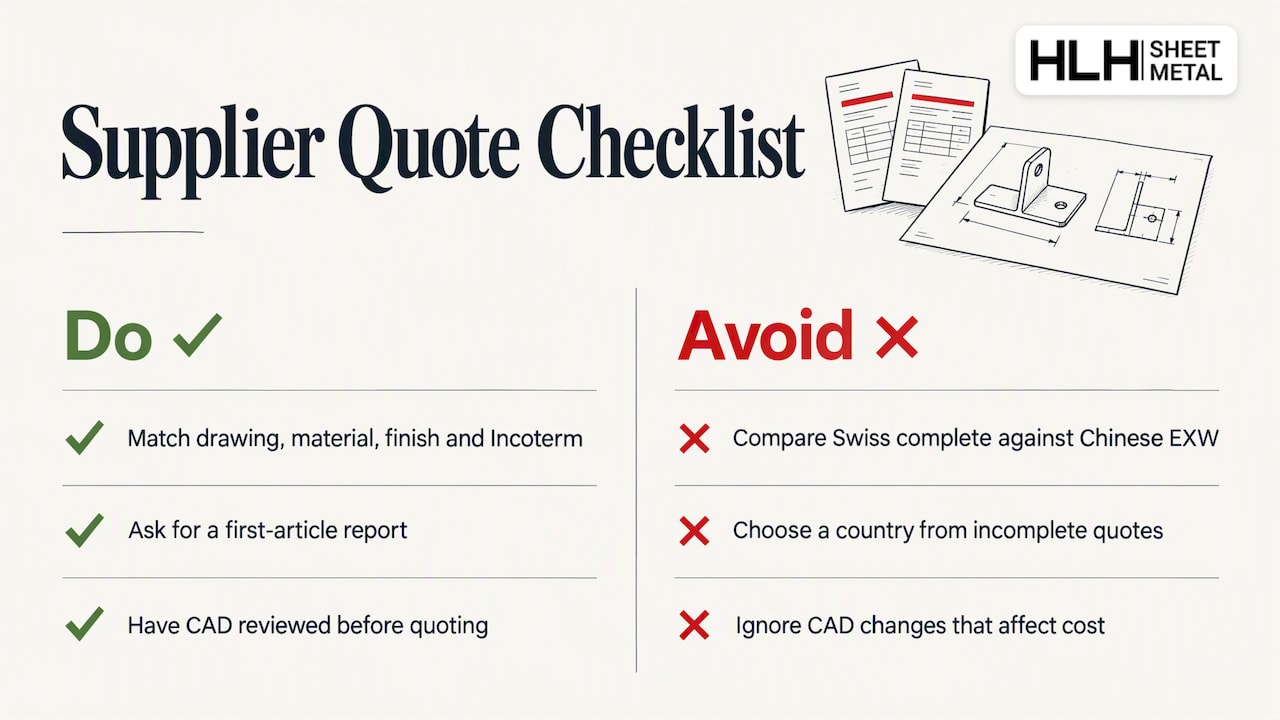
Our advice: send the same drawing, the same material callout, the same finish and the same Incoterm to every supplier. Ask for a first-article report on the first order. Have us review your CAD for manufacturability before quoting, because a few changes to bend radii, hole placement or weld count often move cost more than any shop-to-shop difference. Our guides to sheet metal DFM and CAD settings that cut China production costs show how.
And where a Swiss shop is the better answer, such as a single urgent part, we’d say so.
— Nash
Getting A China Quote You Can Compare
HLH Sheet Metal makes custom parts, enclosures and server rack chassis in multiple plants in China, from prototypes to large runs, under ISO-certified quality control. Our English-speaking project support is available around the clock, so questions on drawings, finishes or shipping get answered quickly. Send your drawing, material, quantity and finish through our sheet metal fabrication page, and state the Incoterm you want so the quote lands directly beside your Swiss one.
Checklist For Comparing Swiss And Chinese Quotes
- Use one drawing revision, one material and one finish spec for every supplier.
- Require the same Incoterm (for example DAP or DDP) on all quotes.
- Ask for tooling, fixtures, packaging and inspection as separate lines.
- Add freight, insurance, duties and taxes using current rates for your import route.
- Add lead time and the carrying cost of inventory in transit.
- Ask what certificates and reports come with the parts.
- Compare total landed cost per part at your real order quantity, and again at the quantity you expect in year two.
FAQ
How Much Cheaper Is Sheet Metal Fabrication In China Than In Switzerland?
Sourcing guides commonly cite 40 to 60% lower pricing than the European average, and labor alone is about US$12 versus US$70 per hour in the AlixPartners study. The real saving depends on volume, alloy, finish and the extra landed costs. Small prototype orders show a smaller gap than volume runs.
Is Chinese Sheet Metal Quality As Good As Swiss Quality?
It depends on the supplier, not the country. Choose a shop with ISO-certified quality control, material certificates and first-article reports, and verify the first order, with third-party inspection if the part is critical. Swiss shops are known for consistency, but well-run Chinese plants can meet the same drawing tolerances.
What Hidden Costs Should I Add To A Chinese Quote?
Add freight, cargo insurance, export packaging, duties and taxes, inspection, and the cost of inventory in transit. Under DAP you handle import clearance and duties; under DDP the seller does. Ask every supplier to quote on the same Incoterm.
How Long Does It Take To Get Parts From China?
A first article typically takes 7 to 28 working days to produce, plus about 25 to 40 days of ocean shipping to central Europe, per the same sourcing guide. Air freight shortens transit at a higher cost. Repeat orders are faster once tooling and programs exist.
Sources
- AlixPartners Industrial Goods Study 2026
- Sheet Metal Fabrication Suppliers in China sourcing guide
- ERI: Metal Fabricator Salary in Switzerland
- DFMA: Manufacturing Process Selection
- Sourcima: Sheet Metal Fabrication
- COVALYZE: Global Sourcing Cost Analysis
- DHL Express Customs Brochure 2025
- S&P Global: US Section 301 tariffs on Chinese steel and aluminum
- Edge finishing overview

