




Table Of Contents
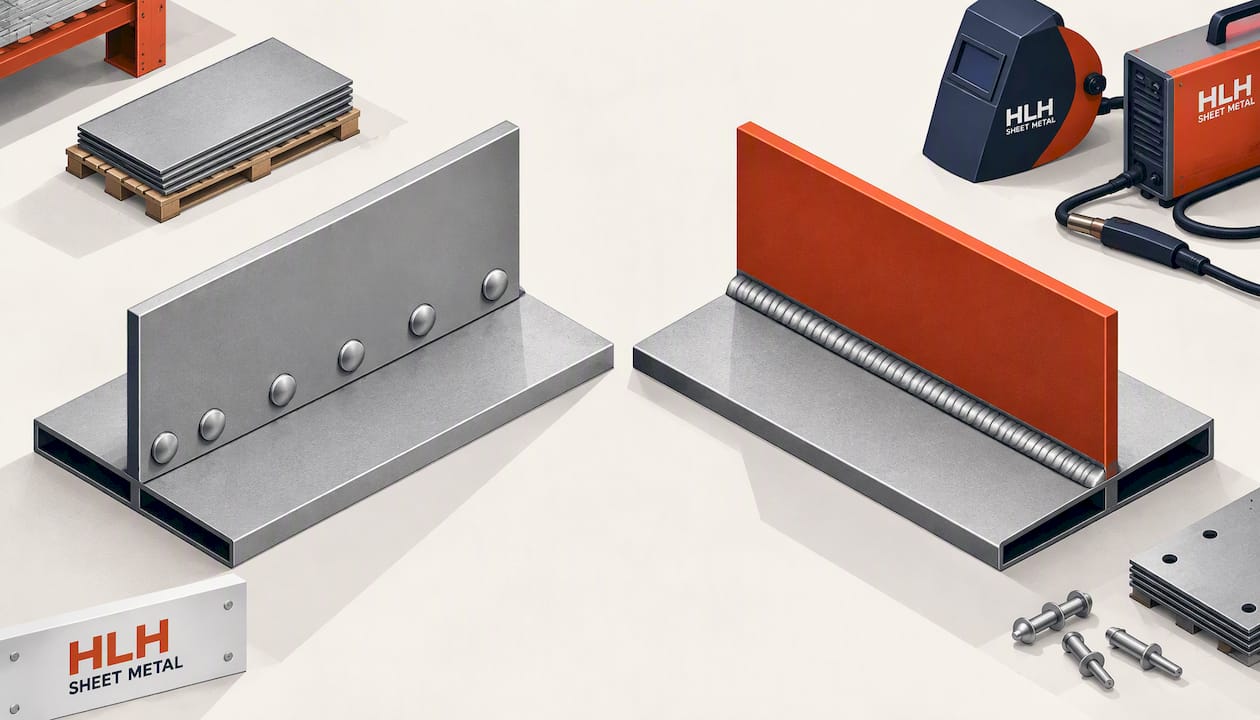
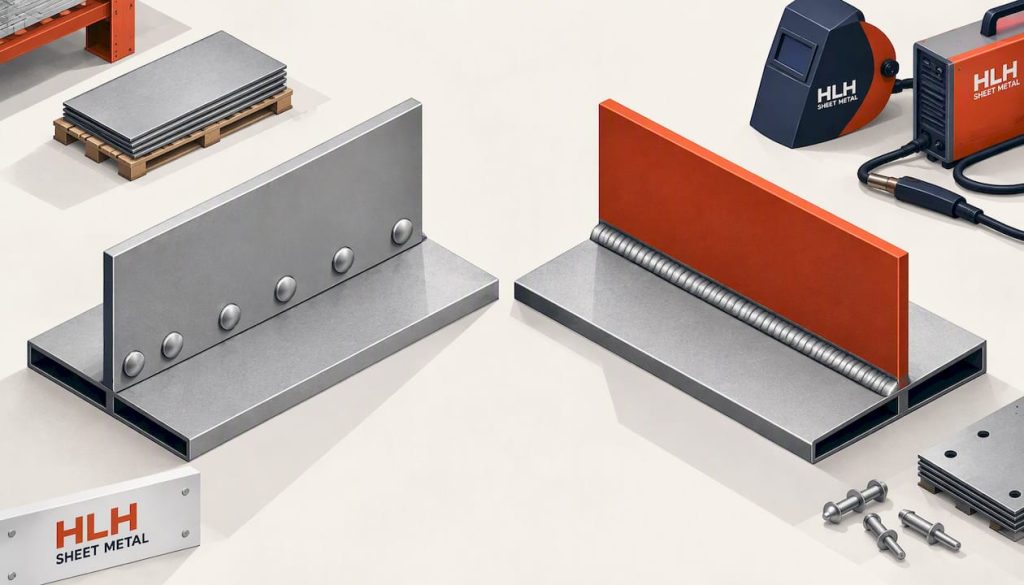
Neither joint is cheaper in every case. Rivets usually win on speed, simple tooling and serviceability. Welding usually wins on strength, rigidity and sealed joints. The cheapest method is the one that fits your design stage, your volume and the environment the part will live in. The sticker price per joint matters less than you would expect.
This guide is for engineers and buyers who have to choose a joining method, write it into an RFQ and defend the cost. It covers where each process is strong, where the money goes, and how to source the assembly.
TL;DR
- Rivets are quick to install, need no post-weld cleanup and suit dissimilar metals and heat-sensitive thin sheet. They are not airtight without sealant.
- Welding gives the highest strength and continuous sealed joints. It brings heat distortion, fixturing and inspection requirements.
- The costly option is often the one that punishes design changes. Welding an unfrozen design can cost more than riveting it.
- Hybrid assemblies are common: weld the structural frame and rivet or bolt the panels that must come off.
- Put the joint type, the strength requirement and the inspection standard in your RFQ, so quotes compare like for like.
Rivets Vs Welding: How Each Process Works In Sheet Metal
Riveting clamps sheets together with a permanent mechanical fastener. In sheet metal shops, blind rivets are the usual choice, because they install from one side. A tool pulls the mandrel and expands the tail. Eureka’s fastening overview notes this makes them practical in enclosed frames where backside tooling cannot reach. Rivets are also the most widely used fastener in aircraft manufacturing, because they are low-cost, permanent and lighter than bolts.
Welding fuses the base metals, often with filler. In thin sheet, that usually means TIG, MIG or resistance spot welding. A spot weld joins overlapping sheets at discrete points with no added hardware. The right spot-welding window depends on thickness, and our guide to specifying spot welding on 0.5–3 mm sheet covers it.
The Welding Institute lists the full family of options, from mechanical fastening to brazing and tongue-and-groove joints, in its overview of sheet metal joining methods. Rivets and welds are only two of them, but they are the two most often compared.
Side-by-side Comparison
| Factor | Rivets | Welding |
|---|---|---|
| Strength | High in shear, lower in peel | High in tensile and shear |
| Sealing | Not airtight without sealant | Continuous, sealed joints possible |
| Heat effect | Minimal distortion | Risk of distortion, discoloration, coating damage |
| Dissimilar metals | Easy to join | Difficult or limited |
| Added weight | Yes, from the hardware | None, or a little filler |
| Appearance | Visible heads | Can be ground and finished flush |
| Skill needed | Low to moderate | Higher, qualified procedures for critical work |
| Rework | Drill out and replace | Grind, re-weld, correct distortion |
| Disassembly | Destructive, but local | Not possible |
The strength, sealing and heat rows follow TWI’s technical guidance. Welding generally offers higher tensile and shear strength and sealed joints. Riveting is better for dissimilar metals and for thin sheets that heat would distort. TWI also stresses that no comparison generalizes, because fitness for purpose decides the answer.
Where The Money Actually Goes
Search results disagree on which method is cheaper. Some say riveting is quicker and cheaper. Others say welding costs less for certain applications because it needs no extra hardware. Both can be right. They are describing different cost drivers.
Per-joint Cost
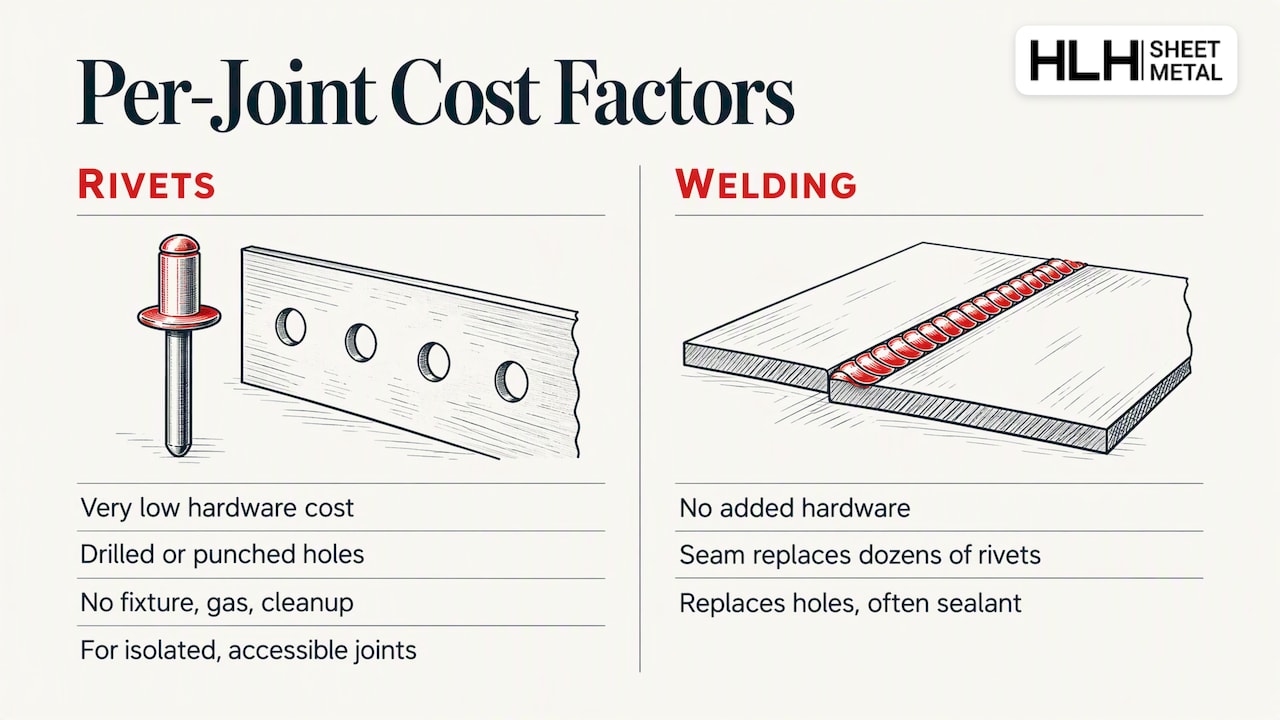
A rivet costs very little, but a welded joint uses no hardware at all. For a long continuous seam, welding replaces dozens of rivets plus the drilled or punched holes, and often a gasket or sealant. For a handful of isolated joints on a part with simple access, rivets are hard to beat. They need no fixture, no shielding gas and no cleanup.
Labor, Fixturing And Finishing
Riveting needs holes. Laser cutting or punching them in the flat blank is cheap, and it also helps alignment. Welding needs fixtures to hold geometry against heat, and a good fixture is a real cost. We cover how to design them in five weld fixture design rules. After welding you may also need grinding, straightening and re-finishing. Rivets generally need none of that.
Finishing sequence matters too. Powder coat or plating before riveting is common. Welding damages coatings near the joint, so welded parts are usually finished afterward. That affects both cost and lead time.
Revision Cost
This is the hidden one. Practitioners point out that the expensive method is rarely the one with the highest direct labor. It is the one that punishes revision the most. If the design is not frozen, welding can cost more, because correcting distortion or re-fixturing is harder than the local rework riveted joints allow. For a prototype run that will change twice before launch, that favors rivets.
Volume
At low volume, rivets avoid fixture investment. At high volume, automated or robotic welding spreads fixture and programming cost across thousands of parts. Our note on robotics in sheet metal fabrication explains where that break-even tends to sit. The curve moves with your geometry and tolerances, so ask for quotes at two or three quantities rather than trusting a rule of thumb.
A Worked Comparison
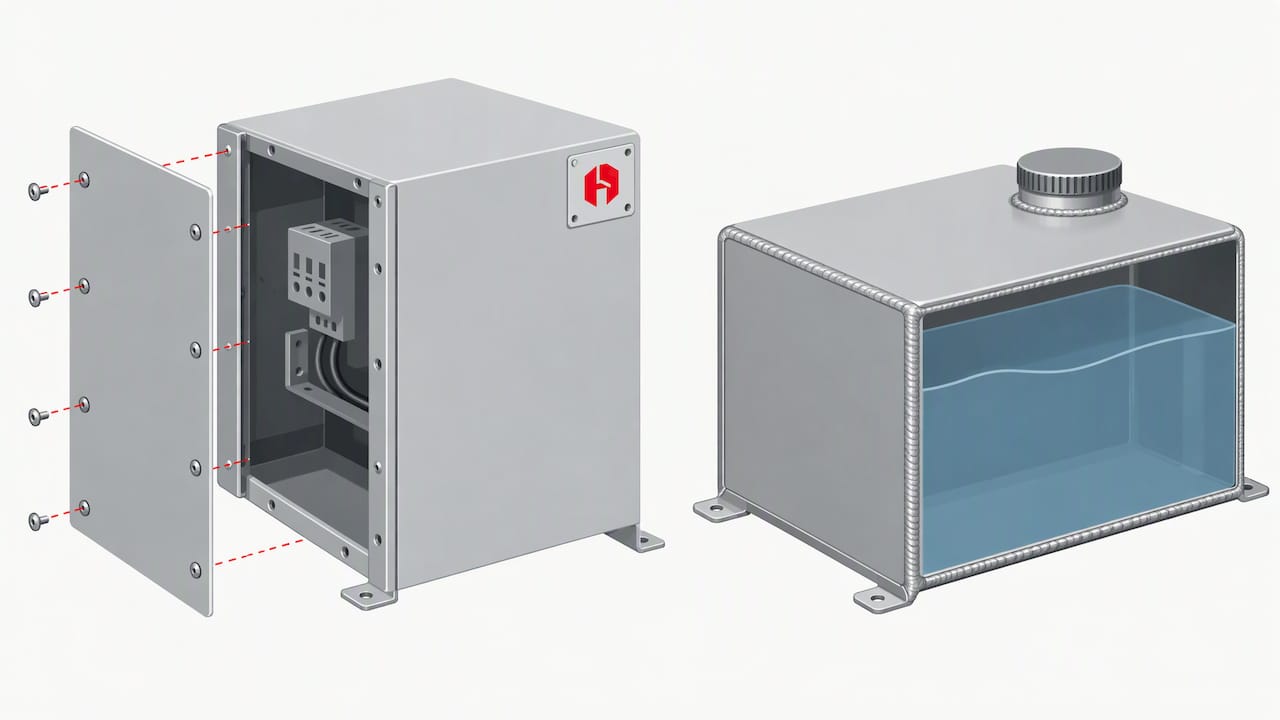
Take a control enclosure with a welded frame and removable side panels. If you weld the panels to the frame, you pay for fixturing, post-weld straightening and a finishing step. You also lose service access. If you rivet or bolt them, you pay for holes you already cut in the flat pattern and a few minutes of assembly. The same enclosure with a sealed liquid compartment flips the answer: that seam wants a continuous weld. One part, two joints, two different answers.
When To Use Rivets
Choose rivets when:
- You join dissimilar metals, such as aluminum to steel, where welding is difficult.
- The sheet is thin or coated and heat would distort it or burn the finish.
- Only one side is accessible.
- The design is still changing, or the assembly needs maintenance, transport or periodic disassembly. Mechanical design guidance points designers toward threaded fastening or riveting in those cases.
- Fatigue life matters and you want to avoid the heat-affected zone a weld creates.
Rivet joint design is not an afterthought. Aircraft builders have long noted that edge distance and rivet pitch are as important as the fastener itself in preventing joint elongation and early failure. Rivets that are too close to an edge tear out. Pitch that is too wide lets the sheet gap and buckle.
When To Use Welding
Choose welding when:
- The joint must be airtight or liquid-tight, as in tanks, housings and pressure containers.
- You need rigidity, such as a frame that carries machine load. The same mechanical design guidance names welding as the standard choice for extreme rigidity or continuous sealing, provided the shop can handle the heat, skill and inspection.
- The part will never need disassembly.
- You want a clean flush surface after grinding, or no visible fasteners.
- Volume is high enough to justify fixtures or automation.
On thin gauge, spot welding is often the efficient answer for overlapping flanges. It adds no hardware and cycles in a fraction of a second. For arc welds on load-bearing sheet steel, you need to work to a recognized code.
Strength And Durability: Which Is Stronger?
Welding is generally stronger in tension and shear, and a good weld can match the base metal. Rivets are strong in shear but weaker in peel, so a riveted lap joint that is pried apart behaves differently from one that is loaded in plane. Design the joint so the rivets see shear.
Durability is not just peak strength. Welds concentrate heat effects, and distortion can build in stress. Riveted joints keep the base metal’s properties but depend on hole quality and pitch. Aerospace work shows both sides: rivet failure tends to be the critical mode in static tests, while in high-cycle fatigue the sheet itself can become the failure point, according to the EAA’s summary of NASA and NACA work. That is why airframes are riveted: thin aluminum, dissimilar materials, fatigue loading and a need for inspection.
Quality Standards Your RFQ Should Name
For welded work, the quality system matters as much as the weld. Two references are worth putting in the RFQ:
- AWS D1.3/D1.3M:2025 is the structural welding code for sheet steel. It covers arc-welded joints in sheet steel up to a 80 ksi yield point, with workmanship and qualification requirements. Use it when load transfer is calculated.
- ISO 3834 sets quality requirements for fusion welding. Part 2 defines comprehensive requirements for workshops and field sites, and Part 1 helps you pick the right level. Medical and aerospace buyers often ask for it.
For riveted work, specify the rivet type, material, diameter, grip range, hole size and the minimum edge distance and pitch on the drawing. Say whether joints must be sealed. If you are vetting suppliers, our guide on how to identify ISO-certified metal parts manufacturers shows what to ask for.
Our Perspective
We weld and assemble sheet metal every day, and our honest advice is to stop arguing about the process and look at the drawing. Most disputes about cost come from joints that were chosen late. A weld that was added to a design with no fixture planning, or a rivet pattern that was drilled into a part that needed a sealed seam, is where money disappears.
Our rules of thumb:
- Decide the joint at the DFM stage, not at the quote stage. Our sheet metal DFM guide shows how holes, tabs and flange widths change with the joint.
- Rivet prototypes and pilot runs where the design may move. Weld once it is frozen and the volume justifies a fixture.
- Weld the seams that must seal or carry load. Rivet or bolt what must come off.
- Ask for quotes at several quantities, and ask what is included: fixtures, finishing, inspection.
We run multiple plants in China, which lets us handle both a ten-piece prototype lot and a production run, and our support team speaks English so engineering questions get answered quickly.
— Nash
Hybrid Assemblies
Many good designs use both. Weld the frame for rigidity, then rivet or fasten panels, brackets and covers. Spot-weld flanges for speed, then add a few rivets where the part sees peel loads. Combining processes lets you apply each where it is cheapest and strongest. Make sure the sequence works: welding comes before coating, and rivets go in after finishing if you want to protect the coating.
How To Source The Assembly
- Freeze what you can. List which features are final and which may change.
- Define the joint requirements. Strength, sealing, appearance, serviceability and the standard it must meet.
- Send complete files. 3D models, 2D drawings with joint callouts, material, finish and quantities.
- Request tiered quotes. Prototype, pilot and production volumes.
- Compare scope, not totals. Check whether fixtures, deburring, finishing, inspection reports and packing are included. Our welding cost estimation checklist lists eight items to fix in the RFQ.
- Check the supplier’s system. Ask about certifications, weld procedure qualification and inspection.
If you are comparing providers, our overview of where to get custom sheet metal welding and assembly services explains the options. For overseas production, sourcing precision spot-welded parts in China covers the practical details. Aerospace buyers should also read where to find aerospace sheet metal fabricators.
Getting The Joint Built By HLH
Our sheet metal welding services sit alongside laser cutting, bending, stamping and surface finishing, so the holes, flanges and finishes that make a joint cheap are cut and formed under one roof. You can also see the full range on our sheet metal fabrication page. Send a drawing and the quantities you are considering, and we will quote the joint options that fit your part. Tell us if you want a rivet version and a weld version to compare.
FAQ
Is Riveting Cheaper Than Welding?
Often at low volume, with simple access and unfrozen designs, because rivets need no fixture and little cleanup. Welding can be cheaper for long seams, high volumes and automated lines. Ask for quotes at several quantities to see where your part falls.
Which Is Stronger, Rivets Or Welding?
Welding is generally stronger in tension and shear, and it creates sealed joints. Rivets are strong in shear but weaker in peel, and they are not airtight without sealant. TWI’s guidance says fitness for purpose should decide.
Why Are Aircraft Riveted Instead Of Welded?
Thin aluminum skins, dissimilar materials, fatigue loading and the need to inspect and repair joints all favor rivets. Rivets are also light and low-cost, and they are the most widely used fastener in aircraft manufacturing.
Can I Use Both On One Assembly?
Yes, and it is common. Weld the structural frame or sealed seams, and rivet the panels or parts that need service access or that heat would distort. Plan the sequence so finishing is not damaged.
What Should I Put In An RFQ To Compare Welded And Riveted Quotes?
Provide drawings with joint callouts, material, finish, quantities at several tiers and any standards, such as AWS D1.3 or ISO 3834. Ask each supplier to list what is included, such as fixtures, finishing and inspection. That makes totals comparable.

